The now-defunct religious-formatted KHOF Ch. 30 in Los Angeles was realllllly bad. "Programming" consisted of endless musings by Dr. Gene Scott, sitting in a chair for hours at a time. Occasionally (maybe when he needed to eat or pee) he'd yell "Sing it again" -- and the choir would fill time with music for 5-10min. Then it was back to Dr. Scott. And his donation phone number was on the screen 24/7, if I remember correctly.

-
Get involved.
We want your input!
Apply for Membership and join the conversations about everything related to broadcasting.
After we receive your registration, a moderator will review it. After your registration is approved, you will be permitted to post.
If you use a disposable or false email address, your registration will be rejected.
After your membership is approved, please take a minute to tell us a little bit about yourself.
https://www.radiodiscussions.com/forums/introduce-yourself.1088/
Thanks in advance and have fun!
RadioDiscussions Administrators
You are using an out of date browser. It may not display this or other websites correctly.
You should upgrade or use an alternative browser.
You should upgrade or use an alternative browser.
Worst TV stations ever
- Thread starter rwells2265
- Start date

1-800-338-3030The now-defunct religious-formatted KHOF Ch. 30 in Los Angeles was realllllly bad. "Programming" consisted of endless musings by Dr. Gene Scott, sitting in a chair for hours at a time. Occasionally (maybe when he needed to eat or pee) he'd yell "Sing it again" -- and the choir would fill time with music for 5-10min. Then it was back to Dr. Scott. And his donation phone number was on the screen 24/7, if I remember correctly.
GIT ON THE TELEPHONE!!!
His widow is still preaching
Last edited:
Fox has been going down all they have now is Simpsons, Family Guy and Bob's Burgers that's been on for awhile.Junk programming even worse than the other three networks. Cheap trash. Will also opine that programming on all four networks sets the bar very low.
As long as you didn't give money to him, Dr. Gene Scott was a real hoot.
Is it true that the final broadcast of KHOF-30 before it was forced off the aur consisted of Dr. Gene Scott making a tirade against the FCC and showing a bunch of mechanical and battery powered monkeys that he called "The FCC Monkey Band"?
I do know he did this at one point, but I'd like to know if this was the final thing transmitted by KHOF before it had to turn off it's transmitter and cease broadcasting?
I do know he did this at one point, but I'd like to know if this was the final thing transmitted by KHOF before it had to turn off it's transmitter and cease broadcasting?
What are the worst television stations you've ever seen?
By "worst" I mean stations which, now or then, set low standards ... i.e., bad production values, terrible newscasts, subpar technically, those defined by weird and/or flamboyant personalities, poor or dated graphics, bizarre programming choices, etc.
My nominations for the Anti-Emmy (or Antie Em?) awards:
WSIL 3 (ABC) / Harrisburg, Illinois (1978-82, when I lived in the market)
About as bargain-basement low-budget as it got for television of the late '70s. At least the people on-air *knew* they were outflanked and outclassed by the other stations in the market; you could see they were having a ball "playing TV"
Station back then was defined by sports director Briggs Gordon's alter ego UNCLE BRIGGS, who hosted a late afternoon 'kiddie show'; the guy literally had just minutes to get out of costume and into a regular attire to do the sportscast.
WSLA 8 (ABC, later CBS) / Selma, Ala. (1960s-1970s)
Low-power station went on the air as an ABC affiliate, owned by the Brennan family (a Deep South radio dynasty back in the day - owned several top-40 stations). Operated out of a Jim Walter home on the outskirts of town.
Had no network line. ABC programs came not via kine ... they made arrangements with WBRC-TV 6, 90 miles away in Birmingham to air ABC matter RIGHT OFF THEIR SIGNAL! If the engineer wasn't paying attention, local WBRC breaks and IDs would air on WSLA. And, more than a few times, they did. Also, when they got ready to 'join the network', fingers would be crossed that ABC would come up -- that WBRC hadn't preempted something at the last minute!
And during times of temp inversion or e-skip, WSLA would magically transform itself into a CBS station; the antenna sometimes picked up WCTV, channel 6 out of Thomasville, Ga.-Tallahassee, Fla.
I'm told one of their program hosts kept a (loaded) gun with him on set, and would sometimes wave it around as he talked.
The Brennans put the station on the air in the hopes that they could secure a power boost, and then sell the station at a good profit. Problem was, Montgomery (50 miles to the east) was a mostly-UHF market and the Us vigorously protested any such move.
The studio and transmitter went up in flames in 1968 ... Brennans chose to walk. Station was dark until another concern put it back on the air in 1973 as a CBS. Things were a bit better, but the station was still a joke.
Dereg in the '80s allowed 8 to go full-tilt ... today it's in Montgomery as the market's CBS, WAKA.
WTVY 4 (CBS) / Dothan, Ala. (pre-1998)
Launched and for years owned by perennial fringe presidential candidate and disfigured war hero Charles Woods. The first station in the South to go 24/7 (early '70s), but aside from that it was defined by two personalities: Farm director Gene Ragan, who for decades hosted the noon farm report. The opening theme and set were practically unchanged from the '60s -- same recorded theme and V/O, and same wood-paneling background and desk mic. This was the case well into the '90s, until after Woods lost the station amidst financial difficulties.
Then there was RED HOLLAND, who hosted a weekend hunting/fishing show Outdoors With Red, and his weekday early-morning show Good Morning Tri-States was a spectacle of bad television. Red didn't talk, he SCREAMED. Imagine Crazy Eddie with a "John Deere" cap and a redneck accent. Did most all sponsors' commercials himself. And the rural trailer-dwellin' folk worshipped him.
WTVY's graphics were pathetic -- just two (2) fonts. Picture wasn't very crisp, and audio was muffled.
When WTVY transferred to new ownership late in 1997, their first order of business was to axe Red.
WDHN 18 (ABC) / Dothan, Ala.
Dothan, Alabama was (and probably still is) bad TV capital of the world. 18 made WTVY above look major-market. Had a very cheap Chyron-esque device - one font. SAME as the one used most by WTVY. Newscast in the early '90s was done by the News Director - who had a pronounced lisp and a HEAVY Southern accent. Intro was done by someone trying to imitate the 'voice-of-God' guy who used to do rock concert promos in the '80s.
WLBT 3 (NBC) / Jackson, Miss. (prior to 1971)
Station Manager for years was a guy named Fred Beard. Fred was very tight with the White Citizens' Council of Mississippi (little more than a country-club level k lan), and his practices caused WLBT to have its license ordered vacated. On the fly preemptions - plenty of anecdotal evidence point to a common practice of interrupting network programming with a TECHNICAL DIFFICULTY slides whenever NBC did anything remotely advocating for integration. Whenever a black leader appeared on camera, suddenly WLBT would have "cable trouble."
A disclaimer was broadcast prior to the Today show: "The following program contains biased, managed Northern news. Be sure to stay tuned at 7:25 for your LOCAL news."
Oh, and a "Freedom Bookstore" operated in the lobby of WLBT -- selling white supremacist literature.
A black church organization challenged the station's license ... toward the late '60s, Lamar Life Insurance (WLBT's parent company) got nervous and fired Beard. But it didn't stop WLBT's license from getting yanked, and Lamar Life (while by then a bit subdued in its racism) cleaned out their desks in 1971.
Watching commercials from WTVY from 1986 right now and it looks like in the 80s they used the NBC font and then in the 90s they used the NBC Today Show font from the mid-80s
yupIs it true that the final broadcast of KHOF-30 before it was forced off the aur consisted of Dr. Gene Scott making a tirade against the FCC and showing a bunch of mechanical and battery powered monkeys that he called "The FCC Monkey Band"?
from wiki and the youtube video
In the 1980s, KHOF came under the scrutiny of the FCC because of its fundraising operations, as well as Scott's refusal to allow the FCC to examine his station's financial records. The FCC eventually revoked KHOF-TV's license. After losing court challenges to the FCC action, KHOF-TV shut down on May 24, 1983. The final broadcast from Scott's channel 30 consisted of a number of cymbal-banging monkey toys termed as "The FCC Monkey Band" playing their mini-cymbals as a final attack against the commission.

They also owned whct channel 18yup
from wiki and the youtube video
In the 1980s, KHOF came under the scrutiny of the FCC because of its fundraising operations, as well as Scott's refusal to allow the FCC to examine his station's financial records. The FCC eventually revoked KHOF-TV's license. After losing court challenges to the FCC action, KHOF-TV shut down on May 24, 1983. The final broadcast from Scott's channel 30 consisted of a number of cymbal-banging monkey toys termed as "The FCC Monkey Band" playing their mini-cymbals as a final attack against the commission.

Also they owned KVOF-TV San Francisco now known as KCNS-TV San Francisco.They also owned whct channel 18


Weird Al Yankovic was in a movie called UHF back in 1989 and it was a parody of worst TV Stations at that time. If I were to base this on where Al Yankovic was going it would be based on KDOC-TV Los Angeles during the time Wally George was there in 1989. If UHF was made today it would be about the worst shows on your TV apps today.
Last edited:
In the not worst but certainly underfinanced dept.:
Looks like nobody's mentioned WLXT-TV 60 Aurora, Ill., on the air from May 1969 through July 1970, when it ran out of money.
This was a barebones independent owned by a handful of businessmen in the suburb west of Chicago. The tower for the underpowered station was the WKKD-FM tower. There was one color camera, plus a color film chain.
WLXT was on the air from late afternoon to 10 p.m. weekdays and from 5 p.m. to 10 p.m. weekends. Occasionally it came on earlier.
I stumbled on it when we received a new TV in June 1970. In part, the weekday lineup was "Cartoon Magic" at 5 p.m. (an artist telling a story while drawing cartoons), "Adventures in Paradise" at 6 p.m., local news at 6:30 and 9:30. I can't recall the 7 to 9:30 shows, but they were shows long off-network. Somehow, the station cobbled together a black-and-white live mobile unit with, I think, two cameras. I recall seeing a neighbor running in a drag race at the Oswego Dragstrip one Sunday afternoon in the short time between my discovering this experiment and it going off the air.
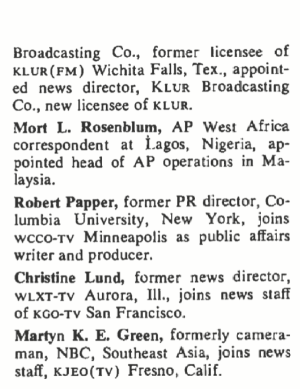
Despite the short time on the air, there are a couple of notable alumni: news director Christine Lund ended up at KABC-TV, and weatherman Tom Skilling, an 18-year-old high schooler who was planning to major in meteorology, is a WGN-TV legend.
Here's an interesting one Christine Lund had a short stint at KGO-TV San Francisco before she became a legend at KABC-TV Los Angeles.
WKYH in Hazard KY was about as pathetic a TV station as one can imagine. The signal was abysmal.
(I hope these clips, which YouTube accepted without any apparent problems, constitute "fair use".)
Thankfully, it was purchased by the owners of WKYT in Lexington, flipped its affiliation to CBS, and developed a news product that compares very favorably with any small-market operation in the country. It is the sole TV news source for a huge area of Eastern and Southern Kentucky, and they do an exemplary job of covering it.
(I hope these clips, which YouTube accepted without any apparent problems, constitute "fair use".)
Thankfully, it was purchased by the owners of WKYT in Lexington, flipped its affiliation to CBS, and developed a news product that compares very favorably with any small-market operation in the country. It is the sole TV news source for a huge area of Eastern and Southern Kentucky, and they do an exemplary job of covering it.

Amazing that NBC hung in there with WKYH, from its affiliation with the network in 1970 until it flipped to CBS in 1985 when WKYT's owners bought the station and significantly upgraded its on-air look, signal, etc.
WQQB-TV 40 in Bowling Green, Kentucky has to rank up there in terms of a poorly run TV station. It was an independent and on air from the late 1980s to early 1990s when it was sold and became Fox affiliate WKNT-TV 40, and now is NBC affiliate WNKY-TV 40. During its brief run as WQQB-TV 40, I remember that the audio of some shows consisted of complete static (seriously) and others suffered from poorly tracking video tape. Various public domain movies were rerun ad nauseam.
It was a station that virtually no one in that market knew about, apart from its listings in the TV section of Bowling Green's Park City Daily News.
It was a station that virtually no one in that market knew about, apart from its listings in the TV section of Bowling Green's Park City Daily News.
Second City did the same concept with SCTV
Weird Al Yankovic was in a movie called UHF back in 1989 and it was a parody of worst TV Stations at that time. If I were to base this on where Al Yankovic was going it would be based on KDOC-TV Los Angeles during the time Wally George was there in 1989. If UHF was made today it would be about the worst shows on your TV apps today.
Hard to say. At that time, NBC wasn't averse to having second affiliates in a market (WMGM Atlantic City, WHAG Hagerstown, KENV Elko, possibly others). That's all changed now.Amazing that NBC hung in there with WKYH, from its affiliation with the network in 1970 until it flipped to CBS in 1985 when WKYT's owners bought the station and significantly upgraded its on-air look, signal, etc.
WQQB-TV 40 in Bowling Green, Kentucky has to rank up there in terms of a poorly run TV station. It was an independent and on air from the late 1980s to early 1990s when it was sold and became Fox affiliate WKNT-TV 40, and now is NBC affiliate WNKY-TV 40. During its brief run as WQQB-TV 40, I remember that the audio of some shows consisted of complete static (seriously) and others suffered from poorly tracking video tape. Various public domain movies were rerun ad nauseam.
It was a station that virtually no one in that market knew about, apart from its listings in the TV section of Bowling Green's Park City Daily News.
The last thing in the world Bowling Green needed was a second independent TV station. For that matter, I've wondered what they were thinking, in making WLTV (later WBKO) an independent back at its inception. Bowling Green now makes up a nice little mini-market, two stations each carrying two of the Big Four, a little too far from either Louisville or Nashville for meaningful local content from those markets.
Hard to say. At that time, NBC wasn't averse to having second affiliates in a market (WMGM Atlantic City, WHAG Hagerstown, KENV Elko, possibly others). That's all changed now.
Also at the time, many of the rural homes did not have cable and there were not many translators in SE Kentucky
The last thing in the world Bowling Green needed was a second independent TV station. For that matter, I've wondered what they were thinking, in making WLTV (later WBKO) an independent back at its inception. Bowling Green now makes up a nice little mini-market, two stations each carrying two of the Big Four, a little too far from either Louisville or Nashville for meaningful local content from those markets.
I wonder if BG was originally in the Nashville market and WBKO ended up joining ABC in the late 1960s as Nashville and Louisville had weak ABC affiliates at the time.