• Get involved.
    We want your input!
    Apply for Membership and join the conversations about everything related to broadcasting.

    After we receive your registration, a moderator will review it. After your registration is approved, you will be permitted to post.
    If you use a disposable or false email address, your registration will be rejected.

    After your membership is approved, please take a minute to tell us a little bit about yourself.
    https://www.radiodiscussions.com/forums/introduce-yourself.1088/

    Thanks in advance and have fun!
    RadioDiscussions Administrators

WYRV-AM (770) Cedar Bluff, VA on at night, interfering with WABC

I've wondered why it's called a cancellation zone when the signal also gets stronger at times too than the daytime signal.

I remember as a kid looking at the S Meter on my brother's radio with WABC at night and it would sometimes give higher readings than the steady reading it showed during the day but often it would go away down to the left near the bottom when the signal had that extreme scrambled sound.

When going down the Turnpike with my parents after visiting family in North Jersey, WABC would start the ground wave/sky wave mixing after Exit 7.

We got off at Exit 4.

And it was always interesting to hear WABC in the background of the phone line at my aunt and uncle's house in Hasbrouck Heights.

You could see the tower looking down their street.
 
Lifelong non-techie AM DXer here, hopeless cause who gets lost just a few microfarads or 5/8 wavelengths into some of Shroedinger's Cat or Boise Engineer's posts. I actually *did* manage to hear just over 1500 AM stations from just one zip code but that was in a different age -- the 60's. Yet I was still the run of the litter-of-4 DXers back near JFK Airport in Queens.
It wasn't until this forum that I even *heard* of something called a cancellation zone.
So I @$$ume that when WKBW came in those nights* on the big Zenith console and its signal would often go through what sounded like a swooshing fade with lots of treble and then return amid a pronounced, reciprocal bass audio, that meant I was in a K-Big Cancellation Zone?
Fwiw: Buffalo is 300 miles northwest of Queens. The KB pattern looks like it sends an awful lot more juice from their 50,000 watts toward us than in any direction other than its reciprocal northeast lobe.

* The mischievous Joey Reynolds on KB would sometimes at sundown say goodnight to any listeners of a Long Island station on 1520. (Or, lol: maybe it was a good evening 'welcome' to WKBW fans in the area?) Wow, that station thundered in.
 
And it was always interesting to hear WABC in the background of the phone line at my aunt and uncle's house in Hasbrouck Heights.

You could see the tower looking down their street.

Heard of that with several AM stations, don't think I ever experienced it though, even in an offending station as it were.
 
Lifelong non-techie AM DXer here, hopeless cause who gets lost just a few microfarads or 5/8 wavelengths into some of Shroedinger's Cat or Boise Engineer's posts. I actually *did* manage to hear just over 1500 AM stations from just one zip code but that was in a different age -- the 60's. Yet I was still the run of the litter-of-4 DXers back near JFK Airport in Queens.
It wasn't until this forum that I even *heard* of something called a cancellation zone.
So I @$$ume that when WKBW came in those nights* on the big Zenith console and its signal would often go through what sounded like a swooshing fade with lots of treble and then return amid a pronounced, reciprocal bass audio, that meant I was in a K-Big Cancellation Zone?
Fwiw: Buffalo is 300 miles northwest of Queens. The KB pattern looks like it sends an awful lot more juice from their 50,000 watts toward us than in any direction other than its reciprocal northeast lobe.

* The mischievous Joey Reynolds on KB would sometimes at sundown say goodnight to any listeners of a Long Island station on 1520. (Or, lol: maybe it was a good evening 'welcome' to WKBW fans in the area?) Wow, that station thundered in.


:D)
 
I would like to know too

I have seen it called a cancellation zone for ages because the skywave falls on top of the weakened groundwave, sometimes boosting the signal and other times canceling it out entirely. Too far from the tower(s) to hear a great groundwave signal, too close for the great skywave. WOWO (in the old days) and WTAM, even WJR, are classic cases here in the Columbus, Ohio area. WLW can be, depending on the time of year, if you're north and east of the city.
 
Lifelong non-techie AM DXer here, hopeless cause who gets lost just a few microfarads or 5/8 wavelengths into some of Shroedinger's Cat or Boise Engineer's posts. I actually *did* manage to hear just over 1500 AM stations from just one zip code but that was in a different age -- the 60's. Yet I was still the run of the litter-of-4 DXers back near JFK Airport in Queens.
It wasn't until this forum that I even *heard* of something called a cancellation zone.
So I @$$ume that when WKBW came in those nights* on the big Zenith console and its signal would often go through what sounded like a swooshing fade with lots of treble and then return amid a pronounced, reciprocal bass audio, that meant I was in a K-Big Cancellation Zone?
Fwiw: Buffalo is 300 miles northwest of Queens. The KB pattern looks like it sends an awful lot more juice from their 50,000 watts toward us than in any direction other than its reciprocal northeast lobe.

* The mischievous Joey Reynolds on KB would sometimes at sundown say goodnight to any listeners of a Long Island station on 1520. (Or, lol: maybe it was a good evening 'welcome' to WKBW fans in the area?) Wow, that station thundered in.

Yes! WKBW came in so loud at night that it seemed like a local.

It was my favorite nighttime station and it had a powerful signal that easily beat other music stations like WLS and CKLW.

In fact I will never forget Christmas morning 1972 when I anxiously got up the get my new radio under the tree.

It was still dark outside and I rushed to open the package and put the batteries in.

The first station I turned to was WKBW and they were playing Crocodile Rock by Elton John.

And every time I've heard that song since, it still reminds me of that moment with WKBW.

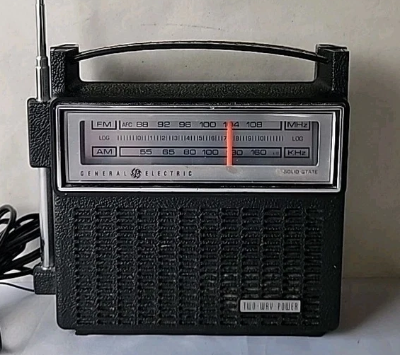
I found a photo on ebay of the radio I got and it seemed so high tech at the time.

radio.webp


So I kept listening to WKBW as it started to get light and slowly fade away.

It wasn't a steady fading but it kept coming back and then leaving with each time it came back again progressively weaker until it was gone and I could still hear it for a time after the station on 1520 in West Chester, Pa had signed on for the day already.

And in the afternoon in winter, WKBW would often show up around 3 pm a while before it got dark.
 
Returning yesterday from a trip to Knoxville, TN, I tried to get a signal from WYRV's AM on 770 while on I-81 in the Marion, VA area -- that's about the closest I got to Cedar Bluff. There was nothing there. I had to assume it's been shut off completely until they are able to properly power it down at sunset. Their low-power FM on 95.1 was not receivable on the interstate either.
 
A search on Radio Locator showed nothing on 770 in the area, but a search by call letters claims the station is currently off the air.

Well its there and it has been on the air. Radio locator.com wont show what it thinks is off air and sometimes when a sytation is taken silent and resumes operation, it doesnt always make it to radio locator
 
Well its there and it has been on the air. Radio locator.com wont show what it thinks is off air and sometimes when a sytation is taken silent and resumes operation, it doesnt always make it to radio locator

It's the broadcast equivalent of repeaterbook for amateur radio operators. It can be useful but can't be trusted. I personally use the radioland app and FCCdata.org usually.

Radioland is quite useful because I can choose to display the coverage maps of several stations at once


Back
Top Bottom