• Get involved.
    We want your input!
    Apply for Membership and join the conversations about everything related to broadcasting.

    After we receive your registration, a moderator will review it. After your registration is approved, you will be permitted to post.
    If you use a disposable or false email address, your registration will be rejected.

    After your membership is approved, please take a minute to tell us a little bit about yourself.
    https://www.radiodiscussions.com/forums/introduce-yourself.1088/

    Thanks in advance and have fun!
    RadioDiscussions Administrators

XEROK 800 is off the air

Neither Hermosillo nor Chicoutimi are using the frequency today as they did in the past, but 1580 jointly belongs to those two nations and any US station on 1580 must protect the Canadian border and the Mexico border nonetheless.
Chicoutimi isn't really Chicoutimi any more either: it's now part of the municipality of Saguenay. Québec has been very proactive in consolidating smaller towns into larger municipalities, something that is much rarer in the United States.

Of course, CBC has been moving away from AM for years through building out networks of FM repeaters.
 
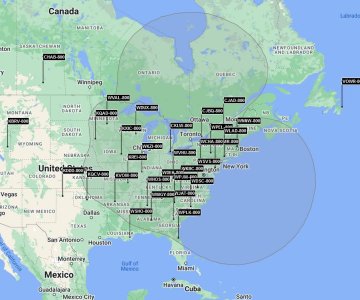
CKLW was 5000 watts nondirectional on 1030 before the NARBA Realignment. It was 5000 watts nondirectional on 800 from 1941 to 1949. The Directional Antenna design was heavily influenced by Carl E. Smith. When it went DA, the arc to protect XELO/XEROK was generally the equivalent of 5000 watts nondirectional. So depending on conditions, you would have heard CKLW depending on conditions, even with the Night Pattern.

CKDO Oshawa, ON is now 10000 watts Class A on 1580.

Ed Buterbaugh headed an entourage that went down to Bonaire to guide installation of a multi pattern DA for PJB, that limited the hours it seriously interfered with CKLW and XEROK. It was supposed to be 100000 watts. But now they are using the DA to the North with 440000 watts to serve Cuba.
 
Last edited:
I can say I never once heard XEROK during the time I lived in Houston from 2007-09. It was either minimal slop from KBME on 790 or a bunch of graveyard-like mush. From what I understood, mostly thanks to @DavidEduardo, XEROK had been at low power (as little as 500 watts, I think) for several years before that.
@Schroedingers Cat, while Toledo is behind CKLW's night pattern, I remember it always came in very well even after dark. An ERP of 5,000 watts from roughly 35-40 miles away sounds about right when it comes to reception.
 
Last edited:
I can say I never once heard XEROK during the time I lived in Houston from 2007-09. It was either minimal slop from KBME on 790 or a bunch of graveyard-like mush. From what I understood, mostly thanks to @DavidEduardo, XEROK had been at low power (as little as 500 watts, I think) for several years before that.
@Schroedingers Cat, while Toledo is behind CKLW's night pattern, I remember it always came in very well even after dark. An ERP of 5,000 watts from roughly 35-40 miles away sounds about right when it comes to reception.

If you look at more supplemental information than the M-3 Map, both Lake Erie and the shoreline areas in Michigan close to Lake Erie, including WJBK/WDEE/WLQV 1500 measured radials from 1972, and actual conductivities measured by environmental scientists of Lake Erie, a reasonable estimate of the path between CKLW and Toledo is closer to 15 than 8 as an estimate of average conductivity along that path. It might also be informative to find Glen Clark's measurements over Lake Erie for the WWJ 50 kW Proofs of Performance. He reportedly went on a rubber raft into Lake Erie to make the measurements himself. So the actual field strength of CKLW is actually much higher in Toledo.

Maybe David has found some measurements of the actual CKLW field strength in Cleveland. In Cleveland, CKLW has a stronger ground wave at Night than during the Day.
 
Last edited:
I can say I never once heard XEROK during the time I lived in Houston from 2007-09. It was either minimal slop from KBME on 790 or a bunch of graveyard-like mush. From what I understood, mostly thanks to @DavidEduardo, XEROK had been at low power (as little as 500 watts, I think) for several years before that.
@Schroedingers Cat, while Toledo is behind CKLW's night pattern, I remember it always came in very well even after dark. An ERP of 5,000 watts from roughly 35-40 miles away sounds about right when it comes to reception.
Growing up in Southeast Texas, I used to listen to XRock 80 at night in the Beaumont Port Arthur area... It would fade sometimes but when it was in it was strong... Shame that such a high power border blaster has ended up the way it has...
 
800 kHz was a mess in Missouri, one of the states where I grew up. XEROK was usually strongest but it was by no means guaranteed. Some days it was good. Some days it wasn´t strong enough to overpower CKLW. In the early 1970s, I got much clearer reception from Mexico City's XEW (900) and XEX (730). I rarely heard PJB.
CKLW should not have been heard in Missouri on night pattern.
 
I was looking for the history of TWR PJB 800. It says it went to 500000 watts in 1963. I don't remember much interference to CKLW before about 1970 though. Probably it was because it was very dependent on conditions. CKLW has the equivalent of a typical Class A IDF to the East, but it was NEVER a skywave protected Class I/Class A Clear Channel. It was always Class II/Class B. CKLW did have a huge effect in rural areas on the East Coast without Top 40 local signals, along with WLS and WCFL, and of course WABC, WBZ, and WKBW, if far enough away from WCBS and WINS, etc. FM changed that increasingly throughout the 1970s.
There is a CKLW aircheck in circulation from 1965 which has major interference at times from PJB. Same for a 1968 aircheck of Charlie Van Dyke and Dick Smythe broadcasting from the CKLW transmitter in Harrow, Ontario, on the occasion of an irate hockey fan cutting guy wires to the CKLW television tower which threatened the studio in 1969.
 
In Southeast Michigan, we could listen to CKLW-FM 93.9 except for 6 PM until Midnight, when they had separate programming on FM. It came in quite well from my location when the tower was on Riverside Drive, about the same distance as the Downtown Detroit FM Area FM Transmitters, about 60 miles. I had a Sony AM FM Portable with a Cassette Player with a telescoping antenna on top of my dresser in my second story room, and I never remember any problem hearing the FM. Except for possibly that 6 PM to Midnight period, there were no problems hearing CKLW. The nonduplication format rules for FM did limit the other stations that had duplicated. The formats on the US FM stations were hit and miss all over the road those early days of nonduplication. So maybe I missed some PJB interference.
 
I forgot what that contour is that is shown. In any event, before all the 500 watt or less stations came on the air at Night, and made 800 sound like a Class IV/Class C channel in some areas, you could have frequently heard CKLW quite well in the null and minor lobe arc to protect XEROK. At one time, all the other stations on 800 had to protect all of the XEROK 50% skywave service area. Now its just 25 uV/m 10% skywave at any point on the Mexican border without a special interference ratio showing. There were none in the US on 800 at Night until circa 1980. There were also no stations on 1570 at Night in the US. When CHLO 680 in St. Thomas moved to 1570 in 1970, you could hear it far and wide in the Eastern US at Night, even in the nulls of the extremely directional pattern. I heard it while on vacation in Tennessee in 1970. But 1000 watt nondirectional CFOR Orillia also came in frequently, and often alone. Only 50 kW WHN/WEPN was allowed at Night on 1050, and only 50 kW WGAR/WHKW on 1220. There were also no stations at Night on 730 or 900 in the US.
 
Last edited:
If you look at more supplemental information than the M-3 Map, both Lake Erie and the shoreline areas in Michigan close to Lake Erie, including WJBK/WDEE/WLQV 1500 measured radials from 1972, and actual conductivities measured by environmental scientists of Lake Erie, a reasonable estimate of the path between CKLW and Toledo is closer to 15 than 8 as an estimate of average conductivity along that path. It might also be informative to find Glen Clark's measurements over Lake Erie for the WWJ 50 kW Proofs of Performance. He reportedly went on a rubber raft into Lake Erie to make the measurements himself. So the actual field strength of CKLW is actually much higher in Toledo.

Maybe David has found some measurements of the actual CKLW field strength in Cleveland. In Cleveland, CKLW has a stronger ground wave at Night than during the Day.

CKLW still blasts into far northeast Ohio at all hours. Around Conneaut where my in-laws live, WJR and CKLW sound as good day and night as any other AM station ... and for my $ have the best 24/7 signals into their town outside the one station actually licensed to the city. It's almost entirely a water path between Conneaut and Detroit/Windsor, of course.
When I was in Akron/Canton for a two-night work stay about a month ago, WJR was subject to some phasing and CKLW sounded terrible after dark. It was there, but the signal was very faint. Clearly I was south of their big eastbound lobe.
 
All of the restrictions on AM BC channel use in the US in 1960 are shown at this link to David's site on pages 1-9 to 1-12.


Also in this section, on Page 1-7, are the definitions of station classes. Of note is that a station on a Regional Channel with just 1000 watts Night could be a Class III-A, if the interference levels were low enough, and a 5000 watts Night station might be a Class III-B or even just Class III if the interference was high enough. When some Michigan stations on Regional Channels went to 20000-50000 watts Night, it was noted in applications that two stations, one was considered Class III-A and one Class III-B, both had NIF contours of 5 mV/m, and the station that had just 1000 watts before "upgrading" had a much larger Nighttime protected service area than one that was 5000 watts Night, due to dial position and conductivity considerations.
 
CKLW should not have been heard in Missouri on night pattern.
Well, it was. Not consistently and not very good when there, but it wasn't a one-off situation either. This was in the northwest suburbs of St. Louis.
 
I tellya, as a MW DXer and a road tripper who had never seen that area of the country before, there was nothin' like tuning in the radio to 800 khz while in the El Paso region and hearing that overmodulated cannon of Radio Canon. This was in the mid to late 80s.
 
I wish I'd have been around in the old XEROK days when it was a borderblaster. I just turned 45 last week so I missed that by a few years :p I remember being sort of disappointed during a trip to Panama City Beach in 2004 ... I sat out on the patio the first night my friends and I were there about 10 CT or so after everyone else had crashed for the night. Lit a cigar, fired up the walkman to see what I could hear, and while there was a lot out there, 800 was a bunch of nothing. I'd hoped to at least catch PJB as I literally looked out over the Gulf from a 1/4 mile off the shore. XEROK would have been a tough if not impossible ask, but still.

 
I have tape of them as Radio Canon with the ID from 1981, and during the Top 40 era, and posted it on the board before.

With all the tape floating around of CKLW now, there is very little of XEROK in comparison, which is a shame.
 
I tellya, as a MW DXer and a road tripper who had never seen that area of the country before, there was nothin' like tuning in the radio to 800 khz while in the El Paso region and hearing that overmodulated cannon of Radio Canon. This was in the mid to late 80s.
Being on a camping trip in Colorado in 1986, I was right in the line of fire of 800’s cannon. Enjoyed the accordions
 
Here's a description of XEROK from a surprisingly detailed listing El Paso radio stations in the El Paso Herald-Post, September 23, 1978. It appeared that the station ran jockless in the evenings.XEROK-1978.jpg
 
I wish I'd have been around in the old XEROK days when it was a borderblaster. I just turned 45 last week so I missed that by a few years :p I remember being sort of disappointed during a trip to Panama City Beach in 2004 ... I sat out on the patio the first night my friends and I were there about 10 CT or so after everyone else had crashed for the night. Lit a cigar, fired up the walkman to see what I could hear, and while there was a lot out there, 800 was a bunch of nothing. I'd hoped to at least catch PJB as I literally looked out over the Gulf from a 1/4 mile off the shore. XEROK would have been a tough if not impossible ask, but still.
My memory is that XEROK, PJB, and CKLW each took turns "owning" 800 at night at my home location northwest of Chicago during XEROK's top 40 blaster days. Depending entirely on conditions.

Fast forward to just last month when I was in the Pensacola area, PJB was on top there most nights, but noticeably weaker than when the "rebuilt 440 kw" version had just came on. I presumed they had tweaked the DA to focus better on Cuba.

The new "incarnation" of PJB is effectively missing at my home location. CKLW is usually on top of 800 most nights, with WVAL and WSVS semi-regular visitors.
 
Status
This thread has been closed due to inactivity. You can create a new thread to discuss this topic.


Back
Top Bottom