
• Get involved.
    We want your input!
    Apply for Membership and join the conversations about everything related to broadcasting.

    After we receive your registration, a moderator will review it. After your registration is approved, you will be permitted to post.
    If you use a disposable or false email address, your registration will be rejected.

    After your membership is approved, please take a minute to tell us a little bit about yourself.
    https://www.radiodiscussions.com/forums/introduce-yourself.1088/

    Thanks in advance and have fun!
    RadioDiscussions Administrators

Your Emergency Situation Station...except when there's an actual emergency

One of the hardest things I ever had to do on-air, was announce a Tornado Warning for our neck of the woods, since our EAS wasn't properly working at the time. I just repeated what the NWS radio said, but it was still pretty hard to do, given the situation.
That why announcers are professionals. I always had a folder that had scripts for emergencies. All I did was "fill in" the location. I also had a tornado warning safety instructions recording too so I would have 90 seconds to 2 minutes or so to catch my breath.

Back in the day of teletype machines, it usually printed out exactly what to say.
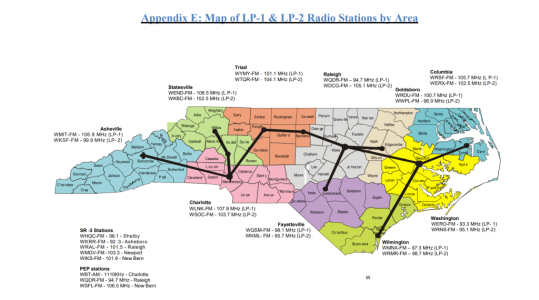
 
Was 107.9 off the air because of the storm? Back when they were WLNK and Mix 107.9, they normally interrupted programming and carried the Emergency Alert System. Is there some federal requirement that 1110 air emergency alerts, since they have that special broadcast bunker at the transmitter site? Do most markets have a designated emergency broadcast station?

Since I am in Spartanburg, I watched the weather alerts on WYFF-4 and WSPA channel 7. Then I switched over to WBTV, WSOC, and WCNC as the storms moved out of the Upstate and approached Shelby.
 
Was 107.9 off the air because of the storm? Back when they were WLNK and Mix 107.9, they normally interrupted programming and carried the Emergency Alert System. Is there some federal requirement that 1110 air emergency alerts, since they have that special broadcast bunker at the transmitter site? Do most markets have a designated emergency broadcast station?

Since I am in Spartanburg, I watched the weather alerts on WYFF-4 and WSPA channel 7. Then I switched over to WBTV, WSOC, and WCNC as the storms moved out of the Upstate and approached Shelby.
Each "major" area has an "EAS input" station. Usually a Class A or B AM or a Class C or B FM. If possible you want to be one. Some stations have FEMA vans at the transmitter site. Usually you can get "grants*" for stuff. (Even locally) stations often got funds for generators from local governments.

* Government Grants can be erratic especially Federal with the political party (both are guilty) out of power trying to wreck the other to score political points.
 
If you are referring to 1110 or any directional AM, I believe the remote control system should have detected a phasing issue that bad. The "sample" would be out of tolerance and most likely several other readings.

On a FM, the EAS box use to be wired in directly before the STL or before the audio processing chain (or box) if transmitter and tower are on site. The box is supposed to interrupt programming automatically. All switching is done by the EAS box. You don't have any "control" over the EAS. If the National Weather Service, Police, three or four letter Government agencies wants to make an announcement it will go out you have no choice to air unless you turn off the transmitter.


If I remember correctly, when the EAS kicks in, there's a relay click (on), of course taking over the whole operation, followed by the second relay click (off), back to RSP. Man, it's been a while.
 
That why announcers are professionals. I always had a folder that had scripts for emergencies. All I did was "fill in" the location. I also had a tornado warning safety instructions recording too so I would have 90 seconds to 2 minutes or so to catch my breath.

Back in the day of teletype machines, it usually printed out exactly what to say.


Roger on that, that's why I did what I did. I always tried to be professional, learning from some of the greats who were the last of a long line, IMHO. Thank the LORD, my memory was sharp then LOL. I'll never forget that feeling, quoting the NWS during that situation, whew.
 
Do most markets have a designated emergency broadcast station?


Yes, I believe they still do. I know they used to have them, anyway, which all the other stations got the EAS broadcasts from.
 
No, stations are not required to relay local/state severe weather warnings sent by EAS.

There are only three mandatory conditions in which EAS messages must be relayed, per § 11.52 (e):

EAS Participants are required to interrupt normal programming either automatically or manually when they receive an EAS message in which the header code contains the Event codes for National Emergency Message (EAN), the Nationwide Test of the Emergency Alert System (NPT), or the Required Monthly Test (RMT) for their State or State/county location.
 
There are only three mandatory conditions in which EAS messages must be relayed, per § 11.52 (e):

EAS Participants are required to interrupt normal programming either automatically or manually when they receive an EAS message in which the header code contains the Event codes for National Emergency Message (EAN), the Nationwide Test of the Emergency Alert System (NPT), or the Required Monthly Test (RMT) for their State or State/county location.
You can quote FCC regulations but when the EAS box takes over your audio you have no choice. Especially when no one is at the station. There is a station I know of that still has the "patch panel" and you might be able to patch around the EAS. I would NEVER recommend doing that unless you are working on, installing or switching out units. I don't remember a setting that allows you to pick and choose which messages go thru. Of course it's been a couple of decades since I had to install an EAS it might have had settings. I don't remember the reading the instructions, but it was the most economical unit available that printed out everything.

I do know missing / kidnapped children announcements have been on Atlanta radio stations occasionally in the last couple of years. Five years ago while driving back from the beach the South Alabama radio stations had tornado warnings from the National Weather Service. They were human not Perfect Paul.
 
"You can quote FCC regulations but when the EAS box takes over your audio you have no choice."

Don't know about other devices, but the Sage allows you to decide which type of alert to react to. Here in Florida we don't broadcast blizzard, avalanche, tsunami or earth quake alerts (among others.) I have selected tornado and severe thunderstorm warnings but don't bother with the silver alerts or blue alerts and so on.
 
"You can quote FCC regulations but when the EAS box takes over your audio you have no choice."

Don't know about other devices, but the Sage allows you to decide which type of alert to react to. Here in Florida we don't broadcast blizzard, avalanche, tsunami or earth quake alerts (among others.) I have selected tornado and severe thunderstorm warnings but don't bother with the silver alerts or blue alerts and so on.

This was a TFT box. I wasn't impressed. Third unit in 5 years.

BTW if you're station is within 20 miles of the Atlantic you might want to turn on the tsunami. There is the remote chance of a "super tsunami" caused but a volcano in the Carney Islands. Of course the USGS is downplaying it. Property Values of the East Coast might be in play. Personally I would rather overestimate than underestimate a volcano 🌋.

I have a minor in Geology and IMHO anyone who thinks they can accurately predict a volcanic eruption's timing and power will always have a margin of error built into their prediction.

Google: Carney Islands land slide

Another possibility for a tidal wave is an astroid but hopefully, the Space Force has that under control.

Do they have EAS warnings about storm surge or is it covered by hurricane 🌀?
 
Don't know about other devices, but the Sage allows you to decide which type of alert to react to. Here in Florida we don't broadcast blizzard, avalanche, tsunami or earth quake alerts (among others.) I have selected tornado and severe thunderstorm warnings but don't bother with the silver alerts or blue alerts and so on.

You make the point that I should have made earlier. Thank you.

A well-designed EAS encoder/decoder has configuration options so that an individual station can choose the appropriate warnings for their service area. The regulation I posted identified the mandatory messages, and no EAS unit should not have the option to turn those off.

As for the complaint by @secondchoice, I can only presume one of two things: Either the warnings he cites as being missing were not properly issued by the proper authorities, or the station configured the EAS unit improperly.

His statement about the "EAS box taking over your audio" refers to a mandated function. EAS was designed to work without human intervention. Configuration, therefore, becomes critical.
 
Last edited:
You make the point that I should have made earlier. Thank you.

A well-designed EAS encoder/decoder has configuration options so that an individual station can choose the appropriate warnings for their service area. The regulation I posted identified the mandatory messages, and no EAS unit should have the option to turn those off.

As for the complaint by @secondchoice, I can only presume one of two things: Either the warnings he cites as being missing were not properly issued by the proper authorities, or the station configured the EAS unit improperly.

His statement about the "EAS box taking over your audio" refers to a mandated function. EAS was designed to work without human intervention. Configuration, therefore, becomes critical.
It wasn't my station that started this thread. It was Charlotte 1110 and 107.9.

I didn't buy the TFT the equipment. I just installed the equipment and made sure it was running at the factory default and the printer worked. The owner's friend programmed it, the automation, and office computers. The major issue with the TFT box was the cheap printer. They would go 2 or three weeks without a printout even when they sent their test tone.

It was a screwy set up with the satellite dish and receiver's ground not being tied into the studio ground. About once every couple of months there would be a "surge" and mess everything else in that rack: the PC that played commercials, the EAS unit and it's receiver and the satellite receiver. The satellite dish was aimed "thru" a high tension electric line about 100 feet away. I was really surprised it worked as well as it did. The manager swore there was no need to tie the satellite system into the station ground.

After he was gone, finally everything's ground got tired together and 10 foot copper rods were driven at the AC / phone line entrance, at the base of the dish, the Air Conditioner compressor, and where the satellite cable entered the station. Magically there were no power surge issues at the studio and the EAS worked fine.
 
That narrative points out something that is a truism more than 90% of the time.

Station managers, by and large, have zero knowledge of engineering and are therefore not qualified to make decisions involving same.

OTOH, I worked for stations owned by individuals who had an engineering background, and they turned out to be the easiest for me to deal with. One, after I told him a production cart machine was dying faster than the contracted help we had to maintain and repair studio equipment could fix it, simply told me to call ITC and order a new one. He had such a good business reputation that ITC sent it Net 30 with nothing more than my call as a purchase order and I had it within a couple of days.

I miss station managers and owners like that. I am grateful that KRKE's owner is also a top-notch broadcast engineer who is often called on by his own competitors for assistance.
 
107.9 has normally carried the EAS announcements. Perhaps there was a technical problem related to them switching from stereo to mono, as mentioned previously. As for 1110, nobody seems to know what they are doing these days. It seems their plans have been indefinitely delayed or forced to change. They should go back to the simulcast and be done with it.
 
If the monthly tests work going to mono should not be an issue.

Like I said before I realize the current EAS system allows "for no human at the station" but I still don't trust it.


Back
Top Bottom