

-
Get involved.
We want your input!
Apply for Membership and join the conversations about everything related to broadcasting.
After we receive your registration, a moderator will review it. After your registration is approved, you will be permitted to post.
If you use a disposable or false email address, your registration will be rejected.
After your membership is approved, please take a minute to tell us a little bit about yourself.
https://www.radiodiscussions.com/forums/introduce-yourself.1088/
Thanks in advance and have fun!
RadioDiscussions Administrators
You are using an out of date browser. It may not display this or other websites correctly.
You should upgrade or use an alternative browser.
You should upgrade or use an alternative browser.
Arbitron Spring 1976
- Thread starter davideduardo
- Start date
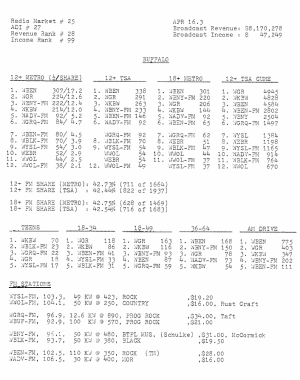
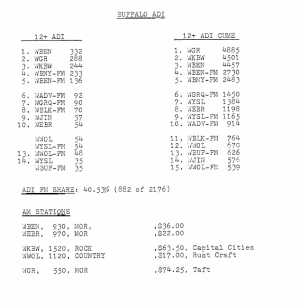
Thanks for posting. Lots of great memories!
This shows that Buffalo has plummeted from market #25 down to its current #59 spot. The top station then had a 17 share. Now, the #1 station has a 9 share. WKBW once had a 12 share and now a 0.2.
That's some significant population and listening erosion...
That was the era when WYSL and WPhD were sold to Bob Howard and he dropped progressive rock and the call letters on WPhD. WGRQ jumped into that void, and WBUF jumped in, transitioning from a Beautiful Music format (in mono). That mistake was rectified a bit later.
Rust belt cities have dropped in rankings as the population has moved south and west. It's a case of lost industries and lost jobs causing a lack of opportunity here while population grew in other areas. We'll see what happens as the water runs out in the deserts of the Southwest and California and temperatures go up.
There are far more radio stations now than there were in those days, and AM radio is a ghost of what it was in 1976. The transition of music to FM was in full swing. Changes in FCC regulations regarding frequency allocations and ownership, along with that new-fangled thing called "the interwebs" has changed the game considerably from the years of FM converters in cars and 8-track or cassette players.
Rust belt cities have dropped in rankings as the population has moved south and west. It's a case of lost industries and lost jobs causing a lack of opportunity here while population grew in other areas. We'll see what happens as the water runs out in the deserts of the Southwest and California and temperatures go up.
There are far more radio stations now than there were in those days, and AM radio is a ghost of what it was in 1976. The transition of music to FM was in full swing. Changes in FCC regulations regarding frequency allocations and ownership, along with that new-fangled thing called "the interwebs" has changed the game considerably from the years of FM converters in cars and 8-track or cassette players.

Most fascinating and instructive!
From a time when...
WADV ("First In Stereo") was Big Band/Jazz/MOR;
WBNY was Schulke Beautiful Music ("All Music ... pause ... All The Time");
WGR was an AC/Full Service 600 pound gorilla, with the Buffalo Sabres;
WBEN was the more traditional MOR/Full Service 600 pound gorilla, with sports and the Bills.
WWOL (now WHTT) was the Country giant, but nowhere near the heights that WYRK (formerly WADV) too the format.
WKBW was still the Top 40 powerhouse, although the mortar between in the bricks in the wall was beginning to show some cracks.
The erosion and fragmentation to FM had begun as younger listeners moved to WBEN-FM ("Rock 102"); WBLK (Urban/R&B); QFM97 (AOR); and WYSL-FM (Rock/Top40), and older listeners gravitated to WADV and WBNY.
The ad rates are equally fascinating.
§
Mildly amusing, those teen and 18-34s from 1976 are now... parents, grandparents and great grandparents. In similar fashion, as listeners moved from AM to FM in '76, we're today seeing a similar shift as listeners gravitate to streaming, listening on-line and alternative platforms.
WECK today seeks to capture some of the "aura" held by KB/WYSL, just as Oldies 104 captured it in the 90s, and 97 Rock essentially plays the same music in about 35% of its rotations.
From a time when...
WADV ("First In Stereo") was Big Band/Jazz/MOR;
WBNY was Schulke Beautiful Music ("All Music ... pause ... All The Time");
WGR was an AC/Full Service 600 pound gorilla, with the Buffalo Sabres;
WBEN was the more traditional MOR/Full Service 600 pound gorilla, with sports and the Bills.
WWOL (now WHTT) was the Country giant, but nowhere near the heights that WYRK (formerly WADV) too the format.
WKBW was still the Top 40 powerhouse, although the mortar between in the bricks in the wall was beginning to show some cracks.
The erosion and fragmentation to FM had begun as younger listeners moved to WBEN-FM ("Rock 102"); WBLK (Urban/R&B); QFM97 (AOR); and WYSL-FM (Rock/Top40), and older listeners gravitated to WADV and WBNY.
The ad rates are equally fascinating.
§
Mildly amusing, those teen and 18-34s from 1976 are now... parents, grandparents and great grandparents. In similar fashion, as listeners moved from AM to FM in '76, we're today seeing a similar shift as listeners gravitate to streaming, listening on-line and alternative platforms.
WECK today seeks to capture some of the "aura" held by KB/WYSL, just as Oldies 104 captured it in the 90s, and 97 Rock essentially plays the same music in about 35% of its rotations.
Last edited:
Climate Change will force people to relocate from different parts of the planet. It will be significant. It won't lead to more Radio listeners in Buffalo, though...Rust belt cities have dropped in rankings as the population has moved south and west. It's a case of lost industries and lost jobs causing a lack of opportunity here while population grew in other areas. We'll see what happens as the water runs out in the deserts of the Southwest and California and temperatures go up.
You can call it "Fragmentation". When a market drops from #25 to #59, that means fewer potential listeners...Many markets like Pittsburgh, Cleveland, and Detroit have dropped enormously in population rank as our manufacturing moved to Asia or the less unionized South.
That is not listening erosion for radio; it is listening fragmentation. Many FMs did not show, and there were 5 AMs in the top 12... one was a daytimer!
Today, the two country market has 27 commercial stations and 8 non-commercial ones. And that does not count LPFMs and translators.
But you focused on share. Nobody has a ten share or above today because more stations are chopping the shares more ways. No matter what the population, there are always 100 shares. The change in market size does not affect the top station's share.You can call it "Fragmentation". When a market drops from #25 to #59, that means fewer potential listeners...
That is going to be a very slow process. And some of what we get in the media is not accurate: the Honduran migration to the US is being blamed on climate change and recent hurricanes. In fact, that nation has had far worse hurricanes in the past with comparable economic disasters. So don't look for dramatic population changes for years if not decades.Climate Change will force people to relocate from different parts of the planet. It will be significant. It won't lead to more Radio listeners in Buffalo, though...
The drop in population CAN affect a stations share. Take WBEN -- as their audience dies off, very few new listeners take their place. As population declines in a given market, that means it's tougher for every station to new find listeners.But you focused on share. Nobody has a ten share or above today because more stations are chopping the shares more ways. No matter what the population, there are always 100 shares. The change in market size does not affect the top station's share.
Fragmentation has also definitely affected network TV. Look at the high shares that shows like MASH, All In The Family, Seinfeld, etc.. used to get. Now a Top rated show has ratings that would have gotten it cancelled 30 years ago...
"Share" is the percentage of all radio listeners who are listening to a particular station at any given time. There are always 100 shares, because the base is people who are actually listening. If there are 10 listeners or 100,000 at any given time in any given market there will always be 100 shares divided among all the stations.The drop in population CAN affect a stations share. Take WBEN -- as their audience dies off, very few new listeners take their place. As population declines in a given market, that means it's tougher for every station to new find listeners.
Rating, not share, is the percentage of the total population who are listening at a given time. In general, "rating" numbers will be about one tenth of the share numbers. A station with a 1 share will have a 0.1 rating.
You are again confusing rating and share.Fragmentation has also definitely affected network TV. Look at the high shares that shows like MASH, All In The Family, Seinfeld, etc.. used to get. Now a Top rated show has ratings that would have gotten it cancelled 30 years ago...
I get it. When only ten listeners remain, a station that has 5 of them can boast "50 percent of Radio users listen to us"."Share" is the percentage of all radio listeners who are listening to a particular station at any given time. There are always 100 shares, because the base is people who are actually listening. If there are 10 listeners or 100,000 at any given time in any given market there will always be 100 shares divided among all the stations.
Rating, not share, is the percentage of the total population who are listening at a given time. In general, "rating" numbers will be about one tenth of the share numbers. A station with a 1 share will have a 0.1 rating.
You are again confusing rating and share.
The point was that the bar gets lower all the time. The massive audience that network TV used to reach is now considerably smaller. It's the same with Radio...
I agree with Bolt. I have been saying this. The terrestrial radio audience is smaller for sure. This is the exact reason WECK will be a solid B type ratings player. With a 3.8 share at WECK, and with other stations continuing to drop, it’s basically gonna be a horse race, with the exception of A players like YRK, BLK, BEN, GRF. The others will be in the 3 to 5 share range.I get it. When only ten listeners remain, a station that has 5 of them can boast "50 percent of Radio users listen to us".
The point was that the bar gets lower all the time. The massive audience that network TV used to reach is now considerably smaller. It's the same with Radio...
There is no doubt that not only is radio listening fragmented, and it is lower. I don’t mind that. We just continue to superserve our 75K weekly cume
I have learned a lot about ratings, and what an old unreliable ratings system we have with diaries. Everything depends on who is getting these diaries.
I recently looked at one diary comment and the person gave WSPQ ALL of their listening hours! The freaking station has been off the air , for what, 4 years?
I have also seen diaries that are messed up in many other ways. One thing for sure is that these ebb and flow.
For instance, in the Nielsen diary insights I received three days ago for the Oct book, KISS had a 3.0 share! Really??? So expect KISS to go down a bit this book, unless the voodoo math in weighing they do raises them. WECK was right around the same share, which means we will go down a tad.
The ratings thing is really out of date very badly
No, that is cume. Share is actual listening by people in a defined time period. Cume is like the circulation of a newspaper.I get it. When only ten listeners remain, a station that has 5 of them can boast "50 percent of Radio users listen to us".
And as long as enough people listen and ad rates are commensurate with delivery, radio can continue to operate as a free service.The point was that the bar gets lower all the time. The massive audience that network TV used to reach is now considerably smaller. It's the same with Radio...
There is still a significant percentage of homes without cable or alternative delivery systems and they watch OTA television. There is a percentage of people without smart phones. And the highest percentage, nearly 90% of adults, still uses terrestrial radio.
Yes, the number of hours of OTA radio used per week by many is less. But as/if commercial radio finds streaming alternatives that can be profitable, the industry will move more and more usage to newer distribution systems.
No, they won't. They will still have the same percentage of listeners but the number of people listening will be less.I agree with Bolt. I have been saying this. The terrestrial radio audience is smaller for sure. This is the exact reason WECK will be a solid B type ratings player. With a 3.8 share at WECK, and with other stations continuing to drop, it’s basically gonna be a horse race, with the exception of A players like YRK, BLK, BEN, GRF. The others will be in the 3 to 5 share range.
Share is the percentage of people actually listening to radio that listen to your station. If all radio usage goes down by, let's say, 50%, there will still be 100 share points divided between the different stations.
Yet the system is the only economically viable one in smaller markets. And it has worked for 56 years. The problems today involve mechanics such as slower mail delivery, fewer places to drop off the completed diary when the survey week is done, need for larger incentives to attract attention and even the fact that many people today are not used to writing on paper.I have learned a lot about ratings, and what an old unreliable ratings system we have with diaries. Everything depends on who is getting these diaries.
The system for recruiting, supervising and tabulating is "good research". All random probability samples, which is how the diary survey participants are selected, have a margin of error. And all such surveys are weighted to overcome differences, high or low, to achieve mathematically correct proportionality on every stratification variable.
This is the same survey method used in all the political polls where they say "margin of error 3.7%" and the like. In radio, that means that a station with a 10 share could really be a 9.6 or a 10.4. And we know that, for sales, that is insignificant.
That is not common, but it happens particularly with elderly people or those who are mentally challenged or have personality disorders. It does not happen enough to materially affect the results.I recently looked at one diary comment and the person gave WSPQ ALL of their listening hours! The freaking station has been off the air , for what, 4 years?
I've seen some of those, such as people who indicated, in the late 90's, that they listened to a deceased morning person on WIND... ten years after the station went to Spanish programming. I requested a follow up call just to get an understanding and the person, in their 80's, was listening to a similar show on WGN that "all sound alike" and was simply writing down what "came easy to the mind".
I've literally reviewed... many just scanning for "red flags"... millions of diaries going all the way back to Beltsville 50 years ago when we looked at the actual paper diaries in trays. I got five books reissued, so I know there are errors. But overall, the system works.I have also seen diaries that are messed up in many other ways. One thing for sure is that these ebb and flow.
Oh, and every reissued book was due to a competitor having registered slogans or names they did not use or which were generic enough to be disqualified,
It all depends on the weighting applies. In this period that is affected by COVID, human behaviour is very "strange" and so it is hard for Nielsen to accurately predict the returns in each stratification variable's cell. Remember, they not only have quotas for age and gender, but by geography, ethnicity, income level, education level, etc. Whenever the returns don't match the market, they apply weighting.For instance, in the Nielsen diary insights I received three days ago for the Oct book, KISS had a 3.0 share! Really??? So expect KISS to go down a bit this book, unless the voodoo math in weighing they do raises them. WECK was right around the same share, which means we will go down a tad.
The best alternative is the PPM. And it has its own defects, such as making participants get "are you a drug dealer now?" remarks. But what you would not like about the PPM in Buffalo is the cost. So you get the best system for your market size.The ratings thing is really out of date very badly
Another comment that points to the "drug dealer" ↑ remark, a program director in a PPM market found that some panel members had been asked, "Why are you wearing a pager?" Apparently drug dealers still use(d) pagers to protect their privacy or identities, so some panelists hid their PPMs. He related another story concerning a woman who threw her PPM in a clothes dryer, whether accidentally or intentionally, but it still recorded the radio station that was on in her home, a Hot AC station. He found the correlation to be funny: Clothes dryer ~ Hot AC. A few years ago while talking to a program director who had worked in a PPM market before coming to Buffalo, I casually asked if he missed the immediacy of PPM and all the bells and whistles. He replied that although he'd been reasonably successful, he was relieved to be back in a diary market because he'd become "almost schizophrenic programming to PPM." He compared PPM to diary markets being like Canadian football to the NFL: the game was similar, but the rules and the playing field were different, and you still had to get the ball across the goal line to score and get more points than the opponent.The best alternative is the PPM. And it has its own defects, such as making participants get "are you a drug dealer now?" remarks. But what you would not like about the PPM in Buffalo is the cost. So you get the best system for your market size.

EDIT: Deleted, I screwed up reading what David wroteThis is the same survey method used in all the political polls where they say "margin of error 3.7%" and the like. In radio, that means that a station with a 10 share could really be a 9.6 or a 10.4. And we know that, for sales, that is insignificant.
Last edited:
If you think this diary system is a reliable and good one, your just not living in reality. I see every one of the diary comments that mention WECK, and also the stations they give quarter hours to.. some people will write down that certain stations are all they listen to, but they give those stations zero quarter hours. How is that normal? Others write down stations that don’t exist, and it’s not just the physically or mentally challenged.No, they won't. They will still have the same percentage of listeners but the number of people listening will be less.
Share is the percentage of people actually listening to radio that listen to your station. If all radio usage goes down by, let's say, 50%, there will still be 100 share points divided between the different stations.
Yet the system is the only economically viable one in smaller markets. And it has worked for 56 years. The problems today involve mechanics such as slower mail delivery, fewer places to drop off the completed diary when the survey week is done, need for larger incentives to attract attention and even the fact that many people today are not used to writing on paper.
The system for recruiting, supervising and tabulating is "good research". All random probability samples, which is how the diary survey participants are selected, have a margin of error. And all such surveys are weighted to overcome differences, high or low, to achieve mathematically correct proportionality on every stratification variable.
This is the same survey method used in all the political polls where they say "margin of error 3.7%" and the like. In radio, that means that a station with a 10 share could really be a 9.6 or a 10.4. And we know that, for sales, that is insignificant.
That is not common, but it happens particularly with elderly people or those who are mentally challenged or have personality disorders. It does not happen enough to materially affect the results.
I've seen some of those, such as people who indicated, in the late 90's, that they listened to a deceased morning person on WIND... ten years after the station went to Spanish programming. I requested a follow up call just to get an understanding and the person, in their 80's, was listening to a similar show on WGN that "all sound alike" and was simply writing down what "came easy to the mind".
I've literally reviewed... many just scanning for "red flags"... millions of diaries going all the way back to Beltsville 50 years ago when we looked at the actual paper diaries in trays. I got five books reissued, so I know there are errors. But overall, the system works.
Oh, and every reissued book was due to a competitor having registered slogans or names they did not use or which were generic enough to be disqualified,
It all depends on the weighting applies. In this period that is affected by COVID, human behaviour is very "strange" and so it is hard for Nielsen to accurately predict the returns in each stratification variable's cell. Remember, they not only have quotas for age and gender, but by geography, ethnicity, income level, education level, etc. Whenever the returns don't match the market, they apply weighting.
The best alternative is the PPM. And it has its own defects, such as making participants get "are you a drug dealer now?" remarks. But what you would not like about the PPM in Buffalo is the cost. So you get the best system for your market size.
I have actually begun to not give a shit about the ratings either way, because it’s a joke. It’s all smoke and mirrors. Even I find it hard to believe that WECK beat STAR 12 plus. How is that possible?
Also, if listening is not going down, or atleast fragmented severely, why are mainly all stations share now 3-5 share? This weighting thing is a joke. On this thread, a few posts ago, I listed the quarter hours for Oct by station. When the ratings come out this week, they will look nothing like that. I realize I am not averaging the three months, but even if I did, after the voodoo math, the actual ratings are totally different.
You give way to much credit to a system that derives its answers not by , who they are listening too, but what they remember. I have said this before. I could promote right now a station that does now even exist , and it would get ratings. How is that indicative of what people are really listening too?
I see comments all the time in the diaries that says ‘we don’t listen to radio, we like Sirius “ then they write in random stations and give them quarter hours when they just got done saying they don’t listen to radio.
You have your belief, I have mine. Win or lose, ratings go up and down. Focus on client results. I should have pulled out when I had the chance. Now I’m stuck with this ratings charade for 2 more years.
In the past 2 ratings trends, WECK had been mid 4 shares. I could care less, because I don’t even believe it. A few days ago KISS had a 3 share. I don’t believe that either
WBEN, a station I love, which I happen to believe is the best news talk in the country, is plummeting. How is this possible, when three months ago the ratings showed an entirely different thing?
You have your view, I have mine. The radio diary ratings are bunk.
If you think this diary system is a reliable and good one, your just not living in reality. I see every one of the diary comments that mention WECK, and also the stations they give quarter hours to.. some people will write down that certain stations are all they listen to, but they give those stations zero quarter hours. How is that normal? Others write down stations that don’t exist, and it’s not just the physically or mentally challenged.
I have actually begun to not give a crap about the ratings either way, because it’s a joke. It’s all smoke and mirrors. Even I find it hard to believe that WECK beat STAR 12 plus. How is that possible?
Also, if listening is not going down, or atleast fragmented severely, why are mainly all stations share now 3-5 share? This weighting thing is a joke. On this thread, a few posts ago, I listed the quarter hours for Oct by station. When the ratings come out this week, they will look nothing like that. I realize I am not averaging the three months, but even if I did, after the voodoo math, the actual ratings are totally different.
You give way to much credit to a system that derives its answers not by , who they are listening too, but what they remember. I have said this before. I could promote right now a station that does now even exist , and it would get ratings. How is that indicative of what people are really listening too?
I see comments all the time in the diaries that says ‘we don’t listen to radio, we like Sirius “ then they write in random stations and give them quarter hours when they just got done saying they don’t listen to radio.
You have your belief, I have mine. Win or lose, ratings go up and down. Focus on client results. I should have pulled out when I had the chance. Now I’m stuck with this ratings charade for 2 more years.
In the past 2 ratings trends, WECK had been mid 4 shares. I could care less, because I don’t even believe it. A few days ago KISS had a 3 share. I don’t believe that either
WBEN, a station I love, which I happen to believe is the best news talk in the country, is plummeting. How is this possible, when three months ago the ratings showed an entirely different thing?
You have your view, I have mine. The radio diary ratings are bunk.
Others write down stations that don’t exist, and it’s not just the physically or mentally challenged.
That is Not Cool.
on so many levels that is offensive, inappropriate and inaccurate you should be embarrassed at your comment.
That is Not Cool.
on so many levels that is offensive, inappropriate and inaccurate you should be embarrassed at your comment.
- Status
- This thread has been closed due to inactivity. You can create a new thread to discuss this topic.