• Get involved.
    We want your input!
    Apply for Membership and join the conversations about everything related to broadcasting.

    After we receive your registration, a moderator will review it. After your registration is approved, you will be permitted to post.
    If you use a disposable or false email address, your registration will be rejected.

    After your membership is approved, please take a minute to tell us a little bit about yourself.
    https://www.radiodiscussions.com/forums/introduce-yourself.1088/

    Thanks in advance and have fun!
    RadioDiscussions Administrators

Radio Locator Maps-How Accurate Are They?

How accurate are these maps? Do you pick up stations on either AM or FM that are
well outside the contours shown on their maps?
I found that with either a decent car or auto radio they are reasonably accurate on AM although I consistently receive many stations that I'm not supposed to receive according to this website.
What do you think of these maps?
 
They seem be in the “ball park” accurate. AM predictions looks pretty close for middle of the day reception conditions. No consideration for sky-wave is given either as an enhancement for class A’s or detriment for class B, C or D’s. That’s the big difference in the real world. FM looks reasonable and seems to track with the FCC contour predictions found at the FM query site. They’re not bad and the price is good.

w/
 
Watt Hairston said:
They seem be in the “ball park” accurate. AM predictions looks pretty close for middle of the day reception conditions. No consideration for sky-wave is given either as an enhancement for class A’s or detriment for class B, C or D’s. That’s the big difference in the real world. FM looks reasonable and seems to track with the FCC contour predictions found at the FM query site. They’re not bad and the price is good.

w/

I would agree that they are pretty good, perhaps a bit conservative, if anything....
 
I started this thread because I think the maps are significantly off in AM and FM in many areas of the country. The Miami sports station on 560 AM goes out way past the contours as well as Key West on 1600 AM. The Chicago blowtorches came in on seek in the middle of the day about 20 mi E of Des Moines IA. According to the maps the stations weren't supposed to come in at all.
In VT WBZ came in on seek near Stratton Mtn VT during the day well beyond it's projected contours.
On FM 96.5 in Harford and Portsmouth NH can be received (depending what part of town you're in) as well as 95.1 Hyannis and 94.9 Mt. Washington. There are many others but according to Radio Locator, these stations cannot be received in Northbridge, MA at all. That's not true.
Out on the Great Plains and in Fla FM's can be received for 90-120 mi but radio locator maxes out at about 75-80mi. So the maps are conservative at best, less than accurate at worst but they are a good source of info nonetheless.
 
vibe said:
So the maps are conservative at best, less than accurate at worst but they are a good source of info nonetheless.

There are many exceptions, of course, but I'd disagree on the AM maps, which can be a little too generous. I mainly use them for general info like seeing the main lobes and nulls on directional patterns. They're useful for estimating daytime coverage, but you have to consider the interference levels from man-made sources. For local coverage limits at night the major factor is the NIF (nighttime interference free) zone, which can vary greatly depending on the particular frequency.

Here's a day versus night example: the daytime signal for KSKY 660 in Dallas is a blowtorch, covering a huge portion of Texas. Look at the plotted plotted 5.0 MVM ("local") coverage from their original application: http://svartifoss2.fcc.gov/prod/cdbs/forms/prod/getattachment_exh.cgi?exhibit_id=70899

KSKY is running 20,000 watts on a low frequency and in this part of the country the ground conductivity is excellent, just like in the upper midwest (e.g., the multi-state coverage of WNAX 570 in Yankton SD). In reality KSKY can be heard during the day in the Houston area, well over 250 miles away. At night they cut back to 700 watts directional and the coverage is greatly reduced, as you'll see on the R-L map: www.radio-locator.com/cgi-bin/pat?call=KSKY&service=AM&status=L&hours=N But compare that with the proposed coverage from their original application at
http://svartifoss2.fcc.gov/prod/cdbs/forms/prod/getattachment_exh.cgi?exhibit_id=70914

The two don't match at all; to the west, Fort Worth (and most of Tarrant County) aren't really in KSKY's nighttime coverage area. The night coverage map on the FCC site was for 2,000 watts (later revised for 700 watts) so reduce it down substantially, take nightly interference from Mexico City into account and you'll find that in practice the coverage on the Radio-Locator maps is very generous. (As a point of reference, both Dallas and Tarrant County are basically 30-mile square "blocks.") In this case, were it not for the Mexican interference, KSKY would have a fairly impressive nighttime signal. In reality their nighttime interference-free zone often doesn't make it out that far.

Radio-Locator maps are fine for what they are, estimates only. But you might want to dig a little deeper. Remember the effect of man-made noise in the city, day or night, and consider the interference level on a particular frequency when you look at the nighttime coverage. What the maps don't show is the all-important NIF zone, the real measure of nightime local coverage. As they say on the site, the nighttime maps show the estimated groundwave coverage only, and ground conductity has nothing to do with skywave coverage. When I look at the maps I consider the shape of the pattern, the frequency used (the higher it is, the further it goes) and co-channel stations that might cause interference.

 
I wouldn't rely on them at all. In Knoxville they show the backup site for two FM's rather than the main sites. One of them is a 100K signal and the main site is almost 20 miles from the location they give. FCC.gov maps are much more reliable. The only good thing about radio locator maps is they show street level detail.
 
I NEED TO MAKE A CORRECTION. The site I was thinking of that has the incorrect sites listed in Knoxville is www.findradio.us NOT radio-locator! I do like the coverage maps on radio-locator and agree that they are helpful (and most likely accurate to a reasonable level of expectation.
 
FM AM said:
I would agree that they are pretty good, perhaps a bit conservative, if anything....

They are great for DXers, but not for much else.

On AM, the innermost red contour is close, but exaggerated, for the useful coverage of most AMs in cities. It approximates the area where AM signals can be heard above the noise level created by man made interference. In rural ares, just beyond the red line is going to be where reliable listening happens.

On FM, the innermost circle is where about 85% of listening occures. Just outside it is where 95% occurs. So really, the red contour on FM is the only measure of where the average listener is going to pick the staiton up with some ease.

DXers have heard 250 watt AMs from Honolulu on the East Coast. But for real listening, take the red contours and be skeptical even then. Nearly all stations can be heard beyond the usable signal area, but they don't get listened to there.
 
A sub question: do the stations consider these maps to be of value or are they for the radio geeks (us)?
 
I agree with the terms "ballpark" and "estimates". I find the daytime AM estimates a bit conservative....the FM estimates a bit generous.
 
I think those radio-locator maps give a general idea of the stations' primary market coverage.
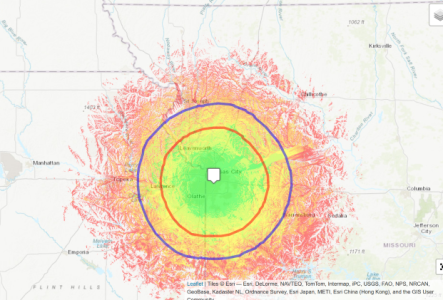
To view more expansive and descriptive coverage maps, https://www.rabbitears.info/fmq.php allows user to make maps of FM contours.

This map shows how far this Kansas City FM goes. I know even this one is conservative as I once received that station driving south on I-35 way past Emporia, probably 50 miles from the outer blue contour (matching radiolocator's). Emporia is shown in the southwest part of the map. The signal remained listenable until I reached the Flint Hills, probably 20 more miles southwest of Emporia. I know this wasn't troposphere or skip because I received it the same way on another trip a week or so later.

Others have reported receiving the station all the way to the Iowa border on I-35 (north side of the map).

Screenshot 2022-01-01 164914--.png
 
I think those radio-locator maps give a general idea of the stations' primary market coverage.
To view more expansive and descriptive coverage maps, https://www.rabbitears.info/fmq.php allows user to make maps of FM contours.

This map shows how far this Kansas City FM goes. I know even this one is conservative as I once received that station driving south on I-35 way past Emporia, probably 50 miles from the outer blue contour (matching radiolocator's). Emporia is shown in the southwest part of the map. The signal remained listenable until I reached the Flint Hills, probably 20 more miles southwest of Emporia. I know this wasn't troposphere or skip because I received it the same way on another trip a week or so later.

Others have reported receiving the station all the way to the Iowa border on I-35 (north side of the map).

View attachment 2467
Using actual listening by people who don’t look at coverage maps, on average 80% of home and work quarter hour listening occures in the 70 dbu contour (will inside the innermost one on radio-locator). And 95% takes place inside the 65 dbu contour.
 
Status
This thread has been closed due to inactivity. You can create a new thread to discuss this topic.


Back
Top Bottom