vibe said:
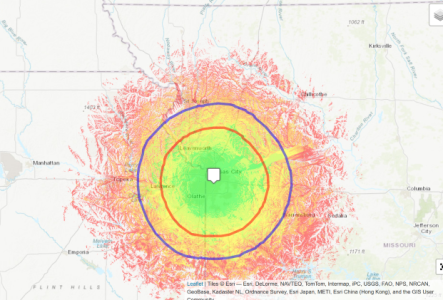
So the maps are conservative at best, less than accurate at worst but they are a good source of info nonetheless.
There are many exceptions, of course, but I'd disagree on the AM maps, which can be a little too generous. I mainly use them for general info like seeing the main lobes and nulls on directional patterns. They're useful for estimating daytime coverage, but you have to consider the interference levels from man-made sources. For local coverage limits at night the major factor is the NIF (nighttime interference free) zone, which can vary greatly depending on the particular frequency.
Here's a day versus night example: the daytime signal for KSKY 660 in Dallas is a blowtorch, covering a huge portion of Texas. Look at the plotted plotted 5.0 MVM ("local") coverage from their original application:
http://svartifoss2.fcc.gov/prod/cdbs/forms/prod/getattachment_exh.cgi?exhibit_id=70899
KSKY is running 20,000 watts on a low frequency and in this part of the country the ground conductivity is excellent, just like in the upper midwest (e.g., the multi-state coverage of WNAX 570 in Yankton SD). In reality KSKY can be heard during the day in the Houston area, well over 250 miles away. At night they cut back to 700 watts directional and the coverage is greatly reduced, as you'll see on the R-L map:
www.radio-locator.com/cgi-bin/pat?call=KSKY&service=AM&status=L&hours=N But compare that with the proposed coverage from their original application at
http://svartifoss2.fcc.gov/prod/cdbs/forms/prod/getattachment_exh.cgi?exhibit_id=70914
The two don't match at all; to the west, Fort Worth (and most of Tarrant County) aren't really in KSKY's nighttime coverage area. The night coverage map on the FCC site was for 2,000 watts (later revised for 700 watts) so reduce it down substantially, take nightly interference from Mexico City into account and you'll find that in practice the coverage on the Radio-Locator maps is very generous. (As a point of reference, both Dallas and Tarrant County are basically 30-mile square "blocks.") In this case, were it not for the Mexican interference, KSKY would have a fairly impressive nighttime signal. In reality their nighttime interference-free zone often doesn't make it out that far.
Radio-Locator maps are fine for what they are, estimates only. But you might want to dig a little deeper. Remember the effect of man-made noise in the city, day or night, and consider the interference level on a particular frequency when you look at the nighttime coverage. What the maps don't show is the all-important NIF zone, the real measure of nightime
local coverage. As they say on the site, the nighttime maps show the estimated groundwave coverage only, and ground conductity has nothing to do with skywave coverage. When I look at the maps I consider the shape of the pattern, the frequency used (the higher it is, the further it goes) and co-channel stations that might cause interference.