• Get involved.
    We want your input!
    Apply for Membership and join the conversations about everything related to broadcasting.

    After we receive your registration, a moderator will review it. After your registration is approved, you will be permitted to post.
    If you use a disposable or false email address, your registration will be rejected.

    After your membership is approved, please take a minute to tell us a little bit about yourself.
    https://www.radiodiscussions.com/forums/introduce-yourself.1088/

    Thanks in advance and have fun!
    RadioDiscussions Administrators

Got KOA 850 Denver in Englewood FL but why did it happen?

I was just doing a nitely band scan on a so so radio with respect to AM reception- a Bose Wave Radio. For the first time here in SW Fla I heard KOA 850 and their call letters for about 5 min- then a fade- an hour later I turned on the radio and it was back again. Now stations were strong to the North and NW- KWKH 1130 Shreveport was booming and I got Chi on 720 and 780, NYC on 880, Wash DC on 1500 etc. DFW -820 and 1080 and San Antonio at 1200 were stronger than usual.
My uneducated (w/ repect to radio) guess is that KOA made it over to the Texas gulf coast than skipped across the vast Gulf of Mexico to the west coast of Fla.
All I know is that I was trying every night for the last 2 weeks without success. Weather conditions were not unusual.
So what makes a station appear like that and probably very infrequently?
 
I've pulled KOA regularly and I live about 100-150 miles east of Nashville.

That's my farthest west. My farthest north would be the Toronto stations CHWO, CHUM, CJBC, CKLW, CHIN, and CFRB.
 
I live in Maryland - the farthest West has been WHO Des Moines and the farthest South WWL New Orleans. I have been trying to pick up KOA Denver and DFW 820, but with no luck.
 
KOA's signal is a monster - or used to be before they fired up IBOC, which severly cut their daytime coverage. They were a regular DAYTIME catch in Dallas on normal car radios. Now there is a local 850 covering them up.
 
rbrucecarter5 said:
KOA's signal is a monster - or used to be before they fired up IBOC, which severly cut their daytime coverage. They were a regular DAYTIME catch in Dallas on normal car radios. Now there is a local 850 covering them up.

IBOC does not cut into analog coverage. I have set up a couple IBOC stations and tested it out myself. Also, if you know how IBOC works there is no way it can cut into coverage. This is a falsehood.
 
Sorry - but I have observed this phenomenon on a number of AM stations that installed IBOC. So have other people. LISTEN to DX'ers, they can be your first line of defense when troubleshooting problems.

You can't tell me that sapping energy from the transmitter to energize the wide IBOC bandwidth doesn't detract from the energy available for analog signal. Unless you add back power to compensate.

The problem may be related to modulation - cutting back modulation effectively cuts the station's range. Ask KOKC - blissfully running 50 kW - hardly having the range of a 1 kW station until they caught the low moduation and corrected it. Maybe - IBOC forces you to cut analog modulation so you don't jam digital sidebands.

Another thing - show me any antenna system with FLAT phase over a 50 kHz bandwidth. If you manage to do that, I am sure the folks at Ibiquity would love to hear about it because I don't think it can be done in the real world. Even a few degrees of phase difference between the sidebands - and you add AMPLITUDE modulated noise back in to the analog signal. Perhaps that is where the range decrease comes from - plenty of carrier, plenty of sidebands - but also plenty of self-jamming noise that masquerades as decreased range in the fringes. And that assumes someone has a synthesized digital receiver, it is darn hard to find the "sweet spot" on an analog tuned receiver that mutes IBOC self-jaming hash. If you do manage to land right on frequency - there is a low level, but audio "warble" effect caused by the small phase differences. REALLY annoying.

But don't get me started on the REAL deficiencies of the Ibiquity AM system, I'll be writing all day. BAD engineering all around.
 
In Tampa, I never received good nighttime (or daytime) AM reception. Too much static.
This was with a Grundig Yachtboy inside my home.
Wasn't much better in my car radio.

This was north of the airport and most of my driving was inland, in the center and southern parts of the state.
Fort Myers area was real staticy.

Plus, looking at coverage maps, very few skywave stations make it to Fla., outside of WBT, WSB, WLW and maybe some others.
Am rather pleased to enjoy far better nighttime coverage here in central Texas, where I recently moved.
 
Last edited:
Plus, looking at coverage maps, very few skywave stations make it to Fla., outside of WBT, WSB, WLW and maybe some others.
Am rather pleased to enjoy far better nighttime coverage here in central Texas, where I recently moved.
Hundreds of stations have predictable, normal sky wave reception in the southern part of Florida. The difference is that most are from Cuba, Colombia, Venezuela and other areas of the Caribbean Basin.
 
Hundreds of stations have predictable, normal sky wave reception in the southern part of Florida. The difference is that most are from Cuba, Colombia, Venezuela and other areas of the Caribbean Basin.
I wish there were listings and maps of those, maybe a global map of radio contours.
It's inexcusable Mexican stations are mostly omitted from those MW frequency maps, like this one, which could show protection for the Mexican station if it showed that Matamoros station's coverage.

Screenshot 2022-01-01 110734-.png
 
I wish there were listings and maps of those, maybe a global map of radio contours.
It's inexcusable Mexican stations are mostly omitted from those MW frequency maps, like this one, which could show protection for the Mexican station if it showed that Matamoros station's coverage.

View attachment 2468


It is not inexcusable.... the mexican database is not as easily searchable/decipherable as the canadian database and that canada database is even harder then the pretty easy FCC database in the US
 
I've heard KOA several times during my stays near Pensacola. Albeit usually under the Birmingham 850. At home, KOA seems to be to be as strong as ever. If anything, it might even be even slightly stronger.
 
KOA's one of those few stations in the perfect spot for near coast-to-coast coverage. I've heard it in the east and in Los Angeles, and in Florida as well.
 
I've heard KOA several times during my stays near Pensacola. Albeit usually under the Birmingham 850. At home, KOA seems to be to be as strong as ever. If anything, it might even be even slightly stronger.
Indeed KOA is as strong as ever in Illinois at night.
 
I wish there were listings and maps of those, maybe a global map of radio contours.
It's inexcusable Mexican stations are mostly omitted from those MW frequency maps, like this one, which could show protection for the Mexican station if it showed that Matamoros station's coverage.

Well, I am the author of those maps, and let me tell you why Mexico isn't included.

Mexico doesn't publish technical data on their AM radio stations. They can't even publish an accurate list of what is on the air today in their own country.

Without technical data you can't generate a pattern map.

To calculate a pattern map, you need for each tower (in database form):

Tower height
Tower spacing from #1 tower
Tower phasing from #1 tower
Tower orientation from #1 tower
Tower field data
Measured RMS at 1 km
Tower configuration (standard?, top hat?, segmented?, etc. and all physical dimensions of each section or top hat)

radio-locator and the rest are relying on the FCC database of Mexican stations which is 90% inaccurate and redundant. New owners, call sign changes, frequency changes, location changes, stations going dark, almost none of it is sent to the FCC after the initial filing. The FCC only "accumulates" Mexican radio data, they don't verify it or delete old records. Don't trust it for Mexican stations.

The current 2022 set of pattern maps seen on Medium Wave Circle have some Mexican station patterns for the first time this year. This is the result of two people (me and Steve Whitt) spending most of their summer and fall hand-correlating and cross-referencing Mexican stations to the mountain of inaccurate FCC data, to try to determine if an accurate record can be found.

Bill
 
I've heard KOA several times during my stays near Pensacola. Albeit usually under the Birmingham 850. At home, KOA seems to be to be as strong as ever. If anything, it might even be even slightly stronger.
I frequently got KOA at Quito, Ecuador, back in the 60's using an HQ-180 and an altaz loop. It was sort of a bellwether station for that zone of the US and North America, and if it was coming in really well, I could look for some of the regional channels and, even on occasion, something on one of the "graveyard" channels. I got both Montana and the Dakotas on 1450, for example.

Where I was, with the exception of my own AMs, there were no stations on the air after midnight or 1 AM for more than 500 miles around, and even then there were few of them. So on many channels I got relatively low power US and Canadian stations. At that location, because there was complete horizon blockage at up to 70° or so by the mountains on one side of the city, I did not have interference from stations in Asia, New Zealand and Australia, either.

It was fun to hear the sign-ons of many stations in Puerto Rico, about 1500 miles away and an hour ahead of Quito. I logged a number of the 1 kw stations, and most of the higher power ones.
 
Mexico doesn't publish technical data on their AM radio stations. They can't even publish an accurate list of what is on the air today in their own country.
Further, with Mexico having cleared over 75% of the commercial stations off of AM in recent years, it is hard to tell which stations are left as some had "postponements" and other were forced to stay on AM to cover "unserved" areas. And there have been many grants of non-commercial stations on the emptied band, and many of those are not operating in compliance with their license, particularly if a lower night power is required.

In past eras, we used to joke about "one tower directional systems" in Mexico where stations that had to protect US or other signatory nations never built their required directional systems yet appeared in notifications as being in compliance.

Or, a better example: years ago I visited an AM in the Dominican Republic that had to cut power by 75% at night. On the transmitter there was a high power and a and low power button. Over the low power one was heavy tape and a typed note: "Under no circumstances should this button ever be pushed".
 
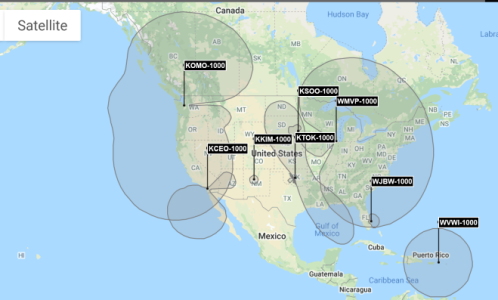
The "real" coverage of those stations can be seen by looking at WVWI in the USVI. It appears to cover even the eastern part of Haiti in this map. In fact, it only has a fair signal on the far eastern coastal areas of Puerto Rico. By the time you get to San Juan or Caguas or even Guayama, it's covered with what we call "tropical noise" and by no means listenable for pleasure.

At night, WVWI is totally covered by other stations on 1000 kHz in that part of the world.
 
Where I was, with the exception of my own AMs, there were no stations on the air after midnight or 1 AM for more than 500 miles around,
.....So, in other words, pre-dawn mornings in Ecuador were generally like a Monday pre-dawn morning used to be here in the U.S, :)

Seriously, David, great stuff, as usual. Thanks for sharing your experiences and knowledge.
 
.....So, in other words, pre-dawn mornings in Ecuador were generally like a Monday pre-dawn morning used to be here in the U.S, :)
Yes. Back in the mid to late 60's there were very few stations in my zone... northern South America and southern Central America... on the air overnight that every morning was a DX opportunity. Sub-Saharan Africa was quite usual, and Brazil, Argentina and Uruguay's early sign-ons were fun to hear. But in that 1 AM to 4 AM period, North America could be quite an opportunity, with conditions often enhancing the West Coast, or the Rockies or the Plains or the East.

With only 3 local stations on the air (570, 590 and 805) every other channel was wide open.
Seriously, David, great stuff, as usual. Thanks for sharing your experiences and knowledge.
Good memories.

And some of the DX experiences had a "remake" years later when as a consultant I'd be hired to work for some of those same stations. The best one was my first logged and verified Puerto Rican station, WITA. 500 watts on 1140. About 15 years later, I was named manager of that same station which became WQII, "11-Q".
 
Status
This thread has been closed due to inactivity. You can create a new thread to discuss this topic.


Back
Top Bottom