• Get involved.
    We want your input!
    Apply for Membership and join the conversations about everything related to broadcasting.

    After we receive your registration, a moderator will review it. After your registration is approved, you will be permitted to post.
    If you use a disposable or false email address, your registration will be rejected.

    After your membership is approved, please take a minute to tell us a little bit about yourself.
    https://www.radiodiscussions.com/forums/introduce-yourself.1088/

    Thanks in advance and have fun!
    RadioDiscussions Administrators

February 2023 Bay Area Radio PPM Ratings

Sports betting buys the airtime. The station makes money whether it gets ratings or not.

That money will eventually dry up if no one is listening to the programming and it fails to generate "leads" for whatever online sports book is sponsoring the air time.
 
That money will eventually dry up if no one is listening to the programming and it fails to generate "leads" for whatever online sports book is sponsoring the air time.

I imagine the model is not unlike "per inquiry" or "PI" advertising.

They pay the station an amount significantly less than their research tells them they ought to make from x number of KGO listeners who respond to their pitch.

If the station underperforms in delivering those downloads, wagers or whatever, the app, sports book (or whatever), protecting its projected profit margin, negotiates a lower rate for their next contract.

Unlike traditional PI advertising, the sports betting guys kinda have KGO over a barrel----the format depends on this disguised advertising. So, even on a lowball offer, KGO has to factor in what it would cost to find a replacement should they tell these guys to go f themselves.

Which means that unless the app, sports book or whatever is offering less than it would cost KGO to employ a board op, KGO's probably gonna take it.

And cynically, since the target is gamblers, the targets are probably gonna be made before it gets down to that.

 
You're kidding, right? 100.7 is a Class A, with a stick 15 miles north of S.F. It only covers a portion of the geographically-huge Bay Area. But it works fine as a signal-extender of 105.7 in San Jose.
I was gonna say, 105.7 covers a lot more of the Bay Area population than 100.7.

Aside from 105.7, most of the spanish-language stations have pretty bad signals.
 
Not for KBRG, your can hear that signal from the peninsula to the San Pablo bay. Transmitter is located in a perfect spot near Sveadal.
 
Not for KBRG, your can hear that signal from the peninsula to the San Pablo bay. Transmitter is located in a perfect spot near Sveadal.
Not to mention South to Salinas. I can even pick them up on a car radio here in Grass Valley. 14.5 kilowatts from 2580 feet above average terrain will do that for you. That's a good question... Who has the largest coverage area of any Bay Area FM station? I always figured it was KQED. But it might be KBRG.

Dave B.
 
Not to mention South to Salinas. I can even pick them up on a car radio here in Grass Valley. 14.5 kilowatts from 2580 feet above average terrain will do that for you. That's a good question... Who has the largest coverage area of any Bay Area FM station? I always figured it was KQED. But it might be KBRG.

Dave B.
Eyeballing the maps calculated on fccdata.org, they're very close. It looks like KBRG has a little more land coverage than KQED-FM, probably due to KQED's more central location and a site that's on the northern end of the Peninsula. That said, you have to account for terrain, too. At my Oakland location, KBRG is ravaged by multipath.
 
I was gonna say, 105.7 covers a lot more of the Bay Area population than 100.7.

Aside from 105.7, most of the spanish-language stations have pretty bad signals.
KSOL is on Mt. Sutro, and is no better or worse than any other station there - plus it has the repeater (KSQL) on 99.1 in Santa Cruz. It also has boosters in Sausalito and Pleasanton.
Every Bay Area station is going to have areas where coverage is deficient, due to our terrain. Then there is the Diablo Valley, "where FM signals go to die".
 
Eyeballing the maps calculated on fccdata.org, they're very close. It looks like KBRG has a little more land coverage than KQED-FM, probably due to KQED's more central location and a site that's on the northern end of the Peninsula. That said, you have to account for terrain, too. At my Oakland location, KBRG is ravaged by multipath.
Having been responsible for the format on this one for over a decade, I can tell you that there was nearly no listening as far north as Oakland or the north end of the Peninsula. It is strictly a South Bay station.
 
KSOL is on Mt. Sutro, and is no better or worse than any other station there - plus it has the repeater (KSQL) on 99.1 in Santa Cruz. It also has boosters in Sausalito and Pleasanton.
Every Bay Area station is going to have areas where coverage is deficient, due to our terrain. Then there is the Diablo Valley, "where FM signals go to die".
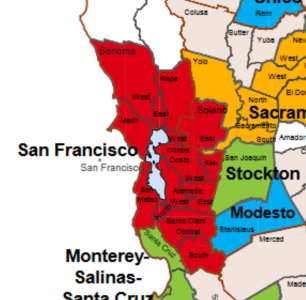
And remember, the radio market begins just north of Santa Clara Rosa and ends down around Gilroy.

1679698669826.png
 
Last edited:
Speaking of the latest ratings, I'm surprised that Adult Contemporary music does very well in San Francisco. Look at #1 and #2 on the ratings. Also, the HOT AC format KIOI (Star 101.3) and KLLC (Alice @ 97.3) nearly at the top. I think it has to be the demographics in the bay area of why Adult Contemporary music does very well.
 
Speaking of the latest ratings, I'm surprised that Adult Contemporary music does very well in San Francisco. Look at #1 and #2 on the ratings. Also, the HOT AC format KIOI (Star 101.3) and KLLC (Alice @ 97.3) nearly at the top. I think it has to be the demographics in the bay area of why Adult Contemporary music does very well.
Hot AC stations are very difficult to compare for demographics in my opinion. KIOI plays (almost objectively) CHR with On Air with Ryan Seacrest’s syndicated programming being CHR formatted. That plays in a time period that has a lot of people listening too.

And when you consider what a station like 98.1 plays for the larger adult contemporary genre, it’s basically an entirely different audience.
 
Status
This thread has been closed due to inactivity. You can create a new thread to discuss this topic.


Back
Top Bottom