
-
Get involved.
We want your input!
Apply for Membership and join the conversations about everything related to broadcasting.
After we receive your registration, a moderator will review it. After your registration is approved, you will be permitted to post.
If you use a disposable or false email address, your registration will be rejected.
After your membership is approved, please take a minute to tell us a little bit about yourself.
https://www.radiodiscussions.com/forums/introduce-yourself.1088/
Thanks in advance and have fun!
RadioDiscussions Administrators
You are using an out of date browser. It may not display this or other websites correctly.
You should upgrade or use an alternative browser.
You should upgrade or use an alternative browser.
Bustos Media buys KDRI "The Drive"
- Thread starter RadioBill
- Start date

Tucson is very consolidated. A stand-alone station is at a big disadvantage, and will get very little agency sales as well.Don't count in the format sticking around. If it was bringing in lots of cash it would not have sold.
Tucson, like Albuquerque and San Antonio, has a very traditional and historically large segment of the Hispanic population that is much later generation and which has not spoken Spanish for a good number of generations.Bustos says the current format will remain and no airstaff changes will be made, per RadioInsight. Of course, they could be talking right out of their butts, and flip it to La Gran D/La Z within weeks.

BUSTOS MEDIA ACQUIRES KDRI 830AM AND 101.7FM
Tucson, Arizona (March 29, 2023) – Bustos Media filed an application with the FCC for the acquisition of the assets of Tucson Radio, LLC. The DRIVE The number two rated station in the market. It offers a large catalogue of music “baby boomers” love and is presented by popular local personalities.
Bustos Media already owns The Voice (KVOI 1030 AM), The Groove (KGTV 106.3 FM), Urbana (KZLZ HD 92.5 FM) and La Poderosa (KZLZ 105.3 FM). Patty Ruiz, the General Manager for Bustos Media in Tucson, will be the GM of the combined stations effective April 1, 2023. KDRI will continue to operate from its downtown studio.
“No other radio station cluster in Tucson will match Bustos’ new range and diversity of listeners,” said Fletcher McCusker, president and founder. “The combined audience will be the most representative of the Tucson market,” McCusker added.
“I am happy to have driven this special format. The listener response has been nothing short of phenomenal. I am also happy to transfer The DRIVE to Bustos so it takes its proud place as the flagship of his radio group,” said Bobby Rich, the Drive’s programmer.
Bustos Media entered into a Management Agreement allowing Bustos to manage the station pending FCC approval.
Tucson, Arizona (March 29, 2023) – Bustos Media filed an application with the FCC for the acquisition of the assets of Tucson Radio, LLC. The DRIVE The number two rated station in the market. It offers a large catalogue of music “baby boomers” love and is presented by popular local personalities.
Bustos Media already owns The Voice (KVOI 1030 AM), The Groove (KGTV 106.3 FM), Urbana (KZLZ HD 92.5 FM) and La Poderosa (KZLZ 105.3 FM). Patty Ruiz, the General Manager for Bustos Media in Tucson, will be the GM of the combined stations effective April 1, 2023. KDRI will continue to operate from its downtown studio.
“No other radio station cluster in Tucson will match Bustos’ new range and diversity of listeners,” said Fletcher McCusker, president and founder. “The combined audience will be the most representative of the Tucson market,” McCusker added.
“I am happy to have driven this special format. The listener response has been nothing short of phenomenal. I am also happy to transfer The DRIVE to Bustos so it takes its proud place as the flagship of his radio group,” said Bobby Rich, the Drive’s programmer.
Bustos Media entered into a Management Agreement allowing Bustos to manage the station pending FCC approval.

In New Mexico in recent years, there's been something of a revival of interest in the Spanish language. Still, it isn't the primary language, not even in the rural areas of northern New Mexico (e.g. Tierra Amarilla) that were such a Hispanic stronghold. There is more of an appreciation of the language than there used to be. Fortunately, the music and the culture never really ever went away, nor did the cuisine!Tucson, like Albuquerque and San Antonio, has a very traditional and historically large segment of the Hispanic population that is much later generation and which has not spoken Spanish for a good number of generations.
Anecdote: I went to elementary school in Albuquerque in the 1960s. Conversational Spanish courses were optional for any student at the school, but they were conducted before regular classes started. My friend Lenny García and I decided we would rather just hang out instead. I later learned Spanish in Iowa and Missouri; Lenny's family moved to Texas for a while and he learned it there. Later, his mom complained to me that "he speaks Spanish with a Texas accent!" For my part, I now wish I had taken the classes; I eventually developed some proficiency with the language but it was harder than it would've been in elementary school.
When I was working in Ecuador, I had a friend from New Mexico whose last name was Olguin. Because that is an antiquated spelling of the contemporary Spanish surname "Holguin" I was a bit curious. While she was there with the Peace Corps, she did not speak Spanish, and that made me all the more curious. When I asked her, she told me that nobody in her family had spoken Spanish since the mid eighteen hundreds.In New Mexico in recent years, there's been something of a revival of interest in the Spanish language. Still, it isn't the primary language, not even in the rural areas of northern New Mexico (e.g. Tierra Amarilla) that were such a Hispanic stronghold. There is more of an appreciation of the language than there used to be. Fortunately, the music and the culture never really ever went away, nor did the cuisine!
Originally, her family was given a huge land grant early in the Spanish colonial days, but they stuck around after the territory became part of the United states and eventually became assimilated in all but the surname. It's a long and rich tradition and heritage.
From "The Place Names of New Mexico" (Robert Julyan, University of New Mexico Press, 1998):
"A Juan López Holguin came to NM with his wife, Catalina de Villanueva, with [Juan de] Oñate's troops in 1600, and other Olguins are mentioned as being in NM before 1680."
"A Juan López Holguin came to NM with his wife, Catalina de Villanueva, with [Juan de] Oñate's troops in 1600, and other Olguins are mentioned as being in NM before 1680."
Same family. Same era. They had a huge land grant, the size of several of today’s counties.From "The Place Names of New Mexico" (Robert Julyan, University of New Mexico Press, 1998):
"A Juan López Holguin came to NM with his wife, Catalina de Villanueva, with [Juan de] Oñate's troops in 1600, and other Olguins are mentioned as being in NM before 1680."
So does a Time Brokerage Agreement mean that Bustos purchased KDRI or did they purchase the right to manage them?
So does a Time Brokerage Agreement mean that Bustos purchased KDRI or did they purchase the right to manage them?
The Time Brokerage Agreement gives Bustos the right to manage KDRI until the FCC approves the transaction and the transaction is consummated. Those agreements are common and have been for at least 30 years. They allow the new operator to execute its plan immediately while preventing the seller from "poor-boying" the property and handing the buyer damaged goods.
Bill Buckmaster interviewed Amador Bustos, Fletcher McCusker and Bobby Rich today. The segment starts at 28:03 in this podcast:
Buckmaster Show 4/3/2023: Bustos Media buys a popular Tucson radio station
Buckmaster Show 4/3/2023: Bustos Media buys a popular Tucson radio station
Same family. Same era. They had a huge land grant, the size of several of today’s counties.
And look at where I had dinner tonight in Paso Robles - did not know this until I saw the menu!
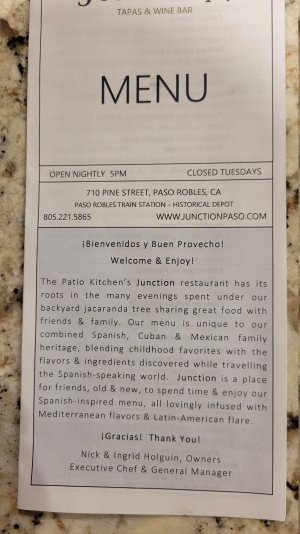
I wonder if there is any relationship... Holguin is a moderately common name throughout the Latin American and Spanish world. "Olguin" was one of its alternative spellings until the Royal Academy of the Spanish language introduced standardization in the 1700's.And look at where I had dinner tonight in Paso Robles - did not know this until I saw the menu!
The Royal Spanish Academy, or Real Academia Española, was founded in 1713, mainly with the purpose of standardizing the language. For example, it did future Spanish learners a big favor by standardizing the use of accents to denote syllabic stress that does not follow the pronunciation rules. (The History of the Spanish Language | Lingvist)
Initial standardization occurred in the 13th Century as Spain began its consolidation and unification.
I have friends and acquaintances named "Holguin" in Ecuador, Puerto Rico and the US, but none were related to the one "Olguin" I knew nearly 60 years ago in Quito.
I don't know, of course, but I can tell you that the reservation was in my husband's name, and he has a last name (Dutch) that most Americans butcher. Those who do get it right seem to be mostly Hispanic. I believe it was Ingrid who greeted us - and she got his last and first name right the first time!I wonder if there is any relationship... Holguin is a moderately common name throughout the Latin American and Spanish world. "Olguin" was one of its alternative spellings until the Royal Academy of the Spanish language introduced standardization in the 1700's.
I remember, in advanced college Spanish classes, being assigned readings from before the 16th century and having little difficulty understanding them, aside from the occasional shifts in vocabulary and obsolete pronouns. You couldn't do that in English!Initial standardization occurred in the 13th Century as Spain began its consolidation and unification.

I see slight tweaks in the format. Part of the deal is Fletcher (or, Bobby?) doing music consulting for a short period, so that could be interesting to follow.Bustos says the current format will remain and no airstaff changes will be made, per RadioInsight. Of course, they could be talking right out of their butts, and flip it to La Gran D/La Z within weeks.
Very true. I could read Quixote with little confusion, but even Shakespeare required constant look-ups or one of those editions that was filled with footnotes explaining word meanings.I remember, in advanced college Spanish classes, being assigned readings from before the 16th century and having little difficulty understanding them, aside from the occasional shifts in vocabulary and obsolete pronouns. You couldn't do that in English!
- Status
- This thread has been closed due to inactivity. You can create a new thread to discuss this topic.