
By Pew research 22% surveyed gave that as a reason, though they could be dissatisfied other ways.It depends on the station. You're looking at national numbers. But some stations manage to hold listeners regardless of trends.
I never see 'too much repetition' as a reason. If I did, I would show you streaming charts that show how people, when able to make their own playlists have more repetition than any radio station. But it's repetition of their personal favorites. People want to avoid commercials.
If people really want to avoid repetition, they can simply change the station. There are lots of stations in every city that play songs you've never heard before. But they may not be in a genre or language you prefer.

-
Get involved.
We want your input!
Apply for Membership and join the conversations about everything related to broadcasting.
After we receive your registration, a moderator will review it. After your registration is approved, you will be permitted to post.
If you use a disposable or false email address, your registration will be rejected.
After your membership is approved, please take a minute to tell us a little bit about yourself.
https://www.radiodiscussions.com/forums/introduce-yourself.1088/
Thanks in advance and have fun!
RadioDiscussions Administrators
You are using an out of date browser. It may not display this or other websites correctly.
You should upgrade or use an alternative browser.
You should upgrade or use an alternative browser.
FCC Considers Whether To Let Canadian Company Buy U.S. Radio Station.
- Thread starter davideduardo
- Start date
By Pew research 22% surveyed gave that as a reason, though they could be dissatisfied other ways.
What are the ages of people who say that? Maybe link the survey.
The only people I see who complain about repetition are over 50. Young people will listen to the same Harry Styles songs over and over.
What are the ages of people who say that? Maybe link the survey.
The only people I see who complain about repetition are over 50. Young people will listen to the same Harry Styles songs over and over.
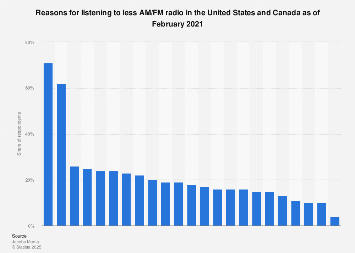
Reasons U.S. and Canadian consumers using less radio 2021| Statista
Survey findings from early 2021 showed that spending less time in a car was considered the main reason for listening to less AM/FM radio in the United States and Canada.
 www.statista.com
A number of Canadian alternative rock stations have embraced CanCon and used it to develop and support local and regional talent and give them a wider reach, and the performance of alt rock radio in Canada is often much better lately than their US counterparts.
Last I saw, Vancouver's CFOX wasn't in the basement like KNDD.
Last I saw, Vancouver's CFOX wasn't in the basement like KNDD.
Reasons U.S. and Canadian consumers using less radio 2021| Statista
Survey findings from early 2021 showed that spending less time in a car was considered the main reason for listening to less AM/FM radio in the United States and Canada.
Behind a paywall.
Oh. I subscribe as I like stats, but they were general users of radio 18-54 in both US and Canada.Behind a paywall.
Oh. I subscribe as I like stats, but they were general users of radio 18-54 in both US and Canada.
So it's possible that most of those who don't like repetition are over 50?
There's a reason why CHR stations play their biggest hits every 90 minutes: Because that's what young people want.
Could be. It was actually 25-54, so not the youngest of demos. It could be the older ones who answered that.So it's possible that most of those who don't like repetition are over 50?
Could be. It was actually 25-54, so not the youngest of demos. It could be the older ones who answered that.
Older people don't like repetition. So they shouldn't listen to CHR radio. They also don't like commercials.
A lot of classic hits are repetitive though. But could be a reason AAA does well among older listeners. Although it seems younger listeners are leaving radio faster.Older people don't like repetition. So they shouldn't listen to CHR radio. They also don't like commercials.
Last edited:
Although it seems younger listeners are leaving radio faster.
Not because of repetition. Perhaps they want genres radio doesn't play. Perhaps they want to make their own playlists.
In that case, probably. There is a lot of stuff on Tiktok which skews very young and does not make radio.Not because of repetition. Perhaps they want genres radio doesn't play. Perhaps they want to make their own playlists.
In that case, probably. There is a lot of stuff on Tiktok which skews very young and does not make radio.
BTW the whole appeal of Tik Tok is repetition. It's how users make money. Short videos played repeatedly.
I know, younger ones don't mind repetition but seek out different product sometimes. Although a lot of CHR comes from Tiktok, so unsure why they do not listen.BTW the whole appeal of Tik Tok is repetition. It's how users make money. Short videos played repeatedly.
Last edited:

Remember that for decades FM stations in Canada could not do "Top 40" formats as the Canadian regulations and regulatory rules prohibited the amount of repetition that such a format required. FMs, in other words, had to have a wide variety of music and could not repeat songs frequently, even if by Canadian artists.And that's a great point that some of us here have made many times when it comes to music and artist variety. When it comes to Can-Con, there is a government mandate to play a percentage of potential stiffs and call it variety. Anymore, that usually means the listener isn't going to another station up or down the dial, but away to streaming, which doesn't require playing of stiffs.
This is what happens when bureaucrats try to legislate personal tastes.
Over the air radio is not in decline due to repetition. It is in decline because streams and on-demand music don't have commercials and in many instances involve personal "station" or playlist creation or curation.But are people really satisfied with radio in the US? It seems to be on a slow decline and too much repetition is a reason, through a Google search. People in tge US find ways to avoid listening to things they don't want either.
The biggest failure of stations that don't examine listener tastes and preferences lies in the belief that "variety" means "more songs". "Variety" when measured means "only songs I like a lot and not songs I don't like or am tired of".
Over the air radio is not in decline due to repetition. It is in decline because streams and on-demand music don't have commercials and in many instances involve personal "station" or playlist creation or curation.
The other issue is a decreasing availability of devices that can receive broadcast radio. If you go to the Consumer Electronics show, you don't see exciting new radios being released. You see phones or internet devices. So radio stations have been making their signals available on those devices, such as smart speakers or phones, because of the decreased availability of portable radios.
That is sort of a dog-chasing-its-tail situation. The reason why there are no now or interesting radios is that there is no demand for stand-alone devices. Sort of the same reason why we no longer buy typewriters or "word processors" (remember that attempt to divert attention from computers?).The other issue is a decreasing availability of devices that can receive broadcast radio. If you go to the Consumer Electronics show, you don't see exciting new radios being released. You see phones or internet devices. So radio stations have been making their signals available on those devices, such as smart speakers or phones, because of the decreased availability of portable radios.
Even other individual, stand-alone items like cameras or calculators have become specialized items for high-end photography or accountants but not generally for the average person.
It could be a homogenization of radio too. Hot AC product and CHR sound interchangeable, Alternative has become more commercial, AC plays both CHR and Classic Hits mainly (the "soft rock" has gone away except Soft AC), while some continue, but the window is more narrow than before, probably for competitive purposes (with each other.)Over the air radio is not in decline due to repetition. It is in decline because streams and on-demand music don't have commercials and in many instances involve personal "station" or playlist creation or curation.
The biggest failure of stations that don't examine listener tastes and preferences lies in the belief that "variety" means "more songs". "Variety" when measured means "only songs I like a lot and not songs I don't like or am tired of".
- Status
- This thread has been closed due to inactivity. You can create a new thread to discuss this topic.