
The L.A. Times was explaining it to Californians 28 years ago. It's a pretty good explanation, too:Now you are going to have to explain to the non-Californians what that word means.
It's No Accident That SigAlert Is a Traffic Watchword

The L.A. Times was explaining it to Californians 28 years ago. It's a pretty good explanation, too:Now you are going to have to explain to the non-Californians what that word means.
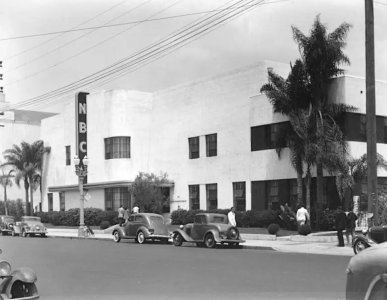
5515 has one heck of a history. It was NBC's West Coast studios before they built the new facility at Sunset and Vine.I mentioned that Ferlin Husky recorded his early hits (such as Dear John Letter) in the old Capitol studio on Melrose. I did a little digging, and saw that the studio had previously been the home of KHJ: 5515 Melrose. Capitol bought it in 1948, and recorded Frank Sinatra and Nat King Cole there until they built the Capitol tower in 1956. Nat's Unforgettable and Mona Lisa were recorded on Melrose, not the tower.
Turns out I also have an aircheck from Gary in 1976, so let's see what evolved in those three(ish) years.To illustrate the difference between KMPC as an MOR and KMPC as an AC, I've got two Gary Owens airchecks---one from 1970, the other from 1973.
Let's look at what records he played. These are both Saturday shows, so he's playing more records per hour than he would on a weekday show:
November 28, 1970:
4:30-5:00 pm
(News)
George Russell: In Laguna (guitar instrumental)
Bobby Sherman: Easy Come, Easy Go (early 1970---peaked at #8 at KHJ)
Claudine Longet: I'll Be There (cover of the Jackson 5 hit)
Chicago: Does Anybody Really Know What Time It Is ( the only current chart record in this half-hour, which Gary describes as having "a Four Freshmen-type of sound")
Ferlin Husky: Sweet Misery (a current, but only charted Country)
The Renaissance: There's Always Something There to Remind Me (a vocal group using baroque-styled arrangements and singing no words---just "ba-ba-da-ba-da")
5:00-5:30 pm
(News)
Five Flights Up: After The Feeling Is Gone (a current---but a stiff--peaked at #89 on the Hot 100)
Peter Nero: Summer Me, Winter Me (piano instrumental)
The Crystal Mansion: Carolina In My Mind (vocal group cover of James Taylor song)
Dionne Warwick: Alfie
The newscast at the top of the hour is longer, and there were some Sigalerts because of crashes in the rain, so the 5:00 half hour had fewer songs than the 4:30.
June 16, 1973:
4:00-4:30 pm
(News)
Stevie Wonder: You Are The Sunshine Of My Life (current)
Matthews' Southern Comfort: Woodstock (1971---peaked at #8 at KHJ)
The Big Bopper: Chantilly Lace (1958)
Freddie Hart: Easy Lovin' (1971---peaked at #19 at KHJ)
Henry Mancini: Theme from "Oklahoma Crude" (instrumental)
4:30-5:00 pm
(News)
Jan & Dean: Surf City (1963)
Tommy Edwards: It's All In The Game (1958)
Arlo Guthrie: Gypsy Davy (current)
Carpenters: Yesterday Once More (current)
Patrick Williams: Like Always (instrumental)
So, three pop chart currents in an hour compared to two three years earlier.
Five Goldens that had Top 40 play in the market (at KFWB, KRLA and KHJ) compared to two in 1970 (though Dionne Warwick's "Alfie" was a bigger record for KMPC when it was new than it was for KHJ, where it stalled at #17 and was only played for four weeks).
No more covers of pop hits.
Instrumentals moved from within the half hour to leading up to the newscast (both Mancini and Williams were pre-rolled to hit the top of the hour, and faded in when the commercials were over).
It looks pretty tame from 50 years out, but at the time, it was a significant shift---and sent many of KMPC's 50-plus listeners to Beautiful Music stations (which, with XTRA and KPOL, could be found on AM as well as the FM choices like KBIG, KOST, KWST and KLVE).
 projects.latimes.com
KHJ moved in after that, then moved out again (to 1313 Vine). Capitol moved in, moved out when the tower was built and KHJ came back, after being sold to RKO General, which owned the soundstage next door (to the west).
I remember seeing a random taxi driver in NYC interviewed on one of the major networks one night: he was essentially blasting WHN country from his cab. The reporter asked what he though of it, he said "It's American music, I love it !"Same with WHN in New York. They played Olivia Newton John, Linda Ronstadt, Kenny Rogers, and Charley Pride. The mix was younger than WNEW or WOR, but older than WABC. In fact WHN had been MOR in the 60s, competing directly against WNEW. They went country in the early 70s.
But does anyone know how long would WHN remain country ?
WHN, like WOR or KFI, etc are legacy call letters, it's sad that nobody in the NYC market is using WHNUntil 1987. They were owned by Mutual Broadcasting at the time. Mutual sold the station to Emmis who flipped the station to sports talk WFAN. The station already had play by play of The Mets. However, the day that happened, WYNY (owned by NBC) flipped from a mushy version of AC to country, and stayed with the format into the 90s.
KHJ was at 5515 Melrose until 1985, I believe. Then they moved in with KRTH at 5901 Venice.How long did KHJ stay in the Melrose building? RKO sold the production studios (facing Gower) to Desi Arnaz & Lucille Ball for DesiLu in 1957. Then Lucy sold it to Gulf & Western (owner of Paramount) in 1968.
WHN, like WOR or KFI, etc are legacy call letters, it's sad that nobody in the NYC market is using WHN
Funny that the WHN call letters were used in one of the Three Stooges comedies, when one of the boys turned on a radio. The Stooges shorts were generally filmed at Columbia ranch in Burbank.WHN was dropped for the first time when the station was sold to the Loews theater chain in the 50s. It then became WMGM, because Loews also owned MGM. Loews sold the station to Storer in 1962, and they got permission to return the WHN letters. It had been Top 40 under Loews, and flipped to MOR by Storer. I think Storer flipped it to country when WWDJ went from country to rock.
There had been a consistent country presence in NYC from WWDJ in 1961. to WHN in the 70s and 80s, to WYNY in the 90s. Then WYNY was sold to become WKTU. A few years later, a small group of rimshot stations revived the WYNY letters & country format for a few years. Then country went away until Cumulus revived it on WNSH in 2014. Now it's gone, likely for good.
I'm guessing they re-purposed the small TV production studio at 5515 (which I believe was the original NBC and Capitol studio) . When I was working from KCAL in '92, covering the riots, the old KHJ air and production studios were long gone---converted to office space.
 ❤️
❤️Same hereI used to listen to 610 WIP in Philadelphia (sister station to WNEW-AM) when Ken Garland was THE morning show. I remember being irritated they only played maybe 6 or 8 songs an hour, but between news reports, traffic updates, commercials (many read by Ken Garland) and general chatter, there wasn’t a lot of time for music
KFI in Los Angeles was one of these stations, really, until 1968. They attempted to leap from that straight to AC, with a Drake PD (Mark Denis from KGB) at the helm and Top 40 stalwart Ted Randal consulting.I think one thing to keep in mind is that even into the early '60s, many of the big full-service 50,000-watt stations that would have considered themselves "MOR" - WJR Detroit, WLW Cincinnati, WCCO Minneapolis, for example - were really programming hodgepodges. Talk, news, even farm programming got as much airtime as music if not more. Music could vary by time of day. If you listen to the WLW aircheck from 11/22/63, you'll notice the music played during the morning drive show fit the "traditional MOR" mold - mostly album cuts (the one country number played being an Anita Bryant cover), a few vintage big-band favorites, with only Frank Sinatra's "Pocketful of Miracles" and Henry Mancini's "Charade" being recognizable to me as singles that reached Billboard's Top 40. However, the station also played hymns (George Beverly Shea, renditions of spirituals by Tennessee Ernie Ford and Nat "King" Cole) during morning religious programming, and ARSA suggests Bob Braun had an after-school-hours Top 40 show on "The Nation's Station" as well at that time. While many of these stations were skittish at best about rock and roll, they didn't exactly have one unifying sound - they were almost throwbacks to pre-rock radio, having a little something for everyone.
J.P. McCarthy at WJR picked his own music, but it was likely little if anything that would stick out like a sore thumb from the rest of the station. The excellent Detroit radio tome "Rockin' Down the Dial" cites Frank Sinatra and the Four Freshmen as his two favorite artists, and there's a photo of him at the mike with an array of album covers on the wall behind him - Sinatra, Connie Francis, Jane Morgan, soundtracks to "Pal Joey" and "Pepe." He would later describe his approach to music as "the Top Ten Thousand" in an interview with one of the local papers, saying he played some of the same stuff as the Top 40 stations were playing but aimed for broader appeal.
At the same time, you had non-network stations like Detroit's WCAR that were a lot more strictly defined in terms of their music policy. WCAR under H.Y. Levinson's ownership for much of the '60s was strictly traditional MOR. I read a story about a DJ who got fired for playing a song by The Association, which was hardly "hard rock." These were the type of stations that might even stop playing a song by one of their core artists if it got picked up by the Top 40s as a hit single. WCAR would later relax that policy and move into a proto-AC format by 1970 (which evolved a year later into full Top 40).
1968-69 seemed to be when the shift to a more contemporary sound for MOR in general really started happening in earnest. Maybe it was because mellower music was gaining more popularity on Top 40 stations as FM prog-rockers became the preferred outlet for harder and acid rock, maybe it was because listeners wanted something soothing to ease the traumas of Vietnam, Kent State, assassinations and other assorted tragedies, maybe it was because MOR stations were more interested in reaching the young adult audiences who had grown up on Elvis instead of Vic Damone. Probably a combination of all three and other factors I haven't considered. I wasn't there at the time so I'll leave it to those who were to put in their two cents. But that seemed to be when the seed that became what we now call AC started to germinate.
KFI in Los Angeles was one of these stations, really, until 1968. They attempted to leap from that straight to AC, with a Drake PD (Mark Denis from KGB) at the helm and Top 40 stalwart Ted Randal consulting.
It scared off the old audience before it could attract the new. and in less than a year, KFI was back to playing it fairly safe musically---including giving Chuck Cecil's "The Swingin' Years" a daily time slot and hiring 1950s-era Today Show host Dave Garroway to do afternoons. There was also a period (1971-73) where they called themselves "Total Spectrum Radio) that included a midday celebrity chat show with Robert Q. Lewis and a country music show in the late evening.
They didn't fully modernize as an AC until 1974, and morphed from that to Top 40 in 1977.
That WLW aircheck is a treasure trove of what kind of radio our parents or grandparents listened to in the early 60s. It of course has what is probably the only full-length episode of Ruth Lyons' 50-50 Club in existence. Right after delayed NBC News, the afternoon music feature was set to be The Lil' Abner Suite but that was interrupted by breaking news obviously. I don't remember much about WLW's music in the 70s....mostly listened for Reds games. I remember hearing the extended version of "Rock Your Baby" by George McCrae in the late 70s. When Randy Michaels took over, the music that was played was thought of as Male A/C (the harder side of A/C leaning AOR, classic and current).I think one thing to keep in mind is that even into the early '60s, many of the big full-service 50,000-watt stations that would have considered themselves "MOR" - WJR Detroit, WLW Cincinnati, WCCO Minneapolis, for example - were really programming hodgepodges. Talk, news, even farm programming got as much airtime as music if not more. Music could vary by time of day. If you listen to the WLW aircheck from 11/22/63, you'll notice the music played during the morning drive show fit the "traditional MOR" mold - mostly album cuts (the one country number played being an Anita Bryant cover), a few vintage big-band favorites, with only Frank Sinatra's "Pocketful of Miracles" and Henry Mancini's "Charade" being recognizable to me as singles that reached Billboard's Top 40. However, the station also played hymns (George Beverly Shea, renditions of spirituals by Tennessee Ernie Ford and Nat "King" Cole) during morning religious programming, and ARSA suggests Bob Braun had an after-school-hours Top 40 show on "The Nation's Station" as well at that time. While many of these stations were skittish at best about rock and roll, they didn't exactly have one unifying sound - they were almost throwbacks to pre-rock radio, having a little something for everyone.
J.P. McCarthy at WJR picked his own music, but it was likely little if anything that would stick out like a sore thumb from the rest of the station. The excellent Detroit radio tome "Rockin' Down the Dial" cites Frank Sinatra and the Four Freshmen as his two favorite artists, and there's a photo of him at the mike with an array of album covers on the wall behind him - Sinatra, Connie Francis, Jane Morgan, soundtracks to "Pal Joey" and "Pepe." He would later describe his approach to music as "the Top Ten Thousand" in an interview with one of the local papers, saying he played some of the same stuff as the Top 40 stations were playing but aimed for broader appeal.
At the same time, you had non-network stations like Detroit's WCAR that were a lot more strictly defined in terms of their music policy. WCAR under H.Y. Levinson's ownership for much of the '60s was strictly traditional MOR. I read a story about a DJ who got fired for playing a song by The Association, which was hardly "hard rock." These were the type of stations that might even stop playing a song by one of their core artists if it got picked up by the Top 40s as a hit single. WCAR would later relax that policy and move into a proto-AC format by 1970 (which evolved a year later into full Top 40).
1968-69 seemed to be when the shift to a more contemporary sound for MOR in general really started happening in earnest. Maybe it was because mellower music was gaining more popularity on Top 40 stations as FM prog-rockers became the preferred outlet for harder and acid rock, maybe it was because listeners wanted something soothing to ease the traumas of Vietnam, Kent State, assassinations and other assorted tragedies, maybe it was because MOR stations were more interested in reaching the young adult audiences who had grown up on Elvis instead of Vic Damone. Probably a combination of all three and other factors I haven't considered. I wasn't there at the time so I'll leave it to those who were to put in their two cents. But that seemed to be when the seed that became what we now call AC started to germinate.
Somewhere I have a short aircheck of WLW (made by a friend who once worked in Ann Arbor radio and has since passed away) with a clip of its Top 100 of 1971 countdown. The music was pretty solidly Adult Contemporary, as opposed to traditional MOR, by then - one song I remember from the aircheck is Bobby Sherman's "The Drum."That WLW aircheck is a treasure trove of what kind of radio our parents or grandparents listened to in the early 60s. It of course has what is probably the only full-length episode of Ruth Lyons' 50-50 Club in existence. Right after delayed NBC News, the afternoon music feature was set to be The Lil' Abner Suite but that was interrupted by breaking news obviously. I don't remember much about WLW's music in the 70s....mostly listened for Reds games. I remember hearing the extended version of "Rock Your Baby" by George McCrae in the late 70s. When Randy Michaels took over, the music that was played was thought of as Male A/C (the harder side of A/C leaning AOR, classic and current).

Mike did not develop and copyright "Hot Hits" until more than a decade later. He just did high energy, jingle filled traditional Top 40 before that.Compare upstart top 40 WLYV, which was Mike Joseph's laboratory for Hot Hits;
