• Get involved.
    We want your input!
    Apply for Membership and join the conversations about everything related to broadcasting.

    After we receive your registration, a moderator will review it. After your registration is approved, you will be permitted to post.
    If you use a disposable or false email address, your registration will be rejected.

    After your membership is approved, please take a minute to tell us a little bit about yourself.
    https://www.radiodiscussions.com/forums/introduce-yourself.1088/

    Thanks in advance and have fun!
    RadioDiscussions Administrators

hitting song posts

Not usually. I'd have said that, too---but in what I've heard listening back, it was a no-talk jingle segue---previous record's fade hits 40% or so, the jingle plays, the next record with a cold open starts. If there's a tempo change, a fast to slow or slow to fast jingle aids the transition.
A lot of stations (at least the ones I managed or set up) in the 70's had separate processors on the mike to make sure that the levels were high enough to "squash" the stuff that was being talked over.

At one station I had no control over the audio at the engineer built his own boards. There was no level control on mikes or music sources. The idea was to set the mike hotter than music, but to avoid "pot whipping" which was all too common in that era... what Drake called, derisively, the "Bakersfield sound".

Sidebar: I had a jock at KTNQ in LA who was very fond of pot whipping, doing it five or six times just in one intro on occasion. One time, I sneaked into the studio from the newsroom door and, when he started pot whipping, I grabbed his arm and held it firmly. Besides almost having a heart attack, he never pot whipped again.
 
Yes ! I should have written:

"As you said, Michael, the Drake format forbade talking over the end of a record unless you were going into a commercial break."

My point was that I think this happened a lot, (talking over the end of records going into a commercial break) , and I got tired of it. So, I was glad to find FM album stations. JMO .

To me, the biggest advantage of the album stations was not talking over the intros.

Both album rock and top 40 talked going into commercial breaks---Top 40 began it over the last five or ten seconds of a fade is all. And again, if the record ended cold, the jock talked in the clear, just as the FM album jocks did.
 
The exception was records with cold endings, in which case the back-announce happened in the clear on the way to the break.
The best back announce after a cold end was done by jocks who could replicate the pace and rhythm of the song that was ending as they did the back sell. You had to be good, but if you could it sounded amazing.
 
A lot of stations (at least the ones I managed or set up) in the 70's had separate processors on the mike to make sure that the levels were high enough to "squash" the stuff that was being talked over.

At one station I had no control over the audio at the engineer built his own boards. There was no level control on mikes or music sources. The idea was to set the mike hotter than music, but to avoid "pot whipping" which was all too common in that era... what Drake called, derisively, the "Bakersfield sound".

Sidebar: I had a jock at KTNQ in LA who was very fond of pot whipping, doing it five or six times just in one intro on occasion. One time, I sneaked into the studio from the newsroom door and, when he started pot whipping, I grabbed his arm and held it firmly. Besides almost having a heart attack, he never pot whipped again.

Good. One of the most annoying things to hear on air was the guy dipping the music three or four times (down while talking, up while taking a breath) for every intro.

I was fortunate in that most of the stations I worked for had processing that actually allowed the jock to be heard clearly over most intros without having to adjust source audio.
 
A lot of stations (at least the ones I managed or set up) in the 70's had separate processors on the mike to make sure that the levels were high enough to "squash" the stuff that was being talked over.

At one station I had no control over the audio at the engineer built his own boards. There was no level control on mikes or music sources. The idea was to set the mike hotter than music, but to avoid "pot whipping" which was all too common in that era... what Drake called, derisively, the "Bakersfield sound".

Sidebar: I had a jock at KTNQ in LA who was very fond of pot whipping, doing it five or six times just in one intro on occasion. One time, I sneaked into the studio from the newsroom door and, when he started pot whipping, I grabbed his arm and held it firmly. Besides almost having a heart attack, he never pot whipped again.

I had a sales guy at a station i worked at in the mountain west come in and mess with my console a time or two when i was doing an interview by phone.. hed come in and adjust it.. hopw in the world he thought he had the right to, i have no idea.. he did eventualyl get spoken to by the boss
 
Here's a good scoped sample of Mark Elliott on KHJ from December of 1970:


Cold ending on "Merry Christmas Darling"---to a jingle, then Mark talks over the intro of the next record, but not to the vocal. That record ("I'm Not My Brother's Keeper") has a fade ending, but Mark only talks over the final three seconds on his way to the break.

Out of the break, a Sam Cooke golden that Mark almost hits the vocal with, and coming out of it, again only uses the last four seconds of the fade for his back-announce.

In fact, throughout the 'check, Mark's using very little of the fades, and he's not obsessive about going all the way to the vocals or even necessarily hitting a post pre-vocal. After literally hundreds of hours of recent (past four years) listening, I can say without citing memory that this was typical of KHJ.

Again, stuff gets more frenetic from '73 onward, and it'll be interesting to see what actually aired compared to what I recall.
 
Here's a good scoped sample of Mark Elliott on KHJ from December of 1970:


Cold ending on "Merry Christmas Darling"---to a jingle, then Mark talks over the intro of the next record, but not to the vocal. That record ("I'm Not My Brother's Keeper") has a fade ending, but Mark only talks over the final three seconds on his way to the break.

Out of the break, a Sam Cooke golden that Mark almost hits the vocal with, and coming out of it, again only uses the last four seconds of the fade for his back-announce.

In fact, throughout the 'check, Mark's using very little of the fades, and he's not obsessive about going all the way to the vocals or even necessarily hitting a post pre-vocal. After literally hundreds of hours of recent (past four years) listening, I can say without citing me47mory that this was typical of KHJ.
Mark Elliott always did a good job. He wasn't as hyper as some of the others.

At 4:47 on this sound check, over the ending of "Stoned Love", someone plays the station I.D. jingle. The jingle plays at the same time that the song is ending. The station I.D. steps on the end of the song. This is an example of what I'm remembering.

Maybe that's not the DJ's fault, though. Maybe the engineer was supposed to fade the ending of the record early, then play the station I.D.
Was this before carts? Were the station jingles on magnetic tape that could not be cued precisely?

Does the engineer play the jingles for the station break, the weather, etc.? Or is that the job of the DJ? Thank you.
 
At 4:47 on this sound check, over the ending of "Stoned Love", someone plays the station I.D. jingle. The jingle plays at the same time that the song is ending. The station I.D. steps on the end of the song. This is an example of what I'm remembering.
I think what you're hearing here is how closely the aircheck was edited to the jingle, giving the impression that it's too quick. The song is actually so far into its fade that it's gone completely by the end of the two-second "More Music-KHJ" jingle.

Maybe that's not the DJ's fault, though. Maybe the engineer was supposed to fade the ending of the record early, then play the station I.D.

The reason board work sounded good most often (and it was certainly the case at Drake stations) was consistency. No matter the jock, no matter the engineer, certain things were done the same. One of them was the natural fade.

The record begins its fade. At the first logical point after the VU meter hits 40% (end of a phrase in the fading chorus, beat, whatever) the jock is cued or the next element (jingle) played (you'll find this in Julian Breen's 1971 programming memo from KYA, posted in another thread, as well---it was fairly standard practice for a smooth sound).

Almost always, by the time a fade gets down to 40%, there's five seconds or less of audio left. As we heard elsewhere on that same aircheck, it can be only two or three.

Most of the time, the engineer has not touched the fader. It's where it's been for the entire song. It comes down after the last sound, unless there's static, scratching or some other distraction.


Was this before carts? Were the station jingles on magnetic tape that could not be cued precisely?

No. Carts came along in 1962 and most Los Angeles stations, including KHJ, jumped at them.

In fact, KHJ was among the first stations, in the late 50s, to use the cart's forerunner, the MacKenzie Repeater:


Does the engineer play the jingles for the station break, the weather, etc.? Or is that the job of the DJ? Thank you.

Up until 1977, the engineer handled everything but the jock's mic switch at KHJ. After 1977, jocks ran their own consoles. By that point, the music was on cartridge too.
 
Here's a good scoped sample of Mark Elliott on KHJ from December of 1970:
Off topic, but as someone who more or less grew up hearing Mark Elliott as the happy, bubbly voice on Disney movie promos, it's interesting for me to hear him here...Where his tone and cadence are completely different. In fact, if you hadn't pointed out that this was Mark, I may not have recognized him.

Again, apologies for going off topic, but there's a great story that Mark told during an interview, about a time they had a few voice actors speaking to a group of college students - and they happened to be of the age where they heard his movie promos for Aladdin, Lion King and similar. Each voice actor introduced themselves, and from what I recall, Mark basically just went into his spiel from one of the Disney promos he'd voiced. Eyes widened and jaws dropped as the students realized who they were listening to and getting to see in person, and the place erupted in applause. Mark seemed flattered - especially since announcers, VO guys and gals and voice actors aren't often seen or recognized for their work.
 
Off topic, but as someone who more or less grew up hearing Mark Elliott as the happy, bubbly voice on Disney movie promos, it's interesting for me to hear him here...Where his tone and cadence are completely different. In fact, if you hadn't pointed out that this was Mark, I may not have recognized him.

Again, apologies for going off topic, but there's a great story that Mark told during an interview, about a time they had a few voice actors speaking to a group of college students - and they happened to be of the age where they heard his movie promos for Aladdin, Lion King and similar. Each voice actor introduced themselves, and from what I recall, Mark basically just went into his spiel from one of the Disney promos he'd voiced. Eyes widened and jaws dropped as the students realized who they were listening to and getting to see in person, and the place erupted in applause. Mark seemed flattered - especially since announcers, VO guys and gals and voice actors aren't often seen or recognized for their work.

Both Mark Elliott (KHJ 1970-73 and 75-77) and Dr. John Leader (KHJ 1975-77) moved into careers in VO. And both adapted their styles from their jock work.

Here's John on KHJ in 1976:


And here, John is using more of the fade---five or six seconds on most of these records.

Three factors at work:
  • The records were fading more slowly from 40% to zero as produced at the time compared to six years before.
  • Mic processing was separate, as David told us earlier, allowing the mic to "squish" the record under it, so you could go a hair earlier.
  • The style in vogue at the time was to have as little talk in the clear (nothing underneath it) as possible---so by this point, you're aiming for the tail of the record to hit the beginning of the commercial, with the jock over it (and sometimes, with jocks like Bobby Ocean, talking up the intro of the commercial).

John was for many years the in-house voice for Paramount Pictures films and home video---and back in the day when Blockbuster ran previews on monitors in the store, it was John's voice that ran between.

Apologies to those who have seen it before, but both Mark and John are featured in this 90s-era video produced to be shown at the Hollywood Reporter Key Art Awards, using the VO deliveries that made them famous (and rich):

 
Last edited:
Both Mark Elliott (KHJ 1970-73 and 75-77) and Dr. John Leader (KHJ 1975-77) moved into careers in VO. And both adapted their styles from their jock work.
Here's John on KHJ in 1976:
John was for many years the in-house voice for Paramount Pictures films and home video---and back in the day when Blockbuster ran previews on monitors in the store, it was John's voice that ran between.
Apologies to those who have seen it before, but both Mark and John are featured in this 90s-era video produced to be shown at the Hollywood Reporter Key Art Awards:

Interesting - and yeah, I'd seen the 5 guys in a Limo bit before. Great stuff. Curious if you have any airchecks from Charlie O'Donnell (sp?) Before his time on Wheel of Fortune?
 
Sidebar: I had a jock at KTNQ in LA who was very fond of pot whipping, doing it five or six times just in one intro on occasion. One time, I sneaked into the studio from the newsroom door and, when he started pot whipping, I grabbed his arm and held it firmly. Besides almost having a heart attack, he never pot whipped again.
A new guy starting at the station I worked for used to pot whip so bad, that the pot would bounce off the lower stop up to about 25%. A couple of times it bit him when playing a caller from tape. He'd attempt to cut the audio at a precise point, like the song intro to vocal, but the call audio would continue because he'd bounce the pot off the lower stop. Because all the airshifts would just tape over prior calls, you never knew what conversation might be under what you had recorded.
 
This is really turning into an interesting thread. These days, the automation is going to handle most of the fading, so the jock or engineer doesn't have to do anything. I've never played with the voice tracking systems in any other system, but in Zara, the system will start the associated track at the same time as the song it is associated with. I honestly don't think Zara's crossfading system works all that well, but lots of others work better.
I've never heard the term pot whipping before, but that reminds me of what Audacity does by default when you use the auto duck effect. I've changed my setting to not do that as I found it really strange to listen to, never knew that was a thing that actually happened on stations.
 
This is really turning into an interesting thread. These days, the automation is going to handle most of the fading, so the jock or engineer doesn't have to do anything.

Exactly. These are conversations about techniques that were used 40, 50 and more years ago---and are rarely a part of what's done today.

I don't know a single music station where there's a jock with an engineer.
 
Up until 1977, the engineer handled everything but the jock's mic switch at KHJ. After 1977, jocks ran their own consoles. By that point, the music was on cartridge too.
And even in the 60's and 70's, nearly all stations did not have a board op. Board ops were only "required" because of union contracts. By the time we had cart machines...

(first ones in 1958: https://www.worldradiohistory.com/A...acturers/SBE-1959-History-of-Cart-Machine.pdf)

... it was so easy for the jock to run the whole station alone that requiring a board op was totally un-needed and superfluous.

For both Daryl Lynn's and Bobdecav's benefit, I might mention that I never worked at or managed or consulted a station that had board ops in addition to DJs or announcers unless there was a union involved. That includes a top rated Cleveland station starting in 1959 (WJMO), about a dozen stations in Puerto Rico, 11 or so in Ecuador, two in Birmingham, about 8 stations in Miami, four elsewhere in FL from Lake City to Tallahassee, one in Traverse City and about 60 with Heftel/HBC/Univision.

Only union Grupo Radio Centro in Mexico and WADO in New York required board ops, but because of the union. Technically, there was no reason to have them other than the union rules.
 
And even in the 60's and 70's, nearly all stations did not have a board op. Board ops were only "required" because of union contracts. By the time we had cart machines...

(first ones in 1958: https://www.worldradiohistory.com/A...acturers/SBE-1959-History-of-Cart-Machine.pdf)

... it was so easy for the jock to run the whole station alone that requiring a board op was totally un-needed and superfluous.

For both Daryl Lynn's and Bobdecav's benefit, I might mention that I never worked at or managed or consulted a station that had board ops in addition to DJs or announcers unless there was a union involved.
Thanks, David !
That union was AFTRA, correct?
I learned about them early in my radio hobby, because they called a strike at KFWB in 1961.

 
I've never heard the term pot whipping before, but that reminds me of what Audacity does by default when you use the auto duck effect. I've changed my setting to not do that as I found it really strange to listen to, never knew that was a thing that actually happened on stations.
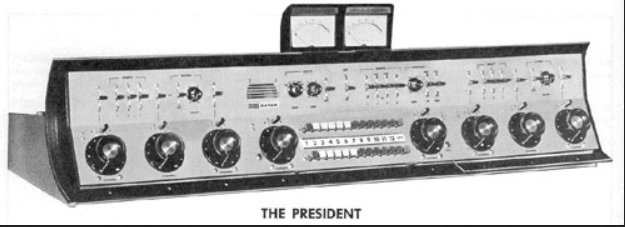
The term was from the days when audio consoles had large knobs for each channel that had a total rotation of 3/4 to one full turn. In my example, the console was a Gates President. The whipping part was when a jock or board op used to take their hand and spin the pot down counterclockwise in a rapid motion to cut the audio off quickly.
Credit oldradio.com
Gates President Console.jpg
 
That union was AFTRA, correct?
There were a variety of unions that represented radio staff in that era of the 50's through the 70's. At one AM/FM I had a newspaper guild, inherited from former ownership of the stations by a daily paper. At another I had an engineering union which had managed to cover radio stations that were part of an AM-FM-TV combo.

In many cases, the union rules came from the tech side. I have some engineering "policy" books for WOR in New York from the post WW II years where it appears that they had about 60 engineers on staff between Manhattan and the transmitter in New Jersey.

It was not uncommon for an operation to have more than one union back then. During the 1960's NYC newspaper strike, one of the big issues was members of one union wishing to respect the strike of another union and refusing to cross picket lines when a company owned print and electronic media.
 
Status
This thread has been closed due to inactivity. You can create a new thread to discuss this topic.


Back
Top Bottom