• Get involved.
    We want your input!
    Apply for Membership and join the conversations about everything related to broadcasting.

    After we receive your registration, a moderator will review it. After your registration is approved, you will be permitted to post.
    If you use a disposable or false email address, your registration will be rejected.

    After your membership is approved, please take a minute to tell us a little bit about yourself.
    https://www.radiodiscussions.com/forums/introduce-yourself.1088/

    Thanks in advance and have fun!
    RadioDiscussions Administrators

LPFM & Tranlslators

Like in the Sacramento Area there like 2 Translators 1 in West Sacramento & the other in Yuba City on 98.1

On 96.5 1 LPFM in the City & 1 in Yuba City & the other in Jackson

My question is, How many miles apart can a LPFM & Translator can be?
 
There is a FCC 'distance separation' portion of the rules that details that. You might be able to search the two words at the FCC website to get the number. Remember, the FCC never allows stations that do not meet that separation or cause interference. With that said, LPFM and Translator stations are secondary facilities and have to accept interference from full power stations (meaning the full power can force you to another frequency or off the air entirely). An LPFM has a 60 dbu of about 3.6 miles from the tower. Depending on the mounting of the bays, a signal can be roughly directional. A translator's 60 dbu is affected by Height Above Average Terrain and the 250 watt maximum. All LPFMs are 100 watts at 100 feet above average terrain or any variation depending on height, so the 60 dbu is consistent. You might be able to hear a LPFM or translator well beyond that if certain conditions apply such as an quiet frequency without nearby neighbors on the dial and generally level terrain.
 
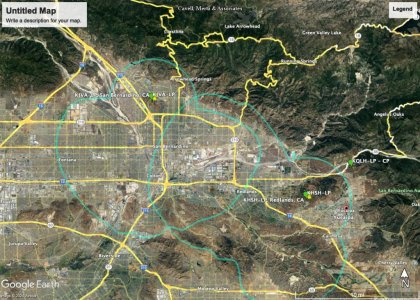
Co-channel LPFMs must be 24 km apart. These two are 23.75 km apart, which rounds to 24 and therefore passes FCC muster.
Ahh... thats.... gotta be..... messy in the middle.
 
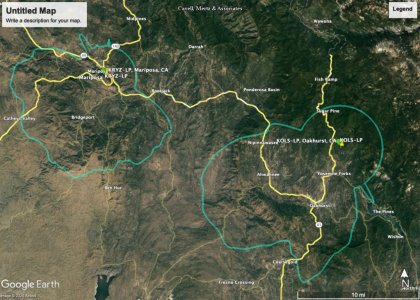
Take a look at coverage of KOLS and KRYZ both on 98.5, in Oakhusrt and Mariposa respectively. These are both in the Sierras where mountaintop sites are aplenty, but also means there are 'valleys' between. I am not familiar with these LPFM antenna sites. I question the mileage separation, and why do they both have to be on the same channel. Reception is going to depend on which side of the hill you are on. Id like to see an overlay of both signals. I don't have a program that will do that for me. Maybe SomeRadioGuy could post such a pic.
 
Take a look at coverage of KOLS and KRYZ both on 98.5, in Oakhusrt and Mariposa respectively. These are both in the Sierras where mountaintop sites are aplenty, but also means there are 'valleys' between. I am not familiar with these LPFM antenna sites. I question the mileage separation, and why do they both have to be on the same channel. Reception is going to depend on which side of the hill you are on. Id like to see an overlay of both signals. I don't have a program that will do that for me. Maybe SomeRadioGuy could post such a pic.

i cant create those either but i did find this, kinda cool.. it shows the operating health of the FM Transmitter for KRYZ:

 
Your question has two different answers based on which perspective you are looking from:

If the modification application is filed by the LPFM, distance separation rules apply. As an initial matter, all FM translators are divided into three different "sub-classes". The "sub-class" is based on the 60 dBu service contour calculation based on the translator's peak ERP and traditional HAAT (based on 8 radials). The FCC does not publish the "sub-class" for each translator, but REC does in our systems. Once the sub-class is determined, LPFM stations must meet the minimum distance separation on co-channel, first-adjacent and second-adjacent (second-adjacent waivers are available) based on the chart shown in §73.807(c)(1). For example, if the translator has a service contour that exceeds 13.3 km, then there must be 39 km of separation for any LPFM proposal. All translators are assumed as nondirectional facilities.

Now.. If the modification application is filed by the translator, contour overlap rules apply. The 60 dBu contour of the LPFM is protected. A translator cannot be proposed if the translator 40 dBu interfering contour overlaps the LPFM service contour on co-channel. Likewise with 54 dBu on first-adjacent channels. FM translators are not required to protect LPFM stations on second-adjacent channels. See §74.1204(a). The translator interfering contour is based on its actual proposed facility and can include the directionality of the translator proposal. With very few exceptions, all LPFM stations are considered as nondirectional facilities. In addition, LPFMs are also provided with additional protection from predicted and actual interference from subsequently authorized translators, pursuant to §§ 74.1203 and 74.1204(f). Because a translator's directional antenna can be considered, there may be some cases where the translator is very close to the LPFM station.

 
Status
This thread has been closed due to inactivity. You can create a new thread to discuss this topic.


Back
Top Bottom