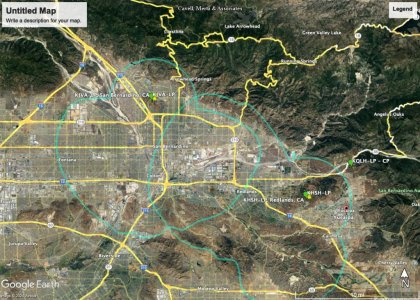
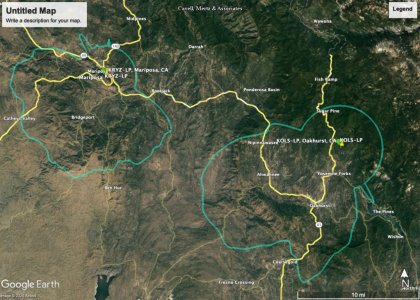
Your question has two different answers based on which perspective you are looking from:
If the modification application is filed by
the LPFM, distance separation rules apply. As an initial matter, all FM translators are divided into three different "sub-classes". The "sub-class" is based on the 60 dBu service contour calculation based on the translator's peak ERP and traditional HAAT (based on 8 radials). The FCC does not publish the "sub-class" for each translator, but REC does in our systems. Once the sub-class is determined, LPFM stations must meet the minimum distance separation on co-channel, first-adjacent and second-adjacent (second-adjacent waivers are available) based on the chart shown in
§73.807(c)(1). For example, if the translator has a service contour that exceeds 13.3 km, then there must be 39 km of separation for any LPFM proposal. All translators are assumed as nondirectional facilities.
Now.. If the modification application is filed by
the translator, contour overlap rules apply. The 60 dBu contour of the LPFM is protected. A translator cannot be proposed if the translator 40 dBu interfering contour overlaps the LPFM service contour on co-channel. Likewise with 54 dBu on first-adjacent channels. FM translators are not required to protect LPFM stations on second-adjacent channels. See
§74.1204(a). The translator interfering contour is based on its actual proposed facility and can include the directionality of the translator proposal. With very few exceptions, all LPFM stations are considered as nondirectional facilities. In addition, LPFMs are also provided with additional protection from predicted and actual interference from subsequently authorized translators, pursuant to §§
74.1203 and
74.1204(f). Because a translator's directional antenna can be considered, there may be some cases where the translator is very close to the LPFM station.