• Get involved.
    We want your input!
    Apply for Membership and join the conversations about everything related to broadcasting.

    After we receive your registration, a moderator will review it. After your registration is approved, you will be permitted to post.
    If you use a disposable or false email address, your registration will be rejected.

    After your membership is approved, please take a minute to tell us a little bit about yourself.
    https://www.radiodiscussions.com/forums/introduce-yourself.1088/

    Thanks in advance and have fun!
    RadioDiscussions Administrators

TV Guide editions and online resources

Unless they already do it that way, I have to think that it would be more practical just to get the SLC stations via satellite links at each translator site, and rebroadcast a pristine signal.
Most "linkage" of that kind can be done with the web or web-related services. Just like the way you get NetFlix or Amazon Prime or the like.
 
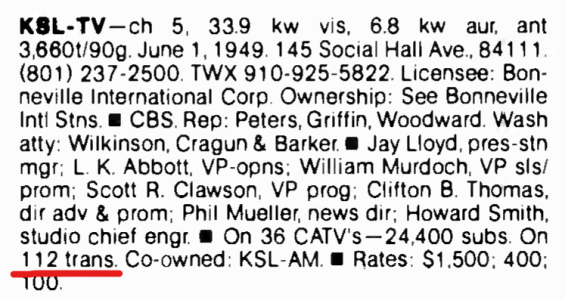
Broadcasting Yearbook 1980 listed KSL-TV with 112 translators!! 🤯

View attachment 7075
At the end of the day, Utah is a large state, and a dense translator network was the only way to transmit SLC stations throughout the state. Moreover, unless it would be St George, there aren't any other places outside of the SLC corridor that could support full-service TV stations. The state is also bound together culturally by the LDS and affiliated organizations (such as Brigham Young University), and I have to imagine that Utahns would much rather watch SLC stations, than those from out of state (to the extent they could even be received). The SLC translator network covers pretty much every nook and cranny of Utah.
 
At the end of the day, Utah is a large state, and a dense translator network was the only way to transmit SLC stations throughout the state.
And keep in mind that SLC is nearer to counties in Idaho, Wyoming, Colorado and Nevada than to St. George. TV markets are not defined by states, but by the counties where most viewing is attributable to stations from a somewhat nearby large market.
Moreover, unless it would be St George, there aren't any other places outside of the SLC corridor that could support full-service TV stations. The state is also bound together culturally by the LDS and affiliated organizations (such as Brigham Young University), and I have to imagine that Utahns would much rather watch SLC stations, than those from out of state (to the extent they could even be received). The SLC translator network covers pretty much every nook and cranny of Utah.
In fact, the SLC TV survey area includes counties outside the state! Many of those markets were first defined in the 50's when there were few or no TV stations in smaller cities, and Community Antenna Television antenna systems were set up to pick up and "cableize" the best signals they could get. Those definitions have survived the later profusion of TV stations in many cases.
 
Broadcasting Yearbook 1980 listed KSL-TV with 112 translators!! 🤯

View attachment 7075
Broadcasting Yearbooks going back to the beginning of time:

 
Broadcasting Yearbooks going back to the beginning of time:

And what about the Nielsen Pocketpieces. They used to be on the Ratings Ryan website. What happened to those?
 
At the end of the day, Utah is a large state, and a dense translator network was the only way to transmit SLC stations throughout the state. Moreover, unless it would be St George, there aren't any other places outside of the SLC corridor that could support full-service TV stations. The state is also bound together culturally by the LDS and affiliated organizations (such as Brigham Young University), and I have to imagine that Utahns would much rather watch SLC stations, than those from out of state (to the extent they could even be received). The SLC translator network covers pretty much every nook and cranny of Utah.

St. George wasn't that big until the last 20-30 years from what I've read
 
And keep in mind that SLC is nearer to counties in Idaho, Wyoming, Colorado and Nevada than to St. George. TV markets are not defined by states, but by the counties where most viewing is attributable to stations from a somewhat nearby large market.

In fact, the SLC TV survey area includes counties outside the state! Many of those markets were first defined in the 50's when there were few or no TV stations in smaller cities, and Community Antenna Television antenna systems were set up to pick up and "cableize" the best signals they could get. Those definitions have survived the later profusion of TV stations in many cases.
I am aware of that. I was just referring to Utahns. I know that SLC stations got into several states in the Intermountain West (even as far as North Dakota at one point via microwave), and I'd be curious to know whether the SLC translator network extended to translators outside of Utah.
 
St. George wasn't that big until the last 20-30 years from what I've read
True, it's grown exponentially in the past two or three decades, but they had free-standing stations in St George and Cedar City (both VHF assignments in analog days), and IIRC KUSG-12 (now KMYT) did have some local origination while being a satellite of KUTV (which it still is, on 2.1, in addition to being the SLC market's MyNetwork TV affiliate on 12.1). Along with Cedar City's KSCG (ex-channel 4, now channel 8) being the SLC market affiliate for MeTV, the SLC market has effectively swallowed up what, in another scenario, could have been a second small market serving southern Utah.
 
Just out of curiosity, before satellite made it feasible to have a separate Mountain Time Zone feed for the networks, how much consistency was there from market to market in network offerings? Stations in larger markets, with the resources to do so, could either run the East Coast feed two hours behind, or tape the evening's schedule and run it either an hour (to be in sync with Central Time Zone patterns) or two hours ahead, to emulate the East Coast schedule. Were smaller markets, that might not have had the budget or personnel to do that, pretty much "on their own"? Prime time from 5 to 9 pm would be kind of awkward, but I suppose if that's all local viewers knew, they'd get used to it.
In New Mexico, it depended on the market. I've been told that the ABC affiliates actually got their programming through Phoenix, and I have a childhood memory of slides on Albuquerque's KOAT indicating that its feed came through Tucson. (KOAT was also the only Albuquerque station that had a backup site that was on the West Mesa.) The NBC and CBS affiliates tape-delayed in the evenings but not for daytime programming. For example, KOB only carried the Today show from 7 to 8 am. Sometime around 1980, NBC set up a delay center in Denver at then-KOA-TV.

The situation in southeastern New Mexico was more complex. Roswell's channel 8 at first was a local NBC station which did not appear to have tape delay capability Later it was a repeater for a station in western Texas, in a different time zone. This was the case until Hubbard bought it and made it a repeater for KOB. Channel 10, also in Roswell, was local until Albuquerque's KGGM (or KRQE) bought it. Carlsbad's KAVE-TV, channel 6, started out as a CBS affiliate that got all its programming on film. Then it was able to get a microwave link to El Paso and pretty much followed the El Paso pattern, which was similar to Albuquerque. Ultimately, it became an ABC station repeating El Paso's KELP-TV. Then KOAT bought it, redubbing it KOCT, and eventually turned in the license in favor of translators. There went those wonderful call letters of KAVE, too.

When KIVA-TV (now KOBF) in Farmington, NM came on the air in the early 1970s, its TV Guide listings indicated that it tape-delayed almost everything from the NBC network, even more than what KOB did.

Albuquerque was also one of the last markets of any substantial size to get live network service: September 25, 1954, just in time for the World Series. KOB's first "live" network program was Saturday morning's "Canadian Pro Football", sponsored by Montgomery Ward! For KGGM, it was the Jackie Gleason show at 5 pm local time. The network relay came through Amarillo, 302 miles away.

 
For example, KOB only carried the Today show from 7 to 8 am. Sometime around 1980, NBC set up a delay center in Denver at then-KOA-TV.
In the Mountain Time Zone in the 1960s and 70s, "Today" was only an hour. I'm not sure why.

Maybe it would throw off the other scheduled programs if NBC gave Today two hours? There was only so much capacity on the network feed lines? Or stations would have to run it from 6 to 8 a.m. and they didn't want to sign on that early?

I believe in the Central Time Zone, stations would run the second hour of Today live at 7 a.m. Then they'd air the first hour via tape delay at 8 a.m.?
 
In the Mountain Time Zone in the 1960s and 70s, "Today" was only an hour. I'm not sure why.

Probably because the affiliates didn't want to go on the air at 6 am, and didn't want to tape-delay the show. Videotape used to be expensive to run. So the daytime schedule was carried live from the East Coast, with local tape-delay reserved for prime time and possibly the Tonight Show. This also meant that stations had gobs of local time to program starting at 2:30 pm Mountain.

I believe in the Central Time Zone, stations would run the second hour of Today live at 7 a.m. Then they'd air the first hour via tape delay at 8 a.m.?
NBC tape-delayed the original first hour, so all the Central affiliates had to do for the 8-9 am hour (Central) was ride the line. I presume Eastern time-zone affiliates had 9-10 am their time to program as they wished. Then the daytime schedule would wrap up at 4:30 pm Eastern. Thus Central and Eastern affiliates would have the same amount of non-network time in the daytime schedule, just differently distributed.

Of course, affiliates still had an opt-out available from :25 to :30, usually for a local news cut-in if they so desired.

ABC in the 1960s was somewhat different: not much of a morning schedule, but American Bandstand and, for a couple of years, Where The Action Is in the afternoon when NBC and CBS affiliates had the time to themselves.

(edited to clarify NBC tape-delay)
 
Last edited:
Salt Lake TV was carried in Pocatello ID on cable for years. It was in the clear and preemption-free until SyndEx. I believe they got out to Twin Falls too, both with large Mormon populations.
The Salt Lake translator network would be the equivalent here of the reach of Spokane TV stations. Analog translators went out as far as Winton and Lake Wenatchee, just within miles of Stevens Pass. To the east, the TV Improvement District had a KREM-2 translator in Polson MT. NE Oregon also got translators from Spokane, specifically around Elgin and Enterprise.
Spokane TV has been the default for just about everybody in eastern WA outside of Yakima and Tri-Cities for many, many years. Wenatchee is an exception given that Seattle stations have been microwaved out there for decades and often get more viewership. Even KONG, KZJO, and KWPX are carried, just like any ordinary westside cable system.
 
The Mountain Zone was a crazy (and fun) time zone for TV wasn't it?
By the 70s the airing of morning shows was all over the place. My 1974 Utah edition has "Today" starting at 6am in Casper, 7am in Salt Lake/Boise/Pocatello, 730am in western Wyoming, and 8am in Twin Falls! My 1978 Colorado edition has most stations doing "Today" at 7am, but Rapid City at 6am. "GMA" is 7am in Denver and Casper, 6am in Colorado Springs and Rapid City. Grand Junction is "Today" at 7, "GMA" at 8!
And let's not forget that a lot of Mountain Zone stations were one and two station markets and they jammed in shows all over the place. In the 60s and 70s, prime time programming could start as early as 5pm or air after the 10pm news. Stations would show two different national evening news or air Saturday cartoons on weekend afternoons. The wildest I ever saw was actually in a three station market, Colorado Springs. In 1978, ABC had a 90 minute show called "Kids Are People Too" that aired on Sunday mornings. The Colorado Springs affiliate actually split the shows into three parts, and aired it 8am Tuesday to Thursday. Yeah I don't get it either.
 
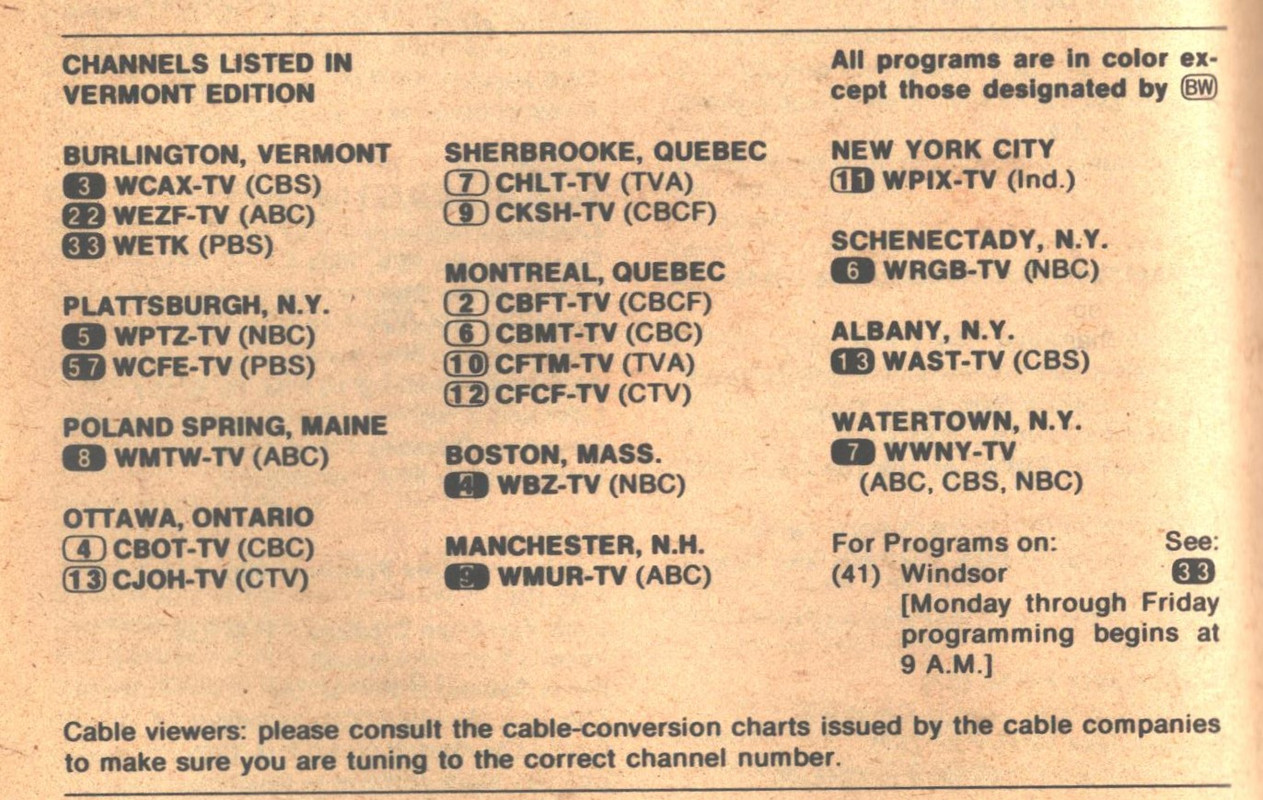
Another fun fact, the Vermont TVG carried listings for the French-language Montreal stations in French, not just program titles but the descriptions as well. I had that edition from 1992 but it's long gone, one of those that got ruined due to poor storage.

From time to time I buy old editions on eBay, but truth be told, they are usually in fairly poor condition, they smell bad due to the sheer age of the newsprint. I wonder if there would be any interest in scanning old TVG editions and putting them on the World Radio History page. @DavidEduardo, your thoughts?
Interestingly, in the '80s, the Detroit Free Press carried listings and descriptions for Windsor's CBEFT 54 (Radio-Canada) in French, though that station was never carried in the Detroit edition of TV Guide. And I'm not aware of CBEFT being carried on any cable systems in Michigan.
The Detroit edition of TV Guide, FWIW, listed Detroit and Toledo stations primarily, with CBET 9 (CBC) and TVOntario 32 being the only Windsor stations listed (in the '80s and '90s). The statewide/Northern Michigan edition listed only CBET, although the Free Press also listed Sarnia's CKCO 42 (CTV) in both the local and state edition's TV listings and Sault Ste. Marie's CKCY/CHBX 2 (CTV) and CJIC 5 (CBC) in the state edition (which didn't include CBEFT or TVO, however).
 
The CANCOM edition, which also served northern Ontario (Sudbury et al), was an example of a TV Guide edition seeking to be all things to all viewers (though not nearly as extreme as editions such as Montana, Northern Colorado, and South Georgia). They ended up just doing station ovals with the call letters within them instead of channel numbers. I'm pretty sure it was also the default terrestrial edition for Sudbury and probably Sault Ste Marie.

View attachment 7021
Sudbury and Sault Ste. Marie actually had their own editions of TV Guide as early as 1989, which differed from the usual edition in that distant U.S. stations and cable/pay networks were listed by their cable channel numbers. Both editions included listings for Elliot Lake (which is about midway between the two cities), so I assume in Elliot Lake one could purchase both. There wasn't as much overlap between the two as one might think - cable viewers in the Sault and Sudbury received different CBC, CTV, NBC, ABC, and PBS stations (prior to CHBX 2 and CJIC 5 being rolled into the MCTV system in 1990, although the Sudbury CTV and CBC stations were listed in the Sault edition and Sudbury's CICI also had cable carriage in the Sault; also, WGTQ 8 wasn't on cable in Sault Ste. Marie, but was in Elliot Lake), the Sault also got WKBD from Detroit while Sudbury didn't, and Sudbury got the TVA and Quatre Saisons French-language networks from Quebec while the Sault didn't.
In the mid-'90s a Northern Ontario edition was introduced which also circulated in Timmins, Hearst, Kapuskasing, North Bay and other communities, but apparently not in the Sault, as Sault Ste. Marie wasn't included in their channel listings grid. (Which may have been because the Sault's slate of U.S. network stations differed slightly from the rest of the region, i.e. getting WGKI/WFQX for Fox instead of WUHF, WJRT instead of WXYZ for ABC, and WNMU Marquette for PBS instead of WTVS.) I'm not aware if any of those other communities previously had their own editions, or simply didn't get TV Guide.
Eventually a revised Northern Ontario edition which did include the Sault and Thunder Bay came about in the early '00s. It listed stations by their cable channel numbers in Sudbury and Thunder Bay, in fact, with a large conversion guide for other communities (channels not carried in either Sudbury or Thunder Bay still got listed by their call letters). I assume, though, that Northwestern Ontario west of Thunder Bay, if it got TV Guide at all, received the Manitoba edition, since their CBC/SRC transmitters were all repeaters of Winnipeg and their CTV service (except for Kenora) came from CKY via cable.
 
Last edited:
Eventually a revised Northern Ontario edition which did include the Sault and Thunder Bay came about in the early '00s. It listed stations by their cable channel numbers in Sudbury and Thunder Bay, in fact, with a large conversion guide for other communities (channels not carried in either Sudbury or Thunder Bay still got listed by their call letters). I assume, though, that Northwestern Ontario west of Thunder Bay, if it got TV Guide at all, received the Manitoba edition, since their CBC/SRC transmitters were all repeaters of Winnipeg and their CTV service (except for Kenora) came from CKY via cable.
Ah, finally, someone who knows it is called The Suault, not "the soo".
 
Johnny Carson went unaired in Missoula for many years. KECI chose to air Nightline and other stuff after the news, KPAX aired CBS Late Movie/Late Night. The only way to watch was via KHQ Spokane on cable, and at 12:30AM MT (not 10:30) given the timezone difference. This was a two-station market for a long time until KTMF came in.
I think there were some stations in Mountain time that shoved two network morning shows into their broadcast day. Daytime shows all out of pattern, Price is Right in the afternoon in market X and at 8AM in market Y, not shown at all in market Z. It was the wild west for sure in the '70s.
 
Johnny Carson went unaired in Missoula for many years. KECI chose to air Nightline and other stuff after the news, KPAX aired CBS Late Movie/Late Night. The only way to watch was via KHQ Spokane on cable, and at 12:30AM MT (not 10:30) given the timezone difference. This was a two-station market for a long time until KTMF came in.
I think there were some stations in Mountain time that shoved two network morning shows into their broadcast day. Daytime shows all out of pattern, Price is Right in the afternoon in market X and at 8AM in market Y, not shown at all in market Z. It was the wild west for sure in the '70s.

I have to imagine it was kind of strange for viewers in the Mountain Time Zone to get prime-time programming from Spokane an hour ahead, 9 pm to midnight, which would be 8 pm to 11 pm in the PTZ, and people in rural areas tend not to be night-owls anyway. Right off the top of my head, I can't think of any areas with substantial population that have such an arrangement --- the only places would be the corners of Utah and Arizona (the latter only during DST) that get Las Vegas stations, and as far as the Yuma-El Centro market (split between MTZ and PTZ respectively), well, that must get confusing during the summer (or does Yuma unofficially follow Pacific time year-round, similar to how the Alabama suburbs of Columbus GA unofficially observe Eastern time, only the other way around)?

Likewise, areas of the Central Time Zone that get their networks from cities in the MTZ are very sparsely populated, but that wouldn't be as jarring, as MTZ stations run a 7 pm to 10 pm prime-time schedule. Add to that, Elko County NV would get SLC network prime-time from 6 pm to 9 pm local time.

The most sensible thing would be for cable providers in these areas to bring in stations that obey the home time zone, and let the ratings chips fall where they may. We're not talking huge numbers, and there would be no question of sim-sub.
 
Last edited:


Back
Top Bottom