• Get involved.
    We want your input!
    Apply for Membership and join the conversations about everything related to broadcasting.

    After we receive your registration, a moderator will review it. After your registration is approved, you will be permitted to post.
    If you use a disposable or false email address, your registration will be rejected.

    After your membership is approved, please take a minute to tell us a little bit about yourself.
    https://www.radiodiscussions.com/forums/introduce-yourself.1088/

    Thanks in advance and have fun!
    RadioDiscussions Administrators

TV Guide editions and online resources

I never understood how they could get by with giving it an almost-identical name ("TV-Guide", with a hyphen), but I guess AFN got a pass on that one (or possibly had an agreement with TV Guide to use the name, slightly tweaked, with different logo and layout). It would be a name familiar to American service personnel and their families, and they obviously wouldn't be getting the "real" TV Guide in Europe and Asia.

Most people on this board probably know this, but AFN took American programs from various networks, running obviously out of pattern, and overlaid the commercials with PSAs and military-themed content. This is similar to the ARCS network in Alaska, same concept, different target audience, but ARCS runs Anchorage-originated programming with the commercials intact. Might be simpler merely to run four or five subchannels on each transmitter as de facto translators of the Anchorage stations.

Just out of curiosity, would the AFN stations have had that much of a signal spillover outside the military bases they served? Also, it was common for military personnel to have multi-system receivers, so that they could get channels from the home country as well (albeit in the home language, which few would have understood unless the bases were in the UK). A friend of mine who had served as a civilian employee in Kaiserslautern swore up and down that the only difference was in the voltage, she could not comprehend the concept of PAL and SECAM, in spite of my explaining it to her.
 
Just out of curiosity, would the AFN stations have had that much of a signal spillover outside the military bases they served?

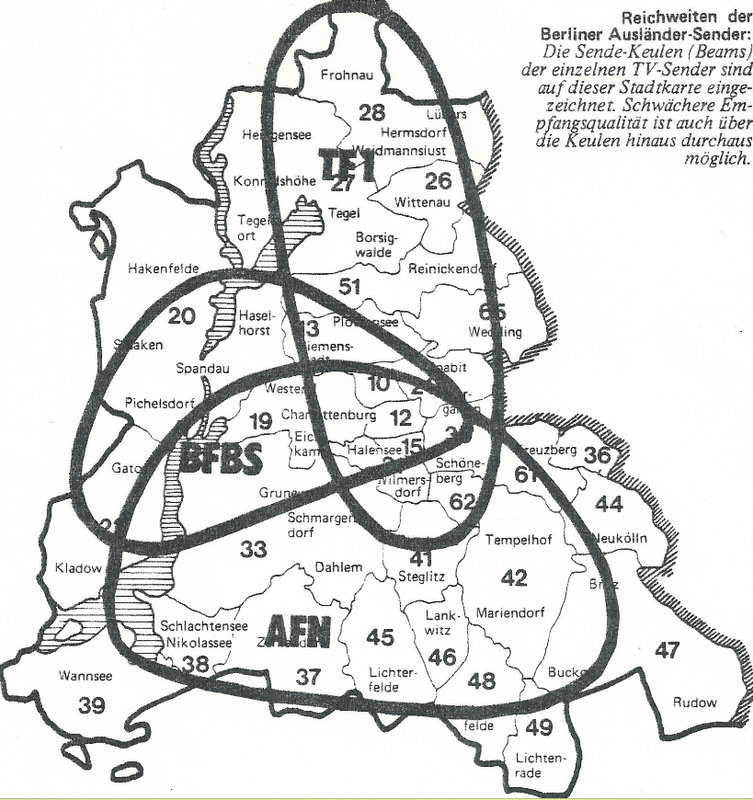
There was some overspill, but I don't know how much in terms of population. For a while in the 1980s, the channel (there was only a single service at the time) was even carried on some cable systems, but as far as I can tell, that was discontinued because of rights issues. West Berlin was a special case. Almost all parts of the city received low-powered TV signals from one of the occupation forces' broadcasters, depending on the sector--either AFN, the British Forces Broadcasting Service, or TF1 (a direct link to the Paris-based network since France didn't have a dedicated military service):


Image: Claus Grimm, Twitter

By the way, here's a 1981 AFN Evening News broadcast from Berlin:

 
Last edited:
Also note absolutely no UHF channels.

That is because the first UHF in Colorado, KDVR/31 in Denver, didn't sign on until August 1983 (although there were several previous UHF grants, in 1952, 1966, 1967, 1969 and 1972 that were surrendered unbuilt).
 
Last edited:
That is because the first UHF in Colorado, KDVR/31 in Denver, didn't sign on until August 1983 (although there were several previous UHF grants, in 1952, 1966, 1967, 1969 and 1972 that were surrendered unbuilt).
There were two in Denver in the freeze period. Empire Coil had KDEN (26), and we all know what happened to Empire Coil.
As for the other CP holder, KIRV (20), it was called on the carpet by the FCC in June 1953 for not getting the station built. There was a hearing that November regarding continuation of the CP. No one from KIRV showed up. That CP was officially cancelled December 12 of '53.

Denver would always have been a tough go for a UHF in the bad old days: KFEL (2), KOA (4), KLZ (7), KBTV (9) all came on within the space of a couple of years after the VHF freeze was lifted. KFEL managed to get on the air in under 10 days after receiving its grant, thanks to having already bought some lower-power equipment and a hastily erected 25-foot pole on Lookout Mountain. (Reading the description in Martin Codel's Television Digest is somewhat hilarious.) KFEL had enough struggles as it was since the other three had pre-existing relations with the networks through co-owned or affiliated radio stations. Channel 31 was actually lit up in 1980 as translator KA2XEG, then relaying the Spanish International Network.
 
There were two in Denver in the freeze period. Empire Coil had KDEN (26), and we all know what happened to Empire Coil.
As for the other CP holder, KIRV (20), it was called on the carpet by the FCC in June 1953 for not getting the station built. There was a hearing that November regarding continuation of the CP. No one from KIRV showed up. That CP was officially cancelled December 12 of '53.

Mark, have you been reading my stuff over at the UHF History site? I covered all of that in the section on unbuilt CP purges. 😁
 
Mark, have you been reading my stuff over at the UHF History site? I covered all of that in the section on unbuilt CP purges. 😁
It's really fun to go through Television Digest in the 1950s. I used to do that at the University of Missouri Journalism Library. Now, thanks to worldradiohistory.com, I can do it from my desktop. (This has not been a paid endorsement.) For the past couple of weeks, I've been trying to run down a mystery about Colorado TV history. I just need to write it up.

By the way, there's a very minor error in the KCTY article. This is in regards to the Cook Paint buyout of KMBC radio and TV, resolving the WHB-TV share-time arrangement and spinning off WHB radio to Storz. Arthur Church, Sr. (not Jr.) was the primary owner of KMBC. His son, Arthur Jr., had a share of the station. Church, Sr. died in Colorado Springs on September 22, 1978. His wife Cicely died in 1994, also in Colorado Springs. Arthur Jr. also lived there; I'm not sure whether he's still around. Arthur Jr.'s wife Virginia passed away in 1998 and he was listed as one of her survivors.

Yes, Arthur Burdette Church, Senior sold the stations in 1954 for reasons of health...and then went on to live another 24 years!
 
By the way, there's a very minor error in the KCTY article. This is in regards to the Cook Paint buyout of KMBC radio and TV, resolving the WHB-TV share-time arrangement and spinning off WHB radio to Storz. Arthur Church, Sr. (not Jr.) was the primary owner of KMBC. His son, Arthur Jr., had a share of the station. Church, Sr. died in Colorado Springs on September 22, 1978. His wife Cicely died in 1994, also in Colorado Springs. Arthur Jr. also lived there; I'm not sure whether he's still around. Arthur Jr.'s wife Virginia passed away in 1998 and he was listed as one of her survivors.

Yes, Arthur Burdette Church, Senior sold the stations in 1954 for reasons of health...and then went on to live another 24 years!

Mark, you lost me. I didn't go into anywhere that level of detail in the KCTY article on the KMBC-WHB deal. I don't mind correcting articles when my original research led me astray, but ... ❓❓❓
 
Mark, you lost me. I didn't go into anywhere that level of detail in the KCTY article on the KMBC-WHB deal. I don't mind correcting articles when my original research led me astray, but ... ❓❓❓
I led you astray...sorry about that...it was the article on share-time stations: History of UHF Television - the last paragraph on KMBC-WHB:

The time-share failed to last a single year; On April 26, 1954, a deal was announced in which WHB acquired KMBC, merging the television stations and spinning off their station at 710. Total amount of the deal was $1.75 million, plus the assumption of $90,000 in obligations and a $25,000 non-compete payment to KMBC's previous owner, Arthur B. Church, Jr. (should be Senior)

A note of irony is that KMBC radio was the survivor of an earlier share-time arrangement with KLDS, which was the radio station of the Reorganized Church of Jesus Christ of Latter-Day Saints* in Independence. That situation is somewhat tangled, since Church was involved in the RLDS radio operations, too, and came to Kansas City from an RLDS community in southern Iowa. The FCC history cards for what's now KMBZ indicate that its previous calls were KLDS, yet the two were licensed separately for a time. It's confusing.

* Not to be confused with the big church in Utah and now known as the "Community of Christ" which is a whole lot easier to write.
 
I will make the correction in the share-time article. Thanks for clarifying where the error was.

I would be tempted to include your information on the radio share-time but given the confusion you reference in the history card for KMBC, I am not sure where to find accurate dates for the beginning and end of same. Have you run across that information yourself?
 
Even the Super Bowl 'commercials' were all about OPSEC, drug use, commissaries, and military-related content. No commercials can be aired on AFRTS per the U.S. government.
The interesting part is seeing how cheesy they were. Sometimes you'd get a splatter of More You Know PSAs, or those CBS American Treasury segments. There were occasional filler segments showing scenic views of various American landmarks and national parks. And the interesting part about Saturday Night Live, which AFN aired: they did NOT air PSAs/military ads in the final break. The entire 'Waltz in A' theme aired over AFRTS!
 
Here's a video giving you a taste of AFN's ad replacements
Interesting. As a military kid, I do remember AFN, although my memories predate anything that was in that video.

Yes, AFN was cheesy as can be. In particular, I remember a PSA to promote driving carefully that went something like this: "Be the wise man, not the fool. When you drive your car, man, drive cool." Yup, this was in 1973 or 1974, hence the ridiculous "hippie talk".

Aside from that, I remember that they ran "Lost In Space" on Saturday afternoons -- but had the episodes in reverse order. That meant that the cliffhanger at the end of each episode was for the episode that had run the *previous* week. Oops. And for us kids, there was an hour of cartoons each on Saturday and Sunday morning. Mostly really old stuff -- I remember seeing "Crusader Rabbit", "Roger Ramjet", the Marvel Superheroes (Captain America, Iron Man, Thor, etc), and something called "Mister E From Tau Ceti".

Still, the cheesiness is understandable when we consider that the people putting all this together were soldiers who almost certainly didn't have a lot of (or any) broadcast experience. In a way, it would be a lot like a television station in a very small market in terms of the amount of experience of the people working at AFN.
 
There was some overspill, but I don't know how much in terms of population. For a while in the 1980s, the channel (there was only a single service at the time) was even carried on some cable systems, but as far as I can tell, that was discontinued because of rights issues. West Berlin was a special case. Almost all parts of the city received low-powered TV signals from one of the occupation forces' broadcasters, depending on the sector--either AFN, the British Forces Broadcasting Service, or TF1 (a direct link to the Paris-based network since France didn't have a dedicated military service):


Image: Claus Grimm, Twitter

By the way, here's a 1981 AFN Evening News broadcast from Berlin:

I would guess that for folks living in West Berlin, in addition to receiving stations from West Germany and the occupation forces, they also received stations from East Berlin and East Germany as well.

I also wonder if the television signals from West Berlin were blocked or jammed in East Berlin and areas of East Germany near West Berlin.
 
I would guess that for folks living in West Berlin, in addition to receiving stations from West Germany and the occupation forces, they also received stations from East Berlin and East Germany as well.

I also wonder if the television signals from West Berlin were blocked or jammed in East Berlin and areas of East Germany near West Berlin.
I tend to doubt it. As a rule, TV from the West (don't think there would have been any special provision for AFRTS) could be freely received in all of East Germany except for two parts parts in the far southeast and northeast. Here's more:

Tal der Ahnungslosen - Wikipedia
 
I tend to doubt it. As a rule, TV from the West (don't think there would have been any special provision for AFRTS) could be freely received in all of East Germany except for two parts parts in the far southeast and northeast. Here's more:

Tal der Ahnungslosen - Wikipedia
However, it was against the law for East Germans to watch those foreign broadcasts -- and anything from West Germany was considered "foreign". Decades ago, I read that the East German authorities would look for TV antennas pointed in the wrong direction. They'd also "test" grade school children by having the kids draw a clock face -- and if the kids drew the kind of clock face seen on West German broadcasts, the authorities knew that the parents were illegally watching the western broadcasts.

As a side note, if East Germans watched West German broadcasts (or vice versa) they would only get the broadcasts in B&W. East Germany and all the other Soviet block countries used the French-developed SECAM system for their color broadcasts, whereas West Germany used the West German-developed PAL system. The B&W portion of the broadcasts (along with the audio) were compatible between the two systems, but the color wasn't.
 
However, it was against the law for East Germans to watch those foreign broadcasts -- and anything from West Germany was considered "foreign". Decades ago, I read that the East German authorities would look for TV antennas pointed in the wrong direction. They'd also "test" grade school children by having the kids draw a clock face -- and if the kids drew the kind of clock face seen on West German broadcasts, the authorities knew that the parents were illegally watching the western broadcasts.

As a side note, if East Germans watched West German broadcasts (or vice versa) they would only get the broadcasts in B&W. East Germany and all the other Soviet block countries used the French-developed SECAM system for their color broadcasts, whereas West Germany used the West German-developed PAL system. The B&W portion of the broadcasts (along with the audio) were compatible between the two systems, but the color wasn't.
As I understand it, the East German authorities finally gave up trying to get people to quit watching West German TV. As to the different color standards, I think people made bootleg converters, and at any rate, being able to get West German TV in black and white was probably seen as better than nothing.
 
That's a fairly adequate knock-off of TV Guide. Interesting that channel 5 is in a black bullet, and the other four stations are in white bullets.

As a kind of side note, TV Guide equivalents in Europe almost universally list each station in its own column, except for one such magazine I saw from (I think) Italy, the listings are never interlocked. And they never use channel numbers, just network names.
That's what I've noticed from UK newspaper listings too. It's almost always BBC1/BBC2/local ITV region/other ITV regions/(post 1982) Channel 4. A lot of British TV sets didn't have dials with channel numbers, just switches for each network. As for British versions of TV Guide, before the 90s there were two--one for BBC and one for ITV! Imagine getting seperate TV Guides for NBC, CBS, and ABC!
 
That's what I've noticed from UK newspaper listings too. It's almost always BBC1/BBC2/local ITV region/other ITV regions/(post 1982) Channel 4. A lot of British TV sets didn't have dials with channel numbers, just switches for each network. As for British versions of TV Guide, before the 90s there were two--one for BBC and one for ITV! Imagine getting seperate TV Guides for NBC, CBS, and ABC!
Yes, that's right, I've found that Europeans typically don't have a concept of channel numbers. Older analog TV receivers had either a dial, a slider (for portable sets), or those individual channel tuners (you'd flip a door open, toggle to VHF or UHF, and use a small sawtooth-like disc, or whatever it's called) with a push-button for each tuner. In the early 1980s, the latter feature was introduced on some North American TV sets, and you would get a plastic sheet of channel numbers to slip into a window for each button. Then fully electronic tuning was introduced, both in North America and in Europe, which is where we are today.

And then there's Australia, where, at least in the larger cities, there were uniform channels for each network (7, 9, 10, and so on), and the networks actually go by those numbers, e.g, the Seven network. (After a fashion, many of the ABC O&Os in the US did the same thing, you have "ABC7" in NYC, LA, Chicago, and at one time, in Detroit when WXYZ was an O&O, ditto "NBC4" and "CBS2" in some of the same cities. The iconic "Circle 7" logo, or a variation thereof, is even used by ABC affiliates in smaller markets such as Lawton OK, Jackson TN, and a couple of markets in Florida.) With the advent of PSIP, Australian broadcasters are able to map to those same channel numbers.
 
Yes, that's right, I've found that Europeans typically don't have a concept of channel numbers. Older analog TV receivers had either a dial, a slider (for portable sets), or those individual channel tuners (you'd flip a door open, toggle to VHF or UHF, and use a small sawtooth-like disc, or whatever it's called) with a push-button for each tuner. In the early 1980s, the latter feature was introduced on some North American TV sets, and you would get a plastic sheet of channel numbers to slip into a window for each button.
My first Proton TV set, bought in 1985, had that feature, which worked exactly as you described. But it couldn't get the CATV superband. When I got Qube Cable later on in Houston, I had to get a block converter to watch some channels.


Back
Top Bottom