• Get involved.
    We want your input!
    Apply for Membership and join the conversations about everything related to broadcasting.

    After we receive your registration, a moderator will review it. After your registration is approved, you will be permitted to post.
    If you use a disposable or false email address, your registration will be rejected.

    After your membership is approved, please take a minute to tell us a little bit about yourself.
    https://www.radiodiscussions.com/forums/introduce-yourself.1088/

    Thanks in advance and have fun!
    RadioDiscussions Administrators

Saving Electricity

Then in that case, you should reduce the coverage of your translator to match. As an intentional AM operator, you're in for a penny, in for a pound.

This is just silly, and you know better. The rules that you claim to revere don't require any such translator signal reduction. Why "should" broadcasters do something that's against their interest and also not required by any FCC rule?

You claimed that a translator can't have better coverage than a "parent" AM, and that wasn't true. And no, I'm not going to run a study to quantify exactly how many translators exceed their AM reach. That's a lot of data to crunch. (And why 34 dBu? That's not a realistic useful coverage contour for any translator. I tell my clients not to expect reliable coverage outside the 60 in most cases.)

I'm not interested in the ridiculous fiction of "intentional AM operator." We are broadcasters who provide content to audiences, and we do it where the audiences want to find us, or else there's no point in continuing to create that content.

Disney wasn't an "intentional seller of VHS tapes," or an "intentional seller of DVDs," was it? It evolved to be where its customers wanted to find it, which is why it now gets my money through a Disney+ account and the VHS tapes my kids watched have long ago been sold off at a yard sale.

AM is dying. No amount of regulation will change that. My interest with my broadcasting clients is to make sure that they continue to reach the audiences they want to reach, and in 2024 that's a combination of FM and streaming. Not one of them would describe themselves as "intentional AM operators." It was a means to an end for a very long time, but that time is mostly over. I make no apology for working within the rules as they are to maximize my clients' FM reach and minimize their expenses carrying AM deadweight, and I make no apology for advocating for further rule changes that will reduce that deadweight going forward.
 
This is just silly, and you know better. The rules that you claim to revere don't require any such translator signal reduction. Why "should" broadcasters do something that's against their interest and also not required by any FCC rule?
I'm saying that if the intent of the licensee is to truncate their AM station coverage only to game the system of still having an AM station on the air while operating an FM translator, then there should be some equal disincentive for doing so. After all, wasn't Commissioner Pai who called issuing FM translators to AM stations part of the AM Revitalization Act? How exactly is intentionally reducing coverage of an AM station revitalizing anything?
You claimed that a translator can't have better coverage than a "parent" AM, and that wasn't true. And no, I'm not going to run a study to quantify exactly how many translators exceed their AM reach. That's a lot of data to crunch. (And why 34 dBu? That's not a realistic useful coverage contour for any translator. I tell my clients not to expect reliable coverage outside the 60 in most cases.)
Okay fine, then make it 60DBu. Let's make it even easier. How many of your clients have translators that have equal 60DBu coverage to the 5mv/m of their AM station day and night?
I'm not interested in the ridiculous fiction of "intentional AM operator."
So AM radio station operators are doing so unintentionally? Could have fooled me.
Disney wasn't an "intentional seller of VHS tapes," or an "intentional seller of DVDs," was it?
Of course, they were intentional. They intentionally used the delivery method for delivery/renting or selling their proprietary movies and shows available at that time. When DVD's came along, that same and new content was intentionally available via DVD's. The big difference is neither method was federally licensed and regulated, nor around 100+ years old. Broadcasters maintain their licenses to broadcast (well most do anyway) by following a prescribed set of rules to remain broadcasting. But, to use your VHS to DVD example; AM broadcasters have had ample time to move to a well-established alternate form of transmission, FM or now streaming. Do you think that if Disney had gone down the same road of sticking with VHS rather than seeing the market changing, they would have done as well in business? And, would the government be responsible for bailing them out of a massive delay to follow the market changes?
Of course not. Disney intentionally followed the market. AM broadcasters haven't until now when the leaky boat has developed too many holes for their fingers on both hands to plug.
AM is dying. No amount of regulation will change that. My interest with my broadcasting clients is to make sure that they continue to reach the audiences they want to reach, and in 2024 that's a combination of FM and streaming. Not one of them would describe themselves as "intentional AM operators."
Of course they are intentional. They applied for a license, but nobody forced them to. They (in theory) follow the rules to keep that license so they can operate, and it's not cheap to do so. The government handed them a gift of FM translators, but true to form, they want the government to give them more. Especially now, given the number of FM stations under financial pressure, an AM broadcaster, if they were really serious about moving away from AM, could easily buy a station for comparative pennies on the dollar. But no, I want to operate my existing FM translator only and in fact, I want it to be upgraded to a protected full-class station. And why is that? It's because they want the government to bail them out rather than invest more money into buying a full-class station.
 
Of course not. Disney intentionally followed the market. AM broadcasters haven't until now when the leaky boat has developed too many holes for their fingers on both hands to plug.

You've created an interesting alternate history that neatly fits your sourpuss view of "AM broadcasters."

The ones I work with have been planning transition off of AM for a decade or longer. Many of them spent money during the "250-mile" window early in the process to purchase and move translators, and they've been spending on transmission equipment, tower rent, promotion and, yes, lobbying because they have long been aware that they won't survive as "AM stations" in the 21st century.

The push for FM-only operation and primary status for translators is hardly new and hardly a last-minute thing. You and I have both been around the DC regulatory establishment a long time. These things happen in stages, with a lot of give and take along the way.

And again, many of these stations are in places where there is no FM signal easily available for purchase at any price. There is no commercial FM station at all in Genesee County, NY (Batavia), halfway between Rochester and Buffalo. It's a market of about 50,000 people that gets good service from two AMs with translators (WCJW and WBTA). Force them to "buy an FM" to stay alive, and they will cease to exist. How does that serve anyone?
 
You've created an interesting alternate history that neatly fits your sourpuss view of "AM broadcasters."
Really? How are my examples inaccurate or what "alternate history" did I make? You were the one who compared the way Disney distributes their proprietary content. I just carried the comparison to AM stations.
The ones I work with have been planning transition off of AM for a decade or longer. Many of them spent money during the "250-mile" window early in the process to purchase and move translators, and they've been spending on transmission equipment, tower rent, promotion and, yes, lobbying because they have long been aware that they won't survive as "AM stations" in the 21st century.
So, this brings up another question, and maybe David has general data that would shed light on it- FM translators for AM stations have been around for a few years. What has been the outcome? Have stations in small or larger markets seen a measurable increase in listeners or, better yet, more than a single-digit percentage increase in revenue?
Has there been any tangible benefit other than AM broadcasters trying to break the bonds of their MW frequencies?

The push for FM-only operation and primary status for translators is hardly new and hardly a last-minute thing. You and I have both been around the DC regulatory establishment a long time. These things happen in stages, with a lot of give and take along the way.
And I suspect the Commission has much bigger fish to fry than revisiting something from Pai's regime. I find it kind of ironic, that AM broadcasters can't come up with the dinero to purchase a new transmitter, or in some cases, even repair what they have, yet will talk about paying lobbyists to get the Commission's attention.
And again, many of these stations are in places where there is no FM signal easily available for purchase at any price. There is no commercial FM station at all in Genesee County, NY (Batavia), halfway between Rochester and Buffalo. It's a market of about 50,000 people that gets good service from two AMs with translators (WCJW and WBTA). Force them to "buy an FM" to stay alive, and they will cease to exist. How does that serve anyone?
So, what you're saying is; that if I'm driving along I-90/490 or I-33 between Rochester and Buffalo, I won't hear any FM stations?
Back when we owned a TV station in Syracuse, Rochester, Utica, Watertown, and Binghamton, I'd driven that route several times and I could swear the entire route in the rental car I could hear FM stations from either Rochester or Buffalo as I crossed through Indian Falls or Pembroke, which I believe is kind of the mid points.
 
So, what you're saying is; that if I'm driving along I-90/490 or I-33 between Rochester and Buffalo, I won't hear any FM stations?
Back when we owned a TV station in Syracuse, Rochester, Utica, Watertown, and Binghamton, I'd driven that route several times and I could swear the entire route in the rental car I could hear FM stations from either Rochester or Buffalo as I crossed through Indian Falls or Pembroke, which I believe is kind of the mid points.

You suggested that these AM station owners should be buying full-power FM licenses if their goal is to be on FM. I'm telling you that's not always an option. Yes, you can hear Rochester and Buffalo FM signals in Batavia, which is the midpoint. But there are no commercial FM channels allocated to Batavia or anywhere in Genesee County and no available spectrum for any new allocation, so if WBTA or WCJW want to be on FM, what option do they have other than a translator?
 
You suggested that these AM station owners should be buying full-power FM licenses if their goal is to be on FM. I'm telling you that's not always an option. Yes, you can hear Rochester and Buffalo FM signals in Batavia, which is the midpoint. But there are no commercial FM channels allocated to Batavia or anywhere in Genesee County and no available spectrum for any new allocation, so if WBTA or WCJW want to be on FM, what option do they have other than a translator?
Then they don't stay in business. Look, I'm not trying to be mean-spirited, but you know as well as I that these radio stations, like many other communities and cities, are businesses. Should any small business be bailed out by the federal government through special rule changes, when brethren broadcasters have spent literally millions of dollars over the years to be in the same business?

It just seemed to me that claiming there was no FM radio service in those areas as justification for giving remaining AM stations some form of special protected FM status seemed strange because I could swear I'd heard plenty of stations in my travels through those particular communities. In other words; it's not like there would be no receivable radio if WBTA or WCJW in particular weren't able to remain in business solely because they were AM stations.
 
Then in that case, you should reduce the coverage of your translator to match. As an intentional AM operator, you're in for a penny, in for a pound.
Depending on the soil conductivity a lot of Class C and D's chould use the "25 mile rule" from the AM tower coordinates.
 
MDCL does work quite well. The more frequent modulation there is, the more the carrier is reduced, and the more electricity is saved. MDCL is more effective on higher power stations, because typically the AC to RF conversion efficiencies on larger transmitters are higher. Also, stations which run on 240 or 480 volts three phase are typically paying a different rate than those on a 120/240 volt single phase service.

Edited to add...
Nautel calls there feature MDCL, Modulation Dependant Carrier Level. It is a software option on NX line transmitters.

GatesAir calls it ACC, Active Carrier Control. It is a retrofit board that can be installed in DX series transmitters.

This document from GatesAir describes the technology clearly. https://www.gatesair.com/documents/slides/2015-07-Anderson-Application-of-MDCL-Control-Tech.pdf

But also see this - comments from J. Fred Riley:

 
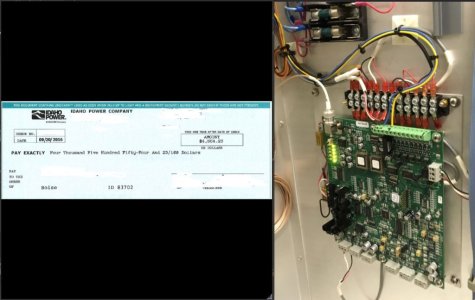
MDCL install on a DX-50.
Did the install ourselves. After 3 months had a 28% savings power bill. That would include air conditioning costs for late summer into fall.
Power company gave us a $4k+ power saving device rebate.
MDCL paid for itself in 4 months.
No comments from listeners.


1718823285927.jpeg
 
Last edited:
MDCL install on a DX-50.
Did the install ourselves. After 3 months had a 28% savings power bill. That would include air conditioning costs for late summer into fall.
Power company gave us a $4k+ power saving device rebate.
MDCL paid for itself in 4 months.
No comments from listeners.


View attachment 7182
I could not resist noting that we are so favored by modern science that we now have pull-through cable ties and stick-on cable routing loops.

I can remember tediously lacing cables with that waxed string and mounting routing loops to the cabinet with carefully drilled holes, nuts and bolts.

And then there are those Velcro straps for often-changes wiring groups instead of adhesive tape from the drug store.
 
MDCL is on at least one AM up here.... city school district owned KDLG 670 Dillingham, AK

I think it may be on KBRW 680 Utqiaġvik, AK

And in a place where power can be 50 cents to $1kwh, i know its saved KDLG 670 alot of money

Side note, KDLG is HD capable/ready but has never used it.
 
I could not resist noting that we are so favored by modern science that we now have pull-through cable ties and stick-on cable routing loops.

I can remember tediously lacing cables with that waxed string
Waxed string was used in most telephone central offices as late as 2001 for securing cables to racks. Also cable or coax entry in to racks and cabinets were tried down with waxed nylon string. Unshielded Fiber had trays but shielded protected fiber got tied too. Tie wraps are discouraged because the little plastic locks can cause cuts to personal and damage cables that are pulled over them when installed latter.

A lot of people would be surprised to discover that their "modern" communication is literally in place by wax string.

How does waxed nylon cord hold up in a transmitter's heat? Phone offices rarely get over 80 degrees.
 
<...>
How does waxed nylon cord hold up in a transmitter's heat? Phone offices rarely get over 80 degrees.
That's also been used in aerospace applications...and was probably acquired from the telcommunications side of things.

The product works remarkably well - heat or cold.

Industry name for the product is "braided waxed cord", and continues to be available.
 
MDCL install on a DX-50.
Did the install ourselves. After 3 months had a 28% savings power bill. That would include air conditioning costs for late summer into fall.
Power company gave us a $4k+ power saving device rebate.
MDCL paid for itself in 4 months.
No comments from listeners.

DX-50 with MDCL - what is your carrier cutback? 3dB? 6dB?

3dB cut back would essentially mean operating the DX-50- as a 25kW transmitter. 6dB cut back would be about the same
as operating a 12.5kW transmitter, right?

I think that was pretty much the position of J. Fred Riley, in his objection to MDCL, when the carrier power is reduced under higher modulation levels, essentially the transmitter operating below rated power at high modulation levels. I believe he was in favor of the carrier controlled modulation systems where the carrier power was reduced 3db to 6dB under no modulation periods and the carrier power ramped back up to full carrier power under high modulation levels.

Obviously, running a DX-50 with 3dB or 6dB carrier cutback does reduce some power costs and you have the full 50kW capacity of the transmitter, if necessary.

On the other hand, what would be the power costs of the DX-50 with 3dB carrier cutback as compared to a DX-25 running normal conventional amplitude modulation - no carrier power changes with modulation?

This comparison doesn't take into account the capital costs of having the second transmitter.
 
250 watts of (TPO) power= 1 kilowatt every 4 hours
(Depending on state: 1 kwh average is around $0.15 - $0.25

At an example rate of $0.20 per kwh, it would cost only $1.20 per day to run a 250 Watts operation (AM or FM) which is around $36 per month. Very Efficient if used as FM Translator for AM station, it would actually cost way less than the average cost of one 30 second advertisement...Low voltage transmitters are seemingly inexpensive to run. Recouping station operation expenses may be considered negligible in that case?

However, At the same rate of $0.20 an AM station with 50,000 watts (50kw) would use 1 kwh every 72 seconds, which translates to a cost of about $7.50 per hour, or $180 per day, $5400 per month, so that could get expensive without something to help fund its operations, like selling ads.

For comparison, an FM station (Class A) Running 3,000 to 6,000 watts, uses about the same about of energy as a home electric dryer, for example, a unit at 5,000 watts (5 kw) is using (1 kwh) every 12 minutes, or exactly $1 per hour on the electric bill. $24 per day or $720 per month if being used 24/7. A bit expensive for the average person.. But For example, that cost is easily recouped if selling just a few minutes of advertising each hour (Lets say for $100 each / aired for 30 seconds every hour) so a commercial break would only be 3.5 minutes per hour. You know the big radio companies are selling many more ads for a lot more money, but is that income really covering any other costs or are they raking in ways much more đź’° than is even necessary.

The biggest cost in that first example is the equipment (transmitter maintenance or new upgrades) and the station license. Not counting other costs of running a studio and STL/tower antenna or employees, etc..

This is a Hypothetically Analysis... btw
Thoughts?
 
Last edited:
However, At the same rate of $0.20 an AM station with 50,000 watts (50kw) would use 1 kwh every 72 seconds, which translates to a cost of about $7.50 per hour, or $180 per day, $5400 per month, so that could get expensive without something to help fund its operations, like selling ads.
AM transmitters are not that efficient. Unless you use carrier supression (detailed elsewhere) you essentially have to power the carrier and the audio component. Old tube transmitters that were high-level plate modulated were around 60% efficient. A lot of heat given out, too. Solid state ones do better, but it is not one kw of energy for one kw of signal.
For comparison, an FM station (Class A) Running 3,000 to 6,000 watts, uses about the same about of energy as a home electric dryer, for example, a unit at 5,000 watts (5 kw) is using (1 kwh) every 12 minutes, or exactly $1 per hour on the electric bill. $24 per day or $720 per month if being used 24/7.
Most FMs use multi-bay antennas to focus the power radiation towards the population and the horizon. So a 6 kw vertical and horizontal ERP FM with a typical 6 bay antenna only needs about third of the input power (every two bays, on average, create unity. Multiple sets create gain over the input power by narrowing the angle of radiation.

For example, it's not unusual to see 100 kw vertical and horizontal power use 40 kw transmitters. Some, in smaller markets, may use up to 10 or 12 bays to avoid higher power bills.

(I tried to make this as layman friendly as possible, knowing that different types and spacings of FM elements change things a bit.)
A bit expensive for the average person.. But For example, that cost is easily recouped if selling just a few minutes of advertising each hour (Lets say for $100 each / aired for 30 seconds every hour) so a commercial break would only be 3.5 minutes per hour. You know the big radio companies are selling many more ads for a lot more money, but is that income really covering any other costs or are they raking in ways much more đź’° than is even necessary.
There are very few stations in very few markets selling $100 spots. Only the biggest stations in the biggest markets get that rate or more. There are a lot more $5, $10 and $20 spots than there are $100 dollar ones.

Before the consolidation of the mid-90's, half of all stations were losing money. And had been since the 60's. Today, I suspect it is even worse. Of course, a lot of single owner stations pay the owner a salary and show no corporate profit, but that is still not my definition of "prosperity".
The biggest cost in that first example is the equipment (transmitter maintenance or new upgrades) and the station license. Not counting other costs of running a studio and STL/tower antenna or employees, etc..
Equipment is a capital expense, and amortized over is usable life time. It is not an operating expense. And the largest expense at most commercial stations is sales commissions... both agency and the station's own sellers. That takes, depending on the station, anywhere from 30% to nearly 30% of the revenue right off the top. Then you have rent or property taxes, other utilities, insurance, bookkeeping, engineering, office staff, the manager, a variety of taxes, legal costs, bad debt write offs, music licenses, memberships like NAB and RAB, T&E, and many other costs of running a radio station.
 
Status
This thread has been closed due to inactivity. You can create a new thread to discuss this topic.


Back
Top Bottom