
• Get involved.
    We want your input!
    Apply for Membership and join the conversations about everything related to broadcasting.

    After we receive your registration, a moderator will review it. After your registration is approved, you will be permitted to post.
    If you use a disposable or false email address, your registration will be rejected.

    After your membership is approved, please take a minute to tell us a little bit about yourself.
    https://www.radiodiscussions.com/forums/introduce-yourself.1088/

    Thanks in advance and have fun!
    RadioDiscussions Administrators

Charlie Tuna tapes for sale on eBay

davideduardo

Moderator/Administrator
Staff member
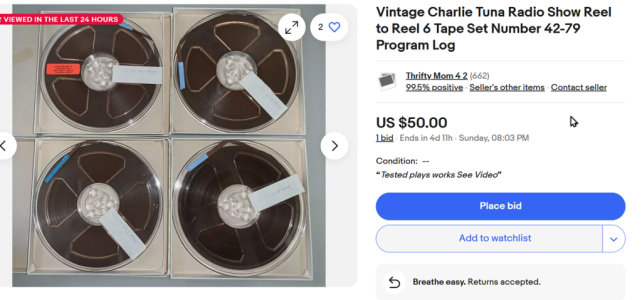
I just found this listing:
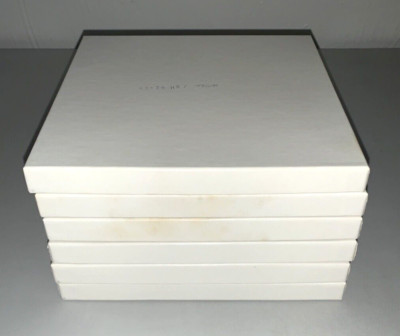

A bunch of Charlie Tuna tapes. They don't say what date or what station, but heck, it's Charlie!
1720021948348.png
 
I just found this listing:


A bunch of Charlie Tuna tapes. They don't say what date or what station, but heck, it's Charlie!

View attachment 7277
This is cool. The cue sheet in picture #7 of the listing says 12-4-1979 in the top right corner (you have to expand the picture to see it).
 
The program logs have the name "Audio Stimulation" as the name of the syndication company. I can find no record of that company. Was that Charlie's own company at the time?
 
This is cool. The cue sheet in picture #7 of the listing says 12-4-1979 in the top right corner (you have to expand the picture to see it).

It also corrects the listing which is actually program 48-79 (week 48 of 1979), which matches up with the handwritten date.
 
The program logs have the name "Audio Stimulation" as the name of the syndication company. I can find no record of that company. Was that Charlie's own company at the time?

In a word, yes. (Charlie and I had just become friends around that time ... a friendship that endured until his unexpected death.)
 
I loved Charlie on Scrabble.. and i was lucky enough to work at a station that used his voice for imaging... another NPR station here in Alaska!
 
It's also
In a word, yes. (Charlie and I had just become friends around that time ... a friendship that endured until his unexpected death.)

It looked like a home brew. Not many shows still used reel to reel tape as late as 1979. American Top 40 was on vinyl disc.

The logo reminded me of Sandy Benjamin's Interview Factory that was operating around that time. So maybe they helped.

KIIS was involved in radio syndication around that time through Gannett. They did some radio shows based on the USA Today brand.
 
It looked like a home brew. Not many shows still used reel to reel tape as late as 1979.

Right again, A. Charlie already had studio facilities for recording at his Tarzana home by 1979 and produced this weekend show on his own. (I remember him running some small ads in one of the trades but I haven't yet un"earthed"* one yet.)

He also did the production on the Wolfman Jack syndicated show for Filmways Radio. (Although I'm dealing with "fuzzy memory syndrome" all these years later, Filmways may have been the actual syndicator for Charlie's show ... I'm just not certain. I am sure about the home studio, though.)

That home studio later had the capacity for live broadcasts via ISDN, which is how he did his morning show for Art Astor's KIK-FM for a couple of years in the mid-1990s.

* - Verbiage selected to honor the last station he worked for, being unceremoniously dumped along with the rest of the weekend staff right before Labor Day 2015.
 
Last edited:
Right again, A. Charlie already had studio facilities for recording at his Tarzana home by 1979 and produced this weekend show on his own.

Pretty funny. He'd take the original master, drop it off at one of many tape duplication centers around LA, and they'd ship it via snail mail to radio stations. Probably a two week lag between when they got the chart, and when the radio show finally aired.
 
Probably a two week lag between when they got the chart, and when the radio show finally aired.

For a weekend show (as this was) that lag probably didn't matter to the stations ...

Also, looking at those cue sheets again, this did not appear to be a countdown show. There were gold titles mixed in with the currents.
 
Who actually, rightfully owns this material? Is it ethical to sell someone else's work?

I have a recording that I made of KROQ's (1500) first two hours on the air back in 1972, featuring Charlie and a host of others. Would it be ethical for me to sell copies of it? And why would I do that?
 
For a weekend show (as this was) that lag probably didn't matter to the stations ...

Then again, the chart was in a print publication that was also mailed out via snail mail. So there were time lags at every step of the way.

He likely got the advance (pre-publication) version of the chart from the chart company. (maybe by fax?) R&R allowed people to use their charts for free. Billboard charged, and Casey had the exclusive. But Charlie could have also used Cash Box or anyone else. Or just made up a chart.

Who actually, rightfully owns this material? Is it ethical to sell someone else's work?

That becomes a legal question. Technically Charlie owns it. But the courts have said if you mail a show to someone, that copy becomes their property to dispose of as they please. If someone took the show, and tried to re-air the show on the radio with new spots, that might activate the lawyers.
 
Who actually, rightfully owns this material? Is it ethical to sell someone else's work?

I have a recording that I made of KROQ's (1500) first two hours on the air back in 1972, featuring Charlie and a host of others. Would it be ethical for me to sell copies of it? And why would I do that?

My understanding has always been that for syndicated programs the rights remain with the syndicator or their successors under copyright law.

Airchecks, however, are considered to be non-copyrighted as they were created on the spot for live airing. Those can be traded or sold (and aircheck collectors do that all the time, with no retribution).

As BigA said, however, there would be issues with rebroadcasting syndicated programs, unless provided for same by the current rights holder. The American Top 40 classic shows with Casey Kasem are a good example of the latter; Premiere owns the rights and repackages them with new spots under new affiliate contracts.
 
Airchecks, however, are considered to be non-copyrighted as they were created on the spot for live airing. Those can be traded or sold (and aircheck collectors do that all the time, with no retribution).

Where we get into a sticky wicket is the music in those airchecks. Some of the radio history websites have been taken to court by music rights companies, claiming digital royalties. They sites claim it's historic material and should be exempt, but there are no exemptions in the copyright act.
 
Where we get into a sticky wicket is the music in those airchecks. Some of the radio history websites have been taken to court by music rights companies, claiming digital royalties. They sites claim it's historic material and should be exempt, but there are no exemptions in the copyright act.

There was a long legal battle between the late Richard Irwin of REELRADIO and the RIAA ten years ago:


Eventually, REELRADIO returned to posting uscoped airchecks, but Richard never said publicly (or told me privately) what, if any, settlement had been reached.

A year ago, Mixcloud sent notices to its account holders prohibiting the uploading of unscoped airchecks.

YouTube has cancelled a few aircheck pages in the past few months on the basis of copyright violations via the songs in the unscoped airchecks.

And in the last few weeks, the presumed "safe haven" for a lot of these folks----The Internet Archive---has started taking down some unscoped airchecks as well, This may be related to a lawsuit filed last summer by some of the labels against the Archive housing the Great 78 Project:

 
I have a recording that I made of KROQ's (1500) first two hours on the air back in 1972, featuring Charlie and a host of others. Would it be ethical for me to sell copies of it? And why would I do that?

Those two hours (and then some---at least six hours) have been in circulation for more than a decade. I'm sure you weren't alone in rolling tape that day.
 
Where we get into a sticky wicket is the music in those airchecks. Some of the radio history websites have been taken to court by music rights companies, claiming digital royalties. They sites claim it's historic material and should be exempt, but there are no exemptions in the copyright act.
And yet many, many hours of unscoped airchecks from around the country can be found in various YouTube collections. I guess there are so many of these out there, and listenership to each is so minimal (usually in the double or low triple figures), that Sound Exchange doesn't deem them worthy of a copyright strike.
 
And yet many, many hours of unscoped airchecks from around the country can be found in various YouTube collections. I guess there are so many of these out there, and listenership to each is so minimal (usually in the double or low triple figures), that Sound Exchange doesn't deem them worthy of a copyright strike.

See my post directly below The Big A's.
 
Those two hours (and then some---at least six hours) have been in circulation for more than a decade. I'm sure you weren't alone in rolling tape that day.
The first two hours were prerecorded with each jock doing a mini-shift of around twenty minutes. This all started at 12 Noon with Charlie leading off. He would return at 2PM live. Interestingly, Johnnie Darin, who was the PD, anchored the 2AM-6AM shift.

The call sign changed from KBBQ to KROQ at 12 Noon
 
Status
This thread has been closed due to inactivity. You can create a new thread to discuss this topic.


Back
Top Bottom