
Does anyone remember WHY, in the past, did the FCC require a First Phone License?
I am writing an article, and I would appreciate any help you can give.
I am writing an article, and I would appreciate any help you can give.

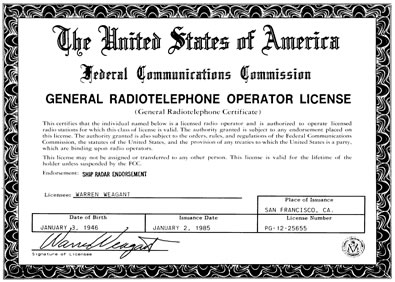
 www.radioworld.com

Actually, that is not the reason at all. The purpose of the licensing of radio operators was to insure that qualified people ran the equipment that was, from the very start and well into six decades after radio began, in need of qualified maintenance and even hour by hour supervision.The whole purpose of the FCC was to add a level of order and professionalism to broadcasting.
Actually, that is not the reason at all. The purpose of the licensing of radio operators was to insure that qualified people ran the equipment
The only employees it licensed were the operators. They were the ones who were responsible for the technical operation of the station.
Once the monitoring equipment and the components in phasors and doghouses were more stable and reliable, in the mid 70's all but highly critical DAs were allowed to be run by 3rd Class license holders.
Again, not really. Establishing order was the purpose of the FRC in the later 20's. The FCC, in the earlier 30's, was just a better successor to the work of the FRC. And only the industry itself, as it became successful and wealthy, could induce professionalism into its labors.I get that. My sentence was: The whole purpose of the FCC was to add a level of order and professionalism to broadcasting.
But that was part of the process of greater regulation and control, needed when more stations all had to share the same frequencies from 550 to 1500. In fact, by the early 30's the WTMJ / WSUN project showed how directional antennas could permit better sharing of channels.Nowhere in that did I say anything about the purpose of licensing radio operators.
But a 3rd Ticket staffer was required to be on duty, and, while by 1976 program automation was in its second decade, transmitters had to be logged by hand. If some readings were printed out by the monitoring equipment, the operator had to attach them to the written log and "endorse" them.It was by the mid 70s that stations started to monitor and operate transmitters by early computer automation. It wasn't necessary to have licensed engineers at the transmitter anymore. Prior to that, many overnight DJs would get hired if they had 1st phones. By 1976, that wasn't necessary.
Remote control of transmitters was authorized long before 1976 eliminating the need for a licensed engineer at the TX site. I couldn't find a hard date, but Gates had the RDC-10 remote control system listed in the 1955 catalog, so somewhere close to that would be when remote control was first authorized, and transmitter engineers were no longer required, but operators with a 1st Phone were still required (at the studio) for stations until 1963, when FMs and 10KW or less non-DA AMs could be operated by 3rd phone with broadcast endorsement. In 1973, a 3rd with endorsement could operate all stations, but maintenance still required a 1st. I recall something about AM "crictical arrays" requiring a 1st operator, though, just can't find a date. Perhaps that's where your 1976 date came from.It was by the mid 70s that stations started to monitor and operate transmitters by early computer automation. It wasn't necessary to have licensed engineers at the transmitter anymore. Prior to that, many overnight DJs would get hired if they had 1st phones. By 1976, that wasn't necessary.

I am reasonably certain that those critical DA arrays were defined as anything above a certain ERP and I think that was a recognition that those were still a little too complex.In 1973, a 3rd with endorsement could operate all stations, but maintenance still required a 1st. I recall something about AM "crictical arrays" requiring a 1st operator, though, just can't find a date. Perhaps that's where your 1976 date came from.
Establishing order was the purpose of the FRC in the later 20's. The FCC, in the earlier 30's, was just a better successor to the work of the FRC.
Then they were mad because all the effort they went to to get the 1st now meant zilch.
Yeah, but everything you ever needed to know you learned in kindergarten.To make matters worse, all the stuff they learned in college is obsolete.
Not really. Electrons are electrons.To make matters worse, all the stuff they learned in college is obsolete.
I remember taking electronics in college and the teacher took on us on a tour of some company that had a retired computer and it was the size of 2 average size bedrooms. Now our tablets have more power!Not really. Electrons are electrons.
And the core of electronics is math. Trig, algebra, calculus. All the math I learned in the 60's is valid today, and I can easily take refresher courses or read some books and catch up with solid state... from transistors to ICs.
Transistors work a lot like tubes. It's just that you can not fit ten million tubes on a one-inch-square chip. It is fascinating to see pictures of the earliest computers, with seemingly miles of rows of gear with lots of tubes in rack after rack. My two square foot Ryzen Threadripper powered unit has more power!


