• Get involved.
    We want your input!
    Apply for Membership and join the conversations about everything related to broadcasting.

    After we receive your registration, a moderator will review it. After your registration is approved, you will be permitted to post.
    If you use a disposable or false email address, your registration will be rejected.

    After your membership is approved, please take a minute to tell us a little bit about yourself.
    https://www.radiodiscussions.com/forums/introduce-yourself.1088/

    Thanks in advance and have fun!
    RadioDiscussions Administrators

Why A First Phone

Does anyone remember WHY, in the past, did the FCC require a First Phone License?
I am writing an article, and I would appreciate any help you can give.

 
The whole purpose of the FCC was to add a level of order and professionalism to broadcasting. As opposed to the way things had been prior to the FRC in the 1920s. The government wanted standardization and reliability. The only employees it licensed were the operators. They were the ones who were responsible for the technical operation of the station. They were in charge of the transmitter and the antenna. Radio was the high tech of the 1920s. It was run by the tech companies of that time: Westinghouse, General Electric, RCA, AT&T, and Crosley. Of course, 40 years later, the technology became easier to operate, and so the standards began to drop. Around the same time, the work of the FCC became more complex with television, so radio took a back seat. Here's an article on the subject:

 
Thanks for the speedy reply.

BTW, I have read the Radio World article, and I really like this quote:

"Ohhhh, if only we were so all-powerful! We would do away with taxes, reruns on TV and marriage (I must be crazy), among other things."
 
The whole purpose of the FCC was to add a level of order and professionalism to broadcasting.
Actually, that is not the reason at all. The purpose of the licensing of radio operators was to insure that qualified people ran the equipment that was, from the very start and well into six decades after radio began, in need of qualified maintenance and even hour by hour supervision.

Example: It was not until the 1970's that directional antenna system operations could be attended by anything less than a First Class license holder. Once the monitoring equipment and the components in phasors and doghouses were more stable and reliable, in the mid 70's all but highly critical DAs were allowed to be run by 3rd Class license holders.

The 60's had seen the FCC allowing a 3rd Class licensee to run non-directional AMs and FMs, but it required a "First Ticket" to open the transmission equipment of any kind because it was both sophisticated and lethal.

The FCC took over from the Federal Radio Commission a bit over 90 years ago, but it was the FRC, in the later 20's, that organized and standardized radio operations. So it was the FRC that gave the order you mention, while they thinned the herd by eliminating lots of amateur and hobbyist stations. The FCC further defined the rules.

But the need for operator licenses came from the instability, unreliability and downright cantankerous nature of broadcast gear. Professionalism itself came from within the industry, not from FCC regulations.
 
Actually, that is not the reason at all. The purpose of the licensing of radio operators was to insure that qualified people ran the equipment

I get that. My sentence was: The whole purpose of the FCC was to add a level of order and professionalism to broadcasting.

Nowhere in that did I say anything about the purpose of licensing radio operators.

Then I said this:

The only employees it licensed were the operators. They were the ones who were responsible for the technical operation of the station.

Which is exactly what you said. So we completely agree.

Once the monitoring equipment and the components in phasors and doghouses were more stable and reliable, in the mid 70's all but highly critical DAs were allowed to be run by 3rd Class license holders.

It was by the mid 70s that stations started to monitor and operate transmitters by early computer automation. It wasn't necessary to have licensed engineers at the transmitter anymore. Prior to that, many overnight DJs would get hired if they had 1st phones. By 1976, that wasn't necessary.
 
I get that. My sentence was: The whole purpose of the FCC was to add a level of order and professionalism to broadcasting.
Again, not really. Establishing order was the purpose of the FRC in the later 20's. The FCC, in the earlier 30's, was just a better successor to the work of the FRC. And only the industry itself, as it became successful and wealthy, could induce professionalism into its labors.

The government can not legislate morals or professionalism. They can just make the rules.
Nowhere in that did I say anything about the purpose of licensing radio operators.
But that was part of the process of greater regulation and control, needed when more stations all had to share the same frequencies from 550 to 1500. In fact, by the early 30's the WTMJ / WSUN project showed how directional antennas could permit better sharing of channels.
It was by the mid 70s that stations started to monitor and operate transmitters by early computer automation. It wasn't necessary to have licensed engineers at the transmitter anymore. Prior to that, many overnight DJs would get hired if they had 1st phones. By 1976, that wasn't necessary.
But a 3rd Ticket staffer was required to be on duty, and, while by 1976 program automation was in its second decade, transmitters had to be logged by hand. If some readings were printed out by the monitoring equipment, the operator had to attach them to the written log and "endorse" them.

Many stations back to the 60's were remote controlled. But they were non-directional AMs of 5 kw or less and FMs. What was "liberated" in 1976 was the need for First Ticket operators at higher powered or critical antenna directional AMs. And those stations for the first time could be operated by remote control and by 3rd Ticket operators.

I had the most complicated directional system in Puerto Rico in 1975. It required First Ticket guys there 24/7. When we were allowed to run by remote control to the system I rebuilt with Bob duTriel and Grafton Olivera, it was so stable that we were able to run with no transmitter engineers at all; that resulted in death threats and the pulling of a gun on me by the union rep.

Those changes also meant the closing of the ticket schools where one was trained in 6 weeks to pass the license exam mostly by memorizing the questions. Most of us have stories about how dangerous those people were when they thought they were really broadcast engineers (they weren't).
 
It was by the mid 70s that stations started to monitor and operate transmitters by early computer automation. It wasn't necessary to have licensed engineers at the transmitter anymore. Prior to that, many overnight DJs would get hired if they had 1st phones. By 1976, that wasn't necessary.
Remote control of transmitters was authorized long before 1976 eliminating the need for a licensed engineer at the TX site. I couldn't find a hard date, but Gates had the RDC-10 remote control system listed in the 1955 catalog, so somewhere close to that would be when remote control was first authorized, and transmitter engineers were no longer required, but operators with a 1st Phone were still required (at the studio) for stations until 1963, when FMs and 10KW or less non-DA AMs could be operated by 3rd phone with broadcast endorsement. In 1973, a 3rd with endorsement could operate all stations, but maintenance still required a 1st. I recall something about AM "crictical arrays" requiring a 1st operator, though, just can't find a date. Perhaps that's where your 1976 date came from.

On the "computer monitoring", actual Automatic Transmitter Systems (ATS) were authorized in 1977, but (clearly!) didn't require an actual computer. The systems had parameter thresholds, time-outs, and a means of alerting personnel with out of tollerence conditions, and were required to shut the station down after a period of out of parameter operation (3 hours?? Maybe? It's been a while...). Also built into that spec was a modulation control system that adjusted mod levels, not with a peak limiter, but with an attenuator that stepped mod levels up and down based on an overshoot count/duration. Kind of a mess, actually. But that was in the days when not everyone had an Optimod yet, and certainly pre-composite clipping. And all based on the relatively unstable (by today's standards) transmission systems of the day.

Glad those days are over.
 
Adding to all of the above: In the 1980s, the Third Phone was replaced by a postcard application, no test required and that was considered to be the requirement for "meter reading" employees. The FCC also combined the First Phone and Second Phone around the same time.

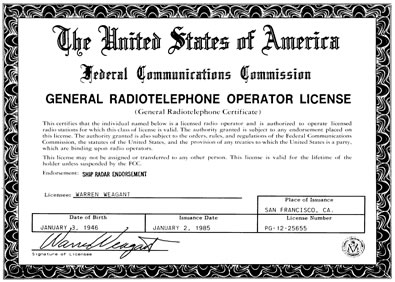
My recollection is that the replacement for First/Second was called General Radiotelephone Operator License and the Third Phone replacement, Restricted Radiotelephone Operator Permit. I think both changes were effective January 1, 1985; I will have to dig up my General license and see what date it was issued.
 
Last edited:
In 1973, a 3rd with endorsement could operate all stations, but maintenance still required a 1st. I recall something about AM "crictical arrays" requiring a 1st operator, though, just can't find a date. Perhaps that's where your 1976 date came from.
I am reasonably certain that those critical DA arrays were defined as anything above a certain ERP and I think that was a recognition that those were still a little too complex.

As long as we are on the subject, back in the late 1970s I was at KACY/1520 in Port Hueneme (Oxnard-Ventura CA) market, which had years before gotten their daytime power increased to 50kw -- mostly so they could make a big deal about it in their sales literature -- with a three-tower array that had the main lobe shooting due west across the Pacific Ocean. (I was told on more than one occasion that we were easily receivable in Hawaii on the day power/pattern.) But the night authorization was 1kw non-DA, which required us to have two transmitters ... an RCA Ampliphase for days and an aging Collins for nights (I always thought it might have been the original transmitter from 1957 😜_. It literally took two people to change back and forth twice a day, since you had to shut down the RCA and then quickly switch the directional array to feeding one tower instead of three, and only then kick the Collins on. If you had to do it solo, there was a guarantee of several seconds with no carrier at all.
 
Last edited:
I was still required to have a 1st for a Critical AM Array in 1977. +-1 degree Phase and +- 3% Ratio and base current limits.
The array was re-licensed in '83 with a power increase from 25 kW to 50 kW and it was now standard +- 3 degrees phase and +- 5% ratio with no base current limits.
About the same time my 1st was replaced with the General Class that expired in 1987.
In 1985 that was replaced with a lifetime General Class license.
 
Establishing order was the purpose of the FRC in the later 20's. The FCC, in the earlier 30's, was just a better successor to the work of the FRC.

Yes I know. I addressed that in the second sentence of my post: ''As opposed to the way things had been prior to the FRC in the 1920s.''

Context helps. We're saying the same things, just in different ways.
 
I still have my old GROL I had forever. I remember going to the City to take my test back in the 70s. I do remember a station in Concord, CA (no longer around I think) that had a complicated directional array antenna system.
 
Well, I found my GROL. It is dated January 2, 1985. That seemed a bit off in the timeline of my career, so I did some digging and here is what I found:

The General was established in 1981 and was issued as a replacement for First and Second Phones as they came up for renewal. Beginning in 1984, the GROL became a lifetime document, and starting in 1985 those were issued either as renewals or upon the request of a current license holder.

The Third Phone (technically called the Restricted Radiotelephone Operator Permit) was changed to the "fill out the postcard, we'll put the FCC stamp on it and send it back to you" version starting in 1980 (I have verified that year, but it took a lot of digging) and was eliminated completely in 1995, except for marine and aviation two-way radio operators.
 
I can corroborate too. My original license was the blue First Class Phone, issued in July 1973. The '78 renewal was also the blue First. By '83 it became a yellow General, and by the time I renewed in '88 they sent the lifetime card-size General.

Seems like a whole other life ago.
 
Know of at least one person that didn't get around to getting the General lifetime certificate and the one they had expired.
They were bummed until told it wasn't needed anymore. Then they were mad because all the effort they went to to get the 1st now meant zilch.
 
To make matters worse, all the stuff they learned in college is obsolete.
Not really. Electrons are electrons.

And the core of electronics is math. Trig, algebra, calculus. All the math I learned in the 60's is valid today, and I can easily take refresher courses or read some books and catch up with solid state... from transistors to ICs.

Transistors work a lot like tubes. It's just that you can not fit ten million tubes on a one-inch-square chip. It is fascinating to see pictures of the earliest computers, with seemingly miles of rows of gear with lots of tubes in rack after rack. My two square foot Ryzen Threadripper powered unit has more power!
 
Not really. Electrons are electrons.

And the core of electronics is math. Trig, algebra, calculus. All the math I learned in the 60's is valid today, and I can easily take refresher courses or read some books and catch up with solid state... from transistors to ICs.

Transistors work a lot like tubes. It's just that you can not fit ten million tubes on a one-inch-square chip. It is fascinating to see pictures of the earliest computers, with seemingly miles of rows of gear with lots of tubes in rack after rack. My two square foot Ryzen Threadripper powered unit has more power!
I remember taking electronics in college and the teacher took on us on a tour of some company that had a retired computer and it was the size of 2 average size bedrooms. Now our tablets have more power!
 
Status
This thread has been closed due to inactivity. You can create a new thread to discuss this topic.


Back
Top Bottom