• Get involved.
    We want your input!
    Apply for Membership and join the conversations about everything related to broadcasting.

    After we receive your registration, a moderator will review it. After your registration is approved, you will be permitted to post.
    If you use a disposable or false email address, your registration will be rejected.

    After your membership is approved, please take a minute to tell us a little bit about yourself.
    https://www.radiodiscussions.com/forums/introduce-yourself.1088/

    Thanks in advance and have fun!
    RadioDiscussions Administrators

TV Guide editions and online resources

My first Proton TV set, bought in 1985, had that feature, which worked exactly as you described. But it couldn't get the CATV superband. When I got Qube Cable later on in Houston, I had to get a block converter to watch some channels.

These were only on the market for a few years, I had two, one was a Sony, the other was an LG that I got at KMart.
 
Fulton probably imported the St. Louis stations but I don't know for sure. The CARS-band relay was originally for the Moberly and Jefferson City systems but the Columbia system was eventually able to buy into it and get an FCC waiver to connect to it, much to the consternation of local broadcasters - and publishers - who fought hard against the introduction of a cable-TV system to Columbia.
Fulton carried St. Louis, at least when I lived there (in 6th grade) in 1974.
Great and interesting thread.
 
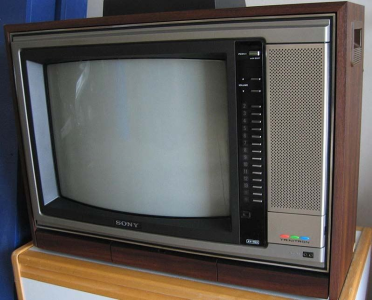
This is what my Sony looked like, IIRC the selectors were behind a door that flipped out:

View attachment 7493

And, as I noted above, the TV came with a sheet of plastic channel number tabs, and you could flip the tuner panel open and insert the tabs as desired. You didn't even have to assign the channels in any particular order, you could, for instance, cluster all of your locals together, and do likewise with out-of-market stations further on down the tuner panel. Fairly primitive by today's standards, but it got the job done. Each channel button had its own sawtooth-like tuner, something I've seen in Europe as well (though, again, as noted, Europeans typically don't think in terms of OTA channel numbers, though there are exceptions, for instance, the third channel in Rzeszow, Poland, referred to itself as "Kanal 29").
 
As I indicated in the "worst TV stations ever" thread, I'm starting a new thread devoted solely to TV Guide. I have been a TVG collector for many years, sadly, though, most of my collection had to be discarded, as they were stored in a garage for a couple of years and they developed a mold problem. I saved a few, as well as channels listed pages for all the editions I had to dispose of.

Matt Sittel's TVG channels listed site is a good place to start:

TV Guide Channels Listed Scans

One thing I noticed on this page, is that on the 2004 map, issued a year before TVG gave up on regional editions and replaced them with two national editions (Eastern/Central and Mountain/Pacific), the Columbus and West Virginia editions were collapsed into a single West Virginia edition, making the WV TVG the default edition for the Columbus market. That would actually have been workable (if Columbus viewers didn't mind having to wade through all those West Virginia stations), in that the previous Columbus edition only contained Columbus-area stations along with WHIZ Zanesville and WOUB Athens, the latter already being in the WV TVG. Moreover, Columbus 4/6/10 appeared for decades in the WV TVG as "cable channels" 4C/6C/10C, and were widely carried throughout far southeastern Ohio all the way to the Ohio River (and even in Point Pleasant and Parkersburg). The channels listed page doesn't include WHIZ, but that could have easily been added (don't know if that ever actually happened or not), and for uniformity, as well as to keep from duplicating WOAY-4 and WVVA-6, Columbus and Zanesville stations could have been listed with white bullets minus the "C" designation (or "Z" for Zanesville, I guess).

Hope it's okay under "fair use" to post the WV TVG channels listed page here:

View attachment 7016

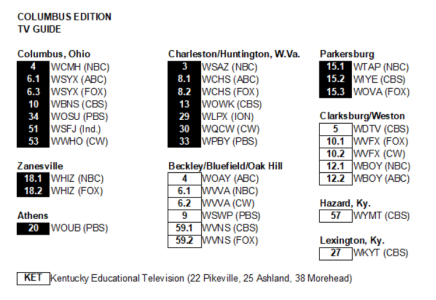
Yes, yes, I know, local editions of TVG aren't coming back, but I decided to play around with what that Columbus edition could have looked like, in a digital subchannel universe, and I came up with this (see below). My rules were:

  • No diginets, just conventional terrestrial networks (and in the case of WSFJ, independent). Diginets, which rarely have local origination inserted, could simply be listed in the same manner as cable networks.
  • Assume the channel to be "X.1" unless otherwise specified, and if X.1 is the only non-diginet channel a station has, just leave it without the subchannel designator.
  • I toyed with excluding Clarksburg/Weston (which were placed into the 2005 Pittsburgh edition in TVG's last-gasp effort to keep local editions), but they get deep into central West Virginia, so I thought "why not?".
  • No LPTVs (which were rarely listed in local TVGs, not unheard of, but outside the norm). For the LPTVs carried in tandem on WTAP, I used the parent call letters instead of calling them "WTAP (CBS)" and "WTAP (FOX)".
  • I included WKYT-27 from Lexington, as it is the most heavily-carried Lexington station on cable in eastern Kentucky, and viewers in the northeast corner (Boyd, Greenup, and Carter counties, basically the area north of I-64) still get it on cable even if they don't get WYMT. Besides, viewers there wouldn't be interested in WYMT if they could get WKYT instead.
  • I made the bullets for Columbus, Zanesville, Charleston/Huntington, and Parkersburg black, with the remaining markets being white. Besides, you have two channels 4, 6, and 10, and there has to be some way to differentiate. (Too bad I didn't have Jim Damm's old TVG channel number font.)
  • I placed Columbus at the top of the list, as it's by far the largest market, and even if the West Virginia TVG was the default edition for Columbus in TVG's final days of local editions, I can't imagine Columbus viewers would have been happy to (a) see their channels listed as "cable channels", (b) not have all of their OTA channels listed, and (c) have their local edition called the "West Virginia Edition". ("Ohio Valley Edition" would be a better choice that includes everyone.)

Anyway, here it is:

cbus tvg.png
I've been collecting and playing around with TV Guides for over 50 years now, and I see no reason to stop, even if it's just a nostalgia thing at this point.
 
Last edited:
Yes, yes, I know, local editions of TVG aren't coming back, but I decided to play around with what that Columbus edition could have looked like, in a digital subchannel universe, and I came up with this (see below). My rules were:

  • No diginets, just conventional terrestrial networks (and in the case of WSFJ, independent). Diginets, which rarely have local origination inserted, could simply be listed in the same manner as cable networks.
  • Assume the channel to be "X.1" unless otherwise specified, and if X.1 is the only non-diginet channel a station has, just leave it without the subchannel designator.
  • I toyed with excluding Clarksburg/Weston (which were placed into the 2005 Pittsburgh edition in TVG's last-gasp effort to keep local editions), but they get deep into central West Virginia, so I thought "why not?".
  • No LPTVs (which were rarely listed in local TVGs, not unheard of, but outside the norm). For the LPTVs carried in tandem on WTAP, I used the parent call letters instead of calling them "WTAP (CBS)" and "WTAP (FOX)".
  • I included WKYT-27 from Lexington, as it is the most heavily-carried Lexington station on cable in eastern Kentucky, and viewers in the northeast corner (Boyd, Greenup, and Carter counties, basically the area north of I-64) still get it on cable even if they don't get WYMT. Besides, viewers there wouldn't be interested in WYMT if they could get WKYT instead.
  • I made the bullets for Columbus, Zanesville, Charleston/Huntington, and Parkersburg black, with the remaining markets being white. Besides, you have two channels 4, 6, and 10, and there has to be some way to differentiate. (Too bad I didn't have Jim Damm's old TVG channel number font.)
  • I placed Columbus at the top of the list, as it's by far the largest market, and even if the West Virginia TVG was the default edition for Columbus in TVG's final days of local editions, I can't imagine Columbus viewers would have been happy to (a) see their channels listed as "cable channels", (b) not have all of their OTA channels listed, and (c) have their local edition called the "West Virginia Edition". ("Ohio Valley Edition" would be a better choice that includes everyone.)

Anyway, here it is:

View attachment 8080
I've been collecting and playing around with TV Guides for over 50 years now, and I see no reason to stop, even if it's just a nostalgia thing at this point.

The only mistake you've made is WPBY. That station has been WVPB-TV since 2015.
 
The only mistake you've made is WPBY. That station has been WVPB-TV since 2015.
Yep, I dropped the ball on that one. I was relying largely on memory and that didn't occur to me. Actually, I considered using "WVP" or something like that, and lumping WSWP and WVPB into one channel slug, but I'd already done that with KET (I omitted 35 Hazard as I assumed almost all viewers of that channel would be using the Kentucky edition) and didn't want to muddy things further.

At least I didn't call it WMUL.
 
Other quirks in the 2004 TVG edition map, where they telescoped many editions into consolidated ones (and, for some reason, quit putting channel guides in some editions):
  • The Virginia State edition didn't include WVVA-6 in Bluefield, even though Mercer County was in its circulation area.
  • The Southern Ohio edition (more or less combining the largely redundant Cincinnati and Dayton editions) was circulated in Ross County (Chillicothe), no doubt because WHIO-7 is carried on cable there.
  • The Eastern North Carolina edition has that little appendix-looking thing where it was circulated in Marion County SC, probably to provide both Florence/Myrtle Beach and Wilmington stations, even though Horry County always had the South Carolina edition (even when it was part of the Wilmington DMA). You could get the Eastern NC edition at stores in North Myrtle Beach, and when I lived in MB, I subscribed to that edition by special request.
 
Other quirks in the 2004 TVG edition map, where they telescoped many editions into consolidated ones (and, for some reason, quit putting channel guides in some editions):
  • The Virginia State edition didn't include WVVA-6 in Bluefield, even though Mercer County was in its circulation area.
  • The Southern Ohio edition (more or less combining the largely redundant Cincinnati and Dayton editions) was circulated in Ross County (Chillicothe), no doubt because WHIO-7 is carried on cable there.
  • The Eastern North Carolina edition has that little appendix-looking thing where it was circulated in Marion County SC, probably to provide both Florence/Myrtle Beach and Wilmington stations, even though Horry County always had the South Carolina edition (even when it was part of the Wilmington DMA). You could get the Eastern NC edition at stores in North Myrtle Beach, and when I lived in MB, I subscribed to that edition by special request.
Some more absolute weirdness:
  • Lapeer, Livingston, and Sanilac counties getting the Northern Michigan edition despite being in the Detroit DMA (and Detroit Metro had its own edition; only CBET and WKBD from Detroit appeared in the Northern Michigan edition)
  • Hillsdale County getting the Detroit Metro edition despite being in the Lansing/Jackson DMA (the Detroit edition only included Detroit and Toledo stations)
  • The Detroit Metro edition never included WFUM, despite that station having fairly widespread cable carriage in Oakland County
  • The Northern Wisconsin edition (which also served the Upper Peninsula of Michigan) never adding WMQF after it signed on in 2003; side note, WGKI/WFQX was also never included despite it being on cable in most of the UP until 2003
 
Some more absolute weirdness:
  • Lapeer, Livingston, and Sanilac counties getting the Northern Michigan edition despite being in the Detroit DMA (and Detroit Metro had its own edition; only CBET and WKBD from Detroit appeared in the Northern Michigan edition)
  • Hillsdale County getting the Detroit Metro edition despite being in the Lansing/Jackson DMA (the Detroit edition only included Detroit and Toledo stations)
  • The Detroit Metro edition never included WFUM, despite that station having fairly widespread cable carriage in Oakland County
  • The Northern Wisconsin edition (which also served the Upper Peninsula of Michigan) never adding WMQF after it signed on in 2003; side note, WGKI/WFQX was also never included despite it being on cable in most of the UP until 2003
My family has lived in Hillsdale, MI, since 1995. They had a TV Guide subscription up to the end of the local editions and it was the Flint-Lansing edition initially in 1995. Then, when editions were consolidated in 2004, they got the Northern Michigan edition.

The title may have seemed odd since Hillsdale county is on Michigan's southern border, but it did include all their "local in-market" TV stations. However, it did not include the two "out-of-market" stations that could were on their cable system and could actually be received over-the-air better than most of the "in-market" stations: WTOL and WTVG from Toledo, Ohio.

They never received the Detroit Metro edition nor did I ever see it for sale anywhere within the city of Hillsdale when I visited. Was it available in other parts of the county, perhaps further east?
 
I had no choice but to toss my CRT TV out (I couldn't fit it in the car and I already had an HD) when I left Ellensburg in 2022...I haven't been able to pick up another one since. Thrift stores don't take them and even estate sales, more often than not, don't have an old CRT TV in the bedroom or spare rooms, even if there's wooden holders full of VHS tapes.
 
I had no choice but to toss my CRT TV out (I couldn't fit it in the car and I already had an HD) when I left Ellensburg in 2022...I haven't been able to pick up another one since. Thrift stores don't take them and even estate sales, more often than not, don't have an old CRT TV in the bedroom or spare rooms, even if there's wooden holders full of VHS tapes.

I have three CRT TV sets, one used by my son for video games, one just sitting in a bedroom beside the bed (acts as a caddy for spare blankets and pillows), and another in the same bedroom, to which I attached one of the old Magnavox converter boxes they gave away in 2009, "just because". I also have two or three other B&W sets, including small portable TVs I got in Germany and Poland while traveling (yes, I did DX, or attempted to, in Europe), they were basically giving them away for about $20 each. I can't bring myself to part with any of them.

The Zenith set-top boxes are golden for DX, you can do additive scanning as well as individual channels not picked up in the scan, and they have a very efficient signal meter. I have two of those attached to auxiliary ports on DTV receivers for a secondary tuner.
 
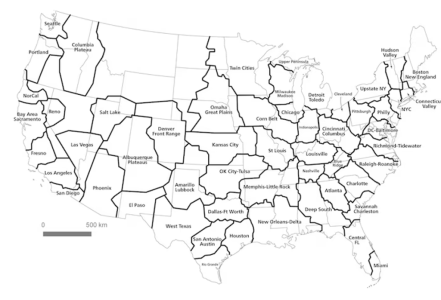
I was struck by this map, tied to commuting patterns, which originally appeared in an online National Geographic article (hope it is okay to share this under "fair use"), that shows how the US divides into very discrete regions, and how, at least on the East Coast, it roughly conforms both to TV DMAs and TV Guide editions (at least in the 2004-2005 incarnation):

1732813296122.png


WRT TV Guide editions, I noted the following:

"Blue Ridge" conforms, give or take a county or two, to the Knoxville and Bristol-Kingsport-Johnson City DMAs
"Charlotte" --- the Charlotte, GSAA, Columbia, Augusta, and Florence-Myrtle Beach markets
"Raleigh-Roanoke" --- Roanoke, NC Triad, Raleigh-Durham, Greenville-Washington-New Bern, and Wilmington
"Savannah-Charleston" --- well, Savannah and Charleston
"Cincinnati-Columbus" --- Cincinnati, Columbus, Dayton, Zanesville, Lima, Charleston-Huntington, Beckley-Bluefield-Oak Hill, and Parkersburg

...and so on.

I also noted that the "Cincinnati-Columbus" region pretty much corresponds to the 2004 Southern Ohio and West Virginia editions (the latter also being the default edition for Columbus).
 
I can think of only a few markets that were obviously divided:
Wichita-Hutchinson - Kansas City and Amarillo-Lubbock
Fayetteville-Fort Smith - OKC-Tulsa and Memphis-Little Rock
Shreveport-Texarkana - New Orleans-Delta and Memphis-Little Rock
Paducah-Cape Girardeau - St. Louis and Memphis-Little Rock
Salt Lake City - Salt Lake City, Albuquerque Plateaus, and Las Vegas (St. George would likely have been in the Las Vegas DMA if Nevada and Utah were in the same time zone)
Portland (OR) - Portland and Columbia Plateau
Albuquerque - Albuquerque Plateaus, El Paso, and West Texas
Traverse City-Cadillac - Detroit-Toledo and Upper Peninsula
 
Other quirks in the 2004 TVG edition map, where they telescoped many editions into consolidated ones (and, for some reason, quit putting channel guides in some editions):
  • The Virginia State edition didn't include WVVA-6 in Bluefield, even though Mercer County was in its circulation area.
  • The Southern Ohio edition (more or less combining the largely redundant Cincinnati and Dayton editions) was circulated in Ross County (Chillicothe), no doubt because WHIO-7 is carried on cable there.
  • The Eastern North Carolina edition has that little appendix-looking thing where it was circulated in Marion County SC, probably to provide both Florence/Myrtle Beach and Wilmington stations, even though Horry County always had the South Carolina edition (even when it was part of the Wilmington DMA). You could get the Eastern NC edition at stores in North Myrtle Beach, and when I lived in MB, I subscribed to that edition by special request.
Here's what I remember by memory about TV Guide editions in the Columbus, Ohio.

During the 1970's, you got the Southern Ohio edition of TV Guide in Columbus until early 1979. It had the listngs for Cincinnati, Columbus, Dayton, Lima, and Zanesville.

Then in early 1979 Columbus had the Columbus Metropolitan edition of TV Guide until early 2004. It had the listings for Columbus, Zanesville, and WUAB from Cleveland listed as cable.

And then in early 2004 Columbus had the Southern Ohio edition of TV Guide again.

I remember between 1979 to 2004, if you drove west of Columbus to London or Springfield, you would get the Southern Ohio edition of TV Guide there. Also if you drove north of Columbus to Marion or Mount Vernon, you would get the Northern Ohio edition of TV Guide there.

I've always thought that the Southern Ohio edition of TV Guide should have also carried the tv listings for the Charleston-Huntington market back then.

I agree that it would make more sense to rename the Southern Ohio edition of TV Guide to the Ohio Valley or Ohio River Valley edition of TV Guide back then.

The Ohio stations from Athens, Cincinnati, Columbus, Dayton, and Zanesville would have black bullets while the West Virginia stations from Charleston-Huntington, Parkersburg, and Wheeling, and KET from Kentucky would have white bullets in the Ohio Valley or Ohio River Valley edition of TV Guide.

I remember that many folks living in Southern and Southeastern Ohio picked up the Charleston Huntington and the Columbus stations on antenna and cable tv back then.

I also remember that Chillicothe (Ross County) carried WSAZ 3 from Huntington and WHIO 7 from Dayton on cable back then.
 
My ex-Mother In Law lived in Waverly, Ohio and they got the West Virginia edition, which carried Columbus and Zanesville in addition to Ashland/Huntington, Charleston and Wheeling. KET had just one listing as the network.
 
My ex-Mother In Law lived in Waverly, Ohio and they got the West Virginia edition, which carried Columbus and Zanesville in addition to Ashland/Huntington, Charleston and Wheeling. KET had just one listing as the network.

Pretty sure the West Virginia edition never carried WHIZ from Zanesville, I think you're mistaken on that count. You might be conflating it with WTRF from Wheeling. It did carry Columbus 4/6/10 as "cable stations", designated "4C", "6C", and "10C". (Before they went to the channel-plus-initial scheme, 4/6/10 had what they called "notched slugs", white with black notches to the left and right of the channel number.) In the 1980s and 1990s they did list WPBO from Portsmouth, which was a repeater of WOSU-34 with no local origination. WPBO was later closed down for financial reasons.

The West Virginia TVG went through the following incarnations (I'm listing channel numbers here only for brevity):
  • Prior to circa 1971 they only listed C-H 3/8/13, Oak Hill 4, Bluefield 6, and Parkersburg 15.
  • About that time, they rolled out "cable channels" comprised of Columbus 4/6/10, Wheeling 7, Clarksburg 12, and Athens 20. (Sometime after that, they added a quirky little cable-only channel, WNOW-9 from Parkersburg, which, bizarrely, carried the ABC Evening News, I'm assuming they plucked that from either WTVN or WHTN, and I think they did their own local newscast as well, perhaps they thought having both local news and a national network newscast made them look more like a "real" TV station such as WTAP).
  • They later added Cincinnati 19 (as a "cable channel", 19C), Hazard 57, and KET.
  • Sometime in the 1980s they added Weston 5 (as a regular channel, black slug with white channel number).
  • They finally streamlined the channel lineup, deleting Wheeling 7 and Cincinnati 19, and abandoned the "cable channel" concept except for Columbus. It stayed that way until the end.
 
Last edited:
Here's what I remember by memory about TV Guide editions in the Columbus, Ohio.

During the 1970's, you got the Southern Ohio edition of TV Guide in Columbus until early 1979. It had the listngs for Cincinnati, Columbus, Dayton, Lima, and Zanesville.

Then in early 1979 Columbus had the Columbus Metropolitan edition of TV Guide until early 2004. It had the listings for Columbus, Zanesville, and WUAB from Cleveland listed as cable.

And then in early 2004 Columbus had the Southern Ohio edition of TV Guide again.

I remember between 1979 to 2004, if you drove west of Columbus to London or Springfield, you would get the Southern Ohio edition of TV Guide there. Also if you drove north of Columbus to Marion or Mount Vernon, you would get the Northern Ohio edition of TV Guide there.

I've always thought that the Southern Ohio edition of TV Guide should have also carried the tv listings for the Charleston-Huntington market back then.

I agree that it would make more sense to rename the Southern Ohio edition of TV Guide to the Ohio Valley or Ohio River Valley edition of TV Guide back then.

The Ohio stations from Athens, Cincinnati, Columbus, Dayton, and Zanesville would have black bullets while the West Virginia stations from Charleston-Huntington, Parkersburg, and Wheeling, and KET from Kentucky would have white bullets in the Ohio Valley or Ohio River Valley edition of TV Guide.

I remember that many folks living in Southern and Southeastern Ohio picked up the Charleston Huntington and the Columbus stations on antenna and cable tv back then.

I also remember that Chillicothe (Ross County) carried WSAZ 3 from Huntington and WHIO 7 from Dayton on cable back then.

I was just going by the map that TVG put out in 2004, which showed Columbus as getting the West Virginia edition. I was assuming that they collapsed the Columbus and West Virginia TVG coverage areas together, and basically told Columbus viewers, "here's your home edition, yes, we know it's called the West Virginia edition, but, hey, it lists your three main stations". I get the impression that in those couple of years before the demise of local editions, TVG went on an efficiency rampage, and combined all the editions they could, regardless of how incongruous some of them might be. What I never understood was why, towards the end, they finally quit putting "channels listed" pages in many of the editions. That made no sense whatsoever.

I also thought that they should have carried C-H stations (at least WSAZ and WHTN/WOWK) in the Southern Ohio TVG, but a combined Columbus/West Virginia TVG (as I envisioned in the mock-up I posted above), with Columbus having pride of place as the principal market in the edition, actually would have made a lot of sense. Unless it would have been Portsmouth or Chillicothe, there wasn't much spillover between C-H and Columbus on the one hand, and Cincinnati and Dayton on the other, and the 2004-2005 Southern Ohio edition carried Columbus and Zanesville anyway. I have to think that the 2004 TVG map may have been in error, and that the Columbus edition and its circulation area was subsumed into the Southern Ohio edition (basically the old lineup resurrected minus WOUB Athens) instead of the West Virginia edition.

Chillicothe cable, so far as I can tell, still carries WHIO from Dayton, though WSAZ and WHTN/WOWK went away a long time ago. And on something called "Horizon View", WCPO from Cincinnati is carried as well. (I'm just going by TVTV.com, which is not always accurate.)


Back
Top Bottom