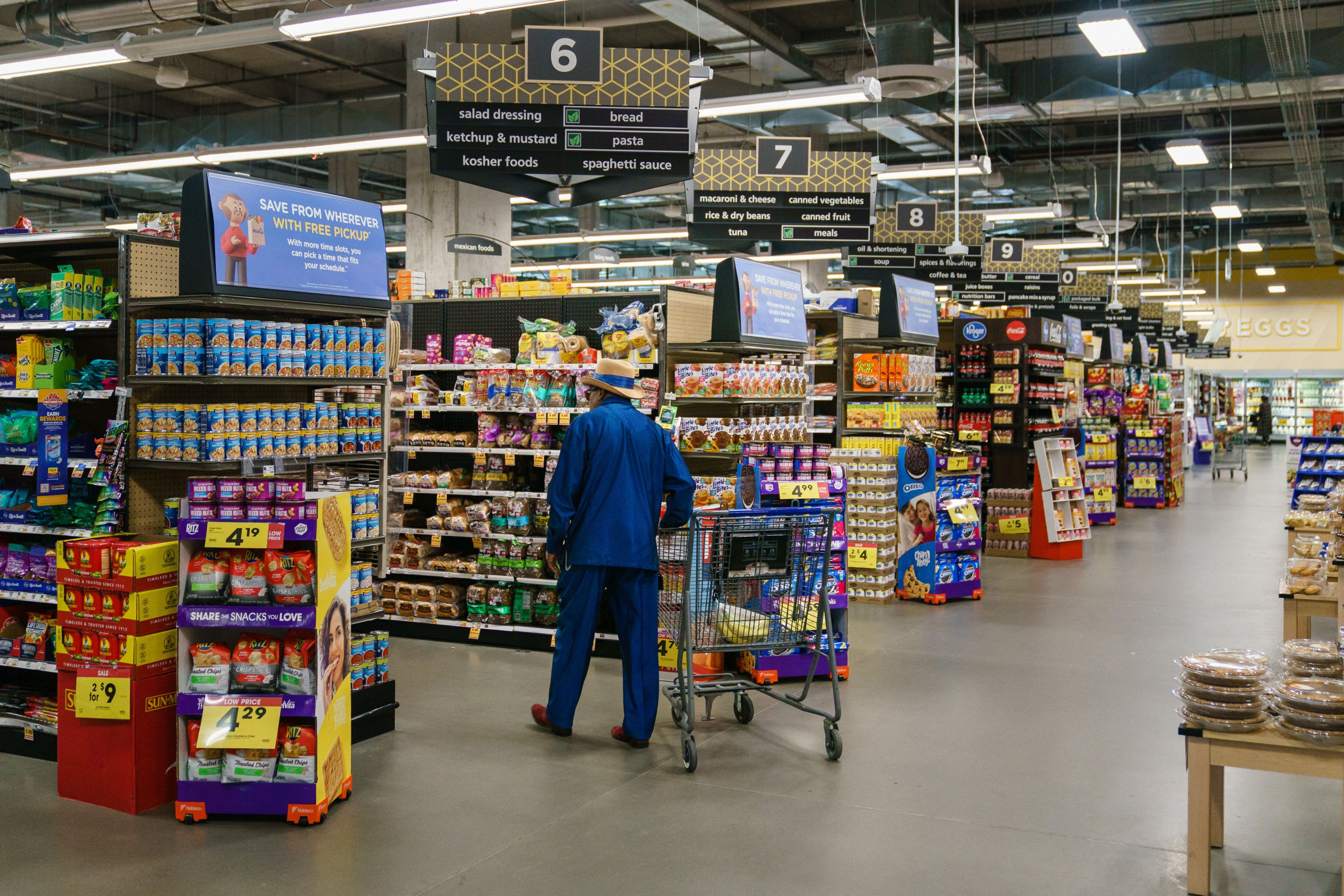
When it comes to grocery delivery Instacart tops Walmart and Amazon, and they rely on local grocers like Kroger and Albertsons. So they would most certainly be affected by store closings, reduced competition and the resulting price hikes.
Instacart is not a grocer. They are a delivery service, and the fees, including obligatory tips, are burdensome for most families today.
OTOH, Amazon delivers as part of an annual fee that also includes delivery on electronics, clothing, medications, and just about everything else. If you use Amazon a lot, the delivery charge can average out to about $0.50 per day. I looked at my Amazon account and last year there were over 2,500 items including about 50 on each month's "Subscribe and Save". We get as many as three deliveries a day, and then we get a bunch of free TV shows and movies and videos to boot!
On clothing, to skip to another area, two of us in the household use uneven sizes... such as a 33 pant length instead of a 32 or 34. Most retailers only have even sizes. So for over a decade and a half I've bough nearly everything from shoes to shirts online.ddd I mention this other area because retail can't offer the breadth of sizes, colors and brands but a company that only has to stock a few regional warehouses can.
I had back surgery last week. I needed to use an elastic belt starting the day afterwards. The local CVS and Walgreens and all their branches without 15 miles were out of the kind I needed. Amazon had over a dozen choices, all with return options. I read reviews and the specs and found two that would work for day and night usage they were delivered the next morning, and they cost about 35% less than the CVS store brand were it in stock. Which it wasn't.
There is a radio side to this, too: Walmart and Zapos and Amazon and the like don't buy local media. As more and more people expand their usage of those online services, the available local revenue for radio will be impacted. More PI attorneys, dermatologists who do Botox treatments, and car dealers. But the big retailers don't use much local radio, and the local small businesses can't afford it when most of their budget goes to the Google and similar resources that help them be noticed when a homeowner, for example, needs roof repair.
The FTC thankfully understands that this kind of mega merger is not good for customers or workers. The agency knows it would lead to higher prices, store closures and job losses.
There is no proof of this. In fact, with the stores that would be close being sold to other grocers or to specialty grocery operators such as natural and organic focused ones, the field might even expand.
And preventing the merger will not make me want to go back to a local grocer for more things. As it is, I only use them for fresh or perishable and frozen things, and find that farmers' markets now satisfy a lot of those needs, too.
Less competition never benefits consumers. Not when it comes to groceries, and not when it comes to media choices either, just to keep this tied to radio.
Docket 80-90 proved that too many over the air choices can nearly destroy a medium. I've mentioned a market with three stations where everyone made money and there was good local service. 80-90 brought in three new local FMs and two more in the adjacent town, and nobody makes money there and no station does local news and personality shows.
And, anyway, over two-thirds of radio time sent listening has gone to streamed services. No local news, no local ads, but the local stations have found that market revenue is hovering around 30% of the level where it was 20 years ago (inflation adjusted) while costs have increased enormously.
This is a case where nobody makes money and the overall quality of radio service is vastly inferior to what it was in Y2K.



 apnews.com