• Get involved.
    We want your input!
    Apply for Membership and join the conversations about everything related to broadcasting.

    After we receive your registration, a moderator will review it. After your registration is approved, you will be permitted to post.
    If you use a disposable or false email address, your registration will be rejected.

    After your membership is approved, please take a minute to tell us a little bit about yourself.
    https://www.radiodiscussions.com/forums/introduce-yourself.1088/

    Thanks in advance and have fun!
    RadioDiscussions Administrators

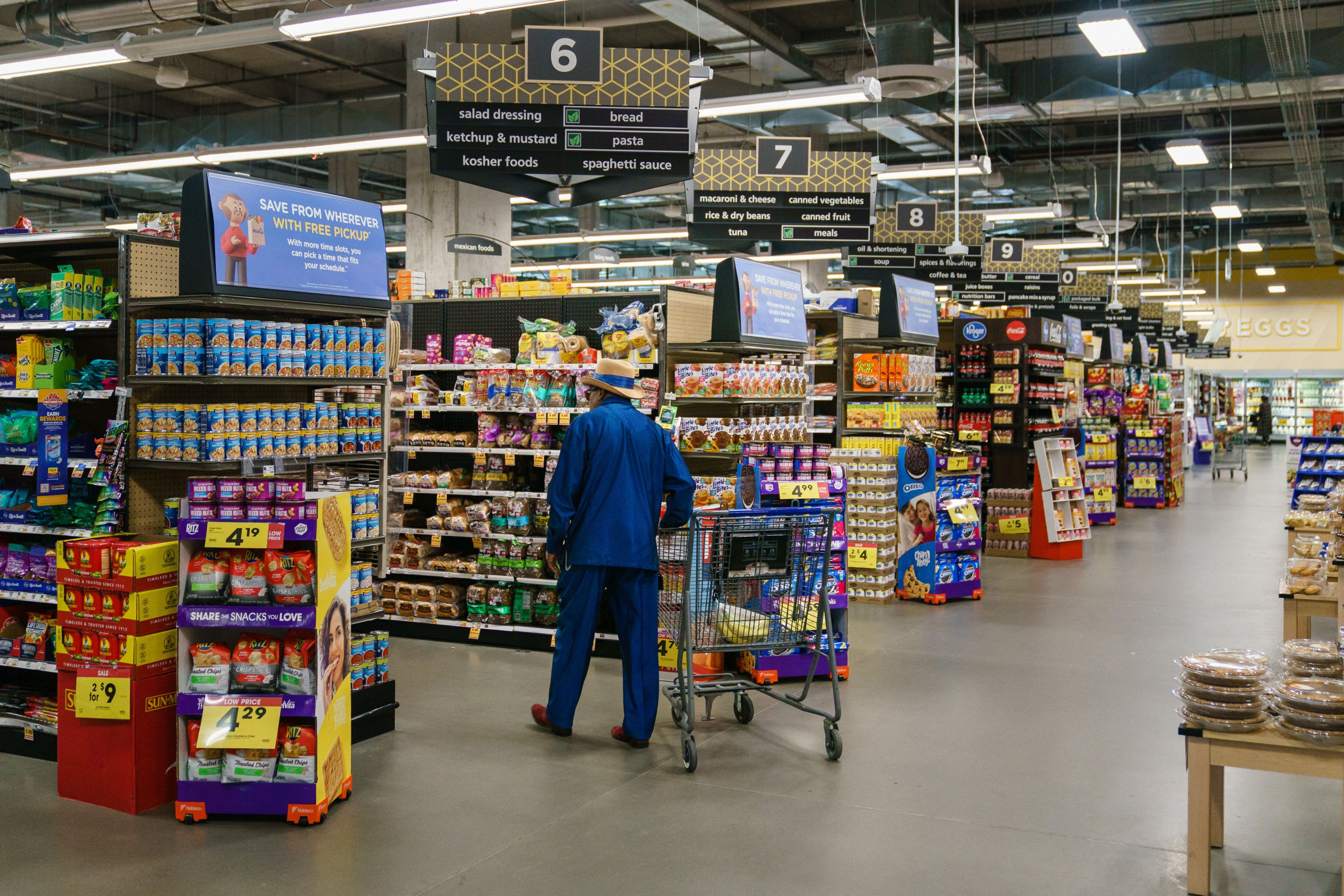
Kroger and Albertsons in talks of a merger

Thank heavens. My neighborhood King Soopers (Kroger-owned) recently was ordered to remediate a problem with rodent droppings found in a storage area of the store. Denver inspectors found rodent feces at the King Soopers in Montclair

Another reason that I go to the Safeway that's just across the street. While a smaller store, it's much nicer.

Did you ever go to Dillon’s (which is also owned by Kroger) when you were in KC? I used to when I was younger but now the closest ones are in Lawrence.
 
Did you ever go to Dillon’s (which is also owned by Kroger) when you were in KC? I used to when I was younger but now the closest ones are in Lawrence.
No; there weren't any close by. Just a couple of smallish supermarkets at 63rd & Brookside, including the last Milgram's remaining in Kansas City. I believe it's now a CVS. I occasionally went to Gerbes in Columbia, which was part of Dillon's. It was, well, OK.

In Houston, I went to what was popularly known as the Disco Kroger on Montrose Boulevard. The people and the things one saw there. It was state-of-the-art when it opened in 1986, but merchandising has moved on since.
 
What the FTC seems to fail to understand is that neighborhood grocery stores are not where there is a monopoly issue... it is the online services ranging from Amazon to the Walmart online grocery service.

In my home, we now get about half of our goods that used to come from supermarkets (H&BA, housekeeping, packaged and canned goods, cereals, bottled juices, etc.) from Amazon or Walmart. Our expenditure with our local grocery stores is off by at least 50%.
 
What the FTC seems to fail to understand is that neighborhood grocery stores are not where there is a monopoly issue... it is the online services ranging from Amazon to the Walmart online grocery service.

In my home, we now get about half of our goods that used to come from supermarkets (H&BA, housekeeping, packaged and canned goods, cereals, bottled juices, etc.) from Amazon or Walmart. Our expenditure with our local grocery stores is off by at least 50%.
I do all my grocery shopping online now. I got tired of grocery stores hassling me about my coupons that different manufacturers mailed me, and having to do self checkout because the stores only had a few registers with clerks open. Plus If my expedited Amazon deliveries arrive after the date they’re supposed to, sometimes they’ll give me the shipping credit back. If stuff gets broken in shipping, customer service will credit me just on my word, I don’t have to even take pictures of the damaged products or anything. Plus there are specialty foods on Amazon I can’t find around here to try, like pickled hot dogs and different sodas.
 
What the FTC seems to fail to understand is that neighborhood grocery stores are not where there is a monopoly issue... it is the online services ranging from Amazon to the Walmart online grocery service.

In my home, we now get about half of our goods that used to come from supermarkets (H&BA, housekeeping, packaged and canned goods, cereals, bottled juices, etc.) from Amazon or Walmart. Our expenditure with our local grocery stores is off by at least 50%.

When it comes to grocery delivery Instacart tops Walmart and Amazon, and they rely on local grocers like Kroger and Albertsons. So they would most certainly be affected by store closings, reduced competition and the resulting price hikes.

The FTC thankfully understands that this kind of mega merger is not good for customers or workers. The agency knows it would lead to higher prices, store closures and job losses.

Less competition never benefits consumers. Not when it comes to groceries, and not when it comes to media choices either, just to keep this tied to radio.
 
When it comes to grocery delivery Instacart tops Walmart and Amazon, and they rely on local grocers like Kroger and Albertsons. So they would most certainly be affected by store closings, reduced competition and the resulting price hikes.
Instacart is not a grocer. They are a delivery service, and the fees, including obligatory tips, are burdensome for most families today.

OTOH, Amazon delivers as part of an annual fee that also includes delivery on electronics, clothing, medications, and just about everything else. If you use Amazon a lot, the delivery charge can average out to about $0.50 per day. I looked at my Amazon account and last year there were over 2,500 items including about 50 on each month's "Subscribe and Save". We get as many as three deliveries a day, and then we get a bunch of free TV shows and movies and videos to boot!

On clothing, to skip to another area, two of us in the household use uneven sizes... such as a 33 pant length instead of a 32 or 34. Most retailers only have even sizes. So for over a decade and a half I've bough nearly everything from shoes to shirts online.ddd I mention this other area because retail can't offer the breadth of sizes, colors and brands but a company that only has to stock a few regional warehouses can.

I had back surgery last week. I needed to use an elastic belt starting the day afterwards. The local CVS and Walgreens and all their branches without 15 miles were out of the kind I needed. Amazon had over a dozen choices, all with return options. I read reviews and the specs and found two that would work for day and night usage they were delivered the next morning, and they cost about 35% less than the CVS store brand were it in stock. Which it wasn't.

There is a radio side to this, too: Walmart and Zapos and Amazon and the like don't buy local media. As more and more people expand their usage of those online services, the available local revenue for radio will be impacted. More PI attorneys, dermatologists who do Botox treatments, and car dealers. But the big retailers don't use much local radio, and the local small businesses can't afford it when most of their budget goes to the Google and similar resources that help them be noticed when a homeowner, for example, needs roof repair.
The FTC thankfully understands that this kind of mega merger is not good for customers or workers. The agency knows it would lead to higher prices, store closures and job losses.
There is no proof of this. In fact, with the stores that would be close being sold to other grocers or to specialty grocery operators such as natural and organic focused ones, the field might even expand.

And preventing the merger will not make me want to go back to a local grocer for more things. As it is, I only use them for fresh or perishable and frozen things, and find that farmers' markets now satisfy a lot of those needs, too.
Less competition never benefits consumers. Not when it comes to groceries, and not when it comes to media choices either, just to keep this tied to radio.
Docket 80-90 proved that too many over the air choices can nearly destroy a medium. I've mentioned a market with three stations where everyone made money and there was good local service. 80-90 brought in three new local FMs and two more in the adjacent town, and nobody makes money there and no station does local news and personality shows.

And, anyway, over two-thirds of radio time sent listening has gone to streamed services. No local news, no local ads, but the local stations have found that market revenue is hovering around 30% of the level where it was 20 years ago (inflation adjusted) while costs have increased enormously.

This is a case where nobody makes money and the overall quality of radio service is vastly inferior to what it was in Y2K.

 
This discussion brings to mind the ever evolving definition of what constitutes the market for competition. Should the FTC just look at supermarkets, all brick & mortar retailers or the entire avenue of choices (including online merchants). The same logic could be applied to a merger between 2 radio chains where ownership cap limits are exceeded in a few markets - is a radio almost monopoly in one market as troublesome with all the audio services and podcasts? Rhetorical question. Same with broadcast networks -could 2 broadcast networks merge today with all the other viewing options? Again, rhetorical question. The important question is “what is the overall/total market?”
 
This discussion brings to mind the ever evolving definition of what constitutes the market for competition. Should the FTC just look at supermarkets, all brick & mortar retailers or the entire avenue of choices (including online merchants).
The definition would have to vary based on the industry.

There's only one manufacturer of jet airliners in the US (Boeing) but there's a solid dozen automakers.

I think the distinction in the Albertsons/Kroger case is that they are mainstream grocers, and in some places, especially in the west, they might be the only two grocers in that category.
Kroger would probably say that premium markets (Whole Foods), discounters (Aldi) and hypermarts (Walmart, Costco) are also competition.

But I think if you looked at what percentage of items are stocked in all the stores, you'd find not a lot of overlap. They all sell a cereal that has raisins and bran flakes, but Costco will have it in extra large size, Aldi will only have a private brand, Whole Foods will have something that costs twice as much... On that particular item, only Walmart and Kroger are truly competing.
 
There are different levels of premium and discount.

Harris Teeter in my area used to be above discount but below premium. Kroger took over and it's closer to a discount chain, even though the stores are still nicer. I go there because I have to buy $100 worth of merchandise each month to save 10 cents a gallon on gas. Anything less and I save 3 cents a gallon, which is possible if you buy absolutely nothing. If you go over $100, no additional savings until you get to $200. And you only get one chance to use your savings, except at Harris Teeters with gas. I did discover those places would let you get gas more than once and still use points.

Food Lion was seen as a discount chain, then they divided their stores into regular, discount and premium. Now they're back to one chain but still above discount and below premium.

I would never go to Aldi because of the lack of choice and their bag policies. I won't use reusable bags and I only get paper bags.
 
A court has sided with the FTC, thankfully blocking this horrible merger. A rare victory for the people against these corporate behemoths, at least for now.

This is good news! I shop at Smith's, not to be confused with Smith's Food King that was owned by the Smith family, or Smittys. Kroger is much better than Safeway and that is not saying much. Any chain these two touch turn to crap. Big shout out to Haagan for showing the benefits of the merger. Smith's Food & Drug came to L.A., built 26 stand alone stores, and shut down 3 years later.
 
And then there was Fleming Foods in Miami, right down the street from Radio Marti who wanted to absorb many of the spun off Kroger stores during their last acquisition in the early 2000's. They went bankrupt instead and closed. At least Haagen still has a few stores left. S & W Supermarket was ready to step in and buy many of the closed Kroger & Safeway stores. They have 2 employees if its the same S & W my Safeway Manager was telling me about?
 
A court has sided with the FTC, thankfully blocking this horrible merger. A rare victory for the people against these corporate behemoths, at least for now.

Where I live, it means that several supermarkets from each of the chains will close anyway, as they were losing money due to Amazon Prime and Walmart grocery services taking their business. The end result is that people in the less dense residential areas that are farther from the shopping zones will have to travel farther.

In groceries, volume is the only way prices can be reduced. You need to read up about the supermarket business, as your beliefs are totally mistaken.
 
In groceries, volume is the only way prices can be reduced. You need to read up about the supermarket business, as your beliefs are totally mistaken.

This is always the corporate talking point that mega mergers will benefit the public with lower prices and greater selection. It always turns out to be a lie and there is plenty of evidence that's the case here too, which is why it was blocked. Less competition equals higher prices, less choice, store closures and layoffs. Same as we see every day in broadcasting.
 
This is always the corporate talking point that mega mergers will benefit the public with lower prices and greater selection. It always turns out to be a lie and there is plenty of evidence that's the case here too, which is why it was blocked.
Have you ever worked for a supermarket chain? I was EVP of a division of a large such chain some years back. The only way to reduce prices is by controlling your distribution sources and the only way to to that efficiently is by "owning" a market... a region, whole state, etc. You have to have a significant percentage of local sales and locations to gain efficiency and you have to have optimum sales per square foot in each location.

In such an ideal situation, you can better negotiate prices with everyone from Kellogs to Campbells to Coca Cola and have the fewest delivery miles per sale on each product. That's how you make it cheaper.

The current merger was blocked because the idiots in government don't understand that on-line "retailers" are part of the industry. They would not look at the influence of online foodstuff and other supermarket staples like H&BA, liquor, deli, etc., were taking more and more of the market that used to belong to your neighborhood A&P.
Less competition equals higher prices, less choice, store closures and layoffs. Same as we see every day in broadcasting.
There is more competition than ever, but it is all online or part of a department store such as Walmart or Target.
 
People only see the retail side of things. What they don't see is the mega-conglomerates that control the wholesale side of the food business. The corporate farms that are putting family farms out of business. The government subsidies that cause us to buy a lot of food from foreign countries. The retail side is just the tip of the iceberg.
 
People only see the retail side of things. What they don't see is the mega-conglomerates that control the wholesale side of the food business. The corporate farms that are putting family farms out of business. The government subsidies that cause us to buy a lot of food from foreign countries. The retail side is just the tip of the iceberg.

 
People only see the retail side of things. What they don't see is the mega-conglomerates that control the wholesale side of the food business. The corporate farms that are putting family farms out of business.
And that is why I mentioned that having control over the distribution channels is key to a supermarket chain's success. That is the only way you can be invaluable enough to a vendor to be able to negotiate prices in your favor.

Example: Coke would not cede on prices at Costco. Costco quit carrying Coke. Coke reduced prices; Costco carries Coke.
The government subsidies that cause us to buy a lot of food from foreign countries. The retail side is just the tip of the iceberg.
The biggest cause of the purchase of groceries from outside the U.S. is seasonality. We can get cherries and apples in December from Chile and so on. Once one chain offers those apples, all the others have to fall in line or loose business: "I went to Hill's yesterday and again they did not have fresh lettuce for my salads so I'm going to Kroger's instead".

We want everything, from fresh corn on the cob to cherries to strawberries all year round. The only way to do that is to import from other parts of the world that have different crop seasons.
 
Status
This thread has been closed due to inactivity. You can create a new thread to discuss this topic.


Back
Top Bottom