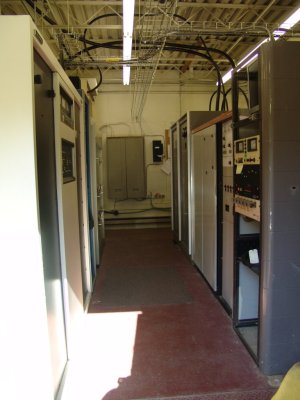
Wow, it has been ten years. Time flies when you are retired. In 2006 I spent a very big bucket of money on that place. We had to install HD and that meant a lot of work on that five tower inline beast. We wound up having to run all new lines to all the towers. And yes it rained just about every day while the trenches were open. How do the clouds know when you are doing work? Had to modify the existing phasor and bring in a new cabinet for the rotation network and other phasor mods needed to blast HD Radio to all the children in Cleveland. Lynn Willoughby really did great job on making that network as good as it could be. When that station sale closed it was extra sad because of a unique personnel situation. I won't go into it here, but after saying goodbye to hundreds of employees. I thought the gut punches were over. Our offices and studio was in a office park strip building a few miles from the site. The buyers had rented a space in the same building, just a couple of doors down.
View attachment 8654
No offense, but going HD was the worst thing that happened to AM 1260, or any AM station. This meant that the frequency response on the analog side had to be cut down to 5 kHz in order to squeeze in the IBOC carrier, which made the audio sound flat and dull, de-voiding it of any high end frequencies that it had. On top of that, 1260 for a while had this clipping/distortion problem which started around November 2006, where it sounded like someone was quickly blowing into a microphone whenever the audio hit its peak. That lasted until mid 2007, when something was adjusted, but altered the audio processing making the dynamic range compression far less aggressive. Then there was this stuttering effect where the audio rapidly cut in and out for several seconds to up to a minute, which sounded like it was a transmitter issue. The promise of the HD carrier being up and running was either late 2006 or early 2007, but I don't think that actually happened until 2008, when I noticed the "waterfall effect" from the IBOC carrier and the HD-1 designation being mentioned in the hourly ID. Other than that, Disney wasted a ton of money upgrading their stations to HD, which never took off, especially on AM, and was rendered pointless once mobile streaming took over. Both 1260 and WTAM 1100, and probably many other stations and broadcasters, pulled the plug on their HD carriers in 2013.
Unrelated to the IBOC carrier, in October of 2005, 1260 experienced an issue where it wasn't properly down-mixing the stereo feed to mono, and was only broadcasting the left channel. A small selection of songs were clearly affected, mainly being older songs from the 60s, one of which was The Monster Mash, where you couldn't hear the lead vocals as they were panned to the right channel. I actually called the station to report this issue, which continued to last throughout 2006 and into 2007 when it was finally corrected.
The feed line replacement to the towers can be seen on Google Earth by rolling back the date to June 2007. I'm in the northeastern null of the pattern, just outside of the local contour, and during time, 1260 would go non-directional at reduced power. I remember hearing the broadcast switch between the directional and non-directional patterns, as the non-directional broadcast was much louder and clearer. Unfortunately, after all the recent transmitter repairs, 1260's reception sounds no better then it did 20 years ago, and is basically the same with no improvement or degradation. As I've mentioned previously, reception sharply degrades southeast of the transmitter site, and even though cities like Peninsula, Hudson, and Kent are well inside 1260's local daytime contour, reception there is horrible. I've narrowed it down to 2 possibilities... The Cuyahoga Valley or the WTAM tower, both of which are possibly nulling the pattern in that general direction, which better reflects the night time pattern.
1260 originally had two sites. I'm very familiar with the long gone Seven Hills site. What year did the nighttime site go full-time?
From what I have gathered, the current site in Brecksville was built in 1982 for the night time pattern, which was moved from the Seven Hills site. In the early 90s (93 or 94), ownership at that time combined the day time pattern with the night time site and got approval to boost the daytime pattern from 5,000 to 10,0000 watts. Afterwards, the Seven Hills site was abandoned and the towers were removed. I have no clue if the land was sold off afterwards or if it was still owned by the station and its future owners, but in recent years, the land has been turned into a small park with walking paths.