• Get involved.
    We want your input!
    Apply for Membership and join the conversations about everything related to broadcasting.

    After we receive your registration, a moderator will review it. After your registration is approved, you will be permitted to post.
    If you use a disposable or false email address, your registration will be rejected.

    After your membership is approved, please take a minute to tell us a little bit about yourself.
    https://www.radiodiscussions.com/forums/introduce-yourself.1088/

    Thanks in advance and have fun!
    RadioDiscussions Administrators

TV Guide editions and online resources

At first, KFXJ/KREX wasn't interconnected. It's possible it could have received CBS programming via private relay from Colorado Springs but I haven't found any indication of that.

Newspaper listings indicate that KREX received protection on the Grand Junction cable system from KMGH network programming.
Was that sim-sub, or CBS programming in general, even if not being aired on both stations at the same time?

The KREX/KKTV sync-up struck me as a bit odd, I wonder if those two stations took the live feed from the ETZ, rather than rolling tape and running it later. I'm not well-versed enough in what the "normal" daytime schedules (that is, ETZ with CTZ an hour behind, or PTZ using the same time frame as ETZ) looked like for CBS (and other networks) in the late 1970s. I'm not clear on when the MTZ got its own feed, but it doesn't seem to have been as early as 1977, otherwise you wouldn't have the hodgepodge that you do in the Colorado edition.
 
I've said at various times in the past that the Columbia-Jefferson City market really should have been put in the St. Louis edition rather than the insanely configured "Missouri" edition that excluded half the state.
Yes, the Missouri edition was strange. It's hard to figure out what the reason was for that spur that went deep along the Arkansas/Oklahoma border, west of Fort Smith but not including it, and getting within spitting distance of Tulsa but not including it either. It appears to have been intended as a catch-all edition for the Columbia-Jefferson City, Joplin-Pittsburg, and Springfield markets, and as for the situation in northwest Arkansas, well, that's kind of strange as well. CJC really should have been part of the St Louis edition. The Missouri edition kind of reminds me of the South Georgia edition, which snaked around to take in Savannah and Jacksonville stations (though the home cities for those markets were in other editions), cobbling together a melange of small-market stations in Georgia and Florida, and including Atlanta stations that got deep into Georgia and even Florida on cable. It also included Dothan stations.

As to single-market editions, all I meant was that there are no markets to compare, it's basically one channel for each network (and, as you note, the independents), aside from WBKO Bowling Green being in the Nashville edition. I never understood why they went to the trouble to carve out a separate Tucson edition, when Tucson stations could easily share an edition with Phoenix (and as the local editions era ended, and TVG consolidated many editions those last couple of years, that's how it ended up).
 
Was that sim-sub, or CBS programming in general, even if not being aired on both stations at the same time?

The KREX/KKTV sync-up struck me as a bit odd, I wonder if those two stations took the live feed from the ETZ, rather than rolling tape and running it later. I'm not well-versed enough in what the "normal" daytime schedules (that is, ETZ with CTZ an hour behind, or PTZ using the same time frame as ETZ) looked like for CBS (and other networks) in the late 1970s. I'm not clear on when the MTZ got its own feed, but it doesn't seem to have been as early as 1977, otherwise you wouldn't have the hodgepodge that you do in the Colorado edition.
Normal daytime would have been the Eastern feed, thus two hours behind. NBC was the first to have a separate Mountain feed, based out of Denver, but I don't know when that started. It definitely wasn't until the 1970s at the earliest. I believe it also only was for prime-time programming. The Mountain time zone proved troublesome for the FCC's attempts to regulate cable substitution rules and for the Prime-Time Access Rule.
 
The North Dakota edition might not be as interesting as I thought. It is basically a two-market edition, Fargo-Grand Forks and Minot-Bismarck, with Minot and Bismarck having one station each, KFYR-5 Bismarck (NBC/ABC) and KXMC-13 Minot (CBS/ABC) feeding satellites in each others' cities, as well as in Dickinson and Williston. It doesn't have stations from neighboring markets aside from KMSP-9 Minneapolis-St Paul. (And earlier on there was KCND-12 Pembina, for all practical purposes Winnipeg's ABC affiliate.)
 
I'd have like to see Eastern North Carolina and Central North Carolina merge back into a North Carolina edition the way Eastern Virginia and Central Virginia merged into a Virginia State edition. I also wish, since Bristol/Kingsport/Johnson City covered such a small area, that a mass-market edition similar to Adelphia Southwest Virginia had been created with Greensboro/Winston-Salem/High Point, Roanoke/Lynchburg, Bluefield/Beckley/Oak Hill, and Bristol/Kingsport/Johnson City.
 
The North Dakota edition might not be as interesting as I thought. It is basically a two-market edition, Fargo-Grand Forks and Minot-Bismarck, with Minot and Bismarck having one station each, KFYR-5 Bismarck (NBC/ABC) and KXMC-13 Minot (CBS/ABC) feeding satellites in each others' cities, as well as in Dickinson and Williston. It doesn't have stations from neighboring markets aside from KMSP-9 Minneapolis-St Paul. (And earlier on there was KCND-12 Pembina, for all practical purposes Winnipeg's ABC affiliate.)
Was KXGN included?

Also, in the 1970s, KDIX was effectively a separately-owned satellite of KOTA
 
I'd have like to see Eastern North Carolina and Central North Carolina merge back into a North Carolina edition the way Eastern Virginia and Central Virginia merged into a Virginia State edition. I also wish, since Bristol/Kingsport/Johnson City covered such a small area, that a mass-market edition similar to Adelphia Southwest Virginia had been created with Greensboro/Winston-Salem/High Point, Roanoke/Lynchburg, Bluefield/Beckley/Oak Hill, and Bristol/Kingsport/Johnson City.
BKJC was basically an infill edition, to accommodate an area that didn't neatly fit anywhere else. It could easily have been merged with the Knoxville-Chattanooga or even the Greenville-Spartanburg-Asheville edition (indeed, GSA carried WCYB, WJHL, and WSJK at the outset).

A merged BKJC-GSA edition would have been pretty much the old Carolina-Tennessee edition. Long story short, C-T was split out and the K-C edition added Chattanooga.
 
Was KXGN included?

Also, in the 1970s, KDIX was effectively a separately-owned satellite of KOTA
To my knowledge, KXGN was never in the North Dakota edition. It's tempting to think of, as the Glendive market lies next to the Williston stations, and Williston's NBC affiliate was carried on Glendive cable.
 
It is interesting though that from 1991-1994 they put Glendive in the North Dakota market so they were in market 147 instead of 213 then 212, 211 and finally DMA 210 after they combined some DMA's and got moved back to their own DMA. 1979 they were market 212, 1986 they were market 214, 1987 they were 213, 1988 they were 212. When they were split back to its own DMA in 1995 they were DMA 211 until 2000 when they were market 210 so there were 2 DMAs combined in 1999-2000
 
To my knowledge, KXGN was never in the North Dakota edition. It's tempting to think of, as the Glendive market lies next to the Williston stations, and Williston's NBC affiliate was carried on Glendive cable.
Was KTVQ, KTVX, or KUTV ever in the ND edition? Those were carried in Williston well into the 1980s. Also the South Dakota stations would have made sense for a combined Dakotas edition (SD never had its own TV Guide AFAIK)
 
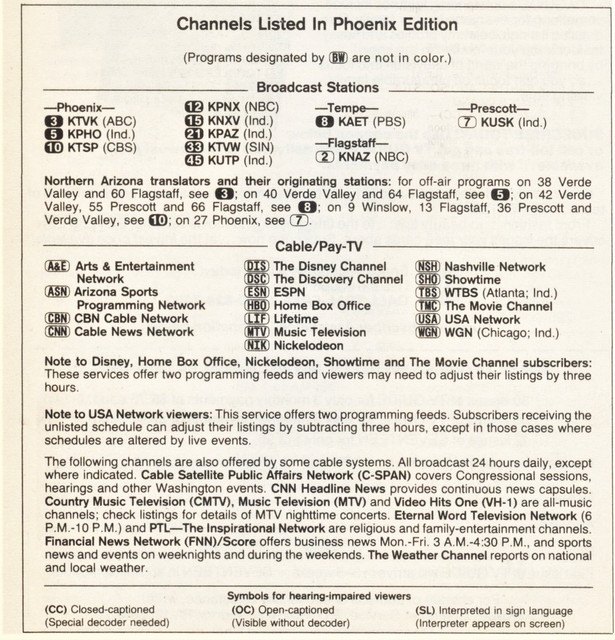
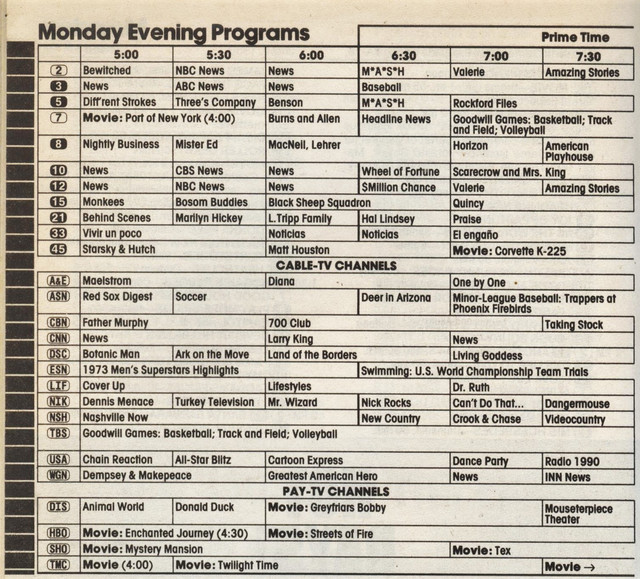
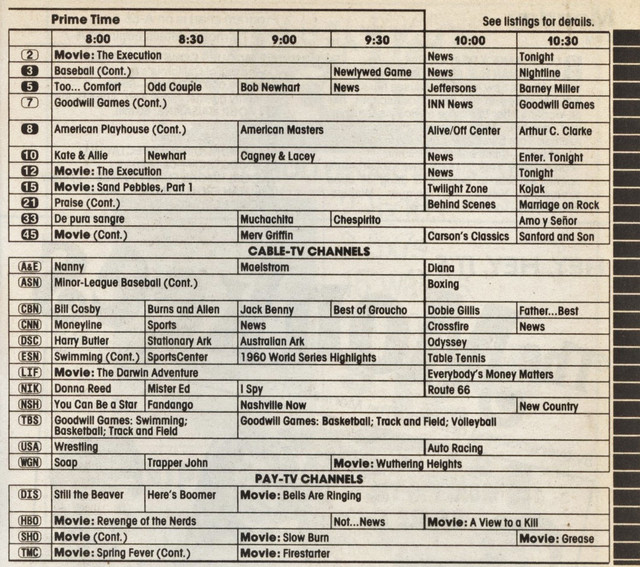
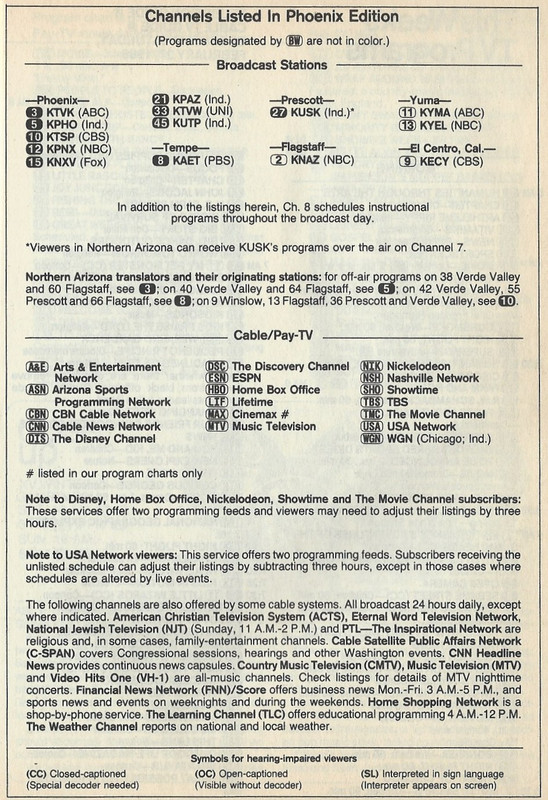
I originally posted this in the Phoenix TV subforum, but I think it's relevant here as well; the channel lineup and a sample prime time grid from the July 5, 1986, Phoenix edition of TV Guide:


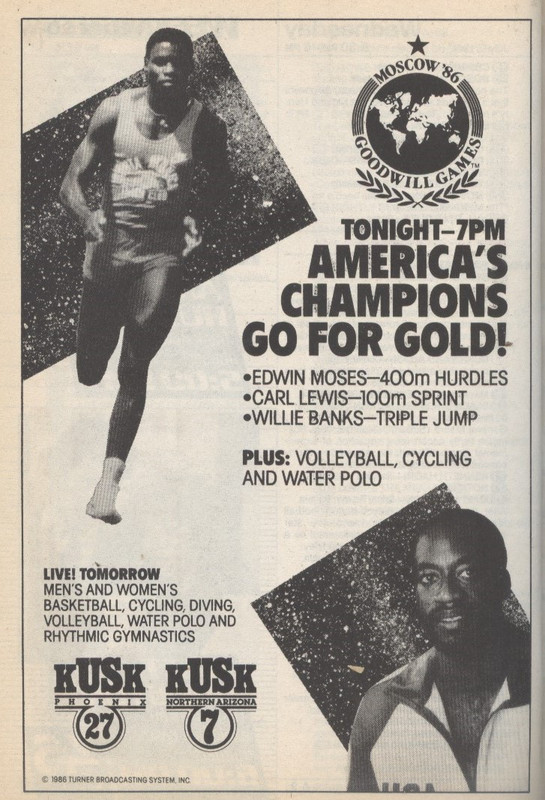
By the way, the first Goodwill Games got the cover billing that week. Perhaps surprisingly, Prescott's struggling little KUSK held the broadcast rights in the Phoenix market (perhaps an indication that even then, the answer to TV Guide's question: "Will the U.S.-Soviet matchup make them a smash on TV?" was "Probably not.")


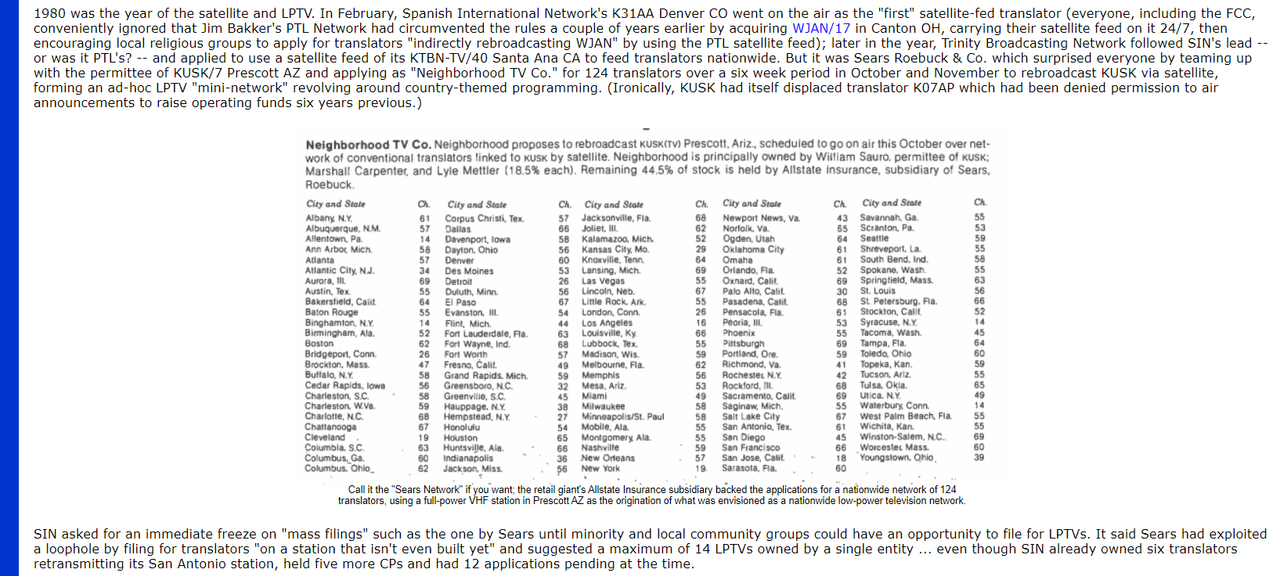
Speaking of KUSK (now KAZT), this article by K. M. Richards mentions KUSK's role in a proposed semi-national LPTV network:


And here's some in-depth information about KUSK for a station sale prospectus in 1993--a sale that didn't go through at the time [PDF format]:

https://www.americanradiohistory.com/Archive-Station-Albums/KUSK-1993-Station-Sale-Prospectus.pdf
 
For comparison with the above, here's a 1988 lineup from Matt Sittel's TV Guide site:


Two changes immediately stand out:
* Yuma/El Centro stations are now included in the Phoenix edition.
* KUSI is now listed with its Phoenix translator channel (27) instead of its originating Prescott channel (7). (It would return to 7 a few years later.)

*****

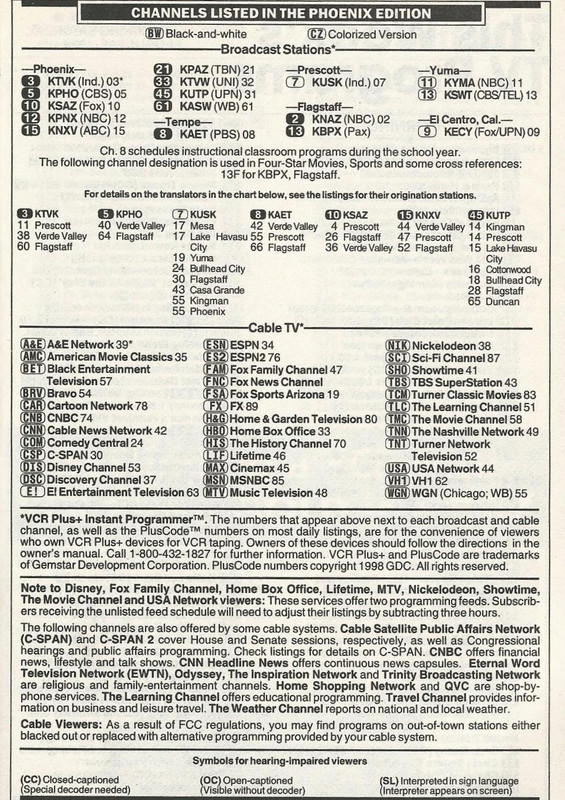
Finally, here's a 1998 lineup, also from Matt Sittel's site, showing just how hard-hit the Phoenix market was by the affiliation turmoil of the mid-1990s (NBC was the only network not to switch channels):

 
Was KTVQ, KTVX, or KUTV ever in the ND edition? Those were carried in Williston well into the 1980s. Also the South Dakota stations would have made sense for a combined Dakotas edition (SD never had its own TV Guide AFAIK)
Not to my knowledge.

And, no, South Dakota never had its own TVG. Most of the state shared the Nebraska edition, which also carried Sioux Falls stations as well as South Dakota public TV. The western portion of SD, as well as perhaps neighboring stations, did not have a TVG edition, per a map from the mid-1970 which I used to have. I'm assuming that adding the Rapid City stations to the Colorado TVG was done to give this area a TVG with home market listings.

Wyoming has never had its own TVG either. It was split between the Utah-Idaho (and later just plain Idaho) and Colorado (later Northern Colorado) editions. Parts of Wyoming may also have been in the TVG "dead zone" to which I referred above. I wish I had a copy of that map (any year in the mid-1970s would do), but they were intended for advertisers, and AFAIK weren't distributed to the general public. I used to have a contact in Dallas who would send me those maps.

Three TVG edition maps (1982, 1998, 2004) are available here:

TV Guide Channels Listed Scans
 
I originally posted this in the Phoenix TV subforum, but I think it's relevant here as well; the channel lineup and a sample prime time grid from the July 5, 1986, Phoenix edition of TV Guide:


This is from back when KNAZ-2 Flagstaff (formerly KOAI) was a free-standing station, and had its own local news. Now it's a full-time repeater of KPNX-12.
 
This is from back when KNAZ-2 Flagstaff (formerly KOAI) was a free-standing station, and had its own local news. Now it's a full-time repeater of KPNX-12.

Yes, Gannett, whose KPNX was not distributed over-the-air in Northern Arizona (as you can see in the TVG lineups above), purchased KNAZ in 1997 and made it a semi-satellite of KPNX, but kept producing separate local news in most dayparts until 2008.

A few KNAZ newscasts are available on YouTube:

1994 (6 p.m.)

1999 (10 p.m., first four minutes only)

2004 (6 p.m.)
 
That is a very basic, simple local newscast. Too bad Flagstaff doesn't have it anymore.
Based on what I've seen of it online, it was refreshingly issues-oriented.

I wonder why KMOH in Kingman was never listed in TV Guide. In some editions from the mid- to late 1990s, the station was mentioned in TVG ads for the WB, but that's it.

KMOH was long co-owned with KNAZ (by Grand Canyon Television), hence the similarity of the station's 1990s "2" and "6" logos. Initially a satellite of KNAZ, it became an independent station in the early 1990s and then a WB affiliate. Apparently, it even produced its own local news for a short time; I've never seen any clips of it online.

Here's a rare KMOH ID from the 1990s:

KMOH ID from 1993
 
Based on what I've seen of it online, it was refreshingly issues-oriented.

I wonder why KMOH in Kingman was never listed in TV Guide. In some editions from the mid- to late 1990s, the station was mentioned in TVG ads for the WB, but that's it.

KMOH was long co-owned with KNAZ (by Grand Canyon Television), hence the similarity of the station's 1990s "2" and "6" logos. Initially a satellite of KNAZ, it became an independent station in the early 1990s and then a WB affiliate. Apparently, it even produced its own local news for a short time; I've never seen any clips of it online.

Here's a rare KMOH ID from the 1990s:

KMOH ID from 1993
They may have figured that since it was a satellite, it wasn't necessary, and didn't start when it became a WB affiliate. Did the Phoenix TVG ever list it as a satellite, e.g., "for programs on 6 Kingman, see 2"? Also, stations often had to register a certain viewership before they were listed.

I also noticed how the continuity reader pronounced Saturday as "sara-day". That is an uncommon pronunciation, but you do hear it once in a great while. I wonder if it could be a "Mormon corridor" thing. They have some unusual pronunciations in that part of the country, such as "the ward of the lard" for "the word of the Lord".
 
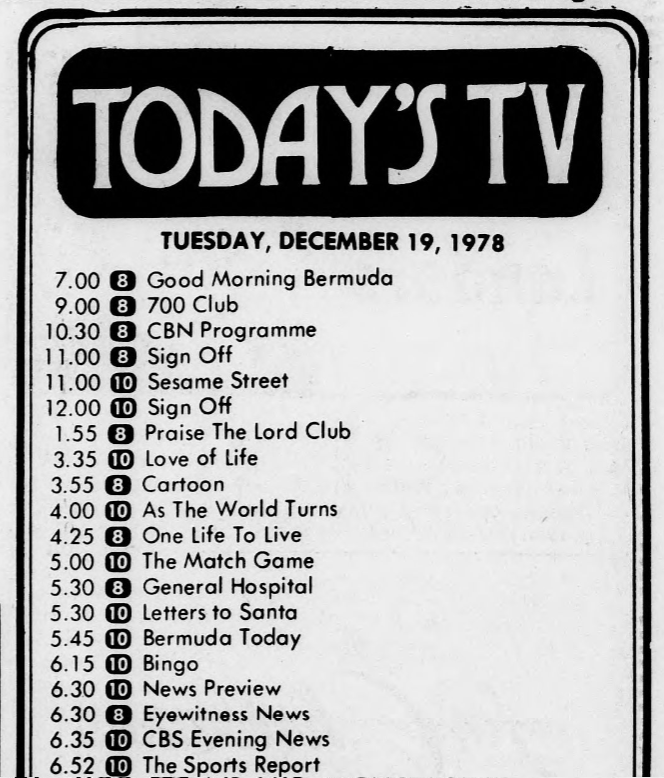
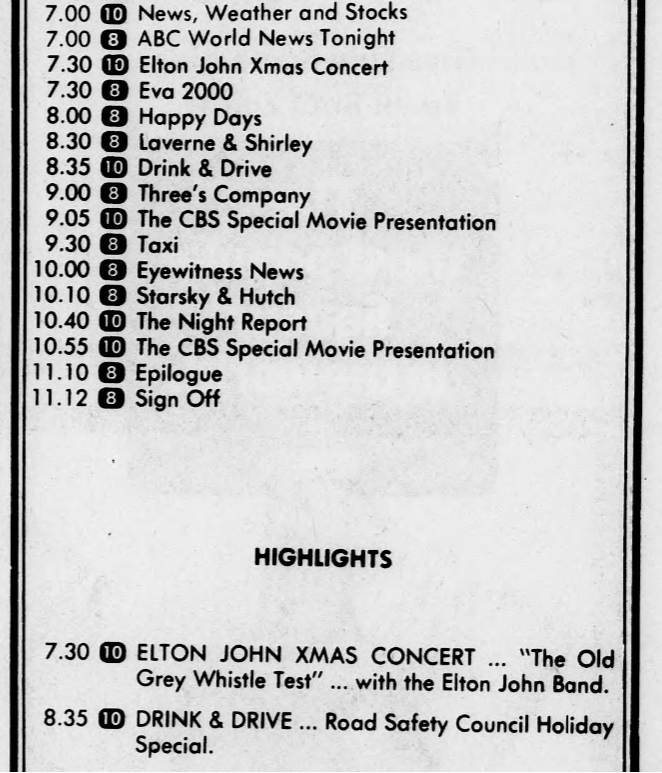
Television in the British territory of Bermuda, whose stations is affiliated with American networks, has been discussed on this forum before (LINK),


but here's a sample 1978 lineup for Bermuda's then-two stations as seen in The Royal Gazette:


That's a strange schedule. If they received a feed direct from ABC and CBS, I'm assuming it would be one hour ahead due to Atlantic Standard Time, such that prime-time would be 9 pm to midnight, but that doesn't seem to be the case here, unless they recorded shows one night and aired them the next.

I look at Bermuda Tonight sometimes on YouTube, and it's kind of a surreal experience, American (or possibly Canadian)-accented reporters, and some voice talent for commercials (as in ads for The MarketPlace grocery store) featuring the same accent, but native Bermudans being all over the place as regards accents, some indistinguishable from Americans, some British-sounding, some Caribbean-sounding (yes, I know, Bermuda isn't considered Caribbean), and so on. The weather comes straight from AccuWeather and temperatures are in Fahrenheit. (And they use the Bermuda dollar, which is at par with the US dollar.)

Bahamian news from ZNS is far more Caribbean-sounding, even though if one really wishes to nitpick, the Bahamas are strictly speaking not in the Caribbean either.


Back
Top Bottom