• Get involved.
    We want your input!
    Apply for Membership and join the conversations about everything related to broadcasting.

    After we receive your registration, a moderator will review it. After your registration is approved, you will be permitted to post.
    If you use a disposable or false email address, your registration will be rejected.

    After your membership is approved, please take a minute to tell us a little bit about yourself.
    https://www.radiodiscussions.com/forums/introduce-yourself.1088/

    Thanks in advance and have fun!
    RadioDiscussions Administrators

TV Guide editions and online resources

Yugoslavia really didn't care. They were institutionally socialist, but very open to the West. Their policies were completely independent from the Soviet bloc.

Indeed. Even in the early 1970s, ABC's Peyton Place was a huge hit in Slovenia:
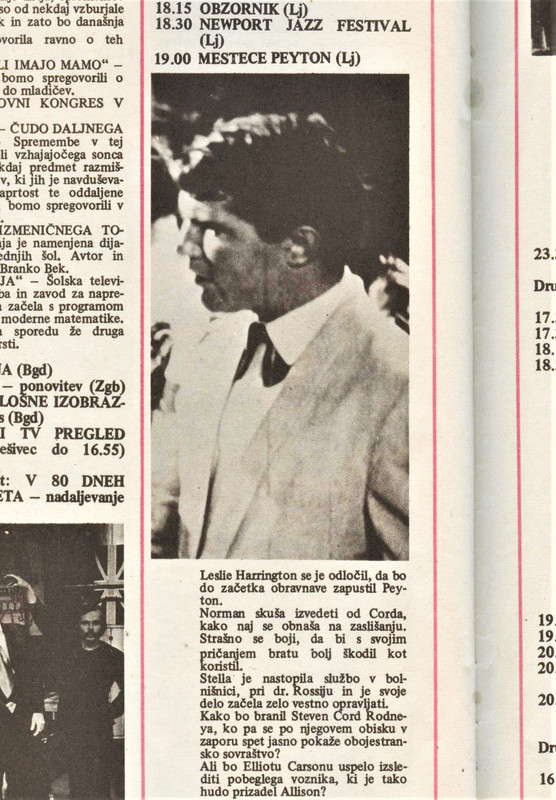


It was the first soap opera shown in Slovenia, and it became such an obsession that Stop, the TV listings magazine published detailed weekly episode summaries (in the style of Soap Opera Digest):
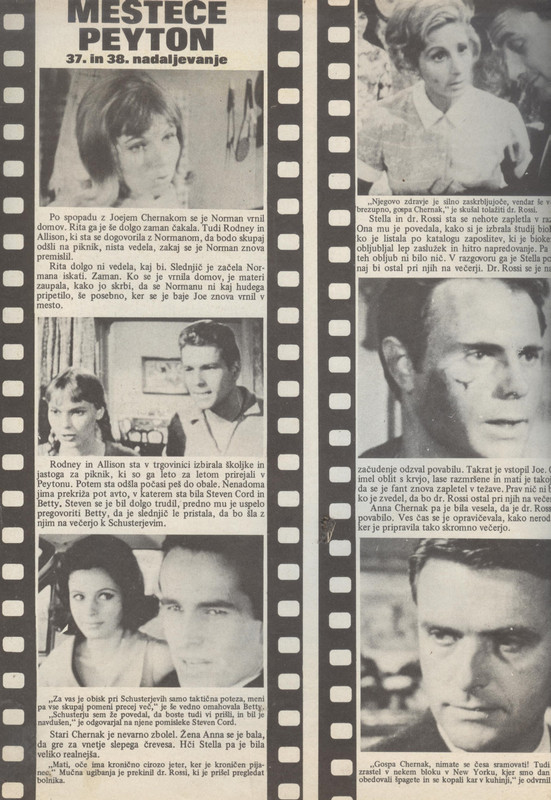


My father, who still hates soap operas with a passion, was the one who wrote the summaries. (He previewed the episodes during special censorship sessions, when the authorities would check the series for any inappropriate content.)

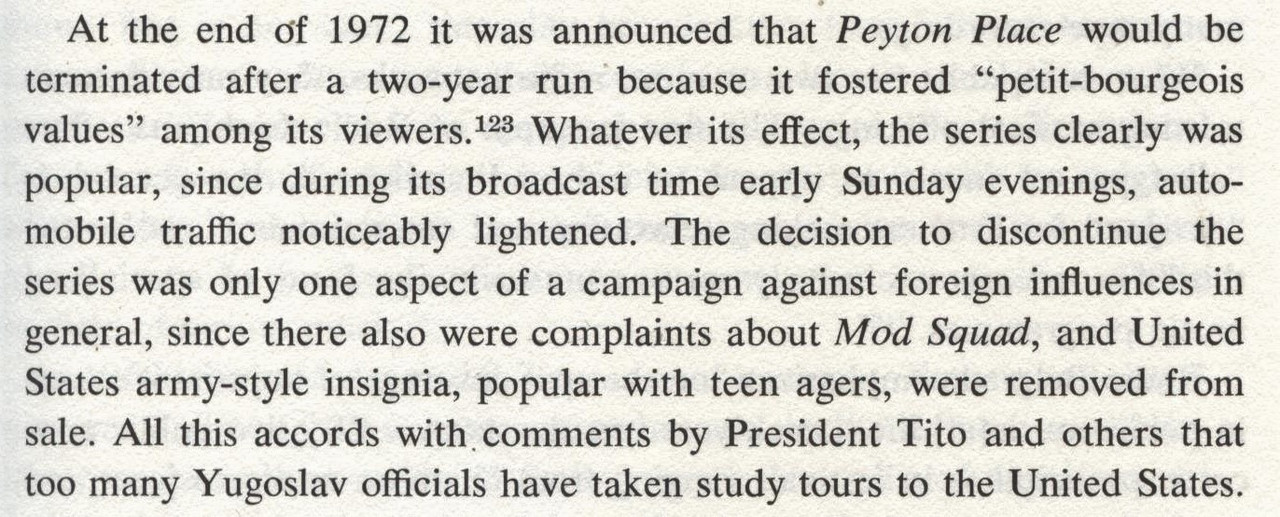
Eventually, Peyton Place was taken off the air because the authorities decided it glamorized an inappropriate lifestyle, but many other American series remained on TV.

Media scholar Burton Paulu explains the decision in his 1974 book Radio and Television Broadcasting in Eastern Europe:
 
Well, then, I guess they did kind of care, but their objections to Western culture were a thimbleful, compared to other socialist countries in general. I've noticed, and maybe it's just a coincidence, that the American and other Western shows that did manage to make it onto TV in Soviet-bloc countries were those that did not depict contemporary life, such as Bonanza, The Flintstones, The Jetsons, The Rifleman, Space:1999, and so on. What's the common thread there? They either depict the past, or the future.

Something to consider.
 
Old Orchard Beach, ME and Brattleboro, VT received the New Hampshire Edition. One town over from O.O.B. was Scarborough (Cumberland County), which received the Maine Edition. The only out-of-state listings were PBS 11 of Durham, NH and WSBK Boston under cable.

The area of the U-Conn campus of Storrs, CT got the Providence Edition (roughly 1993), despite being in Tolland County, entirely part of the Hartford/New Haven market.
 
Old Orchard Beach, ME and Brattleboro, VT received the New Hampshire Edition. One town over from O.O.B. was Scarborough (Cumberland County), which received the Maine Edition. The only out-of-state listings were PBS 11 of Durham, NH and WSBK Boston under cable.

The area of the U-Conn campus of Storrs, CT got the Providence Edition (roughly 1993), despite being in Tolland County, entirely part of the Hartford/New Haven market.

Those were probably the decisions of news distributors. Being assigned to one TVG region or another was not set in stone.
 
I stayed overnight in Brattleboro, VT on Sunday night. The "cable" at the Comfort Inn was almost entirely Burlington/Plattsburgh. The exceptions were WBZ, WHDH and WMUR.
 
The Burlington/Plattsburgh market never extended that far southeast in the analog era, or did it?

Actually, just spot-checking various Broadcasting Yearbooks, Windham County looks to have been in the Boston market forever and a day. Springfield is a hair closer, but that is a small market, and terrain plus UHF limitations, coupled with what I am assuming has been the historical availability of Boston stations on cable, probably planted Windham County in the Boston market. Perhaps Brattleboro cable wanted to bring in stations from in-state as well as Boston and Manchester. Hard to say. When you have someplace that "really isn't close to anywhere", and there has historically been viewership for a given market, especially with ADIs tending to keep the same counties year after year, the die is pretty well cast. Cherry County, Nebraska, part of the Sioux Falls market (though quite distant from it), is another case in point. Cherry County is massive in area and, again, "really isn't close to anywhere".
 
After I wrote the above, I did some checking on TVTV.com, and supposedly the Albany-area stations can be picked up OTA in Brattleboro (Boston stations can't be). I have to think that stations from Albany would be of absolutely no interest to viewers in a Vermont town on the New Hampshire border. Albany isn't in New England (a culturally distinct part of the US if there ever were one), it's out of state (so is Boston, but Boston is by far the major city in New England), and neither the terrain nor the distance make Albany a place with which people from Brattleboro would identify (and there's no major road going to Albany). It would be kind of like the relationship, or lack thereof, that southeastern Kentucky has with the Tri-Cities (Bristol-Kingsport-Johnson City), not all that far, but a world apart. Tri-Cities stations don't cover Kentucky unless something really huge happens (and sadly, the floods would have been "something huge").
 
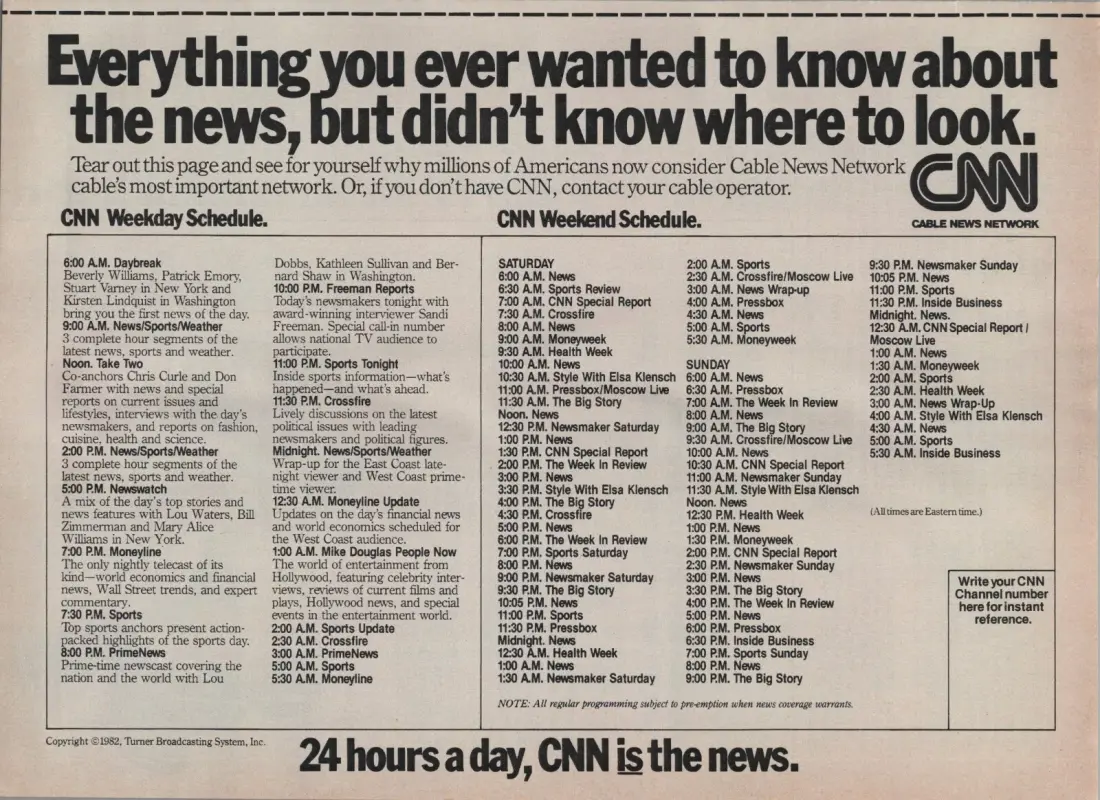
A 1982 magazine ad touting CNN's schedule before the channel was widely listed in TVG and newspaper supplements:


Source: eBay

A similarly conceived pull-out insert was featured in TV Guide at the time, but I can't seem to find it.

A promotional video for CNN made shortly after the channel's 1980 launch:


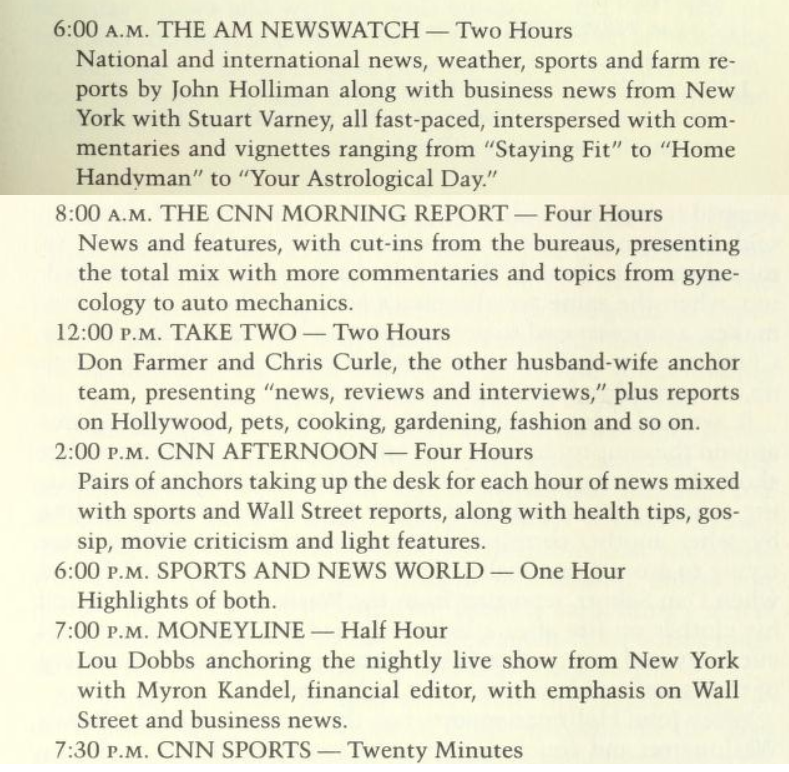
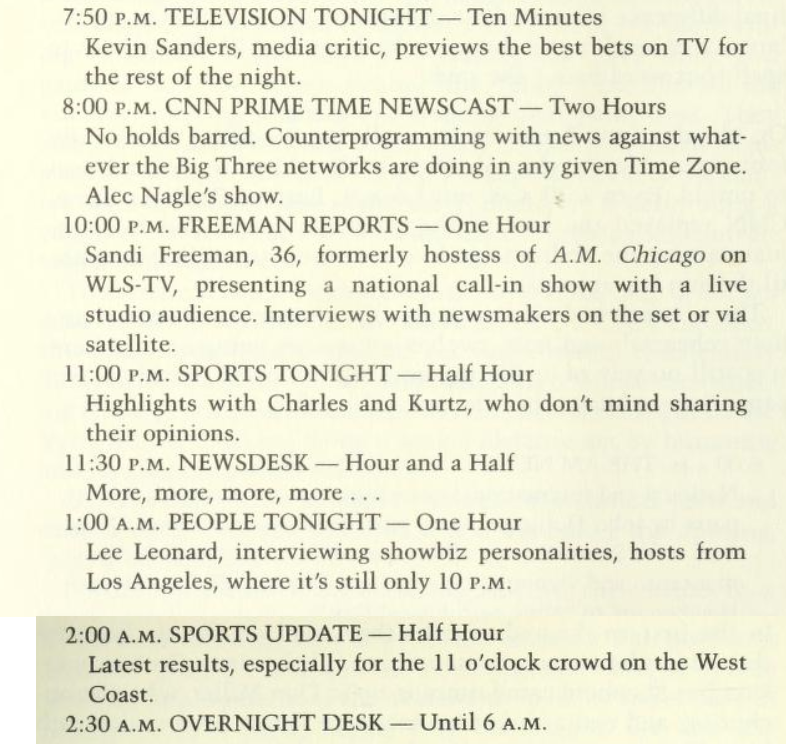
CNN's first schedule from Hank Whittemore's 1990 book CNN: The Inside Story:


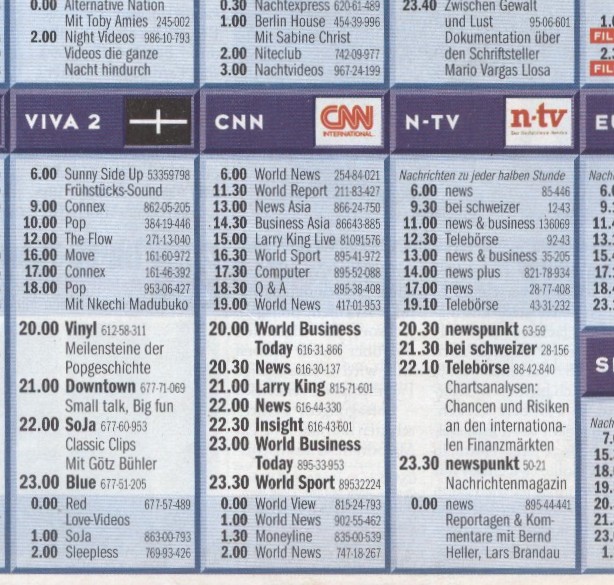
Listings for CNN International from a 1997 issue of Austria's TV Media magazine:

 
Old Orchard Beach, ME and Brattleboro, VT received the New Hampshire Edition. One town over from O.O.B. was Scarborough (Cumberland County), which received the Maine Edition. The only out-of-state listings were PBS 11 of Durham, NH and WSBK Boston under cable.

The area of the U-Conn campus of Storrs, CT got the Providence Edition (roughly 1993), despite being in Tolland County, entirely part of the Hartford/New Haven market.
If you go back far enough in time, WLVI-TV was also included as a cable TV station. I think it was dropped in the late 80s.

The Eastern New England edition served Eastern-Central MA, RI, and eastern CT. It was split into the Boston, Worcester and Providence editions in 1980. Boston served Boston metro. Worcester served Worcester county (and picked up WFSB/Hartford and all Springfield stations). Providence edition served all of RI, southeastern MA and eastern CT.
 
After I wrote the above, I did some checking on TVTV.com, and supposedly the Albany-area stations can be picked up OTA in Brattleboro (Boston stations can't be). I have to think that stations from Albany would be of absolutely no interest to viewers in a Vermont town on the New Hampshire border. Albany isn't in New England (a culturally distinct part of the US if there ever were one), it's out of state (so is Boston, but Boston is by far the major city in New England), and neither the terrain nor the distance make Albany a place with which people from Brattleboro would identify (and there's no major road going to Albany). It would be kind of like the relationship, or lack thereof, that southeastern Kentucky has with the Tri-Cities (Bristol-Kingsport-Johnson City), not all that far, but a world apart. Tri-Cities stations don't cover Kentucky unless something really huge happens (and sadly, the floods would have been "something huge").
I'm not sure how well most Albany stations could be picked up OTA in Brattleboro. However, WTEN could be picked up throughout southern VT, via its satellite station, WCDC, in Adams, MA. Historically, WWLP in Springfield could be picked up throughout SE VT/SW NH via its satellite, WRLP in Greenfield, MA. My understanding is that WFSB in Hartford, CT, could be picked up historically in southern VT/SW NH with a good outdoor antenna. SE VT/SW NH has always been an interesting patchwork.
 
If you go back far enough in time, WLVI-TV was also included as a cable TV station. I think it was dropped in the late 80s.

The Eastern New England edition served Eastern-Central MA, RI, and eastern CT. It was split into the Boston, Worcester and Providence editions in 1980. Boston served Boston metro. Worcester served Worcester county (and picked up WFSB/Hartford and all Springfield stations). Providence edition served all of RI, southeastern MA and eastern CT.
I always wondered how Worcester County merited its own edition. They could easily have shared a TVG with Springfield.

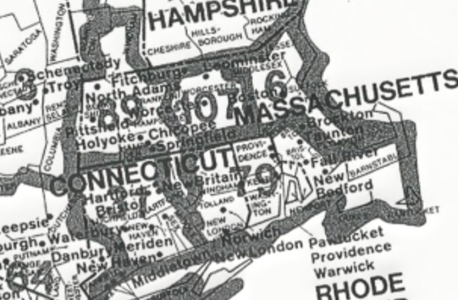
Some TVG editions in the northeastern US covered very small areas:

1741992044043.png

And that bizarre little appendix that juts down into Connecticut for the SCH edition is hard to figure (this from the 1982 TVG editions map). It doesn't conform to county lines, but Connecticut doesn't really have counties, they're just geographical areas, so maybe that was it.
 
I always wondered how Worcester County merited its own edition. They could easily have shared a TVG with Springfield.

Some TVG editions in the northeastern US covered very small areas:

View attachment 8782

And that bizarre little appendix that juts down into Connecticut for the SCH edition is hard to figure (this from the 1982 TVG editions map). It doesn't conform to county lines, but Connecticut doesn't really have counties, they're just geographical areas, so maybe that was it.
Worcester edition was absorbed into Boston edition in 1987. At that time, Ch. 3, WFSB (CBS), Hartford, CT, Ch. 22, WWLP (NBC), Springfield, MA, and Ch. 57, WGBY (PBS), Springfield, MA, were added to the Boston edition. There was a special note at the beginning of the listings section that these channels were added for Worcester viewers. Ch. 40, WGGB (ABC), Springfield, MA, did not carry over from Worcester to Boston edition. One-by-one these Hartford/Springfield stations disappeared from the Boston edition by 1991.

Another oddity is that the Worcester edition included Ch. 36, WSBE (PBS), Providence, RI, but the Boston edition never did until it merged with the Providence edition in 2004. WSBE appeared as a second PBS option on many Boston metro area cable systems. Those Boston area cable systems that didn't carry WSBE from Providence typically carried WENH from Durham, NH, as a second PBS option. Cablevision of Boston carried WENH.
 
Worcester edition was absorbed into Boston edition in 1987. At that time, Ch. 3, WFSB (CBS), Hartford, CT, Ch. 22, WWLP (NBC), Springfield, MA, and Ch. 57, WGBY (PBS), Springfield, MA, were added to the Boston edition. There was a special note at the beginning of the listings section that these channels were added for Worcester viewers. Ch. 40, WGGB (ABC), Springfield, MA, did not carry over from Worcester to Boston edition. One-by-one these Hartford/Springfield stations disappeared from the Boston edition by 1991.

Another oddity is that the Worcester edition included Ch. 36, WSBE (PBS), Providence, RI, but the Boston edition never did until it merged with the Providence edition in 2004. WSBE appeared as a second PBS option on many Boston metro area cable systems. Those Boston area cable systems that didn't carry WSBE from Providence typically carried WENH from Durham, NH, as a second PBS option. Cablevision of Boston carried WENH.
When I lived in Waltham in the 1990s, we were a little island of TCI in a surrounding sea of Continental/Cablevision.

We got WSBE on our system with a fairly snowy picture, but none of the surrounding towns did. I believe they were listed in the Globe, so we could see what was on there.

We also got WENH, again with a decidedly imperfect picture. And TCI put 4, 5 and 7 on 4, 5 and 7, so there were almost always bad ingress bars on those channels, while everyone else had them clearly on 24/25/27.
 
When I lived in Waltham in the 1990s, we were a little island of TCI in a surrounding sea of Continental/Cablevision.

We got WSBE on our system with a fairly snowy picture, but none of the surrounding towns did. I believe they were listed in the Globe, so we could see what was on there.

We also got WENH, again with a decidedly imperfect picture. And TCI put 4, 5 and 7 on 4, 5 and 7, so there were almost always bad ingress bars on those channels, while everyone else had them clearly on 24/25/27.
When I lived in Watertown in 1999, we got WSBE on cable. I think it was MediaOne then? I do think channels 4, 5 and 7 were on 24, 25 and 27 in Watertown. They definitely were not on 4, 5 and 7.
 
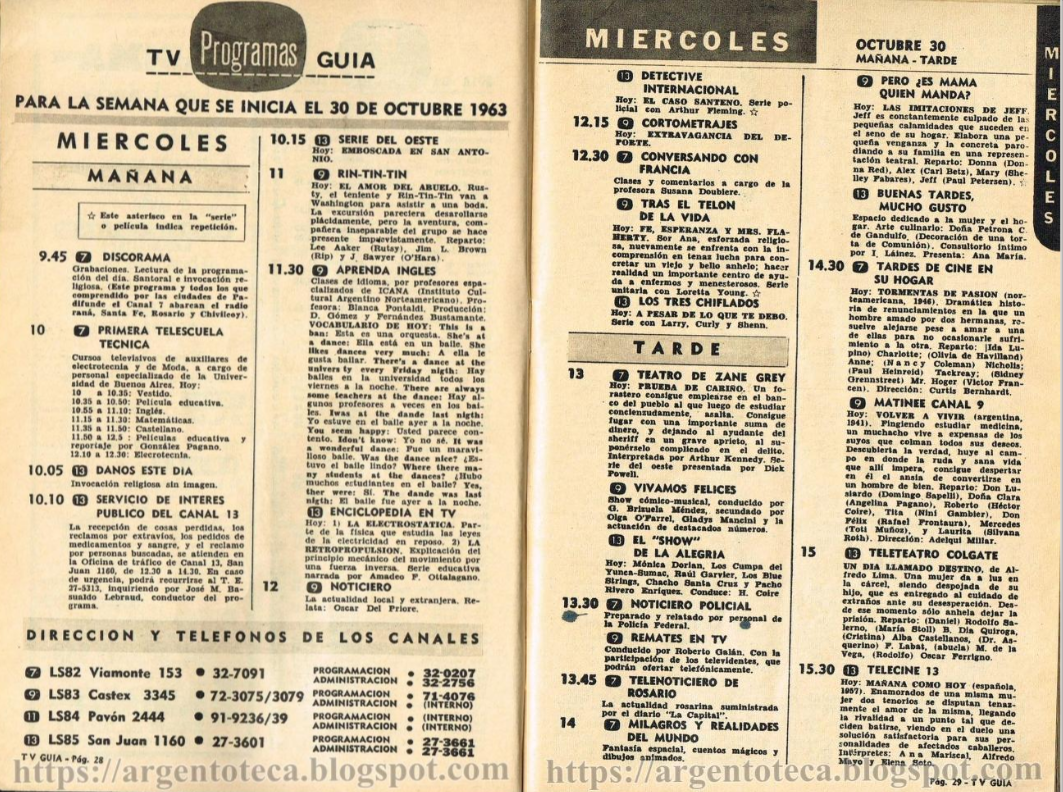
Wow! That looks almost exactly like a US TV Guide from the early 1960s. They also list the addresses and phone numbers of the stations, which I always found a little strange in the US TVG of the time.
 
I wonder if Triangle Publications licensed the TV Guide look-and-feel for other markets.

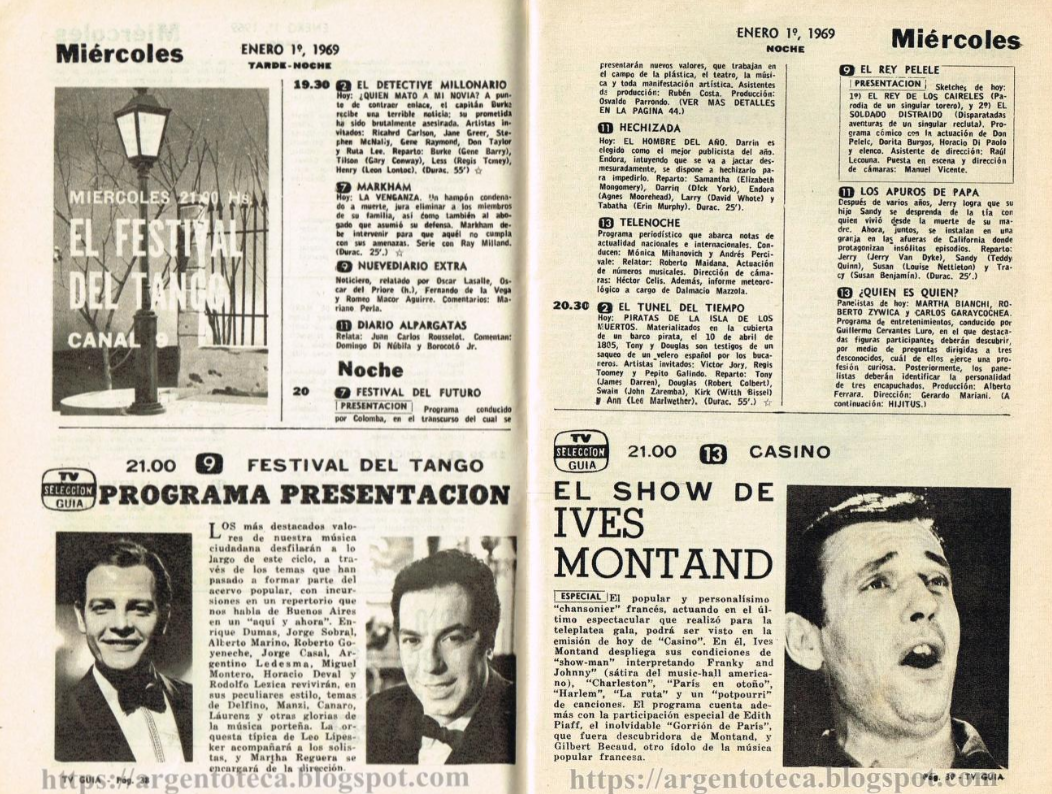
There's a striking amount of detail. And they had Time Tunnel (El Túnel del Tiempo)! And, in 1963, I wonder what the newscast hosted by the cops looked like (13:30 on channel 7).
 
I wonder if Triangle Publications licensed the TV Guide look-and-feel for other markets.

There's a striking amount of detail. And they had Time Tunnel (El Túnel del Tiempo)! And, in 1963, I wonder what the newscast hosted by the cops looked like (13:30 on channel 7).

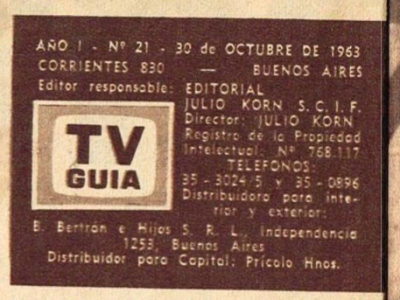
Such an arrangement isn't indicated on the masthead:

1742058049942.png

It does make reference to an intellectual property registration. I'm really not sure that Triangle would have enforced a case of trade dress infringement in a place so far removed from the US, where there was no chance that a reader would confuse one magazine for the other. I seriously doubt people in Argentina were aware that a US magazine called "TV Guide" even existed.

I've actually been more struck by how AFRTS was allowed to call their magazine "TV-Guide" (note the hyphen). If I had to guess, I'd say that Triangle probably gave them a pass on that, in that American service personnel would be familiar with the name, and that it would be just another "touch of home". Nobody could reasonably object to that.


Back
Top Bottom