• Get involved.
    We want your input!
    Apply for Membership and join the conversations about everything related to broadcasting.

    After we receive your registration, a moderator will review it. After your registration is approved, you will be permitted to post.
    If you use a disposable or false email address, your registration will be rejected.

    After your membership is approved, please take a minute to tell us a little bit about yourself.
    https://www.radiodiscussions.com/forums/introduce-yourself.1088/

    Thanks in advance and have fun!
    RadioDiscussions Administrators

How was We Built This City considered "bad?"

I don’t have the original close at hand at the moment but I’m pretty sure the opening of “Riders on the Storm” on the KFMB air check was shortened.

That was the 45. Edited down to 4:35 by starting there, removing the long instrumental and sound effects from the middle. Both store and promo copies were that edit.


KFMB played 'em straight off the vinyl in those days. In fact, Mark Larson, who joined the station to do 9-midnight in 1976 and by 1978 was PD and afternoon drive, posted this photo of himself in the KFMB air studio from '76.
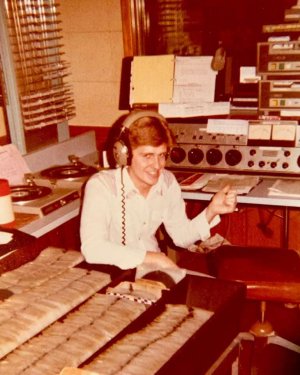
475432617_10161071051696824_9124403869697371359_n.jpg


I have never seen a studio where the entire gold library is in the studio with the jock before, but that's what KFMB had at that time.


The air check also gives a good flavor of the effects of aggressive AM processing: Jim Morrison sounds like he’s giving a speech in a canyon. The tune is essentially remixed. It kind of destroys the tune.

KFMB's processing was very aggressive for an adult station. However, listening to the 45, they really buried Morrison in the mix. It's half the single edit, half the processing (which I think has a touch of reverb).

(Then there’s the segue to “Telstar” … bizarre to my ears.)

Almost nobody on AM radio in 1973 was aiming for flow. Train wrecks were commonplace.

The reference earlier in the air check to Brenda Lee and Pinky Lee tells me that KFMB was going for an older audience.

Some background: For years, the only success at KFMB-AM-FM-TV was the TV. The AM had been country, and an also-ran to KSON, for a lot of the 60s, then went MOR and was an also-ran to KOGO.

In September of 1972, Midwest Television decided to change that, They hired 35-year-old Paul Palmer, who'd been Sales Manager at a station in Chicago (the internet has lost the call letters) to be GM.

Paul hired Charlie and Harrigan away from KLIF in Dallas for mornings, and made "Charlie"---Jack Woods---the Program Director.

There had been Adult Contemporary stations before---lighter current hits with soft oldies pulled from early Top 40---but most were low-key in their presentation.

Woods realized that the 18-49 target lined up with people who had listened to Top 40 between 1956 and then. And so that was the Gold library. And the pacing and production values owed more to Top 40 than to MOR.

As you can see from the studio shot, the jocks picked their own gold.

While the Brenda Lee record was intentional, the Pinky Lee line was purely Clark, who liked to twist a pop culture reference (I had an aircheck of him years ago back-announcing "Michelle" with "KFMB...with John, Paul, George and Ringo, or as we know them---The Arbors").

Again, remember---this is 1973. Seven months into Jack Woods' turnaround of the station. Nobody's overthinking anything. They're just trying to grab people who used to listen to KDEO, KCBQ and KGB who were by then in their 30s and bring them in.

As another point of reference, here's Charlie and Harrigan in mornings 10 months later:

Also notable is the stilted way the newscasters speak. That became passé not too long after 1973, though ABC radio still could sound like that in the 1980s and Fox News still kind of sounds like that.

Morrie Alter got over it. His next stop was WCBS-TV. In San Diego, you had some legendary old-school Top 40 newscasters. Reid Carroll and Richard Mock at KCBQ were giants in town. In fact, Jack hired Richard, and you can hear him on the Charlie & Harrigan aircheck.

The air check also reminds me of why I became primarily an FM listener about a year after my family moved to the St. Louis area in 1973 - the AMs were blabby and made music sound weird; once I realized there were alternate choices on FM, that’s where I went.

You weren't the target.

I was 18 when I first heard KFMB, during a (brief) attempt at higher education in San Diego in early 1975.

I'd hit a point where I realized I was never going to be comfortable as a Top 40 jock, I wanted to do more than the typical AOR talent did in an hour and MOR was dying.

After hearing what Jack (and later Bobby Rich) were doing with KFMB, I understood my own comfort zone and realized that I could program a station very close to Top 40 but a bit less hyper and still deliver a valuable adult audience.

A lot of what I did from that point through the rest of the 70s was inspired by KFMB.

Some of it was just plain ripped off from KFMB.

For those interested, Mark posted a couple more studio shots, this one from the middle 70s, after KFMB moved from downtown to the building they're still in up in Kearney Mesa:
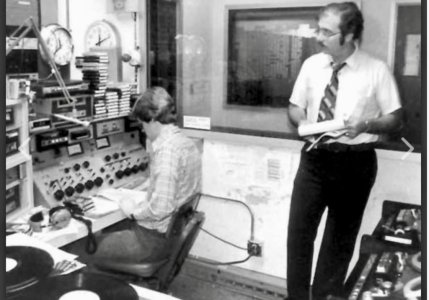
480512601_10161140734716824_1530422431683452317_n.jpg

That's mark at the console, with Cliff Albert, who was and is conversational as a news guy. He is currently News Director at KOGO.

And from the 80s, in the same building:
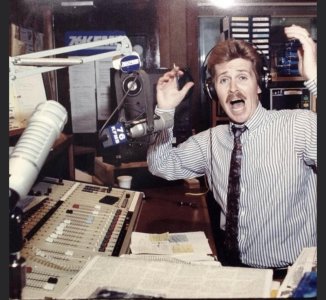
480541371_10161118009346824_2501232851922457314_n.jpg
 
Last edited:
*When I say "they" ("the building they're still in"), I mean KFMB-TV. 760 (now KGB) is now in the iHeart cluster, and what was KFMB-FM is on its second set of owners after the radio stations were spun off by Tegna six years ago.

Despite it only being KFMB-TV, the sign on the building still reads "KFMB STATIONS".
 
Also, I'm not sure it's really seven words anymore. And there's clarification that the words have to be used in a sexual or excretory context. So the "S" word, as long as it's figurative and not literal ("what a bunch of" as opposed to "I'm gonna take a") probably doesn't get you fined, though most radio stations won't risk it.
WVBF 105.7 played the uncut version of "Money" by Pink Floyd in 1974. I don't think anything was ever said about it.
 
Yes, KFMB played the 45 version of Riders On The Storm. The edit was issued as a digital 45 several years ago and was included on The Singles collection as well. The edit runs 4:50.
 
Yes, KFMB played the 45 version of Riders On The Storm. The edit was issued as a digital 45 several years ago and was included on The Singles collection as well. The edit runs 4:50.
I worked at a station that played Tesla's remake of the Five Man Electrical Band's "Signs" complete with the F bombs
 
This has been brought up many times. For the FCC to fine a station, someone has to complain. If no one complains, nothing happens.
I wonder what meets the criteria for FCC fines? For example, I notice some stations air the line "d*** on you in a theatre" in You Oughta Know by Alanis which seems to be pushing it.
 
I wonder what meets the criteria for FCC fines? For example, I notice some stations air the line "d*** on you in a theatre" in You Oughta Know by Alanis which seems to be pushing it.

Slow down and read what has been written many times in this thread.

"Down on you" does not violate the FCC indecency standards, a copy of which I posted in a reply to you.

Using the words "f**k", "s**t", "p**s", "c**t", "c**ksucker" and "motherf***er" does violate the standards, but the FCC isn't listening to everyone all the time (in fact, I'm not sure they're listening to anyone any of the time) and so, someone has to hear you broadcast the offending word and complain to the FCC for them to even investigate the claim, much less levy a fine.
 
Slow down and read what has been written many times in this thread.

"Down on you" does not violate the FCC indecency standards, a copy of which I posted in a reply to you.

Using the words "f**k", "s**t", "p**s", "c**t", "c**ksucker" and "motherf***er" does violate the standards, but the FCC isn't listening to everyone all the time (in fact, I'm not sure they're listening to anyone any of the time) and so, someone has to hear you broadcast the offending word and complain to the FCC for them to even investigate the claim, much less levy a fine.
No, but in that document there's indecency, which doesn't meet the qualifications of obscenity (I think one teacher in college called "obscenity lite.") So it seems that this song falls close to being "indecent."
 

Attachments

  • Screenshot_20250406_105606_Chrome.jpg
    Screenshot_20250406_105606_Chrome.jpg
    96.2 KB · Views: 7
No, but in that document there's indecency, which doesn't meet the qualifications of obscenity (I think one teacher in college called "obscenity lite.") So it seems that this song falls close to being "indecent."

From that document:

Indecent content portrays sexual or excretory organs or activities in a way that is patently offensive but does not meet the three-prong test for obscenity.


And since Alanis doesn't describe his private organs or her technique, it doesn't meet the indecency standard. It's how stations have managed to play the long version of Lou Reed's "Walk on the Wild Side", which includes the phrase "giving head", for 52 years now.

I think, generally speaking, that the phrase "going down" is milder than "giving head."
 
And since Alanis doesn't describe his private organs or her technique, it doesn't meet the indecency standard. It's how stations have managed to play the long version of Lou Reed's "Walk on the Wild Side", which includes the phrase "giving head", for 52 years now.

I think, generally speaking, that the phrase "going down" is milder than "giving head."
"But she never lost her head even when she
Was giving head." was the Lou Reed lyric. I remember hearing it on AM stations, including one where the GM was totally clueless about what he had just heard. Very few people probably realized that the song was also talking about Transvestites...
 
From that document:


And since Alanis doesn't describe his private organs or her technique, it doesn't meet the indecency standard. It's how stations have managed to play the long version of Lou Reed's "Walk on the Wild Side", which includes the phrase "giving head", for 52 years now.

I think, generally speaking, that the phrase "going down" is milder than "giving head."
Michael is absolutely correct. And you should *always* keep in mind that whether the content is explicit or indecent, someone has to complain about it before the FCC will take any action.

One other point I would make (and Michael Hagerty has alluded to it). Up until now, the FCC's primary concerns have been that broadcasters have their transmitters and towers where they say they do; that broadcasters do not stray from their assigned frequencies; that broadcasters keep their towers lighted properly; and that broadcasters keep accurate technical paperwork that both the FCC and the public can peruse upon request. Policing content is really deemphasized right now. Could that change? You bet. And I would give the current administration the most likely group to do it. But even it, I think, is more concerned with how the current President is portrayed in the broadcast media than whether or not a song is considered to be indecent.

Finally, the only time I can remember where licenses may have been scrutinized for content (and I'm not sure they ever were even then) was when then-President Nixon in the early 1970s complained about drug references in song lyrics and I believe he requested the FCC to go after radio stations at license renewal time. While I don't think that anybody followed through on these threats at the government end (and I'm sure that there are others on this forum who know more than I do on the subject), it appears that making the threats alone was enough, especially on top-40 formatted stations.
 
Finally, the only time I can remember where licenses may have been scrutinized for content (and I'm not sure they ever were even then) was when then-President Nixon in the early 1970s complained about drug references in song lyrics and I believe he requested the FCC to go after radio stations at license renewal time. While I don't think that anybody followed through on these threats at the government end (and I'm sure that there are others on this forum who know more than I do on the subject), it appears that making the threats alone was enough, especially on top-40 formatted stations.

Ted, I had to go look. I am old enough, but I couldn't remember.

The FCC announced its policy in the spring of 1971. A licensee (Yale Broadcasting Company) filed suit. It lost and went through several rounds of appeals---all the way to the Supreme Court, which two and a half years later (October, 1973), refused to hear the case, allowing the policy to stand.

By that point, the Nixon administration had more pressing issues (Watergate), drug lyrics weren't as big a thing (at least in hit records) and peoples' attitude toward things like marijuana were softening, so, near as I can find, there was never a single enforcement action.
 
By that point, the Nixon administration had more pressing issues (Watergate), drug lyrics weren't as big a thing (at least in hit records) and peoples' attitude toward things like marijuana were softening, so, near as I can find, there was never a single enforcement action.
Leap forward to the 80's and the PMRC sprouted up.
Parental Music Resource Center? Records that had explicit lyrics had warning labels attached to the CD or Vinyl packaging. I remember seeing them at Tower Records.

There's always going to be some group that will complain.
WKRP in Cincinnati had a famous episode where some Christian leader was pressuring the station to drop certain songs from the playlist. John Lennon's IMAGINE was considered "obscene" because of the line "Imagine there's no Heaven"...
 
And John had gotten on those people's bad sides five years earlier when he claimed the Beatles were more popular than Jesus.
Lennon never said the Beatles were better than Christ.
He made an off the cuff remark that The Beatles were more popular than Jesus. Beatlemania was at its zenith. Stupid people reacted by burning Beatle records. The Beatles gave up on playing live because the shrieking crowds made it pointless. They shouldn't blame the messenger...


Back
Top Bottom