I don’t have the original close at hand at the moment but I’m pretty sure the opening of “Riders on the Storm” on the KFMB air check was shortened.
That was the 45. Edited down to 4:35 by starting there, removing the long instrumental and sound effects from the middle. Both store and promo copies were that edit.
KFMB played 'em straight off the vinyl in those days. In fact, Mark Larson, who joined the station to do 9-midnight in 1976 and by 1978 was PD and afternoon drive, posted this photo of himself in the KFMB air studio from '76.
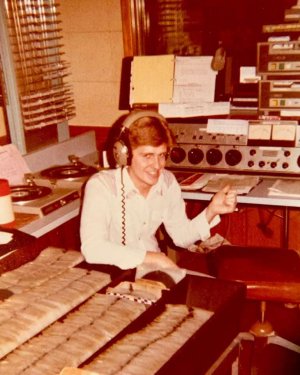
I have never seen a studio where the entire gold library is in the studio with the jock before, but that's what KFMB had at that time.
The air check also gives a good flavor of the effects of aggressive AM processing: Jim Morrison sounds like he’s giving a speech in a canyon. The tune is essentially remixed. It kind of destroys the tune.
KFMB's processing was very aggressive for an adult station. However, listening to the 45, they really buried Morrison in the mix. It's half the single edit, half the processing (which I think has a touch of reverb).
(Then there’s the segue to “Telstar” … bizarre to my ears.)
Almost nobody on AM radio in 1973 was aiming for flow. Train wrecks were commonplace.
The reference earlier in the air check to Brenda Lee and Pinky Lee tells me that KFMB was going for an older audience.
Some background: For years, the only success at KFMB-AM-FM-TV was the TV. The AM had been country, and an also-ran to KSON, for a lot of the 60s, then went MOR and was an also-ran to KOGO.
In September of 1972, Midwest Television decided to change that, They hired 35-year-old Paul Palmer, who'd been Sales Manager at a station in Chicago (the internet has lost the call letters) to be GM.
Paul hired Charlie and Harrigan away from KLIF in Dallas for mornings, and made "Charlie"---Jack Woods---the Program Director.
There had been Adult Contemporary stations before---lighter current hits with soft oldies pulled from early Top 40---but most were low-key in their presentation.
Woods realized that the 18-49 target lined up with people who had listened to Top 40 between 1956 and then. And so that was the Gold library. And the pacing and production values owed more to Top 40 than to MOR.
As you can see from the studio shot, the jocks picked their own gold.
While the Brenda Lee record was intentional, the Pinky Lee line was purely Clark, who liked to twist a pop culture reference (I had an aircheck of him years ago back-announcing "Michelle" with "KFMB...with John, Paul, George and Ringo, or as we know them---The Arbors").
Again, remember---this is 1973. Seven months into Jack Woods' turnaround of the station. Nobody's overthinking anything. They're just trying to grab people who used to listen to KDEO, KCBQ and KGB who were by then in their 30s and bring them in.
As another point of reference, here's Charlie and Harrigan in mornings 10 months later:
Also notable is the stilted way the newscasters speak. That became passé not too long after 1973, though ABC radio still could sound like that in the 1980s and Fox News still kind of sounds like that.
Morrie Alter got over it. His next stop was WCBS-TV. In San Diego, you had some legendary old-school Top 40 newscasters. Reid Carroll and Richard Mock at KCBQ were giants in town. In fact, Jack hired Richard, and you can hear him on the Charlie & Harrigan aircheck.
The air check also reminds me of why I became primarily an FM listener about a year after my family moved to the St. Louis area in 1973 - the AMs were blabby and made music sound weird; once I realized there were alternate choices on FM, that’s where I went.
You weren't the target.
I was 18 when I first heard KFMB, during a (brief) attempt at higher education in San Diego in early 1975.
I'd hit a point where I realized I was never going to be comfortable as a Top 40 jock, I wanted to do more than the typical AOR talent did in an hour and MOR was dying.
After hearing what Jack (and later Bobby Rich) were doing with KFMB, I understood my own comfort zone and realized that I could program a station very close to Top 40 but a bit less hyper and still deliver a valuable adult audience.
A lot of what I did from that point through the rest of the 70s was inspired by KFMB.
Some of it was just plain ripped off from KFMB.
For those interested, Mark posted a couple more studio shots, this one from the middle 70s, after KFMB moved from downtown to the building they're still in up in Kearney Mesa:
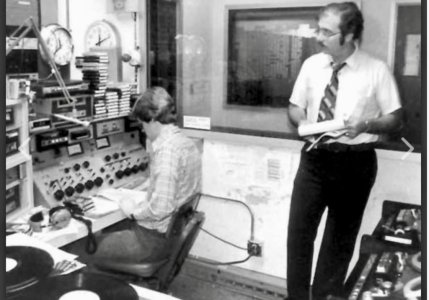
That's mark at the console, with Cliff Albert, who was and is conversational as a news guy. He is currently News Director at KOGO.
And from the 80s, in the same building:
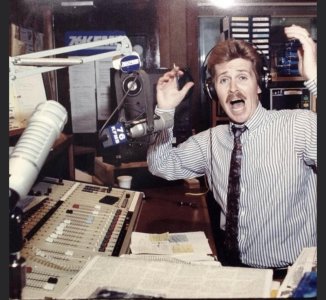
Last edited: