• Get involved.
    We want your input!
    Apply for Membership and join the conversations about everything related to broadcasting.

    After we receive your registration, a moderator will review it. After your registration is approved, you will be permitted to post.
    If you use a disposable or false email address, your registration will be rejected.

    After your membership is approved, please take a minute to tell us a little bit about yourself.
    https://www.radiodiscussions.com/forums/introduce-yourself.1088/

    Thanks in advance and have fun!
    RadioDiscussions Administrators

560

If you want to live in the 1950s that's your prerogative, but this ain't the '50s anymore and not everyone sounds like Douglas Edwards or Robert Trout. Actually, very few do anymore.
I have a pretty healthy aircheck collection, and everytime I go back to something from the 1950s...and increasingly from the 1960s, it's clear how language and phrasing have changed. Douglas Edwards and Robert Trout would stick out like sore thumbs today, as would Murrow and Cronkite.
I just reread what I wrote a few hours ago, and it inadvertently sounds like the comment above was directed at Mr. Hagerty, which wasn't my intention. I intended it to be a general observation about how language use, diction, pronunciation, etc. have become so much more casual (or put another way, degraded) since that era. Sorry for not being clearer myself.
 
I have a pretty healthy aircheck collection, and everytime I go back to something from the 1950s...and increasingly from the 1960s, it's clear how language and phrasing have changed. Douglas Edwards and Robert Trout would stick out like sore thumbs today, as would Murrow and Cronkite.
As I said in an old thread along time ago my favourite Top 40 radio voice would have to be Sam Riddle. For MOR, Jim Lange. But as we're reminiscing about great TV news announcer voices, my all-time favourite would have to be the CBC's Peter Mansbridge. Too bad he retired from The National. Incredible voice and delivery. He would stand out in any decade.
 
But as we're reminiscing about great TV news announcer voices, my all-time favourite would have to be the CBC's Peter Mansbridge. Too bad he retired from The National. Incredible voice and delivery. He would stand out in any decade.
Mansbridge had an excellent voice for anchoring TV news. For those unfamiliar with him, I always thought he sounded like a blend of Tom Brokaw and Peter Jennings.
 
Mansbridge had an excellent voice for anchoring TV news. For those unfamiliar with him, I always thought he sounded like a blend of Tom Brokaw and Peter Jennings.
You might be right. Peter Jennings is another one if my Canadian favourites. As I understand it, he ignored direction from his American producers and retained most of his Canadian pronunciations, for example he said "Shedule" instead of the American "Skedule" and said "Bean" instead "Bin".
 
Getting back to 560... why turn it off? Just want less clutter/competition on the dial? Or just getting ready to sell it?

What's the hard cost of keeping it on the air? Unless their lease is expensive and there is a lot of deferred tower maintenance coming due.

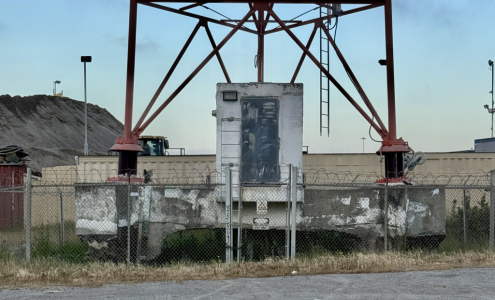
I drove by a week or so ago, and the west tower looks worse than ever... I wonder how far down those footings go.

I also wonder about things like the value of all the copper for the ground system and the salvage value of the tower steel itself.

1748031051169.png
 
Getting back to 560... why turn it off? Just want less clutter/competition on the dial? Or just getting ready to sell it?

What's the hard cost of keeping it on the air? Unless their lease is expensive and there is a lot of deferred tower maintenance coming due

They've already done that. They know exactly how much it costs, and how it compares to the other stations they own, and which ones can cover the costs with revenues. They likely have talked with brokers about selling. This is what they do for a living. It's not a hobby.
 
I drove by a week or so ago, and the west tower looks worse than ever... I wonder how far down those footings go.
The tower bases are designed by engineers who take into account soil density and other factors and then over-design the bases to account for all kinds of situations. It is very uncommon to hear of a tower base failure bringing down a tower.
I also wonder about things like the value of all the copper for the ground system and the salvage value of the tower steel itself.
The salvage value of the copper is a few thousand dollars. The salvage value of the tower is likely less than the cost of disassembling it.
 
They know exactly how much it costs, and how it compares to the other stations they own, and which ones can cover the costs with revenues.

"They" know it, sure. I'm just curious as to what those costs would be, and if all those costs are tangible. The power bill can't be that prohibitive. They're still paying for the lease on the land. But who knows, saving even $5000 a month can add up after taking 20 transmitters dark.

The tower bases are designed by engineers who take into account soil density and other factors and then over-design the bases to account for all kinds of situations.
Agreed. It was more idle speculation about how down the footings go - I'm sure it's deep enough to be sound.

I did a little research around salvage value of the towers, and all of what I'm reading is what you say: no money to be made there.

Digging around on fybush.com it says "In 1981, KSFO boosted night power to 5000 watts by adding a second tower to the east of its existing tower" (which is the photo included above that I mistakenly referred to as the west tower). So that tower isn't as old as I thought (the building is from the early '40s)

Will be interesting to see what becomes of it in the next 1-2 years. I have a kind of sentimental attachment to the transmitter facility (just seeing it there for as long as I can remember).

There is so much legacy infrastructure surrounding it. The old grain silos. The Darling rendering plant (still served by rail!). That whole area is being explored for future development much in the way the Pier 70 area has been redeveloped, and KEST had to move.
 
"They" know it, sure. I'm just curious as to what those costs would be, and if all those costs are tangible. The power bill can't be that prohibitive. They're still paying for the lease on the land. But who knows, saving even $5000 a month can add up after taking 20 transmitters dark.

Have you looked into their bankruptcy filing? I'm sure somewhere in there you'll find specifics about costs and liabilities.

It doesn't matter what the costs could be. They need to cut things that don't make money. Having FOUR AMs in one city is terrible. At least one needed to go, and this is the one.

Now that it's dark, the next step is letting the tower lease lapse, and that's it. If someone else wants to turn it into a museum or historic site, they can pick up the lease and discover the costs.
 
Having FOUR AMs in one city is terrible. At least one needed to go, and this is the one.
But 1050 is inferior to 560. Not terrible, 50,000 watts days, 10,000 watts nights. But it's on a Mexican clear channel frequency so it is highly directional.

I'd say 560 is among San Francisco's best AM frequencies. I know Radio-Locator maps should be taken with a grain of salt. But it shows 560 giving primary coverage not just to San Francisco and San Jose but Monterey, Santa Rosa, Sacramento, Stockton and Modesto.

KTCT 1050's primary nighttime signal doesn't even include San Jose that well. And it misses Sacramento, Stockton and Modesto. (Yes, I know those cities are not in the SF metro. But it may indicate some places within the metro aren't getting a decent nighttime signal either.)

If you are Cumulus and you want to eliminate one of your four SF AM stations, I'd say ax 1050. Put KTCT's spill-over sports programming on 560.
 
If you are Cumulus and you want to eliminate one of your four SF AM stations, I'd say ax 1050. Put KTCT's spill-over sports programming on 560.

I suggest they're BOTH dead stations walking. KNBR is in no financial position anymore to support two AM stations. The overflow can go on 680. Split programming, just like some other AM-FM combos do. Get rid of two boat anchors.
 
But 1050 is inferior to 560. Not terrible, 50,000 watts days, 10,000 watts nights. But it's on a Mexican clear channel frequency so it is highly directional.

I'd say 560 is among San Francisco's best AM frequencies. I know Radio-Locator maps should be taken with a grain of salt. But it shows 560 giving primary coverage not just to San Francisco and San Jose but Monterey, Santa Rosa, Sacramento, Stockton and Modesto.

KTCT 1050's primary nighttime signal doesn't even include San Jose that well. And it misses Sacramento, Stockton and Modesto. (Yes, I know those cities are not in the SF metro. But it may indicate some places within the metro aren't getting a decent nighttime signal either.)

If you are Cumulus and you want to eliminate one of your four SF AM stations, I'd say ax 1050. Put KTCT's spill-over sports programming on 560.
Oh, Lordy, not this again. Cumulus decided it wanted better coverage for KSFO and moved it to 810. KTCT, i.e. "KNBR 1050", has an identity. Maybe not a great one, but it feeds off KNBR-AM/FM. Once KSFO moved to 810, 560 had no identity. KSFO had an audience that, to some degree, could be motivated to make the move; even so, Cumulus simulcasted the stations for weeks and then had a redirect message on 560 for additional weeks. Do you seriously think Cumulus wanted to go through round two by moving "KNBR 1050" to 560? What would be in it for them? Cumulus may also have figured that they would have a better chance of spinning off the 560 to someone, particularly someone looking for that kind of reach. Those who know the reasoning ain't talkin'.
I suggest they're BOTH dead stations walking. KNBR is in no financial position anymore to support two AM stations. The overflow can go on 680. Split programming, just like some other AM-FM combos do. Get rid of two boat anchors.
I anticipate that will happen the next time Cumulus needs to trim its portfolio. I don't think play-by-play sports is that profitable any more anyway.
 
I ran into someone over the weekend who was extolling the virtues of "LoFi" music. He said the LoFi DJ's are in high demand. So of course I had to look it up. From Wikipedia:

******************************
The genre name originates from the low fidelity ("lo-fi") aesthetic of the music, which tends to be deliberately less "polished" than high fidelity ("hi-fi") music and features audio imperfections, distorted sound quality, and less professional audio equipment.[6] Lo-fi hip-hop originated within the underground beatmaking hip-hop scene of the 2000s, particularly after the advent of Roland SP-303 and Roland SP-404 samplers, each of which featured the "lo-fi" effect as a separate button.[7]
******************************

There ya go. Finally, the perfect format for 560. (ducking for cover)

Dave B.

I've mentioned lo-fi as a potential AM niche format several years ago. The recordings sound as good as they'll ever sound on AM, looking at the super tight bandwidths of some stations on the SDRs, they're perfect for it. Most recordings are in mono (it's described as an aesthetic. But with all active participants in lo-fi and their common idiosyncrasies, it's really an underground scene. Not much different from House or Grunge were in their embryonic years.) Always on the fringe of a mass commercial breakthrough. But needing That Something or That Song to send them over....


Back
Top Bottom