I can't keep up with you people!
And further respect. I haven't actually recorded anything in...40 years. If you see KKHR, Los Angeles from May 9, 1984 or October 24, 1985, those are mine---recorded off the cable at my mom's house in Bishop so that I'd have something to listen to on the drive home (to Reno in '84 and Vegas in '85). Everything else has been stuff people either gave me, that I've traded for or that I've found available for download.
Most of what I have is what I recorded. Some things were lost because, at various times in my life, I didn't have much money and needed to re-use tapes. For example, I lost most of what I had of St. Louis' KCFM when it had a short-lived "Natural Turn-On" format in 1978-79 that I now believe was a precursor to AAA. KCFM applied beautiful-music formatics to mellow and mellow-ish rock. It struggled, but what really killed it was the station's sale to Gannett, which went right back to beautiful music. I have found one tape remaining of that. My recordings tended to focus on rock formats.
I know tapes will deteriorate over time, which is why I want to digitize as much as I can. That takes time, and my tapes were only somewhat organized. I had a numbering system but did not consistently use it.
I did a little trading in the 1990s when I lived in Kansas City, but by then I had gotten a Hi-Fi VCR and made use of it, particularly for some notable format changes. Another example: while I did not get the actual change of KBEQ from CHR to country in 1993, I did get the run-up to it, and also got its earlier efforts to run modern rock at night, which I now realize was very well done. Many of my Chicago airchecks in the late 1990s were also on Hi-Fi VCR. These are the ones that have had the most deterioriation.
I bought my first cassette recorder with a built-in AM radio in either late 1965 or early 1966 at a duty free shop at the Panama City airport when on my way to Mexico. I recorded all the Top 40 stations in Mexico City and played them a lot to my staff at Radio Musical in Quito. I later went to Mexico City to record the tropical music stations to play for my Canal Tropical staff after I launched that station in 1966.
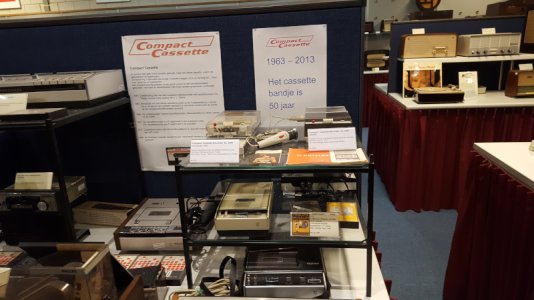
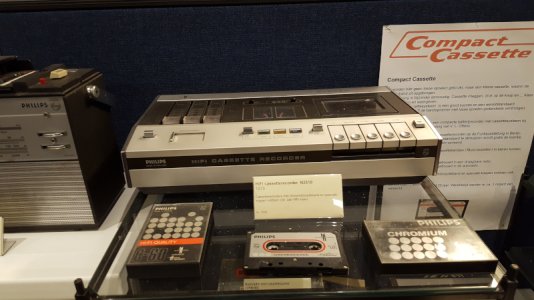
I ended up with a little collection of cassette recorders with radios as they kept making smaller and smaller ones with better audio... and FM.
My first cassette recorder was a General Electric recorder that I got as a Christmas present in 1967. The audio quality was so-so. Around 1972, I got a bigger, better Ampex recorder and used that for a few years - still mono, moderate fidelity. When I started journalism school, I got a smaller, better Pioneer recorder. Still mono, but it could accommodate 1/4" stereo headphone plugs, which were standard in newsrooms of the time. In 1979, I got a Superscope C-105. That thing is heavy (I still have it but the power supply is questionable) and packed with features: a switchable limiter, high- and low-pass filters, a line output, and a container for rechargeable batteries the size of a small paperback. Still mono; I couldn't afford stereo. But the Superscope made good quality recordings, albeit with no noise reduction. Finally went to stereo recording in 1980.
I always cared about audio quality in my reporting and had excellent production skills. Even though I worked for AM stations, I still felt that mattered. Why make people listen to crap?
I never had an integrated radio/cassette recorder; I felt there were too many compromises in sound quality. I might not have been entirely right about that.
Reel-to-reel was always outside my budget. I still have a box of reel-to-reel tapes that I can't do anything with. They date to the 1970s.
1960s: Reel to reel tapes from talents, station and networks continue, as do high-quality reel recordings which capture the beginnings of FM Stereo Multiplex broadcasting and the emerging formats as the FCC ends 100% simulcasts. A flood of cheap reel-to-reel machines with condenser mics, best suited to dictation, start ending up in the hands of kids and teens, who too often put a microphone next to a speaker and hit "record".
That's what I did with my first cassette recorder. I didn't know any better.
1970s: The reels from the source and from audiophiles continue, and some of the kids with the bad recorders graduate to good recorders with line inputs, but just as many move to cheap cassette recorders.
The Ampex I described had a line input as well as a mic input, plus a line out as well as a headphone jack. The line-in and line-out were RCA jacks! But I didn't have a good radio then to serve as a source; it wasn't until I bought an Advent 400 in 1975 that I had a good source. (Oh, yeah, I still have that Advent, though it sometimes has difficulty contending with a modern FM reception environment where there's a station on every other channel.)
As an aside, I sure wish that, when I was a broadcast reporter, that I had the kinds of tools available now. The Tascam recorders would have been excellent for field reporting, as long as one kept some spare batteries at hand.
1990s and beyond: Cassettes of varying quality, a brief spurt of high-quality airchecks using videocassettes at their highest speed, and then the various forms of digital.
Actually, with a Hi-Fi VCR, you still get very good quality even at the slowest speed. Those recordings are a little more prone to the dropouts that I described in previous posts.
I mean, that kind of condenses all of radio down to just Top 40. The same holds true of talk, news, MOR, Country and fine arts programming.
Being a headstrong 20-something, I usually focused on what I liked, which was usually AOR. There's some news, a tiny bit of country, and the occasional DX tape. In my next decade, modern rock and the precursors to EDM came along, and I was paying more attention to format changes as well, so I have a wider variety.
One thing I'm trying to do with my present recordings is to sample various formats, even country, and sample some different markets. First of all, I do this because I think radio is on the verge of some major changes. Perhaps just five years from now, it will sound quite different. How that will play out, I wouldn't pretend to know. But I think something is going to happen.
Aside from that, I think it's important to save gems such as this one, from last year in Denver, just before KFCO changed from advertising sticks of weed set on fire to the Pillar of Fire:
https://www.mediafire.com/file_prem...3.14-1633-MarijuanaAdsWithDisclaimer.mp3/file (no music, so it should be safe from the Kopyright NKVD)