• Get involved.
    We want your input!
    Apply for Membership and join the conversations about everything related to broadcasting.

    After we receive your registration, a moderator will review it. After your registration is approved, you will be permitted to post.
    If you use a disposable or false email address, your registration will be rejected.

    After your membership is approved, please take a minute to tell us a little bit about yourself.
    https://www.radiodiscussions.com/forums/introduce-yourself.1088/

    Thanks in advance and have fun!
    RadioDiscussions Administrators

New Life for REELRADIO

But most of the content on those reels is copyrighted music that the radio station didn't own. That's why the RIAA sued. People are listening and enjoying this music and the creators aren't getting paid. So throwing away those reels eliminated the liability. Personal collections aren't covered by such recording licenses. What you do in the privacy of your home is your business. But transferring that material back into the public revives that rights problem.

Gordon started collecting those reels from the dumpsters in the late 1960s. And had the stations kept the reels, there would not have been any liability.


Are you sure about that? The NBC News archive has been selling and licensing its content for over 40 years. Both video and audio. It's in 30 Rock. I've seen it. It's all catalogued. Same with CBS and ABC. If you look at the credits to any news documentary, you'll see credits given to the network archive departments.

It was in the late 1970s---almost 50 years ago. It's almost likely that employee has passed, is certainly retired and NBC, tired of paying for material it had, may have simply bought it back.
 
Last edited:
Thank you, Michael, for your assistance. Unfortunately, I wasn't able to get the file to play using a Windows 10 system with Firefox and my screenreader JAWS. The direct link you sent sent has the page with a frame inside the page that reads:

Displaying rwmkiqq120773-sc.mp3.

There are no buttons on the page at all. Thinking that the problem might be that I had MP3 files set to the wrong player (I had them playing in Windows Media player), I switched the player to the VLC player and tried again. No dice in either case.

I'm going to try to play the file again and see if I can find a direct link through Firefox and play the file that way. As I said, I have absolutely no idea what's going on but I am trying possible solutions as I can think of them.

I saw from a later post that you did get it to work, Ted, but this looks to me as if the filetype MP3 has the wrong default program set in Control Panel (if that's still what it's called in Win10).

I can try to talk you through that as well, if it helps.
 
I mean, that kind of condenses all of radio down to just Top 40. The same holds true of talk, news, MOR, Country and fine arts programming. And it's really no different than TV's failure to archive. NBC reused tapes, recording over most of the first decade of Johnny Carson on the Tonight Show. They didn't learn from that and in the late 70s, threw out most of their news file footage, thinking they wouldn't need it again. An NBC employee rescued it from the dumpster, rented a warehouse and made a nice living licensing the footage back to them on a per use basis.
True, but most of this site's nonprofessional users seem to be interested in those DJ air checks, not old news coverage or talk shows. Surely you're not comparing a random shift by a DJ playing the same songs he played the previous days or weeks to Playhouse 90 or the Tonight Show.
 
True, but most of this site's nonprofessional users seem to be interested in those DJ air checks, not old news coverage.

As witnessed on this very site, there's interest in Beautiful Music airchecks. There's a guy on SoundCloud who's become a hero because he started a whole thing with Country airchecks.

REELRADIO's focus was Top 40 because that was Richard Irwin's choice. He had to be gently prodded to include things like MOR and early A/C (KFWB's last year before news, KIIS-AM and KFMB).

Surely you're not comparing a random shift by a DJ playing the same songs he played the previous days or weeks to Playhouse 90 or the Tonight Show.

Only in answering the question of why the stations and networks disposed of the tapes in the first place---which is what Don CT asked ("why didn't the industry archive"?).

And again, in reducing it to "random shift by a DJ playing the same songs he played the previous days or weeks", you're excluding major talents like Don Sherwood, Bob Crane and many others, for whom every show was something completely different. Again, you're focused on typical Top 40. There's way more to radio---and to aircheck collecting---than that.
 
Even companies that did archive some of their shows (Westwood One, for example), there wasn't a lot of organization to them and they were just stuck on shelves.
 
Even companies that did archive some of their shows (Westwood One, for example), there wasn't a lot of organization to them and they were just stuck on shelves.
It wasn't just broadcast companies. Record companies could be just as bad with their archives. Aretha Franklin was one of the last major artists to have her albums released on CD, not because of any licensing disputes, but because it took Atlantic years to find the proper masters. They were mislabeled or un-specific as to generation, in some cases un-labeled and often just plain missing.

The thing about art produced for commerce is that at the time, it's just product. A few years later it's just old product. 25 years later, when it's acquired "legendary" status, the stuff's not easily accessible.

That's changed over the years, to some degree---but only because money was on the line again.
 
Thousands of radio stations were on the air even back in the 60's. Multiply everything by that.

Lets go back to the 60's and look at a smaller market station. Reel to reel tapes were generally up to about an hour, two hours if "flipped". A good tape deck for recording would be around $3,000 for a daytimer, there would be 6 to 8 reels a day at perhaps $4 to $5 a reel. So taping cost more than an entry level employee. And then there was storage. In just a year, you'd have a nice closet full of them. In 5 years, you'd need a separate room. m

Who would pay for that? And why? In, let's say, 1967, why would, for example, daytimer WCCW in Traverse City spend thousands each year on tape and more on storage for something nobody thought might be listened to.

Later, big stations often had a slow speed recording system to verify ad placements, content, and the like if needed. But they reused the tapes every month or so, and when worn, they tossed them. Now, some stations do the same with recording to the cloud or hard drives. In either case, they don't keep the files for longer than deemed legally necessary.
As luck would have it, there are 4 days of CKLW from 1973 on reelradio (and other sites) that came from those slow-speed logger tapes that somehow weren't destroyed, and there was one guy who had the equipment to restore them. He also worked on some WOWO logger tapes that escaped the dumpster, those are on the History of WOWO site. Logger tapes from WBAP, KLIF, WLW and I'm sure many others from Nov. 22-23, 1963 were saved, amd are on YouTube in various configurations.
 
Aretha Franklin was one of the last major artists to have her albums released on CD, not because of any licensing disputes, but because it took Atlantic years to find the proper masters.

Atlantic was an independent label. Things were a bit sloppy. Could be why when Ray Charles left Atlantic for ABC, he had it in his contract that HE owned the masters. For years they sat on shelves at his studio in LA. With the labels in braille.
 
Atlantic was an independent label. Things were a bit sloppy. Could be why when Ray Charles left Atlantic for ABC, he had it in his contract that HE owned the masters. For years they sat on shelves at his studio in LA. With the labels in braille.

Atlantic was bought by Warner Bros. the same year Aretha came on board (1967).

Ray left in 1960, when Atlantic was an indie.
 
As luck would have it, there are 4 days of CKLW from 1973 on reelradio (and other sites) that came from those slow-speed logger tapes that somehow weren't destroyed, and there was one guy who had the equipment to restore them. He also worked on some WOWO logger tapes that escaped the dumpster, those are on the History of WOWO site. Logger tapes from WBAP, KLIF, WLW and I'm sure many others from Nov. 22-23, 1963 were saved, amd are on YouTube in various configurations.

Logger tapes? 1 7/8 ips? Yikes! Good for him, but man, that's really lo-fi source material.
 
As luck would have it, there are 4 days of CKLW from 1973 on reelradio (and other sites) that came from those slow-speed logger tapes that somehow weren't destroyed, and there was one guy who had the equipment to restore them. He also worked on some WOWO logger tapes that escaped the dumpster, those are on the History of WOWO site. Logger tapes from WBAP, KLIF, WLW and I'm sure many others from Nov. 22-23, 1963 were saved, amd are on YouTube in various configurations.
A lot of the CKLW stuff that was early on REELRADIO came from or was personally processed by Greg Ogonowski, the co-developer of later Optimod models, who was fascinated with the sound of CKLW in the "glory days".


I had the first prototype of the 2540 at WQII in San Juan, a 10 kw fulltime Hot AC station. I went through many (expensive) long distance calls with Greg as we swapped cards, made adjustments and even modified boards at my end. The result was that my station sounded louder and cleaner than any other AM in the mid-70's, accounting for it being the market's #1 music station.

This is another case of not having to be a genius to run a radio station; you just have to surround yourself with people smarter than yourself and let them work!
 
Good idea. I have some small (6tb) hard drives and I'd be glad to copy the site onto one and send it. It won't fit on anything smaller, and an 8tb ssd is way to expensive. So you will get a big hard drive that doubles as a doorstop.
I would be willing to pay for one of those hard drives and for shipping as well. ❤️🙂 It wouldn't be the most absurd thing I've ever purchased lol

Seriously, I can message my mailing address and pay you accordingly.
 
I would be willing to pay for one of those hard drives and for shipping as well. ❤️🙂 It wouldn't be the most absurd thing I've ever purchased lol

Seriously, I can message my mailing address and pay you accordingly.
And since hard drives getting cheaper, make back-ups and more back-ups. The stuff on that site needs to be preserved in all ways possible.
 
A lot of the CKLW stuff that was early on REELRADIO came from or was personally processed by Greg Ogonowski, the co-developer of later Optimod models, who was fascinated with the sound of CKLW in the "glory days".


I had the first prototype of the 2540 at WQII in San Juan, a 10 kw fulltime Hot AC station. I went through many (expensive) long distance calls with Greg as we swapped cards, made adjustments and even modified boards at my end. The result was that my station sounded louder and cleaner than any other AM in the mid-70's, accounting for it being the market's #1 music station.

This is another case of not having to be a genius to run a radio station; you just have to surround yourself with people smarter than yourself and let them work!
There you go!
 
There are links to audio files on the old site but when you click on a file, it prompts you to login to the site if you still are registered there.
 
I can't keep up with you people!

And further respect. I haven't actually recorded anything in...40 years. If you see KKHR, Los Angeles from May 9, 1984 or October 24, 1985, those are mine---recorded off the cable at my mom's house in Bishop so that I'd have something to listen to on the drive home (to Reno in '84 and Vegas in '85). Everything else has been stuff people either gave me, that I've traded for or that I've found available for download.
Most of what I have is what I recorded. Some things were lost because, at various times in my life, I didn't have much money and needed to re-use tapes. For example, I lost most of what I had of St. Louis' KCFM when it had a short-lived "Natural Turn-On" format in 1978-79 that I now believe was a precursor to AAA. KCFM applied beautiful-music formatics to mellow and mellow-ish rock. It struggled, but what really killed it was the station's sale to Gannett, which went right back to beautiful music. I have found one tape remaining of that. My recordings tended to focus on rock formats.

I know tapes will deteriorate over time, which is why I want to digitize as much as I can. That takes time, and my tapes were only somewhat organized. I had a numbering system but did not consistently use it.

I did a little trading in the 1990s when I lived in Kansas City, but by then I had gotten a Hi-Fi VCR and made use of it, particularly for some notable format changes. Another example: while I did not get the actual change of KBEQ from CHR to country in 1993, I did get the run-up to it, and also got its earlier efforts to run modern rock at night, which I now realize was very well done. Many of my Chicago airchecks in the late 1990s were also on Hi-Fi VCR. These are the ones that have had the most deterioriation.

I bought my first cassette recorder with a built-in AM radio in either late 1965 or early 1966 at a duty free shop at the Panama City airport when on my way to Mexico. I recorded all the Top 40 stations in Mexico City and played them a lot to my staff at Radio Musical in Quito. I later went to Mexico City to record the tropical music stations to play for my Canal Tropical staff after I launched that station in 1966.

I ended up with a little collection of cassette recorders with radios as they kept making smaller and smaller ones with better audio... and FM.
My first cassette recorder was a General Electric recorder that I got as a Christmas present in 1967. The audio quality was so-so. Around 1972, I got a bigger, better Ampex recorder and used that for a few years - still mono, moderate fidelity. When I started journalism school, I got a smaller, better Pioneer recorder. Still mono, but it could accommodate 1/4" stereo headphone plugs, which were standard in newsrooms of the time. In 1979, I got a Superscope C-105. That thing is heavy (I still have it but the power supply is questionable) and packed with features: a switchable limiter, high- and low-pass filters, a line output, and a container for rechargeable batteries the size of a small paperback. Still mono; I couldn't afford stereo. But the Superscope made good quality recordings, albeit with no noise reduction. Finally went to stereo recording in 1980.

I always cared about audio quality in my reporting and had excellent production skills. Even though I worked for AM stations, I still felt that mattered. Why make people listen to crap?

I never had an integrated radio/cassette recorder; I felt there were too many compromises in sound quality. I might not have been entirely right about that.

Reel-to-reel was always outside my budget. I still have a box of reel-to-reel tapes that I can't do anything with. They date to the 1970s.
1960s: Reel to reel tapes from talents, station and networks continue, as do high-quality reel recordings which capture the beginnings of FM Stereo Multiplex broadcasting and the emerging formats as the FCC ends 100% simulcasts. A flood of cheap reel-to-reel machines with condenser mics, best suited to dictation, start ending up in the hands of kids and teens, who too often put a microphone next to a speaker and hit "record".
That's what I did with my first cassette recorder. I didn't know any better.

1970s: The reels from the source and from audiophiles continue, and some of the kids with the bad recorders graduate to good recorders with line inputs, but just as many move to cheap cassette recorders.
The Ampex I described had a line input as well as a mic input, plus a line out as well as a headphone jack. The line-in and line-out were RCA jacks! But I didn't have a good radio then to serve as a source; it wasn't until I bought an Advent 400 in 1975 that I had a good source. (Oh, yeah, I still have that Advent, though it sometimes has difficulty contending with a modern FM reception environment where there's a station on every other channel.)

As an aside, I sure wish that, when I was a broadcast reporter, that I had the kinds of tools available now. The Tascam recorders would have been excellent for field reporting, as long as one kept some spare batteries at hand.

1990s and beyond: Cassettes of varying quality, a brief spurt of high-quality airchecks using videocassettes at their highest speed, and then the various forms of digital.
Actually, with a Hi-Fi VCR, you still get very good quality even at the slowest speed. Those recordings are a little more prone to the dropouts that I described in previous posts.

I mean, that kind of condenses all of radio down to just Top 40. The same holds true of talk, news, MOR, Country and fine arts programming.
Being a headstrong 20-something, I usually focused on what I liked, which was usually AOR. There's some news, a tiny bit of country, and the occasional DX tape. In my next decade, modern rock and the precursors to EDM came along, and I was paying more attention to format changes as well, so I have a wider variety.

One thing I'm trying to do with my present recordings is to sample various formats, even country, and sample some different markets. First of all, I do this because I think radio is on the verge of some major changes. Perhaps just five years from now, it will sound quite different. How that will play out, I wouldn't pretend to know. But I think something is going to happen.

Aside from that, I think it's important to save gems such as this one, from last year in Denver, just before KFCO changed from advertising sticks of weed set on fire to the Pillar of Fire: https://www.mediafire.com/file_prem...3.14-1633-MarijuanaAdsWithDisclaimer.mp3/file (no music, so it should be safe from the Kopyright NKVD)

 
There are links to audio files on the old site but when you click on a file, it prompts you to login to the site if you still are registered there.

The last part of that makes sense, but I thought everything was now on a different server. Perhaps this is still a work in progress.
 
Ted, I wish I could do more. The only thing that occurs to me is that these will play on any device. The audio does not need to be routed through a player like WMP or VLC.

What I see on my screen in that link, just in case it's helpful:

A box with the following text:

Robert W. Morgan, K-100/KIQQ Los Angeles, December 7, 1973 (scoped) (0:06:22)​

Scoped​


And then a narrow black strip. On the left is a white "play" arrow (without a label), to its right is the progress bar, with an oval button that moves as the aircheck plays (once it begins, time elapsed is displayed to the right of the progress bar).

Then comes the volume control, an oval button with a slider. Far left is mute, far right is full volume, which is the default when I go there.

Finally, there's an expander button that takes that black strip full-screen and gives options including saving to Google Drive (if you have it), downloading and opening with alternate players.

On the off-chance that it makes a difference, let me send you the link for the same exhibit, but opened to full-screen:


Michael Hagerty:
Thank you for the description of what you can see when loading the exhibit and the full-screen version of the link. Unfortunately, JAWS can't read anything inside the latter, but the former is most helpful as it gives me a description of what I am supposed to see but cannot.

Fortunately, I did find a way to at least play the exhibits (the first message below the message I'm responding to) and I've left step-by-step instructions on Reelradio's old site for other blind people trying to play the exhibits from the new site on desktop or laptop computers using JAWS screenreader software.

Also, in a response to the first message I left on the subject at the old reel radio site, former Board member Don Jennett (I hope I spelled his last name correctly) said that his team and the team at the Carolina Broadcasting museum were working on ways to transfer over the exhibit comments from the old site to the new site as well as fixing some other glitches. For these reasons, he said that, for the time being, the old site is still operational for those who have paid for the service.
 
Cassette tape - Wikipedia is an interesting read and seems, for Wikipedia, to be unusually accurate.
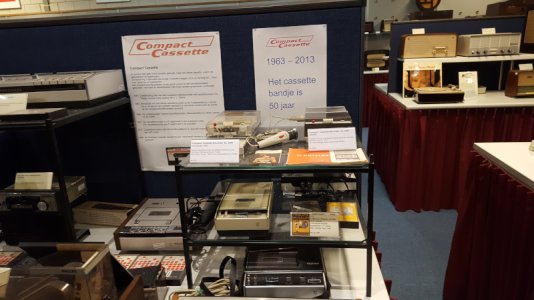
Sidebar: There's a small museum in Eindhoven (Netherlands) that has at least one example of every product Philips ever made. The museum is run by Philips retirees. My late father-in-law, who was a retired Philips executive, took me there in 2018. Photos relevant to this discussion:

1) Marking the 50th anniversary of the cassette in 2013 (sign on the right says, "1963-2013 / The cassette (small) tape is 50 years (old)") with several machines from that era:

20180509_111318-resized.jpg
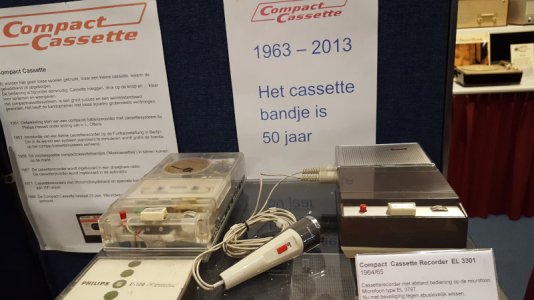
2) A close-up, where you see that one of the vintage recorders is in a transparent case! The microphone used by these first recorders is shown between the two units.

20180509_111325-resized.jpg
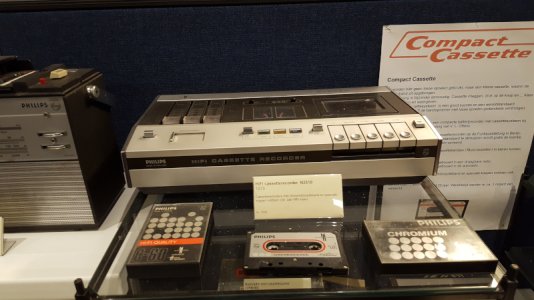
3) This shows the first stereo cassette recorder made by Philips, in 1973. In front is a chromium-dioxide blank tape cassette with the Philips label. The sign between the recorder and the cassette basically explains that chromium-dioxide tapes were used in the first hi-fi cassette recorders.

20180509_111354-resized.jpg
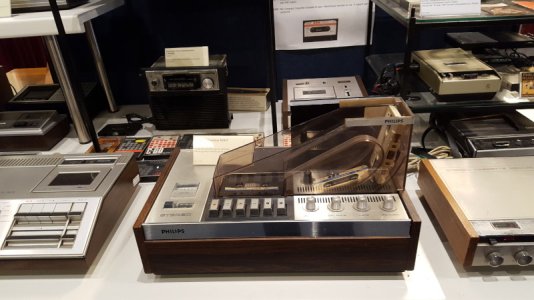
4) Finally, this is a hi-fi cassette recorder that could act as a changer to play back up to six tapes stored in the unit. Three cassettes are in the unit; one is actually engaged with the tape's transport mechanism; the other two are lined up in a loop-like plastic structure that extends upward from the unit; one of those two tapes is actually stacked almost vertically. Looks scary!

20180509_111333-resized.jpg


Back
Top Bottom