• Get involved.
    We want your input!
    Apply for Membership and join the conversations about everything related to broadcasting.

    After we receive your registration, a moderator will review it. After your registration is approved, you will be permitted to post.
    If you use a disposable or false email address, your registration will be rejected.

    After your membership is approved, please take a minute to tell us a little bit about yourself.
    https://www.radiodiscussions.com/forums/introduce-yourself.1088/

    Thanks in advance and have fun!
    RadioDiscussions Administrators

560

You took that completely out of context. The majority of home games start at 7:05-7:15, now 6:45 since Manfred wants games ending earlier. Of course road games outside of the pacific time zone start earlier. Do you know why that is?

I know how baseball and timezones work.

You said what you said....

Street Novelist said:
From 7 p.m. to 10? I wouldn't think a lot of people would be listening to talk radio in that time slot. Most Giant games start between 6:45 - 7:05.

...and I said:

So far this season, 27 Giants games have had first pitch times of 6:45 or later. Even if you include the seven games that started at 6:40, that's 34 games.

40 have been day games (start times before 5:00 p.m.). Of those, 38 have been before 4:00 p.m. and 34 have had first pitch prior to 3:00 p.m. In fact, today's game hosting Philadelphia began at 12:45.

So in terms of its possible (I still don't know if @adradio is right) impact on KSFO's numbers...

adradio said:
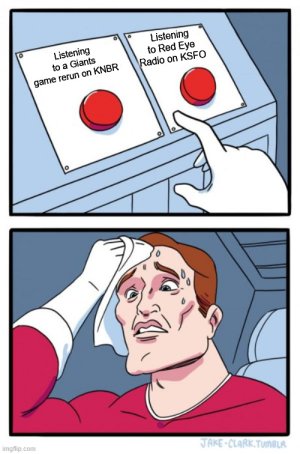
Competition on the AM band from Giants Baseball likely is the reason for KSFO ratings decline.

...and your assertion, not just once...

I fail to see how listening to Giants' game would conflict with listening to conservative radio. And by the time most Giants' games start, the afternoon drive is well over.

...but twice:

From 7 p.m. to 10? I wouldn't think a lot of people would be listening to talk radio in that time slot. Most Giant games start between 6:45 - 7:05.

…the bottom line is that it doesn't matter whether it's a home game or a roadtrip, the game is on KNBR, where people can tune into it...more often during the day than during the evening.

Finally,

And yes, Michael, today's home game started at 12:45. I hate to be that guy, but without using a search engine to give you the answer, can you tell me why it was an afternoon game?

No.

But if when because I use a search engine and look up why, my answer here is infinitely more likely to be right than any wild-ass guess I might make.
 
Last edited:
But how much does it really matter to Cumulus? Whether you punch/dial up KSFO on 810 or KNBR on 680/104.5, you're still listening to a Cumulus station, and not to an Audacy or iHeart one. (Or, for that matter, TV of any kind.)
 
Also, I wonder whether everyone is missing the forest for the trees. Having read through all 600+ posts in this thread (because it's hard to readjust sleep patterns after returning from freaking Norway), the question nobody is asking is, what's the TOTAL rating that radio's getting these days, and what's its share of all rated media consumption? My guess - and feel free to excoriate me for guessing too, Mike - is that's a much bigger question than why KSFO dropped from a 1.8 to a 1.3. (Which, BTW, seems also to have happened concurrently with the insane asylum getting let loose to run our government. That might have played a bigger role than the start time of Giants games, dontcha think?)
 
what's the TOTAL rating that radio's getting these days, and what's its share of all rated media consumption?

The answer to your first question is: only subscribers get that information; The answer to your second question is: nobody really knows. Especially when you consider non-rated media, which is a lot.

My sense is that Cumulus San Francisco has much bigger problems than the ratings at KSFO.
 
My sense is that Cumulus San Francisco has much bigger problems than the ratings at KSFO.
The structural issues (more AMs than FMs, leases, costs, etc.) have already been discussed pretty thoroughly. What's left is management.

For example, what would keep Cumulus from firing 560 back up again with time-brokered ethnic programming? Too much corporate overhead? Shame? "Not invented here"?

I'm not advocating this, but it's interesting that something that would bring in at least some amount of money doesn't seem to have been considered.
 
For example, what would keep Cumulus from firing 560 back up again with time-brokered ethnic programming? Too much corporate overhead? Shame? "Not invented here"?

I don't think that's the case. To me, it's still the situation of having four AM stations in a market where the revenues for the cluster are declining. How does brokered ethnic add more corporate overhead? That seems like something the local market manager handles. Cumulus has access to lots of programming. They could run one of the WW1 24/7 formats. But it might not make enough to pay the for the tower lease.
 
How does brokered ethnic add more corporate overhead? That seems like something the local market manager handles.
No, what I mean is that there would be too much overhead to be covered by the revenues from such a format. A small broadcaster tends not to have that much overhead. Fewer corporate VPs, if any.
 
No, what I mean is that there would be too much overhead to be covered by the revenues from such a format. A small broadcaster tends not to have that much overhead. Fewer corporate VPs, if any.

That doesn't address the issue, which is they own 4 AMs in a market where revenues are declining.

If a "small broadcaster" wants to make an offer, they know who to contact.
 
Also, I wonder whether everyone is missing the forest for the trees. Having read through all 600+ posts in this thread (because it's hard to readjust sleep patterns after returning from freaking Norway), the question nobody is asking is, what's the TOTAL rating that radio's getting these days, and what's its share of all rated media consumption? My guess - and feel free to excoriate me for guessing too, Mike - is that's a much bigger question than why KSFO dropped from a 1.8 to a 1.3. (Which, BTW, seems also to have happened concurrently with the insane asylum getting let loose to run our government. That might have played a bigger role than the start time of Giants games, dontcha think?)

I have no issue with a guess clearly labeled as one, @Weiserguy .
 
That doesn't address the issue, which is they own 4 AMs in a market where revenues are declining.

That's what I referred to as a structural problem. That's baked into the cluster.
If a "small broadcaster" wants to make an offer, they know who to contact.
The point is to ask what stops large broadcasters from doing brokered ethnic formats.
 
But that's why they're looking to shut at least one of them down.
As I stated upthread, this has been gone over time and time again:
The structural issues (more AMs than FMs, leases, costs, etc.) have already been discussed pretty thoroughly. What's left is management.
So Cumulus eventually ends up with three AMs and two FMs rather than four and two. The structural problem remains. They could be at zero and two, and there would still be a structural problem, though it might not be as severe, or that configuration positions them better for a trade of some kind.

I'm not advocating this, but it's interesting that something that would bring in at least some amount of money doesn't seem to have been considered.
Just repeating to make that clear.

Regarding time-brokerage:
Probably because the players on the client side are not always easy to deal with. I'm basing that on what I've read, not on experience.
Certainly that field doesn't have the best reputation, and it's tended to be the programming of second-to-last resort. But income is income. It seems like some rationality is missing from the equation.
 
But income is income. It seems like some rationality is missing from the equation.

But it's income at a cost. That's part of the consideration.

My sense is that Cumulus is trying to shrink its broadcasting footprint as much as possible. Other companies may see it differently. But the traditional radio business is changing, and not everyone wants to be a part of the new business model. Companies seems to be running away from 24/7 linear broadcasting, both radio and TV.
 
But it's income at a cost. That's part of the consideration.

Well, sure, profit is the ultimate objective here. All income has some kind of cost to it, even passive income.
My sense is that Cumulus is trying to shrink its broadcasting footprint as much as possible. Other companies may see it differently. But the traditional radio business is changing, and not everyone wants to be a part of the new business model.
Whatever that business model is. I don't see a whole lot having developed other than a traditional advertising-supported model, sometimes transferred to digital media, distributed through different mechanisms. In that process of transference, the profit potential appears to have shrunk considerably.
 
My guess - and feel free to excoriate me for guessing too, Mike - is that's a much bigger question than why KSFO dropped from a 1.8 to a 1.3. (Which, BTW, seems also to have happened concurrently with the insane asylum getting let loose to run our government. That might have played a bigger role than the start time of Giants games, dontcha think?)
Of course, the margin of error in ratings for low-rated stations (those with a 0.1 or 0.0 rating) is quite wide. 1.3 and 1.8 are at the extremes, but such a wobble would likely not be unusual. We have to wait another book or two to see what the average is before concluding that this is a programming based issue.
 
From 7 p.m. to 10? I wouldn't think a lot of people would be listening to talk radio in that time slot. Most Giant games start between 6:45 - 7:05. Warriors' games are 2.5 hours long. Does that mean 95.7 The Game is also drawing away listeners from KSFO? :unsure:
At one point, KGO had a 26 share at night in Portland and had advertisers there!
 
For example, what would keep Cumulus from firing 560 back up again with time-brokered ethnic programming? Too much corporate overhead? Shame? "Not invented here"?
The whole management and cost structure for companies that deal with brokering is different. It just does not fit with a public corporation like Cumulus that predominantly gets revenue from ad sponsorships, not time brokers.

The same applies for a few local stations that target 45 and over (such as Buddy Shula's WECK which is often discussed here) where a concerted and very service oriented local sales force brings in revenue... mostly for local owners who run those "localized" stations.


Back
Top Bottom