
I know you mentioned the link to Matt Sittel's site in the OP of this thread, but it's such a wonderful resource that for anyone who missed it, here's the link again:

-
Get involved.
We want your input!
Apply for Membership and join the conversations about everything related to broadcasting.
After we receive your registration, a moderator will review it. After your registration is approved, you will be permitted to post.
If you use a disposable or false email address, your registration will be rejected.
After your membership is approved, please take a minute to tell us a little bit about yourself.
https://www.radiodiscussions.com/forums/introduce-yourself.1088/
Thanks in advance and have fun!
RadioDiscussions Administrators
You are using an out of date browser. It may not display this or other websites correctly.
You should upgrade or use an alternative browser.
You should upgrade or use an alternative browser.
TV Guide editions and online resources
- Thread starter IM42A
- Start date
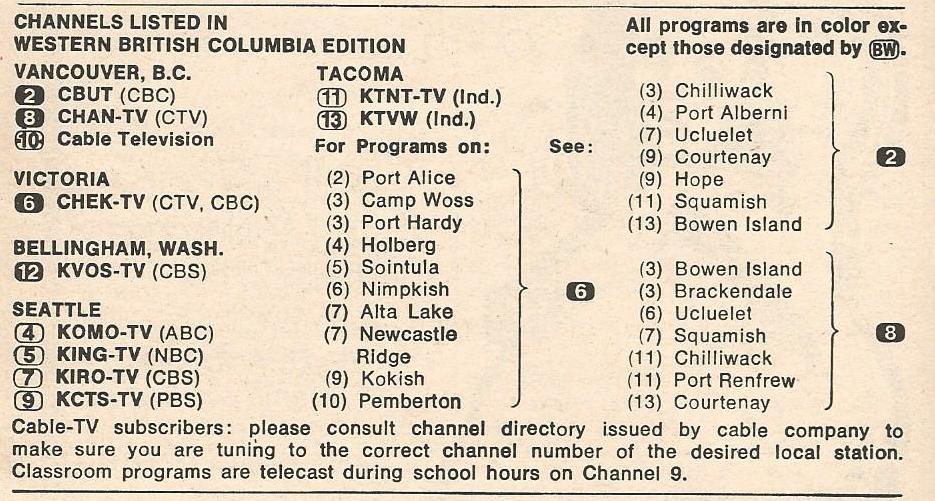
As I was browsing the site, a station caught my eye: Channel 10, "Cable Television" in the 1973 Western British Columbia edition of TV Guide:
I remembered reading about the cable-only station in Martin Mayer's 1972 book About Television; Mayer even mentioned its TV Guide listing:
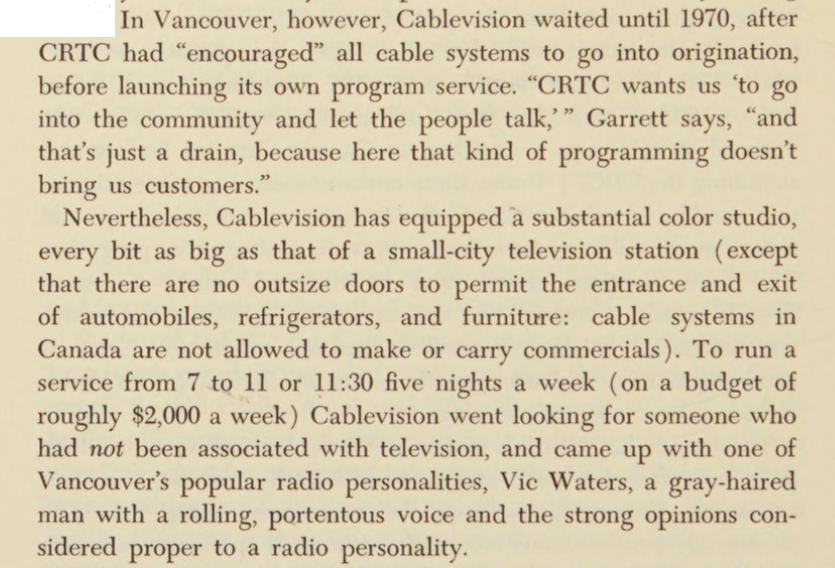
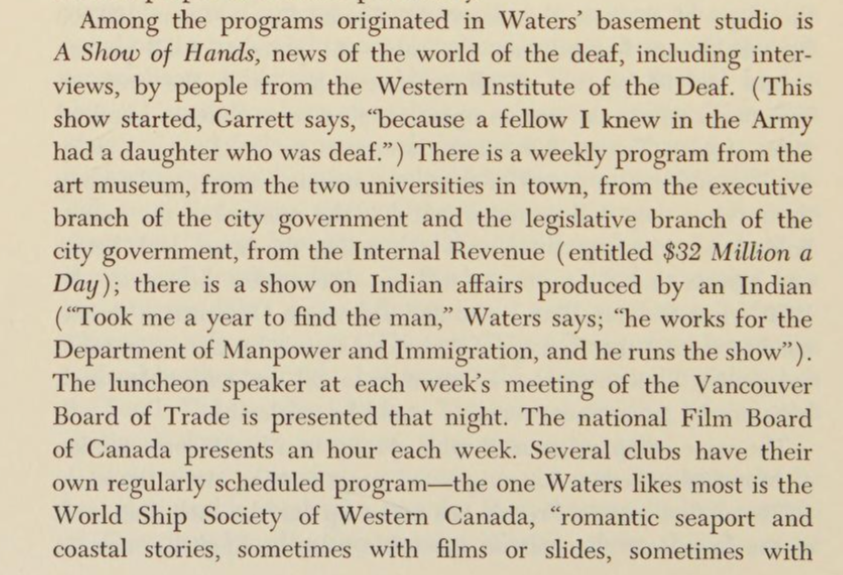
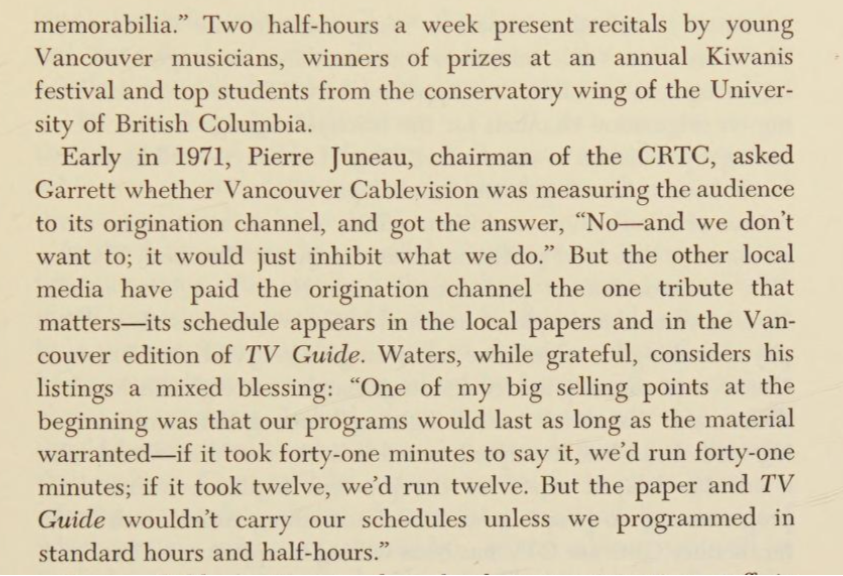
I remembered reading about the cable-only station in Martin Mayer's 1972 book About Television; Mayer even mentioned its TV Guide listing:
Last edited:
That is a nice edition. It could have been used equally well on the US side of the border.
The "10" reminded me of when the West Virginia edition added "cable channels" back in the 1970s, indicated by "notched slugs", as they called them. In the run-up to these channels being added, there were ads in the WV TVG announcing the change, and as a youngster, I was excited, I wondered what the new TVG was going to look like (we did not have cable at the time). Turns out it was basically a customized channel expansion for Parkersburg cable (Durfee's TV Cable), and WSTV-9 and WDTV-5 were conspicuous by their absence, as Parkersburg cable carried neither one. WOUB, despite being in-market, appeared as a "cable" channel. The Columbus stations also provided at least some of the in-state stations carried on cable in Portsmouth, Waverly, Jackson, Ironton, and so on. Kentucky viewers were ignored in all of this, no Lexington stations were ever listed in the WV TVG.
Here's what it looked like in 1971:
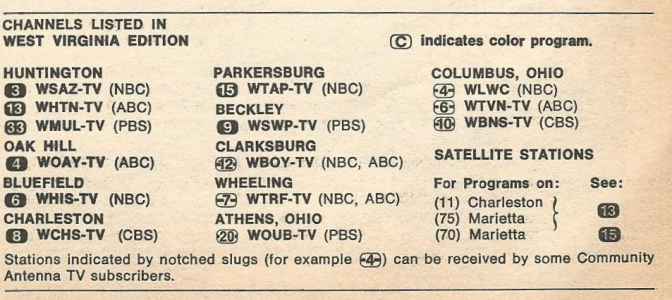
They later added a cable-only station, WNOW-9 Parkersburg, which curiously carried the ABC evening news. I suppose that gave the station more of the look and feel of a "real" TV station (IIRC they also did local news). I never saw it.
The "10" reminded me of when the West Virginia edition added "cable channels" back in the 1970s, indicated by "notched slugs", as they called them. In the run-up to these channels being added, there were ads in the WV TVG announcing the change, and as a youngster, I was excited, I wondered what the new TVG was going to look like (we did not have cable at the time). Turns out it was basically a customized channel expansion for Parkersburg cable (Durfee's TV Cable), and WSTV-9 and WDTV-5 were conspicuous by their absence, as Parkersburg cable carried neither one. WOUB, despite being in-market, appeared as a "cable" channel. The Columbus stations also provided at least some of the in-state stations carried on cable in Portsmouth, Waverly, Jackson, Ironton, and so on. Kentucky viewers were ignored in all of this, no Lexington stations were ever listed in the WV TVG.
Here's what it looked like in 1971:
They later added a cable-only station, WNOW-9 Parkersburg, which curiously carried the ABC evening news. I suppose that gave the station more of the look and feel of a "real" TV station (IIRC they also did local news). I never saw it.
That is a nice edition. It could have been used equally well on the US side of the border.
Except for the different order of stations and (of course) the missing Channel 10, the lineup of the Western Washington edition was almost identical! Here's what it looked like in 1979:
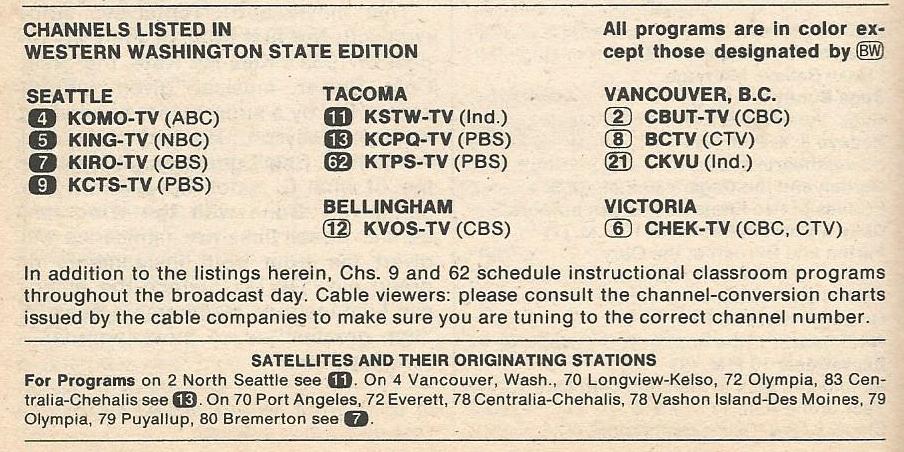
Curiously and unlike the 1973 Canadian edition, it identified Channel 8 in Vancouver as BCTV, its on-air identity, rather than as CHAN, its call letters.
Except for the different order of stations and (of course) the missing Channel 10, the lineup of the Western Washington edition was almost identical! Here's what it looked like in 1979:
Curiously and unlike the 1973 Canadian edition, it identified Channel 8 in Vancouver as BCTV, its on-air identity, rather than as CHAN, its call letters.
I noticed that in the Western Washington edition when I was out there in the mid-1990s. I get the impression that, even back then, Canadian stations were largely getting away from using call letters in favor of network names or acronyms. AFAIK, Global always appeared in Canadian TVGs as "[channel number] (Global)" in parentheses, rather than using call letters (such as CIII Paris ONT).
That would be more in keeping with European usage. Europeans really don't have a concept of call letters or channel numbers. Everything is just this "program" or that one, and you're just expected to figure out how to receive it locally.
Kind of a side issue, does anyone know if there is a Europe-specific resource similar to rabbitears.info? It would be great to have access to call letters and OTA/PSIP channel numbers, and coverage maps would be icing on the cake. Longley-Rice maps would be even better. I've done just a bit of OTA reception logging in Europe (Poland and Germany), and if I can ever get back over there, I intend to get a DVB-T dongle and take my Channel Master mudflap with me (or even buy a cheap antenna and give it to someone when I'm ready to come back home).

K.M. Richards
Program Director, The Eighties Channel™
Curiously and unlike the 1973 Canadian edition, it identified Channel 8 in Vancouver as BCTV, its on-air identity, rather than as CHAN, its call letters.
Best guess? CHAN-TV gradually introduced the BCTV identity starting in 1971. Perhaps TV Guide thought it was not established enough in 1973 to replace the call letters.
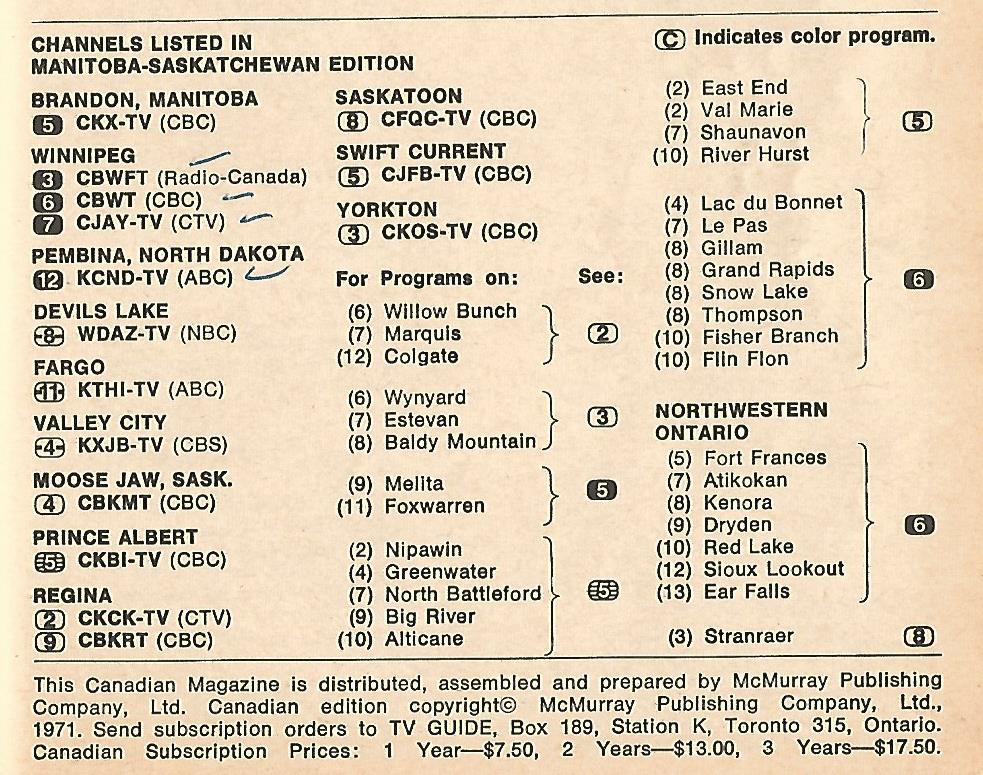
Another thing regarding both editions, I went back and looked at TV listings in the Bellingham newspaper in 1973 (newspapers.com), and it looks as though KVOS was a full-time CBS affiliate. In later years KVOS started cutting back its CBS programming until, towards the end (1987), they were a CBS affiliate in name only, carrying a very small amount of CBS programming such as 60 Minutes. It appears that in earlier years, they were Vancouver's de facto CBS affiliate, there would be no other reason to have a second CBS affiliate in northwest Washington so close to Seattle. It was a situation not unlike KCND, an ABC affiliate in Pembina, North Dakota, serving Winnipeg. (Fun fact, at one time Pembina was its own market, #206 in Arbitron's 1975 list, taking in a handful of very small counties in North Dakota and Minnesota.)
Another thing regarding both editions, I went back and looked at TV listings in the Bellingham newspaper in 1973 (newspapers.com), and it looks as though KVOS was a full-time CBS affiliate. In later years KVOS started cutting back its CBS programming until, towards the end (1987), they were a CBS affiliate in name only, carrying a very small amount of CBS programming such as 60 Minutes. It appears that in earlier years, they were Vancouver's de facto CBS affiliate, there would be no other reason to have a second CBS affiliate in northwest Washington so close to Seattle.
Martin Mayer briefly mentions KVOS in his 1972 book:
"The Du Pont-Columbia Survey also commended KVOS-TV in Bellingham, Washington, for a series called Our Northwest Environment, taking special note of the fact that Bellingham is 'a small city.' The comment was New York provincialism at its purest, for KVOS-TV is essentially a Vancouver station, with a studio and, more important, a selling office in the Canadian metropolis."
It was a situation not unlike KCND, an ABC affiliate in Pembina, North Dakota, serving Winnipeg. (Fun fact, at one time Pembina was its own market, #206 in Arbitron's 1975 list, taking in a handful of very small counties in North Dakota and Minnesota.)
My other go-to book about 1970s television, The Universal Eye by British journalist Timothy Green, has this to say about KCND (before its virtual "move" to Winnipeg):
"The village of Pembina in North Dakota seems a strange place to have a powerful television station. Only a couple of hundred people live there and the nearest American town of any size is many miles away. But the advertisers who queue up to buy time on KCND-TV Pembina have their eye not on Americans, but on the half a million Canadians living just north of the border in the city of Winnipeg. The investment pays off; the people of Winnipeg spend a fifth of their viewing time watching the Pembina station."
This anniversary video explains how KCND in Pembina eventually became CKND in Winnipeg:
By the way, here's a TV Guide lineup (again from Matt Sittel's site) from before KCND's move:
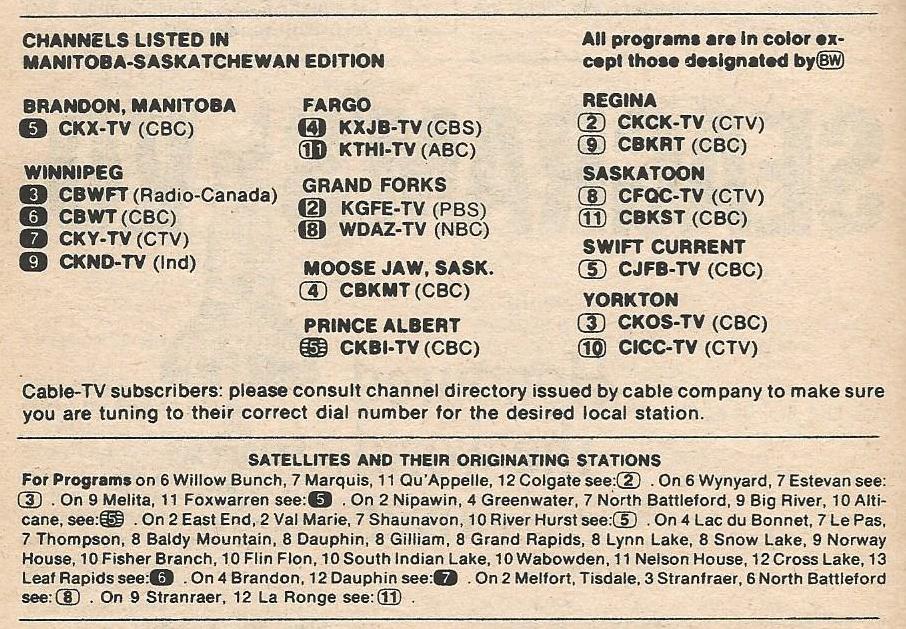
And after the move:
And after the move:
WNOW was a Christian AM station in Charlotte NC which later became the first Spanish language station in the market, adding Spanish programming gradually.
These were fake call letters, AFAIK, WNOW had no OTA presence, it was a cable-only station, and LPTVs aside from translators weren't a thing back then.
Indeed, WNOW appeared with a "sandwich" bullet and was listed as "WNOW-cTV" (this from 1973):
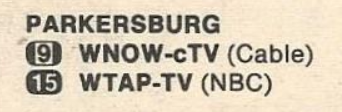
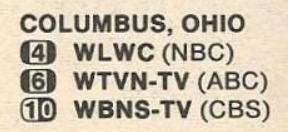
By this time, notched slugs for "cable" stations in the WV TVG had been replaced by sandwich bullets for single-digit channels or split bullets for double-digit channels (left side black digit on white background, right side white digit on black background), like so:
I just wondered if the Charlotte station had to get permission from the, or if those letters weren't real anyway.These were fake call letters, AFAIK, WNOW had no OTA presence, it was a cable-only station, and LPTVs aside from translators weren't a thing back then.
I just wondered if the Charlotte station had to get permission from the, or if those letters weren't real anyway.
I seriously doubt it would have ever been an issue. WNOW-cTV was a cable-only station on Durfee's Cable in Parkersburg. I am willing to wager that no one knew or cared, unless someone moved from Parkersburg to Charlotte (or vice versa), or was just traveling through, and said, "hey, that's just like back home".
It'd be no more of an issue than a pizza place in Charlotte being called Gino's, but not a part of the iconic West Virginia chain.
K.M. Richards
Program Director, The Eighties Channel™
I just wondered if the Charlotte station had to get permission from the, or if those letters weren't real anyway.
I wish you had just asked that in the first place. It's a lot harder for us to understand what you mean when you post something like this ...
WNOW was a Christian AM station in Charlotte NC which later became the first Spanish language station in the market, adding Spanish programming gradually.
... without telling us why that was relevant to the discussion.
In the early 1970s, I worked at the early attempt of local programming on the two cable systems in Ventura CA. It was a joint venture between them, with both contributing equipment, one providing the studio origination facilities and the other providing a step van for remotes and a videotape library of movies in the public domain.
We originally only operated on Saturday mornings and early afternoons, with a teen oriented dance show, a tape-delay of the previous evening's high school football or basketball game, a local news summary of the previous week, and one of the movies. We later added Monday night live coverage of the City Council meeting and an open-ended interview/call-in/discussion program on current events and prominent elected officials and the like on Tuesday evenings. We started off just calling ourselves "Cable Channel 6" but quickly adopted the fake call letters "KABL-TV" despite those belonging to a San Francisco-area radio station.
Since cable is not broadcast, and the idea of call letters as intellectual property not having been established, there were a lot of instances where cable systems' local origination channels "appropriated" call letters.
These days, where viewers are much more acclimated to acronyms, channel 6 in Ventura is now operated by a non-profit community organization and branded as CAPS (based on their name, Community Access Partners of San Buenaventura) and headquartered at the east edge of the Ventura College campus.
(Side note: In the early days when I was there, channel 6 was a weather scanner until around 3:00pm every day ... the headend had equipment to switch to what was then KBSC-TV/52 when they turned their transmitter on.)
That was a very interesting report on a very small "market" TV station.Here's more on KYUS:
One thing that stands out is how the locals the host talked with really value having a local media presence, not some distant station 100s of miles away that rarely (if ever) even mentions the town.
That was a very interesting report on a very small "market" TV station.
One thing that stands out is how the locals the host talked with really value having a local media presence, not some distant station 100s of miles away that rarely (if ever) even mentions the town.
Those little stations had heart, you've got to give them that. It's a dying phenomenon. About the closest thing we have anymore are small single-station markets such as WAGM Presque Isle ME and WBKB Alpena MI, both on the fringes of the US, and Aroostook County is entirely its own thing.
By the way, here's a TV Guide lineup (again from Matt Sittel's site) from before KCND's move:
And after the move:
This was a very interesting, efficient edition, with the useful mnemonic of Manitoba stations in black bullets, Saskatchewan stations (in the main) in white bullets, and US stations with "cable" bullets. Interesting that KCND was clustered with the Manitoba channels. And of course there were tons of translators and repeater stations.
Those little stations had heart, you've got to give them that. It's a dying phenomenon. About the closest thing we have anymore are small single-station markets such as WAGM Presque Isle ME and WBKB Alpena MI, both on the fringes of the US, and Aroostook County is entirely its own thing.
Australian television stations outside the big cities were like that for decades. They enjoyed a commercial monopoly (the noncommercial public brodcaster ABC was their only "competitor"), so they could spend a lot of resources on local programming. That golden age of local production ended with "aggregation," when TV markets were expanded and competition was introduced.
Here's a promotional video for an Australian "regional" (i.e., small-market) station form 1985, before aggregation:
*********
WCAX in Burlington, Vermont, wasn't a monopoly station for long, but it was always a dominant station in the state and an important voice in the community (even though some Democrats detected a Republican bias in its news coverage and dubbed the station "WGOP").
The station's 60th anniversary special, which aired a decade ago, was very well done and provides a wonderful glimpse at what community-minded local TV once looked like:
I've read some Bellingham newspapers articles about KVOS. Apparently in the mid70s the Canadian government disallowed tax breaks Canadian advertisers were getting for ads on KVOS. The only way KVOS could stay in business was drop its rates and expand its commercial load. Well the network really limit the amount of local ads on their shows so KVOS largely left CBS behindAnother thing regarding both editions, I went back and looked at TV listings in the Bellingham newspaper in 1973 (newspapers.com), and it looks as though KVOS was a full-time CBS affiliate. In later years KVOS started cutting back its CBS programming until, towards the end (1987), they were a CBS affiliate in name only, carrying a very small amount of CBS programming such as 60 Minutes. It appears that in earlier years, they were Vancouver's de facto CBS affiliate, there would be no other reason to have a second CBS affiliate in northwest Washington so close to Seattle. It was a situation not unlike KCND, an ABC affiliate in Pembina, North Dakota, serving Winnipeg. (Fun fact, at one time Pembina was its own market, #206 in Arbitron's 1975 list, taking in a handful of very small counties in North Dakota and Minnesota.)
Yes, and KIRO Seattle also had an issue with having another full-service CBS affiliate that close by, but it wasn't really that close, about 80 miles, and over somewhat difficult terrain at that. The fact of the matter was, Bellingham had the channel 12 allocation, and they just happened to be affiliated with CBS.I've read some Bellingham newspapers articles about KVOS. Apparently in the mid70s the Canadian government disallowed tax breaks Canadian advertisers were getting for ads on KVOS. The only way KVOS could stay in business was drop its rates and expand its commercial load. Well the network really limit the amount of local ads on their shows so KVOS largely left CBS behind
Again, it was basically Vancouver's CBS affiliate, and when the CRTC started cracking down on Canadian advertisers on US stations, something had to give.
As a kind of side issue (but this is a very broadly-based thread and isn't confined to a single market or set of circumstances), what other US stations, not necessarily near the Canadian border, ran a bare-bones network schedule for this reason or that, aside from small stations affiliated with multiple networks? WWOR/WZJB Worcester MA is the only one that comes to mind.
By the way, KVOS's station image promos, like this one from Frank Gari's Turn To campaign, featured both Washington State and British Columbia communities:
And the station's weather forecasts used both Fahrenheit and Celsius:
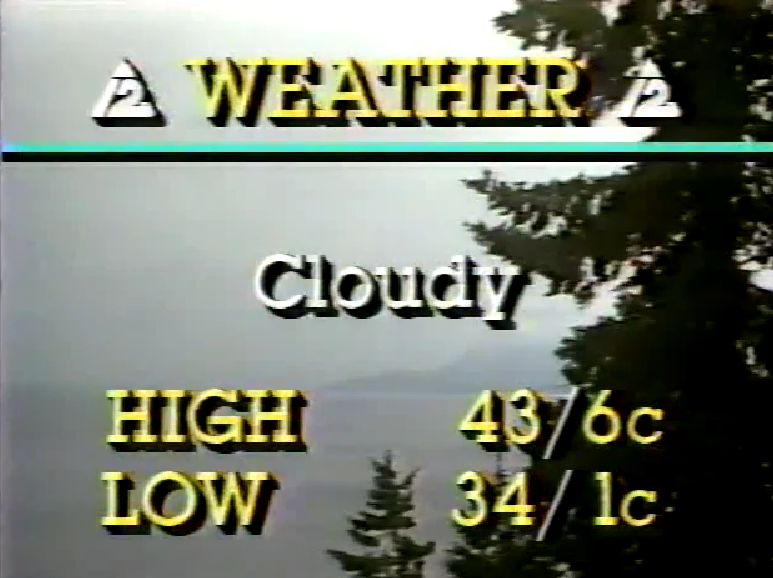
Image: robatsea2009/YouTube
And the station's weather forecasts used both Fahrenheit and Celsius:
Image: robatsea2009/YouTube