
Before today I’ve never seen a radio in the US that can tune to 108.1, has anyone else? This is part of an RCA component system:
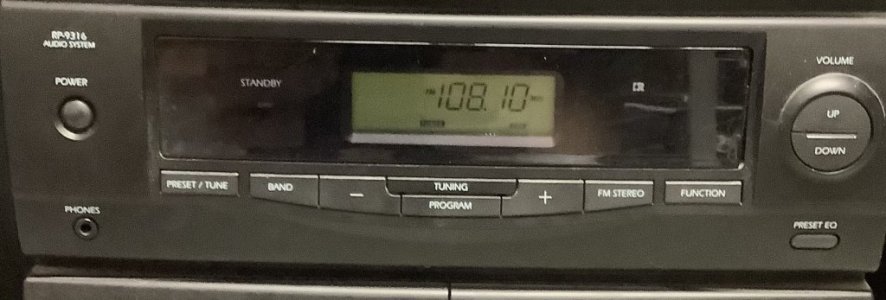

Before today I’ve never seen a radio in the US that can tune to 108.1, has anyone else? This is part of an RCA component system:
View attachment 9941
There were quite a few analog tuners that could reach 109 MHz, though there were rarely any receivable signals between 108 and 109. Very rare to see a digital FM tuner that goes to 108.1, and I’ve never seen one go higher than that.Before the arrival of digital tuning, most analog tuners stopped just above 107.9 FM, meaning that they were probably in, or near, the center of the 108.1 frequency when they reached their end.
What is the lower limit of the aeronautical band that sits above the FM broadcast band? Is it 108.1 or some higher frequency where splatter wouldn't be a problem? (Yes, I know plane-to-tower comms on that band are in AM.)
What in the world do you mean? A dead zone? There are stations, successful ones at that, at 107,9 all over the country. That's the end of the band, or at least the last channel designated for broadcasting on the band, as 108.0 MHz is not used. The only advantage I can think of for being up there is a lower likelihood of tropo or E-skip interference compared to the stations at the low end of the band, Otherwise, it doesn't matter what frequency a station is on in terms of its potential for success, despite the bizarre concept of "cursed frequencies" brought up occasionally on these boards.Is there any advantage to having a station at the end of the band. Or is it truly a dead zone.
Is there a “sweet spot” where if you had your choice of where to be engineers would pick one frequency.What in the world do you mean? A dead zone? There are stations, successful ones at that, at 107,9 all over the country. That's the end of the band, or at least the last channel designated for broadcasting on the band, as 108.0 MHz is not used. The only advantage I can think of for being up there is a lower likelihood of tropo or E-skip interference compared to the stations at the low end of the band, Otherwise, it doesn't matter what frequency a station is on in terms of its potential for success, despite the bizarre concept of "cursed frequencies" brought up occasionally on these boards.
If you're trying to equate the AM band with the FM band, you need to stop.Is there a “sweet spot” where if you had your choice of where to be engineers would pick one frequency.
WNCT-FM was at 107.7. Maybe the change to 107.9 happened when the localizer moved.Far too many years ago, the localizer at the Pitt-Greenville (NC) airport was 108.3MHz or at least that is what I thought I remember and a contact at the airport thought he remembered the same frequency.
At some point, 1990 or maybe slightly earlier, the localizer frequency was changed to 110.7MHz which appears to be the current frequency.
Okay, two things - the change was no doubt in response to pilot complaints of bleed-over from WNCT-FM on 107.9Mhz, but I never heard any on any of the aircraft I flew into PGV.
WNCT-FM was at 107.7. Maybe the change to 107.9 happened when the localizer moved.
Wikipedia says 1982.It looks like WNCT-FM was originally on 107.7 and the application for the move to 107.9 was late 1981.
But, in looking back at the Broadcasting Yearbooks, the listing for the FM was still 107.7 even as late as 1991. 1992 was the first listing for 107.9.
Subject: Re: Vintage radio info please
From: Jerry McCarty
Date: 31 Jan 1994 10:34:48 PM
Newsgroups: rec.radio.broadcasting
In article <2ieatc$[email protected]>, [email protected] (Stephen D. Cohen) wrote:
> What I'm wondering about is the FM radio. The scale goes from 200-300, rather than the current 88-108. What gives? Was this the FM broadcast band at one time? Any idea as to the vintage of the beast given the above?
Back in the early days of FM (don't know the exact dates, maybe mid 40's) radio dials were marked with the FM Channel number rather than frequency. Why? Don't know. In any event, the FM band is divided up into 100 channels of 200 kHz each. The first channel number is 201 (for 88.1 MHz) and the last is 300 (for 107.9). This is according to 47 CFR 73.201. One last note- FM channel 301, 108.0 MHz might be assigned to a VOR facility if no interference to existing stations, present or future, can be proved.
However, I need to make a correction based on what you said.
Can you tell me where Broadcasting Yearbook says the change happened?
A license to cover for WNCT-FM's move was filed 11/24/1981, though it wasn't granted (a formality) until October 1982.
No. It doesn't fit the band plan (200 kHz spacing starting from 88.1 MHz), so I think the "channel 301" tidbit was nonsense, or at best a colloquialism.Has anyone ever heard of 108.0 being referred to as "FM channel 301" in official material from the FCC? I can't find any other references to it anywhere.

