• Get involved.
    We want your input!
    Apply for Membership and join the conversations about everything related to broadcasting.

    After we receive your registration, a moderator will review it. After your registration is approved, you will be permitted to post.
    If you use a disposable or false email address, your registration will be rejected.

    After your membership is approved, please take a minute to tell us a little bit about yourself.
    https://www.radiodiscussions.com/forums/introduce-yourself.1088/

    Thanks in advance and have fun!
    RadioDiscussions Administrators

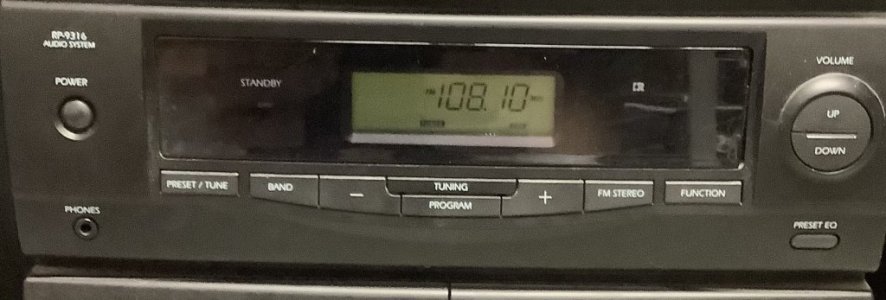
US radios that can tune to 108.1 FM

Before the arrival of digital tuning, most analog tuners stopped just above 107.9 FM, meaning that they were probably in, or near, the center of the 108.1 frequency when they reached their end.
There were quite a few analog tuners that could reach 109 MHz, though there were rarely any receivable signals between 108 and 109. Very rare to see a digital FM tuner that goes to 108.1, and I’ve never seen one go higher than that.

More common to see FM receivers that reach down to at least 87.5, and less often 87.0, presumably models that are sold internationally in places where the FM band goes that low.
 
I remember listening to the 'end of the dial' station in the Bay Area(then KSOL) at 107.7, picking it up at the beginning of 'High VHF' on a multi-band radio I had in the late 80s. Most analog radios I remember had '108' at the end of the band.
 
What is the lower limit of the aeronautical band that sits above the FM broadcast band? Is it 108.1 or some higher frequency where splatter wouldn't be a problem? (Yes, I know plane-to-tower comms on that band are in AM.)
 
What is the lower limit of the aeronautical band that sits above the FM broadcast band? Is it 108.1 or some higher frequency where splatter wouldn't be a problem? (Yes, I know plane-to-tower comms on that band are in AM.)

Far too many years ago, the localizer at the Pitt-Greenville (NC) airport was 108.3MHz or at least that is what I thought I remember and a contact at the airport thought he remembered the same frequency.

At some point, 1990 or maybe slightly earlier, the localizer frequency was changed to 110.7MHz which appears to be the current frequency.

Okay, two things - the change was no doubt in response to pilot complaints of bleed-over from WNCT-FM on 107.9Mhz, but I never heard any on any of the aircraft I flew into PGV.

Second, the FM receiver in my Datsun 280ZX, analog, would tune to the old localizer frequency, 108.3 and in my unscientific monitoring of that frequency, I also never heard anything from WNCT-FM. But, to be fair, my Datsun was never at 1600 feet flying the localizer to PGV with the WNCT-FM tower in front of me, and me trying to land.
 
Last edited:
Is there any advantage to having a station at the end of the band. Or is it truly a dead zone.
What in the world do you mean? A dead zone? There are stations, successful ones at that, at 107,9 all over the country. That's the end of the band, or at least the last channel designated for broadcasting on the band, as 108.0 MHz is not used. The only advantage I can think of for being up there is a lower likelihood of tropo or E-skip interference compared to the stations at the low end of the band, Otherwise, it doesn't matter what frequency a station is on in terms of its potential for success, despite the bizarre concept of "cursed frequencies" brought up occasionally on these boards.
 
What in the world do you mean? A dead zone? There are stations, successful ones at that, at 107,9 all over the country. That's the end of the band, or at least the last channel designated for broadcasting on the band, as 108.0 MHz is not used. The only advantage I can think of for being up there is a lower likelihood of tropo or E-skip interference compared to the stations at the low end of the band, Otherwise, it doesn't matter what frequency a station is on in terms of its potential for success, despite the bizarre concept of "cursed frequencies" brought up occasionally on these boards.
Is there a “sweet spot” where if you had your choice of where to be engineers would pick one frequency.
 
In the analog tuning era, some stations used to brag about being "in the middle of your radio dial" as it meant less twisting of the knob to get to.

And didn't FM originally only go up to 104 MHz, and then later 106, before it was finally extended to 108 MHz?
 
Is there a “sweet spot” where if you had your choice of where to be engineers would pick one frequency.
If you're trying to equate the AM band with the FM band, you need to stop.

Stations at the high end of the AM (medium wave) band are at a disadvantage due to the differences in propagation at those frequencies compared to the lower part of the band. There's literally a world of difference in the properties of 540 and 1710 KHz. The bottom of the band is just above the longwave band, while the top end nestles up against the amateur 160 meter band. All the FM frequencies are VHF and a signal at 88.1 (or 92.1 for commercial broadcasters) behaves just the same as one at 107.9. The three top-rated commercial stations in the most recent Nielsens here in the VT/NH Upper Valley are at 106.1, 95.3 and 100.5.
 
Far too many years ago, the localizer at the Pitt-Greenville (NC) airport was 108.3MHz or at least that is what I thought I remember and a contact at the airport thought he remembered the same frequency.

At some point, 1990 or maybe slightly earlier, the localizer frequency was changed to 110.7MHz which appears to be the current frequency.

Okay, two things - the change was no doubt in response to pilot complaints of bleed-over from WNCT-FM on 107.9Mhz, but I never heard any on any of the aircraft I flew into PGV.
WNCT-FM was at 107.7. Maybe the change to 107.9 happened when the localizer moved.
 
WNCT-FM was at 107.7. Maybe the change to 107.9 happened when the localizer moved.


It looks like WNCT-FM was originally on 107.7 and the application for the move to 107.9 was late 1981.

But, in looking back at the Broadcasting Yearbooks, the listing for the FM was still 107.7 even as late as 1991. 1992 was the first listing for 107.9.

The Jepp navigation chart for PGV with the 110.7 localizer frequency that I have is dated 1990, and I left the area in 1989.

I might have some older charts, but I don't think I can find them. Too much clutter.

But I know the localizer was lower in frequency, because I could hear it on the Datsun radio in the mid 1980s. I don't seem to be able to find a site which has old approach plates to try to see when the localizer frequency was changed.

Now, as to the WNCT-FM frequency, since I was using an analog radio, the station could have been on 107.7 up until 1989 and I'd never have known the difference between 107.7 and 107.9.

Damn, getting old is not much fun, but I did make a phone call to WNCT-FM and they took my information to return a call to me, if someone can pinpoint a frequency change date.
 
It looks like WNCT-FM was originally on 107.7 and the application for the move to 107.9 was late 1981.

But, in looking back at the Broadcasting Yearbooks, the listing for the FM was still 107.7 even as late as 1991. 1992 was the first listing for 107.9.
Wikipedia says 1982.

http://americanradiohistory.com/Archive-BC/BC-1982/BC-1982-01-04.pdf Page 92.

However, I need to make a correction based on what you said.

Can you tell me where Broadcasting Yearbook says the change happened?
 
I had a vague recollection of 108.0 MHz having once had a special purpose, and searching one of my old haunts, I found this:

https://groups.google.com/g/rec.radio.broadcasting/c/fnj9pqk91r0/m/NgS1DH8emRYJ

Subject: Re: Vintage radio info please
From: Jerry McCarty
Date: 31 Jan 1994 10:34:48 PM
Newsgroups: rec.radio.broadcasting

In article <2ieatc$[email protected]>, [email protected] (Stephen D. Cohen) wrote:
> What I'm wondering about is the FM radio. The scale goes from 200-300, rather than the current 88-108. What gives? Was this the FM broadcast band at one time? Any idea as to the vintage of the beast given the above?

Back in the early days of FM (don't know the exact dates, maybe mid 40's) radio dials were marked with the FM Channel number rather than frequency. Why? Don't know. In any event, the FM band is divided up into 100 channels of 200 kHz each. The first channel number is 201 (for 88.1 MHz) and the last is 300 (for 107.9). This is according to 47 CFR 73.201. One last note- FM channel 301, 108.0 MHz might be assigned to a VOR facility if no interference to existing stations, present or future, can be proved.

Has anyone ever heard of 108.0 being referred to as "FM channel 301" in official material from the FCC? I can't find any other references to it anywhere.

(The thing is, my vague recollection was actually that 108.0 may have once been an official frequency authorized for special STA experimentation. If that is in fact accurate, then perhaps the reference to "channel 301" in this 1994 poster's mind may have pertained to those days, from prior to its re-assignment to VOR use?)
 

Yes, that was the notice of application for the frequency change, December 3, 1981

However, I need to make a correction based on what you said.

Can you tell me where Broadcasting Yearbook says the change happened?

I looked at the Broadcasting Yearbooks from 1982 to 1995. The 1991 edition had the frequency as 107.7. The 1992 edition had the frequency listed as 107.9.

As I remember, the information for each station in the Broadcasting Yearbooks was a voluntary update from each station. If the station reported no changes, the new year's version of the Yearbook simply showed the previous year's information.

But yes, I could not see a definitive date for the frequency change, only that Broadcasting Yearbook changed the frequency listing between the 1991 edition and the 1992 edition.
 
Has anyone ever heard of 108.0 being referred to as "FM channel 301" in official material from the FCC? I can't find any other references to it anywhere.
No. It doesn't fit the band plan (200 kHz spacing starting from 88.1 MHz), so I think the "channel 301" tidbit was nonsense, or at best a colloquialism.

The 108 to 138 MHz band is allocated broadly, across national borders, to aircraft navigation and ATC. I can't think of any reason for a digital FM tuner to tune to 108.0 or 108.1, even if it was being sold in Japan or Europe or wherever.
The aircraft band uses amplitude modulation, so an FM tuner there would be useless.


Back
Top Bottom