• Get involved.
    We want your input!
    Apply for Membership and join the conversations about everything related to broadcasting.

    After we receive your registration, a moderator will review it. After your registration is approved, you will be permitted to post.
    If you use a disposable or false email address, your registration will be rejected.

    After your membership is approved, please take a minute to tell us a little bit about yourself.
    https://www.radiodiscussions.com/forums/introduce-yourself.1088/

    Thanks in advance and have fun!
    RadioDiscussions Administrators

"Historic" BMI and ASCAP royalty rate increases for broadcast radio

BMI secured the ‘largest rate increase ever’ for radio royalties in the U.S., quickly followed by ASCAP announcing the same. These are songwriter royalties, but as we know the Big Music labels are desperate to add artist royalties onto broadcast radio on top of that, and would most certainly follow the same strategy of aggressive rate increases as soon as they get their foot in the door.

Details, complete with a smug looking photo of the BMI president smiling about his bonus, at the archive link -- to save you from the popup hell of the original source.

 
I'll keep this brief:

I understand the need for artists to get reimbursed justly for their efforts, but even without the increase, the rates stations have to pay are already quite high, and increasing them relentlessly is, in my opinion, unjust and unfair to radio, and threatens to make an already bad situation worse. Corporate greed knows no limits.

Don't even get me started about the obscene fees small Internet stream operators must pay....:mad:🤬

c
 
I understand the need for artists to get reimbursed justly for their efforts, but even without the increase, the rates stations have to pay are already quite high, and increasing them relentlessly is, in my opinion, unjust and unfair to radio, and threatens to make an already bad situation worse. Corporate greed knows no limits.

I'm not sure which is appropriate to describe the short-sightedness of these actions, but it's some combination of "be careful what you wish for because you might get it" and "killing the goose who laid the golden egg".

This is likely to move more stations away from music-based formats, and that is where the short-sightedness comes in: If you raise the royalties but have fewer stations to collect it from, will the compensation increase ... or will it actually decrease?

If the latter, even just the status quo will make a lot of songwriters upset.

As far as performance royalties, how much of today's music is by singer/songwriters, meaning they are already receiving royalties? I know we had a lot of that in the 1980s with Prince, U2, Billy Joel, Lionel Richie, etc.
 
As far as performance royalties, how much of today's music is by singer/songwriters, meaning they are already receiving royalties? I know we had a lot of that in the 1980s with Prince, U2, Billy Joel, Lionel Richie, etc.

Even if 100% songs were written by the performers the music industry would still want to extract a performance royalty. It's hundreds of millions of dollars right in front of their faces and will continue to fight until they get it.
 
I'll keep this brief:

I understand the need for artists to get reimbursed justly for their efforts, but even without the increase, the rates stations have to pay are already quite high, and increasing them relentlessly is, in my opinion, unjust and unfair to radio, and threatens to make an already bad situation worse. Corporate greed knows no limits.

Don't even get me started about the obscene fees small Internet stream operators must pay....:mad:🤬

c

I'd say that *human greed* knows no limits. Before she passed away in 2011, singer/songwriter Phoebe Snow told WXPN's David Dye that when she saw her Internet royalties check from SoundExchange, she was very surprised (and probably displeased--though she didn't say that) by how small it was. Many recording artists, including songwriters, believe, rightly or wrongly, that the radio industry is making money at their expense. And the whole and terrible truth is that many of us in the human family just don't have enough money, no matter how much we earn. I suspect it might be in our genes--though there is no evidence of that that I know of.
 
BMI secured the ‘largest rate increase ever’ for radio royalties in the U.S., quickly followed by ASCAP announcing the same.

Keep in mind some of that is hyperbole coming from the PROs for the benefit of their clients, the songwriters. BMI in particular is now a for-profit company, and no longer has any connection to broadcast radio. BMI was founded by broadcast radio in the 1930s (the B is for Broadcast), and the major radio companies each owned a stake in the company. Not anymore. So it's a very different relationship. Some of it is also aimed at GMR, the third PRO, that has convinced some BMI and ASCAP members to jump to them for higher rates.

These are negotiated royalties, done by the non-profit Radio Music Licensing Committee. They represent more than 9,000 commercial radio stations. They are not imposed by royalty judges (the government), as are the royalties paid to SoundExchange. Those too have been increasing every term. None of this bodes well for public radio stations, who will now have to negotiate music royalties without the experience or money of CPB.

These are songwriter royalties, but as we know the Big Music labels are desperate to add artist royalties onto broadcast radio on top of that, and would most certainly follow the same strategy of aggressive rate increases as soon as they get their foot in the door.

Broadcast radio pays labels and artists for their streaming signals. Yes those royalties go up every term, generally every three years. They're imposed by the government, not negotiated, through copyright royalty judges. One of the key sticking points in this battle is broadcast radio wants royalties to be negotiated, and the music industry wants the government.
 
I love how a government who under the current administration claims small business is so burdened also created a system where small operators and even large ones have very little actual leverage and the proceedings feel like mere formality before the increase.

One of the least fair structures I've seen in place in running a business. And remember, a lot of this is thanks to the RIAA in the early days of streaming disingenuously creating the idea in the minds of non-tech savvy elected officials that "streaming" would be used to make "copies" of music equal to the fidelity of a CD.

We're past that now and a ton of streams still sound like lo-fi crud. No one's ripping music off that to replace music industry revenue when they can pay $12 a month for Spotify. Such a comedy of errors.
 
I love how a government who under the current administration claims small business is so burdened also created a system where small operators and even large ones have very little actual leverage and the proceedings feel like mere formality before the increase.

Keep in mind the president has nothing to do with music royalties. The various copyright acts were passed by congress, and the collection of royalties are even covered in the constitution.

And remember, a lot of this is thanks to the RIAA in the early days of streaming disingenuously creating the idea in the minds of non-tech savvy elected officials that "streaming" would be used to make "copies" of music equal to the fidelity of a CD.

They got the idea from the early incarnations of satellite radio, who were promoting their service as "CD-quality music." When the music industry saw that, they hit the ceiling and ran to congress with the DMCA. The fear was that people would simply record music from satellite rather than buy albums. There are provisions in the law that prevent digital services from playing entire albums for that reason.
 
They got the idea from the early incarnations of satellite radio, who were promoting their service as "CD-quality music." When the music industry saw that, they hit the ceiling and ran to congress with the DMCA. The fear was that people would simply record music from satellite rather than buy albums. There are provisions in the law that prevent digital services from playing entire albums for that reason.
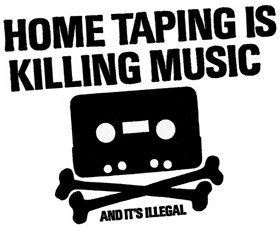
Long before that, we got "Home Taping Is Killing Music".

And then the music industry put the kibosh on DAT because of its ability to make perfect digital tape copies of CDs:
 
I thought a bigger issue with DAT was that the players and tapes were really expensive for home use.
It was, probably in large part because of the industry's lobbying efforts to keep it away from the public. They tried doing something similar with VHS and, as I recall, their efforts failed.

That said, DAT was relatively popular in pro studios for making masters for a time back in the 90s, and the industry was fine with that, for obvious reasons.

c
 
It was, probably in large part because of the industry's lobbying efforts to keep it away from the public. They tried doing something similar with VHS and, as I recall, their efforts failed.
That was the "Betamax case" which legalized home taping. The movie studios freaked out when they thought "nobody will ever go to the movies again if you can just tape it from TV for free".
 
Even if 100% songs were written by the performers the music industry would still want to extract a performance royalty. It's hundreds of millions of dollars right in front of their faces and will continue to fight until they get it.

Until, as I said, this causes more stations to drop music-based formats. They will find themselves getting less compensation than they did before greed set in.

I do not object to both songwriters and artists being fairly compensated. It is when the process becomes "bite the hand that feeds you" that I deem it unreasonable.

Some of it is also aimed at GMR, the third PRO, that has convinced some BMI and ASCAP members to jump to them for higher rates.

You left out SESAC, which also lured songwriters away. My favorite example of that is Neil Diamond, who formed Tallyrand Music as his own publishing company; when he wrote "Red Red Wine" it was under BMI, by the time UB40 had a hit with it he had moved to ASCAP, and on that group's greatest hits CD it's SESAC.
 
For anyone looking at the seemingly small numbers, an increase from 1.78% to 2.14% of gross revenue, further increasing to 2.20% of gross revenue in 2026, is pretty significant. It's an increase of more than 20 percent over the previous rate.

It would be interesting to know what that translates to in terms of dollars. Are there recent gross revenue numbers from the big companies that can be used to estimate?

Prediction: More layoffs to pay for it, since broadcast executives won't tolerate any reduction to their profit margins, and thus, their bonuses.
 
Prediction: More layoffs to pay for it, since broadcast executives won't tolerate any reduction to their profit margins, and thus, their bonuses.

Or maybe more gold-based formats operating as jukeboxes (as I know all too well ;) )

Maybe I should start posting my phone number in case any decision-makers want me to help protect their bonuses?
 
There might be a way companies can get a "deal" on royalties. Just file bankruptcy, most creditors get pennies on the dollar.

That's what Accu-Radio's Kurt Hanson did a couple months ago:


Back
Top Bottom