Point taken, Michael. That was 8 years before I was born! So, I feel like that logic holds much better in the 60s than it would in the 80s or especially in the 90s as electronic measurement was taking hold over reported airplay. At that point, I think we were getting used to hearing songs play out much longer as recurrents.And Bill Drake's problem was that the songs making their way down were past their peak popularity---approaching burnout and turnoff---and those making their way up hadn't achieved theirs yet, and might yet stiff out.
Let me amplify Drake's point (Bill Drake V/O: "57 years ago today"):
View attachment 10164
Take a look at #30-#16 and imagine that playing back-to-back for an hour.
It did.
The four "bonafide hits making their way down"? "Give a Damn", "Brown Eyed Woman", "Love Makes A Woman" and an instrumental piano cover of "The Impossible Dream".
Yikes.

-
Get involved.
We want your input!
Apply for Membership and join the conversations about everything related to broadcasting.
After we receive your registration, a moderator will review it. After your registration is approved, you will be permitted to post.
If you use a disposable or false email address, your registration will be rejected.
After your membership is approved, please take a minute to tell us a little bit about yourself.
https://www.radiodiscussions.com/forums/introduce-yourself.1088/
Thanks in advance and have fun!
RadioDiscussions Administrators
You are using an out of date browser. It may not display this or other websites correctly.
You should upgrade or use an alternative browser.
You should upgrade or use an alternative browser.
Top-40 AMs transition in the 80s.
- Thread starter CentralFL
- Start date
Based on the "sound" of the music, that could actually make sense. But how do you think it would play out from the perspective of their affiliates carrying the shows?From time to time, I hear rumblings that Premiere may combine the four-hour 1970s version with the early years' 1980s shows and make a separate "package" out of that, but so far I have heard nothing even close to definitive about that.

Point taken, Michael. That was 8 years before I was born! So, I feel like that logic holds much better in the 60s than it would in the 80s or especially in the 90s as electronic measurement was taking hold over reported airplay. At that point, I think we were getting used to hearing songs play out much longer as recurrents.
Sure. But we were discussing the 60s, KHJ, Bill Drake and Ron Jacobs.
Really, from the mid-1970s on, we realized that the biggest hits never burn and that recurrents are enormously valuable. We also didn't take nearly the chances on unproven records that PDs in the 60s in general did and that KHJ in particular did.
Here's a fun little factoid: If you take a playlist of 30 records, then add 3 new records every week for 441 weeks (the number of weeks the KHJ site with all this information covers), you should end up with 1,323 records. Sure, some weeks will have fewer hitbounds, some more, but it'll safely average out to three hitbounds a week.
In that time, KHJ played 2,325 records, according to Ray Randolph's site. They were swinging for the bleachers and the "you heard it here first" was such a thing at the time that they rushed a lot of records onto the air only to rush them off in three or four weeks.
Point taken, Michael. That was 8 years before I was born! So, I feel like that logic holds much better in the 60s than it would in the 80s or especially in the 90s as electronic measurement was taking hold over reported airplay. At that point, I think we were getting used to hearing songs play out much longer as recurrents.
Actually, the Billboard charts have done a complete 360-degree turn when it comes to the length of time songs stayed on its charts. During the pre-rock and roll days of the late 1940s and early 1950s when Billboard listed only (if I'm remembering correctly) the top 30 songs every week, there were very few songs that debuted from week to week (in fact, some weeks didn't have any debuts) and songs stayed around for a long, long time.
That began to change with the advent of rock and roll, the greater number of African-american artists appearing on the Billboard charts, and the magazine moving to a top 50 in (I think) 1956. Billboard didn't start printing a combined top 100 radio play/record sales list until the late summer of 1958 and by that time, the beginning of changes that would result in much shorter timespans on those charts were well underway. At the height of the chart boom during the late 1960s, you might see fifteen or more new entries in Billboard's top 100 during any given week with a lot of chart movement and the vast majority of songs, even if they got close to the top ten, not staying around more than say, two-and-a-half months. It was during the 1970s that the pendulum began to swing back the other way. And, as you've observed, when Billboard went to SoundScan in late 1991, the 360-degree cycle was completed. And, unless I'm very mistaken, I don't think we are going to see the quick up-and-down movement of songs on the charts that occurred during the mid- and late 1960s ever again.
Thanks for adding the pre-rock & roll context, Ted. As far as the rock & roll era, I've observed what you stated from my Whitburn books. The number of Hot 100 hits in the 60s per year was crazy (to me). Even in the most active years in the mid-80s, the number of Hot 100 hits per year was still much less. I think would've loved the quick turnover in the 60s if I had been a kid back then!Actually, the Billboard charts have done a complete 360-degree turn when it comes to the length of time songs stayed on its charts. During the pre-rock and roll days of the late 1940s and early 1950s when Billboard listed only (if I'm remembering correctly) the top 30 songs every week, there were very few songs that debuted from week to week (in fact, some weeks didn't have any debuts) and songs stayed around for a long, long time.
That began to change with the advent of rock and roll, the greater number of African-american artists appearing on the Billboard charts, and the magazine moving to a top 50 in (I think) 1956. Billboard didn't start printing a combined top 100 radio play/record sales list until the late summer of 1958 and by that time, the beginning of changes that would result in much shorter timespans on those charts were well underway. At the height of the chart boom during the late 1960s, you might see fifteen or more new entries in Billboard's top 100 during any given week with a lot of chart movement and the vast majority of songs, even if they got close to the top ten, not staying around more than say, two-and-a-half months. It was during the 1970s that the pendulum began to swing back the other way. And, as you've observed, when Billboard went to SoundScan in late 1991, the 360-degree cycle was completed. And, unless I'm very mistaken, I don't think we are going to see the quick up-and-down movement of songs on the charts that occurred during the mid- and late 1960s ever again.
Things have evolved tremendously even since I was a kid, so who knows...maybe the charts will move quicker again someday? But I would hedge my bets on your hypothesis that they will not.
I think would've loved the quick turnover in the 60s if I had been a kid back then!
I did. I started actively, daily listening to Top 40 the summer I was 11 (1967). SO much new material to look forward to every week, and not much chance of getting sick to death of songs. Ten weeks on the chart was unusual---most lasted eight or nine, The Beatles "Hey Jude", which was HUGE, lasted 11.
By this week in 1973, it was VERY different:
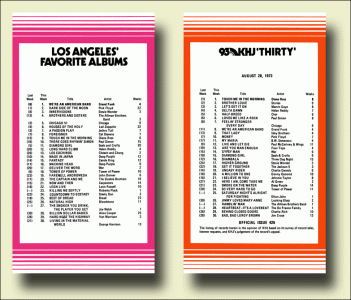
FIFTEEN weeks for Three Dog Night's "Shambala". It stayed on for two more weeks, making 17---the record to that point. That was tied later in the year by, of all things, the DeFranco Family's "Heartbeat-It's A Lovebeat".
And that record was broken by Barbra Streisand's "The Way We Were", which managed 18. And then that record fell weeks later to Redbone's "Come and Get Your Love", which lasted 21 weeks.
The topper? Morris Albert's "Feelings", which stayed on the KHJ Thirty for 24 weeks.
That was a LONG five and a half months.
I love your enthusiasm for KHJ! And I also love both "Shambala" and especially "The Way We Were." "Feelings" is ok...but a big hit!I did. I started actively, daily listening to Top 40 the summer I was 11 (1967). SO much new material to look forward to every week, and not much chance of getting sick to death of songs. Ten weeks on the chart was unusual---most lasted eight or nine, The Beatles "Hey Jude", which was HUGE, lasted 11.
By this week in 1973, it was VERY different:
View attachment 10167
FIFTEEN weeks for Three Dog Night's "Shambala". It stayed on for two more weeks, making 17---the record to that point. That was tied later in the year by, of all things, the DeFranco Family's "Heartbeat-It's A Lovebeat".
And that record was broken by Barbra Streisand's "The Way We Were", which managed 18. And then that record fell weeks later to Redbone's "Come and Get Your Love", which lasted 21 weeks.
The topper? Morris Albert's "Feelings", which stayed on the KHJ Thirty for 24 weeks.
That was a LONG five and a half months.

In later research, "Feelings" was often the most negative former hit song you could find. It just totally burnt out.I love your enthusiasm for KHJ! And I also love both "Shambala" and especially "The Way We Were." "Feelings" is ok...but a big hit!
I love your enthusiasm for KHJ!
I'm not sure "enthusiasm" is the right word---it's just the big-city Top 40 I was able to tune into (at night, along with KFRC, San Francisco). Over the last 29 years, since the launch of REELRADIO, @ted chittenden , @K.M. Richards , myself and other people who know the history have been taking advantage of the resources of the internet and putting these stories into context.
I use KHJ as an example because I'm familiar with it, it was in the second-biggest city in the U.S., because it was tremendously successful (until it wasn't) and influenced other stations around the country, and because chart information, jock schedules and airchecks are readily available online. It's easy to use to illustrate a point.
And I also love both "Shambala" and especially "The Way We Were." "Feelings" is ok...but a big hit!
I think you had to be there to understand how mind-numbing it could get. These are records that, in their lowest rotations, were played roughly every 3 hours and 40 minutes...in secondary rotation every 2 hours and 25 and when they were at their peak, every hour and 40. Multiply that by that many weeks and it's asking---even for songs you loved a month ago.
It's one of the factors (among several others) that drove teens of my generation to FM rock radio.

It became a recurring joke on TV’s The Gong Show, which, unfortunately, delighted in ridicule of people whose main faults were not understanding their lack of talent combined with their absolute sincerity in wanting to perform for the world.In later research, "Feelings" was often the most negative former hit song you could find. It just totally burnt out.
It became a recurring joke on TV’s The Gong Show, which, unfortunately, delighted in ridicule of people whose main faults were not understanding their lack of talent combined with their absolute sincerity in wanting to perform for the world.
Fair. The show definitely had a mean streak to it that got worse as it went on.
Which I think supports my "feelings." Definitely not a song that survived as a gold.In later research, "Feelings" was often the most negative former hit song you could find. It just totally burnt out.
Then there was the follow-on, the $1.98 Beauty Show, which at least was only in syndication, but even more cruel. The Gong Show was on NBC.Fair. The show definitely had a mean streak to it that got worse as it went on.
I have a very enthusiastic memory for the top 40 stations I grew up with in Boston (not #2 but still a top #10 market) starting with the end of 68 RKO (bringing it back to the original topic of this thread), CBS radio's WHTT (which was a slightly-watered down version of hot hits), Kiss 108 and 94.5 WZOU. I've always felt I was incredibly fortunate to grow up in a top 10 media market.I'm not sure "enthusiasm" is the right word---it's just the big-city Top 40 I was able to tune into (at night, along with KFRC, San Francisco). Over the last 29 years, since the launch of REELRADIO, @ted chittenden , @K.M. Richards , myself and other people who know the history have been taking advantage of the resources of the internet and putting these stories into context.
I use KHJ as an example because I'm familiar with it, it was in the second-biggest city in the U.S., because it was tremendously successful (until it wasn't) and influenced other stations around the country, and because chart information, jock schedules and airchecks are readily available online. It's easy to use to illustrate a point.
I think you had to be there to understand how mind-numbing it could get. These are records that, in their lowest rotations, were played roughly every 3 hours and 40 minutes...in secondary rotation every 2 hours and 25 and when they were at their peak, every hour and 40. Multiply that by that many weeks and it's asking---even for songs you loved a month ago.
It's one of the factors (among several others) that drove teens of my generation to FM rock radio.
Actually, Mauricio Alberto Kaisermann was both talented and successful in Brasil. He did nearly 40 albums, innumerable singles in a variety of languages, and is still played a lot on the equivalent of "classic hits" stations in Brasil.It became a recurring joke on TV’s The Gong Show, which, unfortunately, delighted in ridicule of people whose main faults were not understanding their lack of talent combined with their absolute sincerity in wanting to perform for the world.
Morris Albert - Wikipedia
Actually, the issue here is with the people covering the tune on a TV show designed to make fun of them. Morris Albert is really just collateral damage and, no, it wasn't fair to him.Actually, Mauricio Alberto Kaisermann was both talented and successful in Brasil. He did nearly 40 albums, innumerable singles in a variety of languages, and is still played a lot on the equivalent of "classic hits" stations in Brasil.
Morris Albert - Wikipedia
en.wikipedia.org
Actually, Mauricio Alberto Kaisermann was both talented and successful in Brasil. He did nearly 40 albums, innumerable singles in a variety of languages, and is still played a lot on the equivalent of "classic hits" stations in Brasil.
Morris Albert - Wikipedia
Not only that but I was told by one of my professors while attending Loyola Marymount University in Los Angeles that as of 1984 (when he told me this), "Feelings," was actually the most played song in the world. My professor said that you could get inside an elevator in Japan and hear portions of the song as you went to the next floor--it was apparently all over the place in that country.
Also, I have in my posession (it came in a box of 45s I got from a blind friend who is now deceased) the original version of "Feelings," sung in Mr. Albert's native Portuegese. Since receiving and hearing that, I've often wondered how long it took him to learn the English pronunciations before recording the English version of the song. I mean when you realize that English was not his first language, it's quite incredible how well Mr. Albert sings the song on the English recording.
Unlike the predominantly monolingual United States, kids from middle and upper income families throughout Latin America, generally go to schools that are what are called “bilingual“. The most common language is English, but there are bilingual schools that teach other languages as well.Not only that but I was told by one of my professors while attending Loyola Marymount University in Los Angeles that as of 1984 (when he told me this), "Feelings," was actually the most played song in the world. My professor said that you could get inside an elevator in Japan and hear portions of the song as you went to the next floor--it was apparently all over the place in that country.
Also, I have in my posession (it came in a box of 45s I got from a blind friend who is now deceased) the original version of "Feelings," sung in Mr. Albert's native Portuegese. Since receiving and hearing that, I've often wondered how long it took him to learn the English pronunciations before recording the English version of the song. I mean when you realize that English was not his first language, it's quite incredible how well Mr. Albert sings the song on the English recording.
While I cannot find any information on whether Morris Albert already knew English, it is certainly safe to suspect that he may have.
I'm the same age as you and grew up listening to KAKC, Tulsa's (at least then) Drake-consulted station. I was introduced to it by my mom, who played it on the radio all day. She loved the mellower stuff, Lettermen, Association, "Theme from A Summer Place". I was there for the Monkees, and later 3 Dog Night and CCR. Those fast rotations worked for us since we'd each hear something we liked at least every third song or so. You're right though, by the time I was 14 I'd switched over to FM rock.I think you had to be there to understand how mind-numbing it could get. These are records that, in their lowest rotations, were played roughly every 3 hours and 40 minutes...in secondary rotation every 2 hours and 25 and when they were at their peak, every hour and 40. Multiply that by that many weeks and it's asking---even for songs you loved a month ago.
It's one of the factors (among several others) that drove teens of my generation to FM rock radio.
By the 70's, songs stayed on the station charts longer - could you explain what the reasoning behind this was? Burnout was still a thing (my mom listened much less than she did in the 60's and she never returned to Top 40 radio). Was it something to do with audience demographics, the available music?
WRKO played Skip a Rope and The Son of Hickory Holler's Tramp. How did Drake come to the conclusion that those songs would work in Boston?I always wondered why KHJ didn’t play those Beach Boys songs.
Sometimes it is understandable why a station didn’t play a big hit. Maybe too controversial or too heavy or too easy or too R&B.
Other times it can seem odd. KHJ never charted the Monkees Valleri, although I’m almost certain I’ve heard that song on a Real Don Steele aircheck.
Another one, KHJ only played Sly Stone’s Everybody Is A Star, the B Side of the BB #1 Thank You.
KHJ didn’t like The Ohio Express although they did play sister act 1910 Fruitgum Co. In general, KHJ didn’t play nearly as much bubblegum as Midwest stations. WLS was all over the Ohio Express and the Archies and other similar records. However, KHJ played a lot of Sunshine Pop records, which in many ways is a more lightweight genre than bubblegum.
As I said on another thread, I love that Bill Drake let the RKO stations sound like their market musically. KFRC, KHJ, WRKO, WHBQ and CKLW playlists are very different in the 1960s and that makes that era so interesting