If the BBC wish to save money, they could get rid of all the local stations. With a few exceptions (e.g. those in major cities), most are, at best, dreadful. They have no idea what they're supposed to be, with phone-in shows for retirees on topics such as gardening and where to buy the most comfortable slippers one hour, and 'your favourite hits from the 90s to today' the next. Wales and Scotland have 'national' channels, so why not just replace the ones in England with 'BBC England'? At night, many of the 'local' stations merge into regional networks so as a minimum they could just leave them as regional stations and save money on all the local studios and staff. BBC local radio stations attract 4.4% of the overall market and many of the individual stations perform much worse (see: RAJAR Quarterly Listening)

-
Get involved.
We want your input!
Apply for Membership and join the conversations about everything related to broadcasting.
After we receive your registration, a moderator will review it. After your registration is approved, you will be permitted to post.
If you use a disposable or false email address, your registration will be rejected.
After your membership is approved, please take a minute to tell us a little bit about yourself.
https://www.radiodiscussions.com/forums/introduce-yourself.1088/
Thanks in advance and have fun!
RadioDiscussions Administrators
You are using an out of date browser. It may not display this or other websites correctly.
You should upgrade or use an alternative browser.
You should upgrade or use an alternative browser.
The BBC needs money!
- Thread starter KilowattKat
- Start date
The population of Scotland is about 5.5 million. The population of London alone (one station) is roughly 9 million, and England as a whole is 58.5 million. How would a station covering 58 million people be relevant at all, in a way that the existing UK national stations aren't? Such a station would have to somehow make itself relevant to Central London city dwellers and people in remote Northumberland villages - it would be nothing to no-one, rather than everything to everyone.If the BBC wish to save money, they could get rid of all the local stations. With a few exceptions (e.g. those in major cities), most are, at best, dreadful. They have no idea what they're supposed to be, with phone-in shows for retirees on topics such as gardening and where to buy the most comfortable slippers one hour, and 'your favourite hits from the 90s to today' the next. Wales and Scotland have 'national' channels, so why not just replace the ones in England with 'BBC England'? At night, many of the 'local' stations merge into regional networks so as a minimum they could just leave them as regional stations and save money on all the local studios and staff. BBC local radio stations attract 4.4% of the overall market and many of the individual stations perform much worse (see: RAJAR Quarterly Listening)
There's an argument for regionalising the stations - for instance, a station covering Yorkshire would cover a population pretty much the same size as Scotland, and the London station should always stand alone, but there's zero point to an all-England radio station, they may as well turn all the transmitters off at that point as we already have a full slate of national networks. Regional stations would be able to provide better quality programming than the current local stations, while still remaining somewhat relevant and unique.

The BBC announced 3 weeks ago, a budget cut of 10% across all divisions. The telling line...."The BBC is not a protected species".
BBC to pursue cuts of up to £600m as bosses point to fall in licence fee income
BBC to pursue cuts of up to £600m as bosses point to fall in licence fee income
If the BBC wish to save money, they could get rid of all the local stations.
Terrible idea. That would leave community radio as the only effective local radio in much of the country. Commercial radio is basically several quasi-national networks with virtually zero local content. Everywhere you go it's either Capital, Heart, The Hits and maybe a couple others here and there with few exceptions.
The population of Scotland is about 5.5 million. The population of London alone (one station) is roughly 9 million, and England as a whole is 58.5 million. How would a station covering 58 million people be relevant at all, in a way that the existing UK national stations aren't? Such a station would have to somehow make itself relevant to Central London city dwellers and people in remote Northumberland villages - it would be nothing to no-one, rather than everything to everyone.
There's an argument for regionalising the stations - for instance, a station covering Yorkshire would cover a population pretty much the same size as Scotland, and the London station should always stand alone, but there's zero point to an all-England radio station, they may as well turn all the transmitters off at that point as we already have a full slate of national networks. Regional stations would be able to provide better quality programming than the current local stations, while still remaining somewhat relevant and unique.
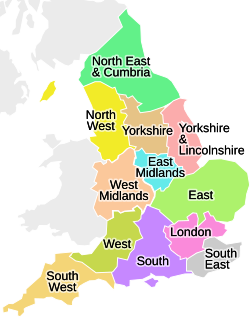
I take your point, and the one about only the BBC offering 'truly local radio'.
Regional stations would at least make sense in as much as 'Grace' from Sussex and 'Jacinta' from Surrey probably have enough in common to share a station whereas 'Vera' from Northumberland and 'Asher' from London probably don't. The BBC already partially agrees because outside the 6am to 2pm period they already merge most local stations into 12 regions - see right.
Maybe the trick is to move staff for the local stations to one regional studio, so that for example BBC Bristol, Somerset and Gloucestershire share the same studio complex rather than needing three. One can still be local even if one isn't sitting in the area concerned.
Then again, the BBC local radio stations in England already have nationally networked shows... All stations carry the 'All-England Late Show' which originates in London / Manchester, and the same Sunday evening show.
All local BBC radio stations rebroadcast BBC 5 Live from 1am until 6am.
They have found £11m down the back of the couch for BBC World Service:Bad news for the BBC World Service. Out of funding in 7 weeks.

BBC World Service faces funding cliff edge in seven weeks, says Tim Davie
As trust in Russia and China’s state broadcasters grows, director general warns of the dangers of cutting back the servicewww.theguardian.com

BBC secures World Service funding ahead of new director-general
Agreement likely to be one of last major achievements of outgoing boss Tim Davie
Behind a paywall. Can't access a thingThey have found £11m down the back of the couch for BBC World Service:
BBC secures World Service funding ahead of new director-general
Agreement likely to be one of last major achievements of outgoing boss Tim Daviewww.ft.com

Of course it is, it’s from Financial Times.Behind a paywall. Can't access a thing
The BBC needs a lot of things, but now they also need a new presenter for the Radio 2 morning show:

 www.bbc.co.uk
Scott Mills' abrupt sacking creates another headache for the BBC
Radio 2 DJ Scott Mills was sacked from the BBC on Monday following allegations over his conduct.
www.bbc.co.uk