• Get involved.
    We want your input!
    Apply for Membership and join the conversations about everything related to broadcasting.

    After we receive your registration, a moderator will review it. After your registration is approved, you will be permitted to post.
    If you use a disposable or false email address, your registration will be rejected.

    After your membership is approved, please take a minute to tell us a little bit about yourself.
    https://www.radiodiscussions.com/forums/introduce-yourself.1088/

    Thanks in advance and have fun!
    RadioDiscussions Administrators

560

I think many AM stations have outlived their realistic expiration, but there still needs to be a place that people go for other content that doesn’t have a home on FM.
Realistically, streaming can do a lot of the heavy lifting here,

Just jumping in to say that anytime you're talking about a use case for radio, you're talking about a business case and every single idea needs to be realistic.

but I see a good use case for the major AM stations that can cover a market and do it well (without interference). That doesn’t solve the problem of getting people to go listen to them,

There goes the realistic part.

but it’s an option.

Is it, though? Until you come up with a realistic idea of how to drag a salable audience back to AM, all you're doing is proposing marooning formats on a dead band and letting the owners of the frequencies worry about losing money instead of stopping the bleeding by turning the license in.
 
Very fair point. (The way they lurched into it didn't help perceptions.) I wonder if any listeners held out hope that the old KGO would come back in some form.

There are some on this board. In this thread. Outside of that, yeah---I know people in the Bay Area (all over 75) who still think it's all a matter of the right six guys and some phone lines.

Maybe the move of the KSFO call letters was intended, at least in part, to make it clear that the old KGO was not coming back even if 810 returned to a talk format. I'm making a big assumption that Cumulus cared about public reaction. That's probably too big of an assumption.

I think you're most of the way right---it mattered but Cumulus didn't care about public reaction. Re-branding an existing station costs money. Keeping it as KSFO and changing "560" to "810" in Photoshop costs nothing.
 
If 560 does resume operations for a few days to keep it alive ...what will they air?

They're not going to do it.

A simulcast of KSFO would confuse some listeners, thinking the 560 frequency is back on the air. I think the previous redirect loop would be best.

There aren't "some listeners" to confuse. Almost nobody's listening to AM in the Bay Area, much less doing a band scan.

Or how about an AM simulcast of 'The Bone'. I don't think those listeners would stumble upon it... being that it's on AM.

Nobody's listeners would stumble upon it.

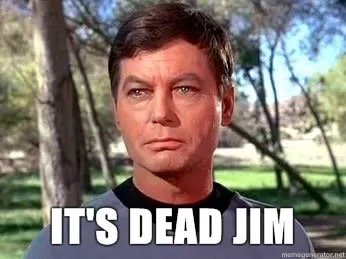
its_dead_jim.0.jpg.jpeg
 
I hear that Cumulus isthisclose to another bankruptcy filing.

Correct. They filed today.


Just jumping in to say that anytime you're talking about a use case for radio, you're talking about a business case and every single idea needs to be realistic.


There goes the realistic part.


Is it, though? Until you come up with a realistic idea of how to drag a salable audience back to AM, all you're doing is proposing marooning formats on a dead band and letting the owners of the frequencies worry about losing money instead of stopping the bleeding by turning the license in.
Well realistically, nobody is going to stumble upon an AM station randomly in 2026. That’s just not how consumers behave, and it’s not how most modern radios operate. With that being said, directing the audience to the radio frequency would involve marketing, and going through the steps to develop (at least some) audience already. Sports talk comes to mind as an example. As we know, sports talk shows are not always about sports. Often times, it’s a place where men can go listen to a show that discusses topics that they find more engaging. If there’s programming that appeals in a place that’s relatively easy to access, that’s not a terrible problem to have.

I don’t disagree with your assessment, but I definitely don’t think that all FM is superior to AM. There are tons of small FMs, LPs, translators, and other stations that do not sound good, have poor coverage, and are stuck somewhere in the dial where most people will never stumble upon it. I totally agree that many AM stations have outlived their expiration date, but if a broadcaster has an option to put something on a good signal that can be clearly heard across the entire market, that doesn’t seem like the worst problem to have either. I’d rather have that problem than be stuck on a translator.

We now live in a world where most people don’t scan across their radio dial manually anymore. So I don’t think that example of the small FM that hardly anyone can hear or knows about it is in any better position.
 
Well realistically, nobody is going to stumble upon an AM station randomly in 2026. That’s just not how consumers behave, and it’s not how most modern radios operate.

You're doing fine so far.

With that being said, directing the audience to the radio frequency would involve marketing, and going through the steps to develop (at least some) audience already.

True. Even on FM. Now, multiply the expense to drag an audience back to a band it has either abandoned or never used.

Sports talk comes to mind as an example. As we know, sports talk shows are not always about sports. Often times, it’s a place where men can go listen to a show that discusses topics that they find more engaging.

Right. And there's a reason KNBR killed KFOG so it could simulcast on FM---and why the other sports station (The Game) is on FM, as well.

If there’s programming that appeals in a place that’s relatively easy to access, that’s not a terrible problem to have.

"Relatively easy" falls apart compared to streaming on a device most of the intended audience carries in their pocket.

I don’t disagree with your assessment, but I definitely don’t think that all FM is superior to AM. There are tons of small FMs, LPs, translators, and other stations that do not sound good, have poor coverage, and are stuck somewhere in the dial where most people will never stumble upon it. I totally agree that many AM stations have outlived their expiration date, but if a broadcaster has an option to put something on a good signal that can be clearly heard across the entire market, that doesn’t seem like the worst problem to have either. I’d rather have that problem than be stuck on a translator.

Here's the question you're not asking: Do those formats have small audiences because they're on poor signals, or are those formats on poor signals because they have small audiences? Getting that equation backwards can lose a broadcaster an enormous amount of money.
 
You're doing fine so far.


True. Even on FM. Now, multiply the expense to drag an audience back to a band it has either abandoned or never used.


Right. And there's a reason KNBR killed KFOG so it could simulcast on FM---and why the other sports station (The Game) is on FM, as well.


"Relatively easy" falls apart compared to streaming on a device most of the intended audience carries in their pocket.


Here's the question you're not asking: Do those formats have small audiences because they're on poor signals, or are those formats on poor signals because they have small audiences? Getting that equation backwards can lose a broadcaster an enormous amount of money.
As for the KNBR example: yes, they are simulcasting on 104.5, but I’m not sure I would call 104.5 the solution to any problem they might have. 104.5 has always been a San Francisco-focused signal. Listeners in other areas don’t pick it up as well as other Bay Area FMs, so I’d argue that many listeners still use (and realistically need) 680.

I was just in the Toronto area for a conference, and their radio dial seems to illustrate the point in trying to make. I’ll try to articulate that here.

590am - local sports talk with good reception around the area and interesting shows. Worth listening to even if it’s on AM.
640am - News/talk. Also good, worth listening to.
680am - all news.
740 - Oldies (not going to make any argument for music on AM, but it was cool to see).
860 - CBC radio in French. Not my thing, but it’s there for French speakers and seems to have a following.
1010 - news/talk.
1050 - TSN sports talk (interesting shows and perspectives with an alternative take than 590).

Overall, there were definitely a few AMs that have interesting programming, and more than adequate coverage around a large metro area. You could pair it down to just 590, 640, 680, 1010, and 1050 and you would have a handful of stations that absolutely have an audience, and broadcast something that people want to seek out. That doesn’t “save AM” per se, but it’s an applicable use case for how the better frequencies in a major city are being used
 
As for the KNBR example: yes, they are simulcasting on 104.5, but I’m not sure I would call 104.5 the solution to any problem they might have. 104.5 has always been a San Francisco-focused signal. Listeners in other areas don’t pick it up as well as other Bay Area FMs, so I’d argue that many listeners still use (and realistically need) 680.

Radio station owners don't care about areas beyond the Nielsen Audio ratings survey area. If it doesn't count toward ratings, which can be used to sell advertising---it doesn't count.

I was just in the Toronto area for a conference, and their radio dial seems to illustrate the point in trying to make. I’ll try to articulate that here.

590am - local sports talk with good reception around the area and interesting shows. Worth listening to even if it’s on AM.
640am - News/talk. Also good, worth listening to.
680am - all news.
740 - Oldies (not going to make any argument for music on AM, but it was cool to see).
860 - CBC radio in French. Not my thing, but it’s there for French speakers and seems to have a following.
1010 - news/talk.
1050 - TSN sports talk (interesting shows and perspectives with an alternative take than 590).

"Worth listening to" is in the ear of the behearer.

Overall, there were definitely a few AMs that have interesting programming, and more than adequate coverage around a large metro area. You could pair it down to just 590, 640, 680, 1010, and 1050 and you would have a handful of stations that absolutely have an audience, and broadcast something that people want to seek out.

Got ratings to back that up? More importantly, do you have revenue statistics on how well those stations are doing?

That doesn’t “save AM” per se, but it’s an applicable use case for how the better frequencies in a major city are being used

Look, if Toronto's AM dial isn't a ghost town, that's great---and they have a better situation from which to navigate going forward. San Francisco's isn't like that. It's been in decline for 40 years and we're now at the "will the last person please turn off the lights" phase.
 
Outside of that, yeah---I know people in the Bay Area (all over 75) who still think it's [reviving KGO] all a matter of the right six guys and some phone lines.
Definitely. Remember Usenet (sort of the AM radio of the Internet, though there are still corners of it that have some activity)...specifically ba.broadcast? The KGO groupies predominated. I don't think they much liked it when, after I moved to San Francisco in 1999, I took a listen to KGO and then wondered openly why anyone would listen to it. I don't claim to be avant-garde about anything, but I think that perception was largely shared by people my age and a little younger. So at the time, based on what I encountered, I think the predominant KGO listening base...or at least the people who would have been quite vocal about being KGO fans...would have been something like 50+. So, yep, they aged out. And, now, you and I might as well be Soylent Green as far as broadcasters are concerned.

As for the KNBR example: yes, they are simulcasting on 104.5, but I’m not sure I would call 104.5 the solution to any problem they might have. 104.5 has always been a San Francisco-focused signal. Listeners in other areas don’t pick it up as well as other Bay Area FMs, so I’d argue that many listeners still use (and realistically need) 680.
Let's also remember what was going on at the time. KFOG went through a repositioning a couple of years earlier that wasn't successful. KFOG had to do something because its listener base was starting to age out, too. It had a great brand, which Cumulus tried to reposition for a younger generation. All the old features, particularly "10 @ 10", were thrown out. The playlist was tweaked to reduce the classic rock and play up more alternative. But what happened was that previous KFOG listeners were alienated while new listeners largely skipped it over. At the time, I referred to it as "Live 105 Lite". (This was pre-"Dave", version 2 of KITS; when I once said that Live 105 was the official station of angry tattooed restaurant workers.)

So KFOG wasn't doing so well, and KNBR was staring a steady decline in the face, along with a rising FM competitor. What would you do if faced with those circumstances?

When the cutover happened, public reaction was surprisingly muted. There were the usual complaints from the Chronicle but that seemed to be it.


I was just in the Toronto area for a conference, and their radio dial seems to illustrate the point in trying to make. I’ll try to articulate that here.

590am - local sports talk with good reception around the area and interesting shows. Worth listening to even if it’s on AM.
640am - News/talk. Also good, worth listening to.
680am - all news.
740 - Oldies (not going to make any argument for music on AM, but it was cool to see).

And you know what used to be on 740. The CBC has been steadily whittling away at its AM portfolio, particularly in English. The small-town repeaters were mostly converted from the 40-watt AM "iceboxes" to FM long ago. (A few "iceboxes" are still left.) Now the conversion is happening in the bigger cities in the eastern part of the country.

Meanwhile, Cumulus heads to bankruptcy court....

Credit where credit is due. K108 heard correctly:
This could be related to the sudden nervousness on Wall Street about the condition of private-equity lenders and of BDCs (business development companies). The New York Times has a good article about it (gift link):


While the flip in sentiment is mostly related to fears regarding what AI will do to software companies, it also means that companies in other fields with shaky financial prospects will have a harder time getting or even keeping financing, too.

 
Radio station owners don't care about areas beyond the Nielsen Audio ratings survey area. If it doesn't count toward ratings, which can be used to sell advertising---it doesn't count.


"Worth listening to" is in the ear of the behearer.


Got ratings to back that up? More importantly, do you have revenue statistics on how well those stations are doing?


Look, if Toronto's AM dial isn't a ghost town, that's great---and they have a better situation from which to navigate going forward. San Francisco's isn't like that. It's been in decline for 40 years and we're now at the "will the last person please turn off the lights" phase.
On the topic of 104.5: the argument here is not about distant listeners, but rather the fact that there are plenty of people directly in the market who also can’t hear it. When I’m in South Bay region, 104.5 is not what I’d consider to be listenable. This is why KFOG tried to simulcast on 97.7. 104.5 is great for San Francisco itself though.

I cannot comment on the revenue situation for any of the stations I referenced, but they all seem to post decent numbers in the Numeris(?) report. There are many other AMs who don’t perform well (as expected), but there are a few who aren’t in that bad of a position.
 
Definitely. Remember Usenet (sort of the AM radio of the Internet, though there are still corners of it that have some activity)...specifically ba.broadcast?

I absolutely remember. I posted there. In fact, my posts got me my first freelance writing gig, for @BossRadioDJ 's pioneering RadioDigest (the site is long gone, but I'm still grateful for the break, the two cents per word and the lifelong friendship that followed).

The KGO groupies predominated. I don't think they much liked it when, after I moved to San Francisco in 1999, I took a listen to KGO and then wondered openly why anyone would listen to it. I don't claim to be avant-garde about anything, but I think that perception was largely shared by people my age and a little younger. So at the time, based on what I encountered, I think the predominant KGO listening base...or at least the people who would have been quite vocal about being KGO fans...would have been something like 50+. So, yep, they aged out. And, now, you and I might as well be Soylent Green as far as broadcasters are concerned.

Exactly.

Let's also remember what was going on at the time. KFOG went through a repositioning a couple of years earlier that wasn't successful. KFOG had to do something because its listener base was starting to age out, too. It had a great brand, which Cumulus tried to reposition for a younger generation. All the old features, particularly "10 @ 10", were thrown out. The playlist was tweaked to reduce the classic rock and play up more alternative. But what happened was that previous KFOG listeners were alienated while new listeners largely skipped it over. At the time, I referred to it as "Live 105 Lite". (This was pre-"Dave", version 2 of KITS; when I once said that Live 105 was the official station of angry tattooed restaurant workers.)

So KFOG wasn't doing so well, and KNBR was staring a steady decline in the face, along with a rising FM competitor. What would you do if faced with those circumstances?

When the cutover happened, public reaction was surprisingly muted. There were the usual complaints from the Chronicle but that seemed to be it.

I think the KFOG audience (even those with fond memories) had moved on in a more realistic fashion than the KGO fanbase.
 
On the topic of 104.5: the argument here is not about distant listeners, but rather the fact that there are plenty of people directly in the market who also can’t hear it. When I’m in South Bay region, 104.5 is not what I’d consider to be listenable. This is why KFOG tried to simulcast on 97.7. 104.5 is great for San Francisco itself though.

Fine. KCBS is in essentially the same situation with 740 and 106.9. But that's not a business case for a standalone AM.
 
Credit where credit is due. K108 heard correctly:


He was indeed correct. What I can't figure out is who these people are who want to jump into radio at the moment, but at least some of the owners of Cumulus would seem to have found a few suckers, I mean interested parties, to take equity in the company.

As for the KNBR example: yes, they are simulcasting on 104.5, but I’m not sure I would call 104.5 the solution to any problem they might have. 104.5 has always been a San Francisco-focused signal. Listeners in other areas don’t pick it up as well as other Bay Area FMs, so I’d argue that many listeners still use (and realistically need) 680.

As Michael points out, broadcasting companies aren't interested in the outlying areas as they really can't sell them, or at least they can't sell them easily. I do actually agree with you that AM can sound quite good when the engineers put their time and effort into it, but none of that helps if significant portions of the market can't hear it. While San Francisco has a few AM's that should be able to cover the market, it's a small number, and most markets aren't lucky enough, if you will, to have that many AM's that cover them in full. Remember, AM is 100 year old technology that was designed for an urban plan that no longer exists. We can tell the audience what it needs, but it has already made up its mind. It has decided that's not AM. FM is now roughly 80 year old technology. It still has life and probably isn't going away anytime soon, but, at some point, it will bite the dust, too.

I was just in the Toronto area for a conference, and their radio dial seems to illustrate the point in trying to make. I’ll try to articulate that here.

Canada has never been a good example of competitive radio. Canadian radio stations have consistently lost money at greater rates than their US counterparts, and that's even with fewer stations cluttering up the dial and splitting the available revenue. I will grant you that Canada did a better job with creating AM's that covered their metropolitan areas, but efforts in the 70's, 80's, and early 90's to keep AM competitive simply meant most everybody lost money. AM couldn't stay competitive, and the stations suffering attrition couldn't move their formats to FM to staunch the bleeding. Despite having firmer ownership caps than we have in the States, Canadian radio has also seen more consolidation than we have.

On the topic of 104.5: the argument here is not about distant listeners, but rather the fact that there are plenty of people directly in the market who also can’t hear it. When I’m in South Bay region, 104.5 is not what I’d consider to be listenable. This is why KFOG tried to simulcast on 97.7. 104.5 is great for San Francisco itself though.

Correct. Ownership has been aware that 104.5 doesn't cover the entire market effectively for at least the last 30 years. As metro areas (and commute times) grow, FM may suffer the same fate as AM. It wouldn't seem to be on the horizon anytime soon, but broadcasters have known that was a potential problem for a long time. As I mentioned above, the biggest obstacle for AM was not sound quality; it was that it wasn't built to cover large metro areas with sprawling suburbias. Some popular AM stations simply weren't always available for people who lived in suburbs and exurbs. Cumulus divesting 97.7 was, if anything, an acknowledgement that the station was never designed to fill-in holes for another station. One of the reasons some broadcasters embraced streaming almost 30 years ago was because they knew simply stringing a patchy network of Class A FM signals together wasn't going to solve the problem of metro areas outgrowing their coverage. For some of those people in the exurbs, an out of band system was always going to be the way.


Back
Top Bottom