• Get involved.
    We want your input!
    Apply for Membership and join the conversations about everything related to broadcasting.

    After we receive your registration, a moderator will review it. After your registration is approved, you will be permitted to post.
    If you use a disposable or false email address, your registration will be rejected.

    After your membership is approved, please take a minute to tell us a little bit about yourself.
    https://www.radiodiscussions.com/forums/introduce-yourself.1088/

    Thanks in advance and have fun!
    RadioDiscussions Administrators

60s VHF Drop-ins

I came across this article regarding a failed attempt to drop in a VHF in Knoxville in the 60s. It also mentions:

The markets that were to have received the drop-ins are Johnstown, Pa.(channel 8); Baton Rouge, La. (channel11) ; Dayton, Ohio (channel 11) ; Jacksonville, Fla. (channel 10); Birmingham, Ala. (channel 3) ; Knoxville, Tenn. (channel 8); and Charlotte, N. C. (channel 6).

I saw in the late 80s Knoxville, Johnstown got their drop-in VHF along with Salt Lake City and Charleston WV, which aren't mentioned in this article.

I thought it'd be interesting to hear some comments from readers on what would have happened if these drop-ins were approved in their respective markets.

The article goes on to say, it was rejected in the 60s because it would be deemed detrimental to the development of UHF television as a whole.

Link to the article: (in PDF format,, go to page 44 for article)
 
A lot of such "wrangling for VHF channels" came during the FCC's deintermixture process, which I wrote about in great detail at the UHF History site:


Oh, and those drop-ins you mentioned as being in the "late 80s" were in 1980 itself. I reference that at the very end of the article.

Direct link to your cited article, via the actual World Radio History site, without scrolling to the page in the entire issue:
 
What I thought interesting was how if Charlotte got a third VHF, that may have had other consequences long term, as Ted Turner got his start by getting a network affiliation for his Charlotte indie, before going to WTBS in Atlanta.
Channel 6 in Charlotte would have been short-spaced to WJBF Augusta GA and WHIS (now WVVA) Bluefield WV. That's probably why it never happened.

WECT Wilmington could have also been a problem at the time, as their transmitter was pretty far inland, between Wilmington and Fayetteville. WWAY caused no problems on channel 3, as WBTV's stick is actually out at Dallas NC.
 
They were talking about dropping Channel 11 into Dayton? How would that have worked with Toledo and Louisville so close? I would think that there would have been adjacent channel issues with Channel 12 in Cincinnati as well.
 
They were talking about dropping Channel 11 into Dayton? How would that have worked with Toledo and Louisville so close? I would think that there would have been adjacent channel issues with Channel 12 in Cincinnati as well.
Again, short-spacing. They'd have had to bobtail the signal to the north and southwest. Nudging the tower to the southeast would have also been a possibility.

An extreme case of the lengths that had to be gone to, to accommodate a station, was WSJK-2 in Sneedville TN (at the time, PBS for both the Tri-Cities and Knoxville). They were stuck in one position, and so I understand it, couldn't have moved the tower by as much as one mile.
 
What I thought interesting was how if Charlotte got a third VHF, that may have had other consequences long term, as Ted Turner got his start by getting a network affiliation for his Charlotte indie, before going to WTBS in Atlanta.
Turner didn't "start" like that. He owned UHF independents in both Atlanta and Charlotte.

The Charlotte station switched to NBC in '78 and Turner sold it to Westinghouse two years later. As for Atlanta...well, we all know how that turned out.
 
I guess I have to once again point at one of my articles at the UHF History site, since that's where all my research is compiled.

This article was about channel 17 in Atlanta pre-Superstation, and includes the background of WRET-TV in Charlotte. @Markxxx should take note that Turner purchased it after he took over in Atlanta, not before.

 
A lot of such "wrangling for VHF channels" came during the FCC's deintermixture process, which I wrote about in great detail at the UHF History site:


Oh, and those drop-ins you mentioned as being in the "late 80s" were in 1980 itself. I reference that at the very end of the article.

Direct link to your cited article, via the actual World Radio History site, without scrolling to the page in the entire issue:
I didn't know going to be all UHF in the 50's in the U.S

The U.K discontinued VHF in 1985
 
I didn't know going to be all UHF in the 50's in the U.S

Well, Mario, that's why the late Clarke Ingram and I started the site about ten years ago ... to provide the history that people were either unaware of or who believed urban legends that had never been corrected.

In saying that, I must acknowledge @davideduardo's World Radio History site. My initial research consisted of going through every issue of Broadcasting at his site, from the date of the FCC decision on UHF to approximately twenty years after the first UHF CP was issued. David added Television Digest about the time that I was finishing that initial research, and we used that to fill in some gaps. (I still have a master Excel spreadsheet with all of my notes, covering not only stations that made it on the air but also CPs thate were never built.)

Clarke and I then decided what stations' stories were worth telling, assisted by Maureen Carney, whp used her subscription at Newspapers.com to locate articles about those stations. Peter Q. George (K1XRB) contributed the articles from his previous UHF Morgue site, which we expanded with the additional resources.

A lot of the articles have my name in the byline, either as sole author or as the expander of other articles. Once in a while, new articles are added, but the reality is that a lot of newspapers gave very little coverage to UHF stations, perhaps an unwillingness to promote a competitor for ad dollars. So much of what I do now as the sole owner of the site (Clarke turned it over to me several months before his death two years ago) I mostly update articles as new or improved information comes to light.

It's a historical resource and I don't make a single penny from it. If it helps educate people, I'm happy.
 
I didn't know going to be all UHF in the 50's in the U.S
Several European countries appear to have gone all-UHF with the advent of digital, Poland being among them. At one time they were mixed low-high-VHF and UHF, just like in North America. Here's a resource that is, sadly, not searchable, and kind of clunky to use, but there's a lot of information there:

Satbroadcasts.com - no. 1 source for professional work

The Polish transmitters are listed by channel number and city, and my browser, anyway, substitutes question marks for all of the letters that employ diacritical marks in Polish. You would have to know the names of the cities to fill in the blanks. Again, kind of clunky.

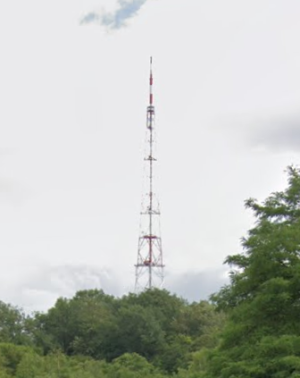
Not all European countries are listed. France, among others, is conspicuous by its absence. It appears that Luxembourg has all of its transmitters concentrated in one place, just south of Dudelange a few hundred feet from the French border, and just a few miles from Germany. Luxembourg is just shy of 1000 square miles, about three-fourths the size of Horry County SC, and just a little smaller than Rhode Island. Here's the tower:

1756224560092.png

There is one transmitter on VHF channel 7 (not exactly the same as the North American 174-180 mHz, but in the ballpark), as well as three UHF channels.
 
Channel 8 Knoxville would become reality many years later as WVLT, Volunteer TV, the CBS affiliate. And in 1986, WWCP fired up in Johnstown PA on channel 8 as a charter affiliate of Fox (when they programmed 1 hour a night for Joan Rivers).
 
Channel 8 Knoxville would become reality many years later as WVLT, Volunteer TV, the CBS affiliate. And in 1986, WWCP fired up in Johnstown PA on channel 8 as a charter affiliate of Fox (when they programmed 1 hour a night for Joan Rivers).

Again, kind sir, that was mentioned in the article I linked to back in post #2.
 
They were talking about dropping Channel 11 into Dayton? How would that have worked with Toledo and Louisville so close? I would think that there would have been adjacent channel issues with Channel 12 in Cincinnati as well.
I also suspect that there likely would have been adjacent channel issues with Channel 10 in Columbus, especially areas west of Columbus between Columbus and Dayton.
 
They were talking about dropping Channel 11 into Dayton? How would that have worked with Toledo and Louisville so close? I would think that there would have been adjacent channel issues with Channel 12 in Cincinnati as well.
I also suspect that there likely would have been adjacent channel issues with Channel 10 in Columbus, especially areas west of Columbus between Columbus and Dayton.
 
What I thought interesting was how if Charlotte got a third VHF, that may have had other consequences long term, as Ted Turner got his start by getting a network affiliation for his Charlotte indie, before going to WTBS in Atlanta.
That's not really correct, as Ted Turner had WTCG (the predecessor call letters for WTBS) in Atlanta for several years before his Charlotte station (WRET) landed a network affiliation.

What is worth noting is that Turner sold the Charlotte station and used that money as part of the funding to launch CNN.


Back
Top Bottom