Any info as to why 760 has apparently been operating intermittently with 50 kW during daytime hours ? Their normal daytime 5 kW non-directional ground wave measures barely above 0.5 mV in my area (SFV). Lately they have been Local with a signal anywhere from 2 to 4 mV, as strong or stronger than 600 KOGO, which of course is 5 kW directional (20-30 kW ERP) aimed up the coast right at me. Just wondering what the story is...

-
Get involved.
We want your input!
Apply for Membership and join the conversations about everything related to broadcasting.
After we receive your registration, a moderator will review it. After your registration is approved, you will be permitted to post.
If you use a disposable or false email address, your registration will be rejected.
After your membership is approved, please take a minute to tell us a little bit about yourself.
https://www.radiodiscussions.com/forums/introduce-yourself.1088/
Thanks in advance and have fun!
RadioDiscussions Administrators
You are using an out of date browser. It may not display this or other websites correctly.
You should upgrade or use an alternative browser.
You should upgrade or use an alternative browser.
760 KGB
- Thread starter TomásEstefan
- Start date

Maybe something to do with the KOGO construction permit to diplex (move to) the KGB towers.
Testing the diplex equipment in day & night mode.
Testing the diplex equipment in day & night mode.
Tomas, I'm noticing the same thing at my San Diego location (AM-760 signal strength in daytime at nighttime 50kw levels).
To do monitor points, a full or partial proof of a directional pattern. You need to do that during the day so there is less sky wave in the mix. Adjustment to any directional antenna system with a person out in the field with a field strength meter should be done during the day.
There are several valid reasons 760 could run their night pattern (50Kw) during the day for adjustment and field measurement.
There are several valid reasons 760 could run their night pattern (50Kw) during the day for adjustment and field measurement.
If KBRT 740 wasn't there they'd be 50 kW days also.
I don't quite understand why. I know many years ago, when 740's towers were on Catalina Island, they had decent coverage over most of San Diego. Back then, I can see how radios with poor selectivity might have some trouble separating 740 and 760 in SD. But after 740 moved to inland O.C., their signal is barely audible down here (except right near the coast). The signal dropoff in San Diego was so bad, they eventually bought AM 1240 to serve as a San Diego simulcast. And... we have other Southern California daytime-power 50kw AM's spaced only two channels apart (690/710, 1070/1090, 1150/1170). So why not 740/760?If KBRT 740 wasn't there they'd be 50 kW days also.
690 and 1090 signals are from Mexico are not based on FCC rules and specifications, their directional antennas radiate much more power than 50 kW, somewhere on the order of 200 kW+ ERP. 1150 and 1170 may run 50 kW during the day, however their respective directional systems radiation toward each other is very low, probably less than 5 kW ERP.I don't quite understand why. I know many years ago, when 740's towers were on Catalina Island, they had decent coverage over most of San Diego. Back then, I can see how radios with poor selectivity might have some trouble separating 740 and 760 in SD. But after 740 moved to inland O.C., their signal is barely audible down here (except right near the coast). The signal dropoff in San Diego was so bad, they eventually bought AM 1240 to serve as a San Diego simulcast. And... we have other Southern California daytime-power 50kw AM's spaced only two channels apart (690/710, 1070/1090, 1150/1170). So why not 740/760?

Any directional 50 kw station in the US radiates more than 50 kw in the major lobe. A good example is 1580 in LA which has the equivalent of a non-directional 300 kw in its major lobe.690 and 1090 signals are from Mexico are not based on FCC rules and specifications, their directional antennas radiate much more power than 50 kW, somewhere on the order of 200 kW+ ERP. 1150 and 1170 may run 50 kW during the day, however their respective directional systems radiation toward each other is very low, probably less than 5 kW ERP.
690 and 1090 are no different than US stations that are highly directional. Good examples are the 50 kw stations licensed on the 1A clear channels in the 70's, nearly all of which have between 100 kw and 150 kw in their major lobes at night.
In much of the world where the 10 kHz separation is standard, stations are licensed in the same market every 20 kHz.I don't quite understand why. I know many years ago, when 740's towers were on Catalina Island, they had decent coverage over most of San Diego. Back then, I can see how radios with poor selectivity might have some trouble separating 740 and 760 in SD. But after 740 moved to inland O.C., their signal is barely audible down here (except right near the coast). The signal dropoff in San Diego was so bad, they eventually bought AM 1240 to serve as a San Diego simulcast. And... we have other Southern California daytime-power 50kw AM's spaced only two channels apart (690/710, 1070/1090, 1150/1170). So why not 740/760?
690-710-730 are three Mexico City stations. They have been on those channels for over 60 years, and did not interfere with each other.
I owned two stations in Quito that were on 570 and 590, and in the same market there were also stations on 550, 610, 640, 660 (mine) and 680 as well. There were also ones on 700, 720, 740, 760, 785, 805 (another of mine), 835, 860, 880, 900, 920, 940, 960, 990, 1020, 1070, 1090, 1111, 1140, 1160, 1180, 1210, 1245, 1280 and 1310 and so on up the dial.
Last edited:

It hit me last night that there may have been a lot of confusion for outside of market listeners to 760. Meaning, truck drivers who might have picked up the station with their "Red Eye Radio" trucker programming during overnight hours that they have had for years. Now they get endless blather about sports teams, etc., as it is likely that the 1360 frequency is pretty localized as opposed to the 760 frequency....
The 760 frequency at night has to protect WJR in Detroit by sending very very little power to the east. Remember, it is protecting the night coverage of WJR, not just Detroit.... so the null covers everything from the Northeast to the Southeast.It hit me last night that there may have been a lot of confusion for outside of market listeners to 760. Meaning, truck drivers who might have picked up the station with their "Red Eye Radio" trucker programming during overnight hours that they have had for years. Now they get endless blather about sports teams, etc., as it is likely that the 1360 frequency is pretty localized as opposed to the 760 frequency....
KGB has little signa towards El Centro and does not reach there well at night. Same to the northeast towards Borrego Springs. Only towards LA does it have a decent signal, but only very close to the coast.
They certainly did not have any interstate truckers listening. And how long is a trip from San Diego or the border to the LA Metro, recognizing that the signal won't get very well to the big warehouse zones in the Inland Empire around Moreno Valley, San Bernardino and Riverside cities.
Of course they aren't, we know that, but what I was trying to say was that the FCC rules would not allow a San Diego Station to radiate even 50 kW let alone a higher ERP toward a Los Angeles station only 20 kHz away, and visa versa.Any directional 50 kw station in the US radiates more than 50 kw in the major lobe. A good example is 1580 in LA which has the equivalent of a non-directional 300 kw in its major lobe.
690 and 1090 are no different than US stations that are highly directional. Good examples are the 50 kw stations licensed on the 1A clear channels in the 70's, nearly all of which have between 100 kw and 150 kw in their major lobes at night.
OK....I guess I got a little twisted on this thought since the show is always addressing truckers on the Interstate Highway System. I thought KGB 760 was a flamethrower station. What about KOGO 600?
Is there somewhere where one can see the intended signal propagation patterns in one place of local stations?
Is there somewhere where one can see the intended signal propagation patterns in one place of local stations?
KOGO is on a regional channel. It has no useful skywave coverage area due to other stations on the channel all over the USA.OK....I guess I got a little twisted on this thought since the show is always addressing truckers on the Interstate Highway System. I thought KGB 760 was a flamethrower station. What about KOGO 600?
Not night time skywave, but you can see the groundwave day and night coverage at:Is there somewhere where one can see the intended signal propagation patterns in one place of local stations?
Radio-Locator.com (does not include skywave: only consider the innermost contour)
KGB: https://fccdata.org/?lang=en&facid=42120 (shows night extreme contour)
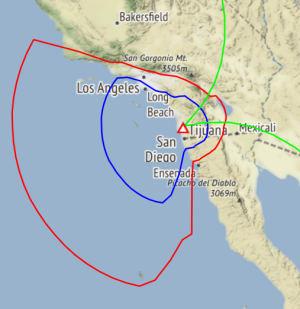
I live in an area 760 supposedly covers at night and it is not clean reception in the Palm Springs - Coachella Valley area.
All those were wedged in as part of the final NARBA deal long ago. They would not likely get approval today, although the theoretical patterns only have non-permitted overlap out over the Pacific.Of course they aren't, we know that, but what I was trying to say was that the FCC rules would not allow a San Diego Station to radiate even 50 kW let alone a higher ERP toward a Los Angeles station only 20 kHz away, and visa versa.
That is correct...bodies of water don't count.All those were wedged in as part of the final NARBA deal long ago. They would not likely get approval today, although the theoretical patterns only have non-permitted overlap out over the Pacific.
In much of the world where the 10 kHz separation is standard, stations are licensed in the same market every 20 kHz.
This is all more proof KGB AM 760 *could* go to 50kw daytime (although it might need a slight null towards Orange County) without causing much interference to KBRT AM 740 -- which is already directional away from San Diego.1150 and 1170 may run 50 kW during the day, however their respective directional systems radiation toward each other is very low, probably less than 5 kW ERP.
Thank you for that fccdata.org link!KOGO is on a regional channel. It has no useful skywave coverage area due to other stations on the channel all over the USA.
Not night time skywave, but you can see the groundwave day and night coverage at:
Radio-Locator.com (does not include skywave: only consider the innermost contour)
KGB: https://fccdata.org/?lang=en&facid=42120 (shows night extreme contour)
View attachment 3497
I live in an area 760 supposedly covers at night and it is not clean reception in the Palm Springs - Coachella Valley area.
This thread suddenly got very interesting! Thank you DavidEduardo for chiming in with your great knowledge! Always appreciated 
For a while this year, KGB AM 760 was not using it’s night-time pattern at night because they were coming in pretty clear at night in Phoenix. That may have changed now, but for most of this year, KGB was staying on day pattern at night.
- Status
- This thread has been closed due to inactivity. You can create a new thread to discuss this topic.