KTOM (country) is also 92.7 which is why there is signal interference with Alamedas (92.7) going southbound 101 freeway on the peninsula especially from SFO airport to the south...Gilroy would likely be covered by both KRTY and KTOM in Salinas/Monterey.

-
Get involved.
We want your input!
Apply for Membership and join the conversations about everything related to broadcasting.
After we receive your registration, a moderator will review it. After your registration is approved, you will be permitted to post.
If you use a disposable or false email address, your registration will be rejected.
After your membership is approved, please take a minute to tell us a little bit about yourself.
https://www.radiodiscussions.com/forums/introduce-yourself.1088/
Thanks in advance and have fun!
RadioDiscussions Administrators
You are using an out of date browser. It may not display this or other websites correctly.
You should upgrade or use an alternative browser.
You should upgrade or use an alternative browser.
Bay Area Country Radio Station
- Thread starter Cityguy76
- Start date
KRTY signal on the other hand is intriguing especially in the city of SF itself. In some parts I can hear KRTY from San Jose but then in another part of they city I can get KUIC same signal but different kind of music from Vacaville...Gilroy would likely be covered by both KRTY and KTOM in Salinas/Monterey.

KRTY signal on the other hand is intriguing especially in the city of SF itself. In some parts I can hear KRTY from San Jose but then in another part of they city I can get KUIC same signal but different kind of music from Vacaville...
not the same signal, different transmitter site.. you mean same frequency .. but not surprising this is how the signals behave when you look at the coverage maps on radio locator
Oops my mistake. I meant to say frequency but your right those 2 frequences do overlap with one coming from San Jose and the other is from Vacaville...not the same signal, different transmitter site.. you mean same frequency .. but not surprising this is how the signals behave when you look at the coverage maps on radio locator
Not happening. Not enough prime demos and likely doesn’t bill well in the market. Best to leave it to the suburban signals.One day soon country radio should return to the Bay Area airwaves...

And that can work---if you have a mass appeal format that will be a first choice or second choice station for the majority of a sales demographic in all of those places and a signal that covers all those places.I spent 7 years on KSAN. During that time (and based only on where people were calling from, sending bounce back form and attending the station's major events) it was clear that we were big in the east bay (think Hayward, Fremont, Diablo Valley) and in the South Bay. San Francisco was our city of license but the ears were elsewhere.
In 1998, I went to Ben Fong-Torres' book signing at the SF Main Library. He'd just released his book "The Hits Just Keep On Coming." Dr. Don Rose was there, as were Dave Sholin, Tommy Saunders and several other Bay Area personalities.
I got a few minutes with Dr. Don afterwards and I said something about accomplishments. DDR was modest and asked what I meant. I said "you were number one in San Francisco for years." And Don said "No, Michael. I was probably number 13 in San Francisco. But I was number one on the Peninsula, and in the East Bay and in Marin and Solano County and in Contra Costa----we just surrounded 'em!"
And they were able to do that with a format that was one of the most dominant in radio history, on a station that was deeply established and at the top of its game, with seemingly limitless promotional resources and zero signal issues for a hundred miles in any direction. Different time, different circumstances.
"Smooth Jazz" I've always thought was a format that wouldn't last, simply because it's not really jazz. You simply take a soft rock/pop arrangement, use a saxophone in place of a vocalist and there you have it: "Smooth Jazz". Folks in LA who were fans of the original 94.7 the Wave would never listen to a real Jazz station such as KKJZ and visa versa. I always considered "Smooth Jazz to be a "fake" format.NAC or "Smooth Jazz" developed in its broad national form out of the team that put together The Wave in LA to replace a declining album rock format. It was an evolutionary format, based on a lot of research by Frank Cody, Owen Leach and several Metromedia local programmers, a model evolved out of fine tuning and heavily researching the intents in the prior year to create the format in places like NYC, Orlando and San Francisco but which met with limited acceptance.
The Breeze was an adaptation of what Cox discovered when trying to do very traditional AC in Miami at WFEZ, basing it on the very old leaning sister station WDUV in Tampa. Realizing Miami was no longer a retirement community, they modified the format and introduced a subtle variant that now regularly ties with WLYF. But the origin of that concept was in Miami, and it is, again, a research based fine tuning of a format, not a new format.
This is a case of an obvious format for an audience that nearly no advertiser wants to buy. Companies as large as CBS TV have tried to get advertisers and agencies to buy 55+ to no avail. And this is not a new format... it is just a fine tuning of "oldies" with a more MOR presentation. It's hardly a new format.
I always considered "Smooth Jazz to be a "fake" format.
I know what you mean. It proved itself to be one dimensional. It didn't take long for the format to add R&B songs just to add some texture and vocals to the mix. Otherwise, everything sounded the same.

I know what you mean Smooth Jazz is a branch related to R&B. Note "Smooth Jazz" was also called "The Quiet Storm" in some places."Smooth Jazz" I've always thought was a format that wouldn't last, simply because it's not really jazz. You simply take a soft rock/pop arrangement, use a saxophone in place of a vocalist and there you have it: "Smooth Jazz". Folks in LA who were fans of the original 94.7 the Wave would never listen to a real Jazz station such as KKJZ and visa versa. I always considered "Smooth Jazz to be a "fake" format.

The term "smooth jazz" came out of a one-on-one research project for a station in Chicago, soon to be WNUA, which was planning to change to the "same format as KTWV" but did not want to license "The Wave" from Metromedia's partner.I know what you mean Smooth Jazz is a branch related to R&B. Note "Smooth Jazz" was also called "The Quiet Storm" in some places.
They were talking with a woman who liked the demo tapes they had prepared. When talking, she said that it sounded like "smooth jazz". The moderator of the project and consultant to WNUA's owner, Owen Leach, made note of this and recommended that "Smooth Jazz" be used as the station's positioner.
The "winning" prototype tape that the researchers played was less Yanni and a bit more r&b than KTWV (which Leach was co-designer of) and very appropriate for a market where there was a significantly higher percentage of Blacks and a lot fewer hipsters. More jazz, less new age and windchimes.
The saxophone is what made it "Jazz" to some ears. God forbid if a piano was used instead, the folks might think it was "easy listening", even though piano is the main instrument in much of authentic Jazz.Agreed ..Sounded the Same? We had a 'smooth jazz' station here in Fresno and 90% of the songs had a saxophone as the lead 'vocal'.....hour after hour...
I immediately thought of Brubeck along with Desmond on Take Five. Beautiful example of alternating lead piano and sax solos in the "official" video. Even a great drum solo at the end!The saxophone is what made it "Jazz" to some ears. God forbid if a piano was used instead, the folks might think it was "easy listening", even though piano is the main instrument in much of authentic Jazz.
I first saw Brubek at John Carroll University in Cleveland around 1960 or 1961 along with our team from WCUY, the sponsoring station.
I'm glad you mentioned Brubeck and Desmond's Take Five. This tune was literally the only actual Jazz record ever played on 94.7 The Wave. It seemed to be played every other day on the station in one daypart or other. The listeners no doubt loved it, but it was musically unrelated to virtually all the other music played on the station.I immediately thought of Brubeck along with Desmond on Take Five. Beautiful example of alternating lead piano and sax solos in the "official" video. Even a great drum solo at the end!
I first saw Brubek at John Carroll University in Cleveland around 1960 or 1961 along with our team from WCUY, the sponsoring station.
Same thing for Houston’s version of The Wave (KHJZ 2002-08). Of course it was the somewhat edited version that leaves out the Joe Morello drum passage, but longer than an even more heavily edited version that floated around years earlier on some MOR formats.I'm glad you mentioned Brubeck and Desmond's Take Five. This tune was literally the only actual Jazz record ever played on 94.7 The Wave. It seemed to be played every other day on the station in one daypart or other. The listeners no doubt loved it, but it was musically unrelated to virtually all the other music played on the station.
Don't forget that KLRS (Colors) in Santa Cruz was the first true New Age station in North America with some Smooth Jazz thrown in. The Wave got most of the publicity since it was in LA but never a true New Age station"Smooth Jazz" I've always thought was a format that wouldn't last, simply because it's not really jazz. You simply take a soft rock/pop arrangement, use a saxophone in place of a vocalist and there you have it: "Smooth Jazz". Folks in LA who were fans of the original 94.7 the Wave would never listen to a real Jazz station such as KKJZ and visa versa. I always considered "Smooth Jazz to be a "fake" format.


Here is Country but this is for Sonoma County and Napa Country. KFGY Santa Rosa shares the Frog logo from Audacy owned KFRG San Bernardino/Riverside. Note this station's coverage at the southern edge fades at Golden Gate Bridge. This Station does not reach San Francisco.
Attachments
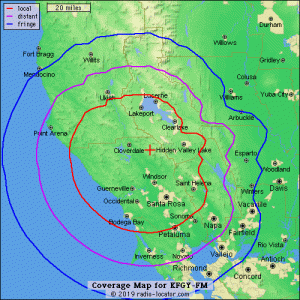
Remember, on those "for amusement only" maps, the innermost red contour is where about 95% of the listening takes place and is the only contour that comes close to approximating the FCC's protected contour.Actually the signal starts fades away when you cross Sonoma /Marin county. I can’t pick up this station in Sausalito or San Rafael. It looks like it fades at the mouth of the Golden Gate Bridge, but you have to realize the terrain around the Bay Area
Unfortunately, KRTY has less than 1kW, and so, only serves the south bay.
95.7 The Bear / The Wolf had a crappy signal to the south. 95.7 has got to be one of the worst signals in the bay area. Not sure which we had more of, static or modulation. I don't mean to bag on 95.7, but there are a few frequency's that are just awful in getting down here to the south bay. You'd think the water (from the bay) would help boost/skip the signal, but nope!!!
Put country on a good frequency, and it will do well. 104.5 will not cut it. I think to cover the entire bay area with a good signal, the station/transmitter would have to be high up, and be in a location that can overlook the entire bay region with at least 50kW output. 100.3 comes to mind. 97.7 might work, but would have to increase the output power!
If KRTY increased to 5-7kW, it might be able to cover area's further north as it is up on top of a hill (875Ft), but the cost of ownership/maintenance would increase to.
95.7 The Bear / The Wolf had a crappy signal to the south. 95.7 has got to be one of the worst signals in the bay area. Not sure which we had more of, static or modulation. I don't mean to bag on 95.7, but there are a few frequency's that are just awful in getting down here to the south bay. You'd think the water (from the bay) would help boost/skip the signal, but nope!!!
Put country on a good frequency, and it will do well. 104.5 will not cut it. I think to cover the entire bay area with a good signal, the station/transmitter would have to be high up, and be in a location that can overlook the entire bay region with at least 50kW output. 100.3 comes to mind. 97.7 might work, but would have to increase the output power!
If KRTY increased to 5-7kW, it might be able to cover area's further north as it is up on top of a hill (875Ft), but the cost of ownership/maintenance would increase to.
- Status
- This thread has been closed due to inactivity. You can create a new thread to discuss this topic.