How well, or not well, do "full power" 250 watt translators penetrate buildings? Since they are not height restricted, does height affect penetration, and if so, what would be the ideal height for a translator, assuming a relatively flat terrain?

-
Get involved.
We want your input!
Apply for Membership and join the conversations about everything related to broadcasting.
After we receive your registration, a moderator will review it. After your registration is approved, you will be permitted to post.
If you use a disposable or false email address, your registration will be rejected.
After your membership is approved, please take a minute to tell us a little bit about yourself.
https://www.radiodiscussions.com/forums/introduce-yourself.1088/
Thanks in advance and have fun!
RadioDiscussions Administrators
You are using an out of date browser. It may not display this or other websites correctly.
You should upgrade or use an alternative browser.
You should upgrade or use an alternative browser.
Building penetration of FM translators
- Thread starter RadioGuy1864
- Start date

We see the same thing with low power Class A's that reduce power to get greater height. In my experience with 600 watt WCAA on the ESB in New York, there was hardly any apartment and office building penetration, even in Midtown.How well, or not well, do "full power" 250 watt translators penetrate buildings? Since they are not height restricted, does height affect penetration, and if so, what would be the ideal height for a translator, assuming a relatively flat terrain?
Height increases the coverage of a weak signal. At KRCV West Covina, a Class A, we were way up the mountainside over San Dimas when we bought it. We got about 0.5 on that signal. We moved to the San Gabriel Valley floor at 6 kw at 100 meters and the station increased to nearly a full 2 share.
The entire power vs antenna height trade-off is based on the FCC 50/50 chart, which defines a distance to a contour where 50% of receivers can be covered 50% of the time. And the assumption is, average signal obstructions to about 30' AGL, and flat land. So if you just increase antenna height (transmit, receive, or both) with no other changes, you increase reception distance by getting the signal obove the obstructions, with better line of sight all the way to the radio horizon. Since an FM station footprint is well defined, and based on other factors such as spacing to co-channels, first and second adjacnts, you can't just increase the transmit antenna height, you'll have to roll back power too to maintain the license requirements at the same location.
Building penetration (or not) is based on raw signal strength, attenuation caused by obstruction, and reflections. Height is not an advantage in most cases (unless it results in less obstruction, attenuation and reflection). So in urban areas, raw power results in better building penetration, with a slight advatage in recption quality if the effective power is obtained without massive antenna "gain". It could be argued that a lower antenna in an urban area might produce better building penetration because the ERP would be higher. But it's also highly situational, and every building is both an attenuator and reflector.
Building penetration (or not) is based on raw signal strength, attenuation caused by obstruction, and reflections. Height is not an advantage in most cases (unless it results in less obstruction, attenuation and reflection). So in urban areas, raw power results in better building penetration, with a slight advatage in recption quality if the effective power is obtained without massive antenna "gain". It could be argued that a lower antenna in an urban area might produce better building penetration because the ERP would be higher. But it's also highly situational, and every building is both an attenuator and reflector.

Except that the translator service, uniquely, does not derate power for height. A fill-in translator can be 250 watts ERP at *any* height, which leads to situations like Sandia Crest above Albuquerque where you have translators running 250 watts at heights where a derated class A or C3 would actually have less than 250.
Obviously that doesn't work everywhere - in more congested parts of the country, a translator at such a high site would probably have to run much less than 250 watts to avoid overlapping interfering contours with other stations.
Obviously that doesn't work everywhere - in more congested parts of the country, a translator at such a high site would probably have to run much less than 250 watts to avoid overlapping interfering contours with other stations.
Sure, but all of that doesn't change the fact that height doesn't improve building penetration, raw power does.

Wrecking balls too.Sure, but all of that doesn't change the fact that height doesn't improve building penetration, raw power does.
Agreed - just pointing out this is that rare case where you (sometimes) don't have to dial down power to go higher.Sure, but all of that doesn't change the fact that height doesn't improve building penetration, raw power does.
As others have correctly noted to the OP's question, there is no one universal answer. It all depends on where you have an available transmitter site, where your target audience is, what they're listening on, and other factors that vary from situation to situation.
In general, the calculation I want to make for building penetration (if that's what my project is aiming for) would be to get 70 dBu or better right outside the building, which for a translator usually means a site within two or three miles at most.
But even THAT is a generality and local circumstances can change it.
There's one market I'm very familiar with where multiple high-power FMs share a fairly low tower right in the core of the city, desensitizing receivers anywhere near downtown. If I were putting a translator there and hoping to be heard in offices, I would be less concerned with overall height and more worried about how close I could get to that downtown "RF haze" to try to punch through it.
There are other areas where I would give up some of that proximity in order to get higher for wider reach.
Then there's the question of antenna choice and number of bays - you can play with that factor to minimize or maximize downward radiation, which of course can be a big factor in whether a downtown site makes it into nearby buildings with enough field strength.
Bottom line: if this is a critical factor for your project, it should be worth the fee of a good consultant to study it and give you an answer that's specific to your unique situation.

A radio station owner should employ or hire someone with technical skill to provide the information the station owner wants to know.
The advantage of employing or hiring someone is the engineering is bespoke, tailored to the specific situation of the owner.
The advantage of employing or hiring someone is the engineering is bespoke, tailored to the specific situation of the owner.
Last edited:
The late Harold Munn advised Class A stations not to increase HAAT much above 400 feet for this reason. This was at a time mainly when they were allowed 3 kW from 300 feet. The ERP taper with HAAT was also different then, about 25 dB per log unit of antenna height ratio, whereas it is now roughly 20 dB per log unit of antenna height. This is not exact, but with a roughly 20 dB taper, works with the most basic non scientific calculators using the square function and inverse function. So it's ERP*1/((H2/100 meters)^2). Compare the result to the FCC ERP at HAAT for Class Utility.
Also, according to "scofflaws" who DX on FM radios on airliners, the reduced ERP from ESB, Willis/Sears, etc. doesn't get out well at all compared to full reference ERP stations when traveling at ~30000 feet AGL. Apparently, it is still taboo to use FM radios in flight. This is because the oscillator for most FM radios radiates in the Aircraft Band. I have recently observed some FM radios with the Oscillator 10.7 MHz below the received frequency. Maybe those should be approved by the FAA, emblazoned on the radio.
Also, according to "scofflaws" who DX on FM radios on airliners, the reduced ERP from ESB, Willis/Sears, etc. doesn't get out well at all compared to full reference ERP stations when traveling at ~30000 feet AGL. Apparently, it is still taboo to use FM radios in flight. This is because the oscillator for most FM radios radiates in the Aircraft Band. I have recently observed some FM radios with the Oscillator 10.7 MHz below the received frequency. Maybe those should be approved by the FAA, emblazoned on the radio.
Last edited:
Yes but the energy in a wrecking ball is many dB higher than that of a 250W translator. And a very one-shot proposition.Wrecking balls too.
You can get 100% building penetration with very low power. This newfangled thing they call streaming. But that's if the Internet ever catches on.
The building material attenuation is a constant value. What is important is to maximize the radiated RF flux density outside of the building. You can use one of the Longely Rice models to estimate the flux density given the local terrain.
There are some take-off considerations at the Tx site that are often ignored, such as an antenna a few feet up on a mountain with a considerable ground content (on the mountain top). The resultant far-field pattern is the combination of the antenna pattern and the reflection diffraction pattern (interference pattern) .
There are some take-off considerations at the Tx site that are often ignored, such as an antenna a few feet up on a mountain with a considerable ground content (on the mountain top). The resultant far-field pattern is the combination of the antenna pattern and the reflection diffraction pattern (interference pattern) .
Having spend most of 50+ years working in an urban market, I'm afraid I have to disagree. It's not constant at all. Varies 20dB on a case-by-case, and total attenuation is even a greater variable when you look at receiver position in a building. But no matter, it's not something you can predict or deal with.The building material attenuation is a constant value.
...plus many other unknown variables. But yes, you are correct in principle.What is important is to maximize the radiated RF flux density outside of the building. You can use one of the Longely Rice models to estimate the flux density given the local terrain.
There are some take-off considerations at the Tx site that are often ignored, such as an antenna a few feet up on a mountain with a considerable ground content (on the mountain top). The resultant far-field pattern is the combination of the antenna pattern and the reflection diffraction pattern (interference pattern) .
Regretfully, I'm going to have to disagree on this, at least in part. The RF field at a given location determines the penetration. If you're at the 72dBu contour for a 25kW station or if it's the 72dBu contour for a 250W station, the penetration is going to be measurably the same for both (if no other factors differ). The FCC model however is not nearly as good at predicting real coverage compared to other models like Longley-Rice. So, some allowance has to be made for model accuracy which isn't great in the FCC model.Sure, but all of that doesn't change the fact that height doesn't improve building penetration, raw power does.
Also, there's a difference when very close in. This is where your building penetration is affected by the raw power. A 250W translator has a peak field of 169uV at the antenna, whereas a 100kW station has a field of 195uV. That 26dB difference means that there is an area close to the 100kW station where the power is greater than the full output of the entire translator, even if you were touching the translator antenna. This is even true of a 6kW class A which has a peak value of 183uV for a 14dB advantage over the translator. That's significant close in.
My overly simplistic post confused you. You are of course correct in every way but one: we're not in desagreement. RF power (including antenna gain), and distance from the radiator to the building, along with building material attenuation determine penetration. The field at the point where it enters the building. I just didn't opt for detail because the question didn't demand it.Regretfully, I'm going to have to disagree on this, at least in part. The RF field at a given location determines the penetration. If you're at the 72dBu contour for a 25kW station or if it's the 72dBu contour for a 250W station, the penetration is going to be measurably the same for both (if no other factors differ). The FCC model however is not nearly as good at predicting real coverage compared to other models like Longley-Rice. So, some allowance has to be made for model accuracy which isn't great in the FCC model.
Also, there's a difference when very close in. This is where your building penetration is affected by the raw power. A 250W translator has a peak field of 169uV at the antenna, whereas a 100kW station has a field of 195uV. That 26dB difference means that there is an area close to the 100kW station where the power is greater than the full output of the entire translator, even if you were touching the translator antenna. This is even true of a 6kW class A which has a peak value of 183uV for a 14dB advantage over the translator. That's significant close in.
Remember the OP's original question? "How well, or not well, do "full power" 250 watt translators penetrate buildings?" It's a simple question, I was just trying to keep it simple.
We could next get into how too much power can in some cases actually aggrivate reception problems, the cover delayed reflections with an AM component, modulation vector summing, and so on, but again, this is a simple thread. Pretty sure it's not a discussion to have right here right now.
A few other important factors.
Inverse Field is 222 mV/m @ 1 km, or 138 mV/m @ 1 mile. Inverse field is the absolute maximum radiated field at any distance, at least without strong reflections producing reinforcements (and cancellations) from buildings and the ground near the tower. For a 250 watt translator, this would be 138 X SQRT(0.25) = 69 mV/m at one mile. Because of the fact that many translators have to protect second and third adjacent stations, they may have multiple bays, which produce nulls at short distances. Some have as many as SIX BAYS to do this. Even some LPFMs have four bays to operate on second adjacent channels. Thus, this affects the inverse field at short distances at significant downward angles. Some have null filling, but that doesn't totally solve nearby distance problems. The distances in between nulls don't get very close to the full horizontal ERP either. This is even more problematic because they may be in a downtown area with many nearby buildings.
Inverse Field is 222 mV/m @ 1 km, or 138 mV/m @ 1 mile. Inverse field is the absolute maximum radiated field at any distance, at least without strong reflections producing reinforcements (and cancellations) from buildings and the ground near the tower. For a 250 watt translator, this would be 138 X SQRT(0.25) = 69 mV/m at one mile. Because of the fact that many translators have to protect second and third adjacent stations, they may have multiple bays, which produce nulls at short distances. Some have as many as SIX BAYS to do this. Even some LPFMs have four bays to operate on second adjacent channels. Thus, this affects the inverse field at short distances at significant downward angles. Some have null filling, but that doesn't totally solve nearby distance problems. The distances in between nulls don't get very close to the full horizontal ERP either. This is even more problematic because they may be in a downtown area with many nearby buildings.
Last edited:
Yes, it's absolutely true that more power can occasionally result in worse coverage. In some cases, dramatically worse. This tends to occur in mountainous areas (and some skyscraper environments) and where the transmitter is on the side of a hill and the antenna is in close proximity to the ground or to the face of the mountain behind the antenna. I personally observed a class C station in the mid-Willamette valley in Oregon that had a far superior signal at 200W than they did at 100kW. An engineer, formerly from Alaska, told me about a case of a class C3 station near Juneau that had a terrible signal in town at 25kW, but by adjusting the power slowly across the range, they found several power levels that provided good coverage. Eventually, they relicensed the station at 10kW, which seemed to them to be the best performer.......We could next get into how too much power can in some cases actually aggrivate reception problems, the cover delayed reflections with an AM component, modulation vector summing, and so on, but again, this is a simple thread....
That is odd indeed. I wonder if they could explain exactly what was happening. Reflections are proportional to the incident field. The only other thing could be if the reflecting surfaces are non linear, like the "old wiring and plumbing in older areas" you used to hear about affecting, and even detecting, AM BC signals. Could part of it be receiver induced, like IF Beat and RITOIE?Yes, it's absolutely true that more power can occasionally result in worse coverage. In some cases, dramatically worse. This tends to occur in mountainous areas (and some skyscraper environments) and where the transmitter is on the side of a hill and the antenna is in close proximity to the ground or to the face of the mountain behind the antenna. I personally observed a class C station in the mid-Willamette valley in Oregon that had a far superior signal at 200W than they did at 100kW. An engineer, formerly from Alaska, told me about a case of a class C3 station near Juneau that had a terrible signal in town at 25kW, but by adjusting the power slowly across the range, they found several power levels that provided good coverage. Eventually, they relicensed the station at 10kW, which seemed to them to be the best performer.
Were the different ERPs at the same HAAT and same antennas and numbers of bays? I've also heard that diplexing antennas with different vertical patterns due to inter bay phasing can cause unwanted beam tilt.
Last edited:
There's really not enough information to analyze this. We don't have even a date in history. In theory a power change only wouldn't change reception negatively, all else being held constant, and with the RX anywhere but near field. But there are a number of unknows in the anecdotes, so it can't be assumed that anything was constant. Like did the antenna and transmission line change (200W to 25KW...should have)? Antenna gain change? And the transmitter clearly changed. Did it's bandwidth and resulting synch AM change? Did the resulting new RF system change the reflections? VSWR on the transmission line? On the surface it sounds like the new RF system aggrivated multipath. There are many possibilities, like certain transmitters radically change their RF bandwidth when power is adjusted, which might have resulted in an increase in sync AM, which when combined with a delayed reflection, could vector sum to radical AM levels beyond what a demod could lock to. Again, just theory, and definitely speculation now.That is odd indeed. I wonder if they could explain exactly what was happening. Reflections are proportional to the incident field. The only other thing could be if the reflecting surfaces are non linear, like the "old wiring and plumbing in older areas" you used to hear about affecting, and even detecting, AM BC signals. Could part of it be receiver induced, like IF Beat and RITOIE?
Were the different ERPs at the same HAAT and same antennas and numbers of bays? I've also heard that diplexing antennas with different vertical patterns due to inter bay phasing can cause unwanted beam tilt.
My reference to increased power aggrivating urban reception was related to close-in reception where the receiver front end was near or above saturation, and when strong time-delayed reflections are then summed to the direct signal, reception seems worse. One method of mitigating this type of urban reception issue is to rotate the recieve antenna to null the direct signal and pick up the weaker reflected signal, reducing the mix of the two, and providing a less intense signal. Or tune a trap over the channel to reduce everything. The old "Beam Box" adjustable FM antenna did both, and did work. No good at all for DX, darned good downtown.
Tuned preamps like the Magnum Dynalab 95, or even a simple tuned RF stage in series with the antenna input, are helpful in eliminating IF Beats, and RITOIE. The old Rembrandt Rabbit Ears with the 12 position switch, which induced phase and attenuation ratio differences between the two elements, could also be helpful, probably like the Beam Box you describe. A rotatable FM Yagi could also be helpful, if you can put one up outdoors, can also be helpful. Brian Beezley's k6sti "Home Depot" type designs, and modifications of stock FM Yagis, would also help.There's really not enough information to analyze this. We don't have even a date in history. In theory a power change only wouldn't change reception negatively, all else being held constant, and with the RX anywhere but near field. But there are a number of unknows in the anecdotes, so it can't be assumed that anything was constant. Like did the antenna and transmission line change (200W to 25KW...should have)? Antenna gain change? And the transmitter clearly changed. Did it's bandwidth and resulting synch AM change? Did the resulting new RF system change the reflections? VSWR on the transmission line? On the surface it sounds like the new RF system aggrivated multipath. There are many possibilities, like certain transmitters radically change their RF bandwidth when power is adjusted, which might have resulted in an increase in sync AM, which when combined with a delayed reflection, could vector sum to radical AM levels beyond what a demod could lock to. Again, just theory, and definitely speculation now.
My reference to increased power aggrivating urban reception was related to close-in reception where the receiver front end was near or above saturation, and when strong time-delayed reflections are then summed to the direct signal, reception seems worse. One method of mitigating this type of urban reception issue is to rotate the recieve antenna to null the direct signal and pick up the weaker reflected signal, reducing the mix of the two, and providing a less intense signal. Or tune a trap over the channel to reduce everything. The old "Beam Box" adjustable FM antenna did both, and did work. No good at all for DX, darned good downtown.
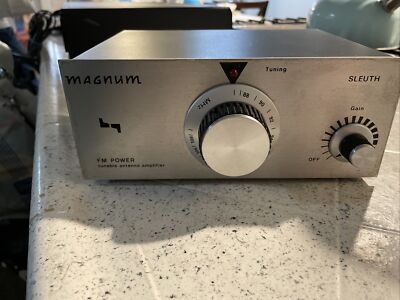
Magnum FM Power Tunable ANTENNA AMPLIFIER CB HAM RADIO SLUTH | eBay
<p>This Magnum ANT Power Amplifier is a great addition to your CB or HAM radio setup. With a tunable power output, it can boost your signal reception and improve the audio quality of your transmissions. The amplifier is compatible with a variety of antennas and audio inputs, including FM, and...
www.ebay.com
Last edited:
After quite a search I found for the (more or less) current product, the Magnum Dynalab Signal Sleuth. $549 at Audioadvisor (if you can stand their nonsense). That puts the thing in a very odd position of being a high-end product for a low-end signal source. At $549 a throw, I guess we can't run that spot "Hey Listeners! Having trouble receiving our station? Text us now, and the first 100 listeners will receive a free Signal Sleuth that solves all your problems! And improves FM reception too! Just send us a 20x15x6 cardboard shipping box, with a check for $549 to cover the shipping...."
After a brief visit to the Magnum site, I'm frankly amazed that Magnum Dynalab is making a box they call "The Worlds Best FM Tuner", that sells for over $10K. What, on FM today, is worth that? Magnum Dynalab MD-109
Oh, I know, it's the balanced 600 ohm outputs.
I'm shocked and amazed, and now I'm off to visit all my FM TX sites to make sure they're worthy. Probably have to disconnect them from the studios too and, I dunno, play a record straight in....
After a brief visit to the Magnum site, I'm frankly amazed that Magnum Dynalab is making a box they call "The Worlds Best FM Tuner", that sells for over $10K. What, on FM today, is worth that? Magnum Dynalab MD-109
Oh, I know, it's the balanced 600 ohm outputs.
I'm shocked and amazed, and now I'm off to visit all my FM TX sites to make sure they're worthy. Probably have to disconnect them from the studios too and, I dunno, play a record straight in....
- Status
- This thread has been closed due to inactivity. You can create a new thread to discuss this topic.