• Get involved.
    We want your input!
    Apply for Membership and join the conversations about everything related to broadcasting.

    After we receive your registration, a moderator will review it. After your registration is approved, you will be permitted to post.
    If you use a disposable or false email address, your registration will be rejected.

    After your membership is approved, please take a minute to tell us a little bit about yourself.
    https://www.radiodiscussions.com/forums/introduce-yourself.1088/

    Thanks in advance and have fun!
    RadioDiscussions Administrators

Canada’s CHU time station to close

I had (still have somewhere) a Patrolman 6, then moved up to a Patrolman 10. Also had a crystal-specific scanner. Picked up the final version of the Zenith TransOceanic a few years ago. A Drake R8B remains on the wish list.
There was an identical-looking aeronautical version of the pocket-sized Patrolman that covered 118-136 mHz, IIRC. Never had it or the Patrolman, as I only got into scanning in the '80s with a Bearcat 800 mHz-capable (unblocked) scanner. Great listening on those cellphone frequencies until the landscape changed.

I had a Transoceanic, too, a Royal 3000-1, that I got for my bar mitzvah in the late '60s. Fantastic radio for SW broadcast and medium wave at night, but the FM was prone to overloading, and it had no BFO for single sideband reception. Did the Transoceanic ever add a BFO before going out of production?
 
There was an identical-looking aeronautical version of the pocket-sized Patrolman that covered 118-136 mHz, IIRC.
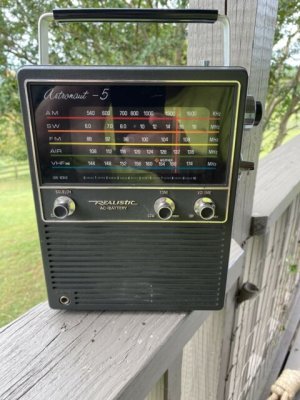
The Patrolman product line had an often similar-looking companion line called the Astronaut. Curious if this Astronaut-5 might be what you're remembering:

a5b.jpg

There was also an older version of the Astronaut-5 which looked more 1960s.

I had (still have somewhere) a Patrolman 6, then moved up to a Patrolman 10.
This version? I would have gone nuts for that in my youth.

The Patrolman-6 and Astronaut-6 receivers were more two examples of visually similar units. And I believe the Astronaut-8, a mint example of which is shown in this video, was the functional equivalent of the Patrolman-9:


Picked up the final version of the Zenith TransOceanic a few years ago. A Drake R8B remains on the wish list.
I love the appearance of the L600 version. The Drake would be wonderful to have if only there were still shortwave programming of equal quality to hear.
 
Last edited:
Check eBay. There were numerous variations of the Patrolman line sold by Radio Shack through the decades, and a number of them always seem to be available there. You can probably find the exact model you had.

Mine was this version (photo from eBay):

View attachment 12225

It was where I discovered amateur radio as well. I still remember the first repeater I ever heard: Richard LaBelle's W6FXN, which was home to the weekly Southern California earthquake net. Whenever things began to shake, they would hit the airwaves and nail down its approximate location and strength before anyone else, broadcast media included. I believe many of them had amateur seismographs and earthquake pendulums in their homes.

And yes, with an external antenna, it could receive WWV and WWVH.


Thanks for the info. Since I don't remember the model number, don't think I'll look on Ebay, but I appreciate the thought. Didn't use an external antenna, just whatever came with the rig. If memory serves, it had TV (like 2-13), along with of course, AM and FM.
 
I had (still have somewhere) a Patrolman 6, then moved up to a Patrolman 10. Also had a crystal-specific scanner. Picked up the final version of the Zenith TransOceanic a few years ago. A Drake R8B remains on the wish list.


First scanner I ever personally owned, was an eight-channel job, that my uncle gave me, with the switches to turn off and on the channels, with (I reckon) lights above the switches. I used to listen to that thing for hours, as well. It made a strange sound while cycling through the channels on scan, the little rocker switch being all the way up for scan. Of course, the fewer switches that were up, the faster it'd go and the faster it'd make that noise LOL. Oh yeah, just the little antenna in the back of the rig, was all I used there, too.
 
The Patrolman product line had an often similar-looking companion line called the Astronaut. Curious if this Astronaut-5 might be what you're remembering:


There was also an older version of the Astronaut-5 which looked more 1960s.


This version? I would have gone nuts for that in my youth.

The Patrolman-6 and Astronaut-6 receivers were more two examples of visually similar units. And I believe the Astronaut-8, a mint example of which is shown in this video, was the functional equivalent of the Patrolman-9:


I love the appearance of the L600 version. The Drake would be wonderful to have if only there were still shortwave programming of equal quality to hear.


Yeah, I forgot the Patrolman covered 118-136, I believe, as well. A few years later, I got (and went through, due to faulty dial construction) a few Sangian SG621s. I remember that name/model, 'cause I had to go back and get it again. :D)
 
CHU, when it was on 7335, was what I used to calibrate my analog-tuned general coverage receivers on 40 meters. It was out of range once it moved to 7850. In any case, it will be missed. Sometimes it would come in perfectly in AZ at night when WWV and WWVH would be inaudible.
 
The Patrolman product line had an often similar-looking companion line called the Astronaut. Curious if this Astronaut-5 might be what you're remembering:


There was also an older version of the Astronaut-5 which looked more 1960s.


This version? I would have gone nuts for that in my youth.

The Patrolman-6 and Astronaut-6 receivers were more two examples of visually similar units. And I believe the Astronaut-8, a mint example of which is shown in this video, was the functional equivalent of the Patrolman-9:


I love the appearance of the L600 version. The Drake would be wonderful to have if only there were still shortwave programming of equal quality to hear.

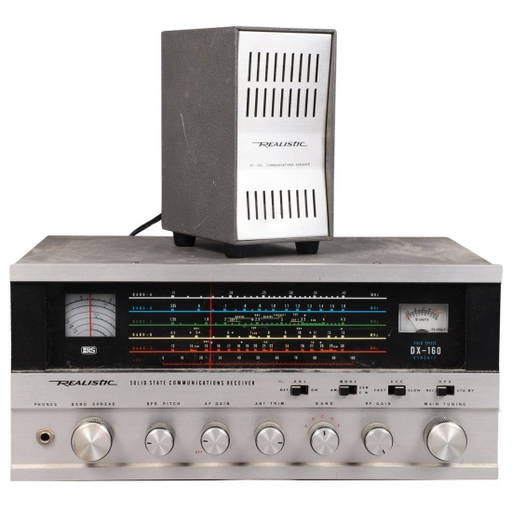
I've been tampeted to get another Realistic DX-160 like I had in the 70's and now regret that I didn't hold on to because when I moved to Florida, I could only fit so much in my car and it then just got lost over the years back in my home in New Jersey.

133553599-1-x.jpg


They have the used ones on Ebay but there's no way of knowing the exact condition from the seller's description.

Chances are, the tuning part is worn out and it's certainly not worth the price if that's the case.

Now I really miss that kind of analog tuner in today's digital age.

Even the AM had great sensitivity and I had a long wire attached to it instead of using the standard ferrite bar antenna inside the unit.
 
It wasn't really built for it's sound qualities but I did an AI search and ended up mentioning I have the CC Skywave now and it said that's far superior to the DX-160 in reception and sensitivity because of the advances in receiver technology such as the DSP software.

As we know, DSP can make it sound like stations fade in and out in increments instead of a steady change and can even block the weaker signals but the one in the CC Skywave is much better than the older DSP chips like I had in my Grundig G8.

So I think I will save some money and not go for another DX-160.
 
cc333 said:
How is its AM fidelity?
In my opinion its goregous.. Much better sounding than 100k FM signals! (Although I dont like HEAVY BASS so to me the music sounds mucho better from a 10k wide carrier in AM mode...
 
In my opinion its goregous.. Much better sounding than 100k FM signals! (Although I dont like HEAVY BASS so to me the music sounds mucho better from a 10k wide carrier in AM mode...

lol what year are you stuck in.. 1982?
 
In my opinion its goregous.. Much better sounding than 100k FM signals! (Although I dont like HEAVY BASS so to me the music sounds mucho better from a 10k wide carrier in AM mode...
Huh? The FCC has imposed a limit of 10 kHz on the top end to avoid hetrodynes with the next adjacent channels. That means that stations might be able to be relatively flat from around 60 to 100 Hz but they can't do anything above that high end limit.
 
Huh? The FCC has imposed a limit of 10 kHz on the top end to avoid hetrodynes with the next adjacent channels.

You've got your terminology wrong. The 10 kHz frequency response limit is to reduce sideband splatter. A heterodyne is a beating or squealing effect caused by carriers interfering with one another. It has nothing to do with the high frequency content in the music or other content being broadcast, and the FCC's limit of 10 kHz on the top end doesn't help with heterodyne interference.

That means that stations might be able to be relatively flat from around 60 to 100 Hz but they can't do anything above that high end limit.

Stations might be able to be able to transmit audio fairly uniformly from around 60 to 10,000 Hz, otherwise written as from 60 Hz to 10 kHz, if their transmitter, towers and related equipment are very well tuned. Given the amount of processing that gets applied to the audio though, especially on an AM radio station, the frequency response of the transmitted audio is hardly "flat."

To fix the problems with sideband splatter that used to bleed through onto adjacent stations, the FCC and the National Radio Systems Committee (NRSC) implemented the NRSC-1 audio mask, enforcing a 10 kHz audio cutoff (20 kHz RF bandwidth) to stop stations from overlapping their neighbors with high frequency audio. However, most AM radios made in the past 30+ years have a frequency response cutoff that ranges from under 3 kHz up to 4 or 5 kHz if you're lucky. A few wideband AM receivers exist that can hear 10 kHz audio but they are few and far between, and they serve a very niche user base, such as people who use this site.
 
Last edited:


Back
Top Bottom