• Get involved.
    We want your input!
    Apply for Membership and join the conversations about everything related to broadcasting.

    After we receive your registration, a moderator will review it. After your registration is approved, you will be permitted to post.
    If you use a disposable or false email address, your registration will be rejected.

    After your membership is approved, please take a minute to tell us a little bit about yourself.
    https://www.radiodiscussions.com/forums/introduce-yourself.1088/

    Thanks in advance and have fun!
    RadioDiscussions Administrators

CapRadio cuts 12% staff and cancels shows

In a way, I get what the university is saying. Doing a deal with a PBS station cheats the radio audience. It devalues the product. The problem is they've already done that on their own with the financial crisis. But anyone who has ever worked for a TV-Radio combo knows that the radio side always gets short shrift. I had that experience once in my career and was able to keep from making that mistake again. So I hope that's the intent here. But they HAVE to fix things with the endowment.
 
I found the most interesting part of the letter(s) down at the very bottom, in the third paragraph under "KVIE Merger Situation", the part about how the Endowment is pushing to merge only KXJZ/90.9 into KVIE. Which implies that Sac State would continue to own, and be responsible for operating, everything else: KUOP Stockton, KKTO Tahoe City/Reno, KQNC Quincy, KXPR and all of the classical music stations tied to it, not to mention all the translators, and the North Country Public Radio mini-network. But KVIE would get to own/operate the Mother Ship, have the NPR affiliation, program the whole kit & caboodle, and originate local content like newscasts and Insight. That is a prescription for chaos, not to mention even more organizational dysfunction. And would inevitably lead to KVIE having to recreate equivalent infrastructure for 90.9, since everything else would stay under the auspices of the current legal licensee and operator, Sac State.

(Mike, did I miss anything?)
 
I found the most interesting part of the letter(s) down at the very bottom, in the third paragraph under "KVIE Merger Situation", the part about how the Endowment is pushing to merge only KXJZ/90.9 into KVIE. Which implies that Sac State would continue to own, and be responsible for operating, everything else: KUOP Stockton, KKTO Tahoe City/Reno, KQNC Quincy, KXPR and all of the classical music stations tied to it, not to mention all the translators, and the North Country Public Radio mini-network. But KVIE would get to own/operate the Mother Ship, have the NPR affiliation, program the whole kit & caboodle, and originate local content like newscasts and Insight.That is a prescription for chaos, not to mention even more organizational dysfunction. And would inevitably lead to KVIE having to recreate equivalent infrastructure for 90.9, since everything else would stay under the auspices of the current legal licensee and operator, Sac State.
(Mike, did I miss anything?)

I think you're reading too much into that.

Somewhere in the letter or reporting (it's getting to be a blur) is the phrase "sell KVIE the licenses." To me, that's CapRadio News (KXJZ 90.9), CapRadio Music (KXPR 88.9) and all the full-power stations and translators that are essentially used as repeaters.

KVIE television serves the area from Modesto to Redding, so all of those and North State Public Radio would be a logical fit. I think they'd buy it all as well as the as-yet unused new equipment that's sitting in the downtown studios.

The money from that would help replenish the University Emergency Fund, which has been paying CapRadio's past due bills.

This would be Sac State getting out of radio, period.
 
Last edited:
In a way, I get what the university is saying. Doing a deal with a PBS station cheats the radio audience. It devalues the product. The problem is they've already done that on their own with the financial crisis. But anyone who has ever worked for a TV-Radio combo knows that the radio side always gets short shrift. I had that experience once in my career and was able to keep from making that mistake again. So I hope that's the intent here. But they HAVE to fix things with the endowment.
You're not wrong, but there's precedent for strong PBS/NPR pairings---KPBS in San Diego and KQED, San Francisco for starters.

And, as a CapRadio retiree, it's hard to imagine radio getting any shorter shrift than it's had since the financial crisis became apparent.
 
What would they do with the downtown studios?

They're still trying to figure out whether they can dump the lease or not. If they can, they will---and if they keep the stations, the preliminary plan is to take all that new gear, bring it back to campus and retrofit what are now 20-year-old studios.

If they can't, President Luke Wood himself has publicly suggested that the University could explore using the space in some other capacity---though the beautiful studio space would probably have to be demolished.
 
They're still trying to figure out whether they can dump the lease or not. If they can, they will---and if they keep the stations, the preliminary plan is to take all that new gear, bring it back to campus and retrofit what are now 20-year-old studios.

If they can't, President Luke Wood himself has publicly suggested that the University could explore using the space in some other capacity---though the beautiful studio space would probably have to be demolished.
Sounds like Wood is up a tree
 
I think you're reading too much into that.

Somewhere in the letter or reporting (it's getting to be a blur) is the phrase "sell KVIE the licenses." To me, that's CapRadio News (KXJZ 90.9), CapRadio Music (KXPR 88.9) and all the full-power stations and translators that are essentially used as repeaters.

KVIE television serves the area from Modesto to Redding, so all of those and North State Public Radio would be a logical fit. I think they'd buy it all as well as the as-yet unused new equipment that's sitting in the downtown studios.

The money from that would help replenish the University Emergency Fund, which has been paying CapRadio's past due bills.

This would be Sac State getting out of radio, period.
Quoting the referenced paragraph:

"On March 19, members of the Endowment board hired a PR firm to publicly pressure Sacramento State into selling the single license for 90.9 KXJZ [emphasis mine] to KVIE. CapRadio operates 32 fully licensed FM stations that reach from Modesto to Eureka, and serves nearly 500,000 people each week. CapRadio has not seen a legitimate plan for a proposed merger."

What you referenced seems to have come from this paragraph in the Endowment's letter to CSUS and Cap Radio, which is quoted in full in Chris Nichols' article from March 28th:

"Financial and other Benefits to CSUS/CSU: The campus can get much of what it wants in terms of programing presence and student engagement, while shedding future station operational expenses. Further, the sale of the licenses to KVIE will bring CSUS/CSU significant funds to credit against its station subsidies since takeover in August 2023. It also releases CSUS staff from continuing to deal with the CapRadio problem and future CapRadio operating expenses."

The "corporate" communications we all received on Friday seems a bit rushed and muddled, and obviously the two quoted paragraphs are factually inconsistent.

Note I'm not taking sides, but as a contributing member of Cap Radio (possibly your only one on the Peninsula), I do take an interest in this fast evolving drama. ("Soap Opera" might be more accurate.)
 
Quoting the referenced paragraph:

"On March 19, members of the Endowment board hired a PR firm to publicly pressure Sacramento State into selling the single license for 90.9 KXJZ [emphasis mine] to KVIE. CapRadio operates 32 fully licensed FM stations that reach from Modesto to Eureka, and serves nearly 500,000 people each week. CapRadio has not seen a legitimate plan for a proposed merger."

What you referenced seems to have come from this paragraph in the Endowment's letter to CSUS and Cap Radio, which is quoted in full in Chris Nichols' article from March 28th:

"Financial and other Benefits to CSUS/CSU: The campus can get much of what it wants in terms of programing presence and student engagement, while shedding future station operational expenses. Further, the sale of the licenses to KVIE will bring CSUS/CSU significant funds to credit against its station subsidies since takeover in August 2023. It also releases CSUS staff from continuing to deal with the CapRadio problem and future CapRadio operating expenses."

The "corporate" communications we all received on Friday seems a bit rushed and muddled, and obviously the two quoted paragraphs are factually inconsistent.

Note I'm not taking sides, but as a contributing member of Cap Radio (possibly your only one on the Peninsula), I do take an interest in this fast evolving drama. ("Soap Opera" might be more accurate.)

First, in case you missed my mentioning it in previous posts, I retired on January 31. If I hadn't, I wouldn't be discussing any of this.

If I'm going to choose between the Friday rant and the Endowment's letter in determining what a deal would look like, I'll take the Endowment's letter.

It's licenses plural and keeping any of them would not "release CSUS staff from future CapRadio operating expenses." The objective would be to get a few million bucks to refill some of the university's emergency fund and not spend another penny in radio again.

If there were signals that KVIE felt it didn't want (again, pretty much everything CapRadio has, including NSPR, matches up with KVIE's coverage area), it could either exclude them from the scope of a deal or buy them and then flip them after the fact.

KVIE would almost certainly buy all that new, state-of-the art radio equipment that's sitting in the downtown spaces, which I think would be an additional several hundred thousand to a million dollars on top of the licenses.

The only questions I have about a possible KVIE deal are:

  • Does KVIE's facility have room for the radio stations or would they have to be housed separately? If they did have to do that, would they assume the downtown leases and simply move in to the new studios, which have been ready to go live for at least six months? That would be a major upside for the university.

  • If CapRadio's reputation ends up damaged beyond what it is, would they change calls and branding for the news station and make it KVIE-FM (as KPBS and KQED do)?
 
Last edited:
The objective would be to get a few million bucks to refill some of the university's emergency fund and not spend another penny in radio again.

One would think that might be acceptable to the university, especially when we know that Cal State Northridge was looking for some sort of professional outside management to take over KCSN before covid. Cal State Long Beach actually did a deal with Saul Levine for KKJZ. So the idea of outside management isn't foreign to the Cal State system. The one thing about the two examples is that Cal State retained the license.
 
One would think that might be acceptable to the university, especially when we know that Cal State Northridge was looking for some sort of professional outside management to take over KCSN before covid. Cal State Long Beach actually did a deal with Saul Levine for KKJZ. So the idea of outside management isn't foreign to the Cal State system. The one thing about the two examples is that Cal State retained the license.

I could be wrong, but here's my take:

Sac State President Luke Wood, who just began his job on July 17 of 2023, has said publicly that he was told by CSU Chancellor Mildred Garcia that "Job One is to fix CapRadio." I think (and this is purely opinion on my part) that he doesn't consider getting out as a fix.

Tom Karlo, the previous interim GM, who announced he was leaving early (two weeks after I did), said this on the record in an interview with CapRadio reporter Chris Nichols last month:

“I had said something to our board at the time that I felt that if we are going to be successful and really be a viable entity in the future that some sort of a partnership or a collaboration or sharing content or even some sort of an acquisition or a merger with KVIE was a very good idea,”

“I was the one that started the whole idea [of partnering with KVIE] to put it on the discussion plate,”

I think President Wood may be taking the mission of "fixing" CapRadio personally, and that came out in Friday's statement lashing out at both the Endowment and KVIE.

If the University changes its position and becomes open to a KVIE deal, it will probably be because Chancellor Garcia has had enough of the drama and expense. I have no idea what her current thinking is.
 
KVIE television serves the area from Modesto to Redding, so all of those and North State Public Radio would be a logical fit.

Don't forget about KIXE (channel 9) - They're serving the Northern part of this area.

The ownership of the North State Public Radio stations is "Chico State Enterprises", so still the CSU system. That cluster seems to be lost in all of the talk about everything, and I haven't heard anything about any financial issues related to them. They have quite a few transmitters scattered around the area, including three from the same site on Mt. Dyer. It probably makes sense to keep this group under separate ownership, as they qualify for a CPB rural grant:


That link says, in part:

Today, more than 95 percent of the U.S. population is able to access public broadcasting's over-the-air signals. This reach could not have been achieved without a significant federal investment in rural communities throughout the country, as well as the efforts of the thousands of Americans employed by local public television and radio stations in those communities.
  • 247 of the total 549 radio and TV grantees are considered rural. Of these, 85 are public television station grantees and 163 are public radio station grantees.
  • During FY 2021, CPB provided more than $190 million to support operations and programming at these stations, which represents 43 percent of our total appropriation. Rural stations leveraged this funding to raise $519 million in non-federal funds, including $152 million in state funding, $48 million from colleges and universities, $34 million from foundations, $38 million from local businesses and $238 million from individual donors. All told, this represents a return of over $2.7 for every appropriated dollar.
Dave B.
 
Don't forget about KIXE (channel 9) - They're serving the Northern part of this area.

Dave, I had completely forgotten about KIXE. Apologies, and clearly, KVIE's coverage area goes a little less to the north than I had thought, but Chico is theirs.

The ownership of the North State Public Radio stations is "Chico State Enterprises", so still the CSU system. That cluster seems to be lost in all of the talk about everything, and I haven't heard anything about any financial issues related to them. They have quite a few transmitters scattered around the area, including three from the same site on Mt. Dyer.

While Chico State owns NSPR, CapRadio has had a managing partnership since 2020.


Their staff was among those cut in last summer's layoffs and, though it apparently didn't make the news anywhere, CapRadio let NSPR's GM since 2018, Phil Wilke, go right around the same time I retired (January 31 of this year)---so CapRadio's financial issues are absolutely an issue for them.

I had also forgotten that in 2021, CapRadio executed a similar managing agreement with KHSU at Humboldt State:


It appears KHSU is still simply running network (NPR, APM and BBC) programming, and there really isn't anything left to cut up there (this link has details on the massive cuts they endured before CapRadio stepped in: KHSU plans to return to local programming).

So, there are complications to any potential deal. Would KVIE want to continue managing Chico and Humboldt?
 
Last edited:
What would KVIE do with the downtown CapRadio studios?
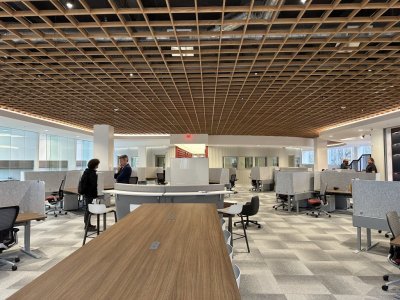
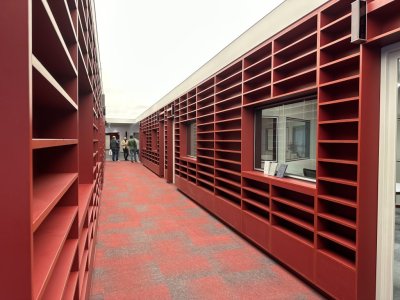
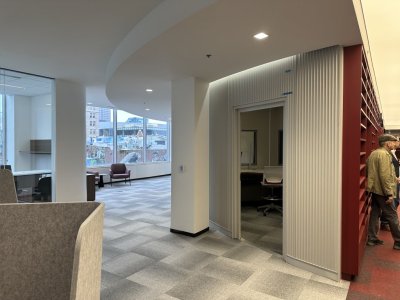
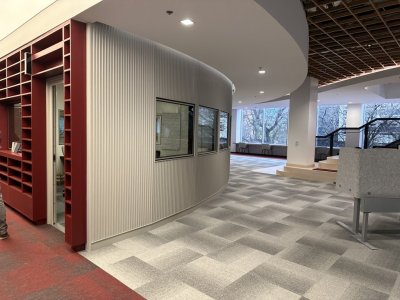
I don't remember if I ever posted the pictures I took when CapRadio took us on a tour last February of the downtown studios.

At that point, the target move-in date was May 1:

IMG_4152.jpeg

IMG_4140.jpeg

IMG_4148.jpeg
IMG_4149.jpeg

The work in progress at that time was completed, and we were supposed to go live from there on Monday, October 2.

I went on a three-week vacation beginning September 9 and was told to take my personal stuff home because I'd be coming back to work on October 3 in the new facility. But while I was gone, the decision was made to hold off on the move-in.

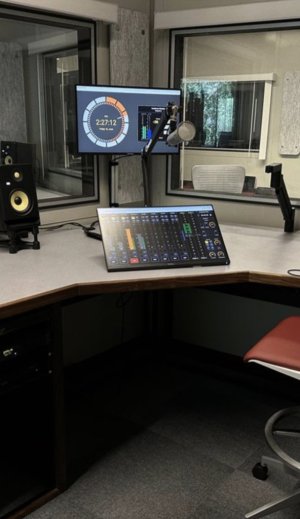
Here's an air-ready anchor studio from just before I went on vacation, missing only a keyboard and monitor for the newsroom software computer, which would have scripts, access to e-mail and slack, an internet browser, etc.:

IMG_6121.jpeg

IF there's a KVIE deal, buying the equipment would seem to be an obvious move.

Taking over the lease, though, might not be wise. According to the September audit, it's expensive from the start, and there are escalator clauses, raising the monthly amount, through the lease term. Beyond that, there's a commitment to x number of parking spaces in the garage below at x per space, security, janitorial, etc.

Heck, for that matter, utilities. This was designed when CapRadio was in a growth spurt, and intended to comfortably accomodate a staff of 150 or more. When I left, the staff size was 52 and more people have left since.

There are cheaper places with less space---enought to accommodate a couple of radio stations.
 
Wow, those are really nice! Is it just studios or were they going to do classes and events, like KQED is doing after their building remodel?
 
Wow, those are really nice! Is it just studios or were they going to do classes and events, like KQED is doing after their building remodel?

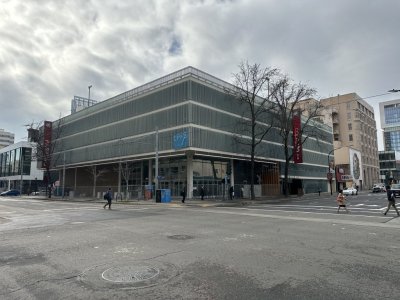
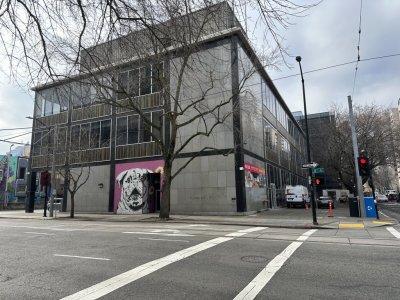
Studios and offices in that building.

IMG_4118.jpeg

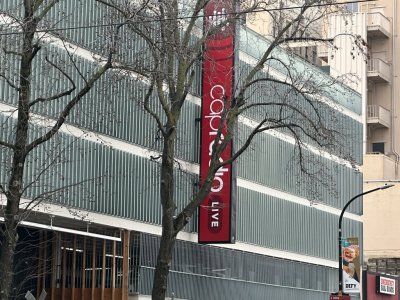
There's a second building that's a performance space with meeting rooms that would be suited to classes about a block and a half away, CapRadioLive. The signage has been up for about a year and a half.

IMG_4114.jpeg

IMG_4115.jpeg

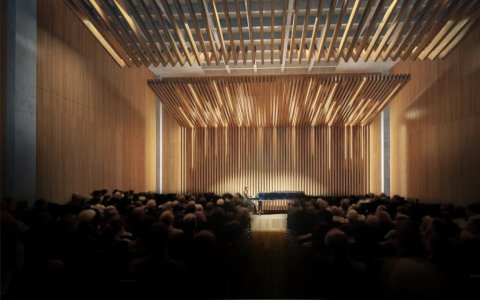
Artist rendering of the performance space:

Concert-CapRadio20Reimagined.jpg

Originally, the offices, studios and performance space were supposed to all be in one building, the one that ultimately became the performance space. Sactown Magazine did a pretty good look at that (with more renderings) in their September 2019 issue:


Somewhere along the way, the decision was made to split the studios and offices into a second building. We never got what we considered a good answer as to why, and the second set of construction and lease costs contributed significantly to the financial issues.
 
That's a cool article. Do you know when they're going to start using either building or why the delay?

The University hopes the answer is never.

While the plan was to go live from the new studios in October, the release of the audit in September revealed just how bad things were. That's when CSUS hit pause.

They're trying to find a loophole or settlement that lets them out of the leases. In the meantime, it's cheaper to pay the monthly leases and keep them empty than it is to move in and incur the utility, security, parking and other associated ongoing and escalating costs.

And that's a sign of just how dire the situation is. IF they could open the performance space, it could be rented out for events---generate revenue. But there's a break-even point even in a good situation, and there'd probably be a year or two where CapRadio Live actually lost money before turning the corner. They can't afford that.
 
Status
This thread has been closed due to inactivity. You can create a new thread to discuss this topic.


Back
Top Bottom