
• Get involved.
    We want your input!
    Apply for Membership and join the conversations about everything related to broadcasting.

    After we receive your registration, a moderator will review it. After your registration is approved, you will be permitted to post.
    If you use a disposable or false email address, your registration will be rejected.

    After your membership is approved, please take a minute to tell us a little bit about yourself.
    https://www.radiodiscussions.com/forums/introduce-yourself.1088/

    Thanks in advance and have fun!
    RadioDiscussions Administrators

FCC grants WBBM a CP to move transmitter site

There would be at least two or three problems with a WMVP diplex. The tallest WMVP tower would be less than 1/2 wavelength at 890, about 159 degrees. The 110 kHz diplexing spacing is too tight for quality audio bandwidth. That's a lot of RF for so close to subdivisions, and probably a fairly large population in the 1 V/m. OK for an AUX facility, and it may be licensed for that. Just looked, it's not. Maybe too problematic with the DA. Or maybe something to consider. From a location standpoint to serve Chicago, very good. Consider that WMVP is the only station to put a 25 mV/m signal over all of Chicago, Day and Night, based on M-3.
 
Last edited:
There would be at least two or three problems with a WMVP duplex. The tallest WMVP tower would be less than 1/2 wavelength at 890, about 159 degrees. The 110 kHz diplexing spacing is too tight for quality audio bandwidth. That's a lot of RF for so close to subdivisions, and probably a fairly large population in the 1 V/m. OK for an AUX facility, and it may be licensed for that.

I can understand the first two items regarding WLS and WMVP, but WBBM and WGN have transmitted from their current sites since the 1930s, and suburban sprawl has extended to Rohlwing Rd. for close to 50 years. No issues RF that I am aware of.

Same goes for the WSCR/WMAQ transmitter on Army Trail Rd. in Bloomingdale that WBBM will be piggybacking with, which also involves a 110 kHz spacing, even though we're talking about lower frequencies. I lived less than a mile from there in 1978-79, and there were no issues regarding RF exposure that I remember. In fact, I lived close enough to listen to a Sox game in late '78, when they were technically off the air (finals were dead), but the exciter was still operating at a watt or two. I wouldn't worry too much about RF in either location.
 
It will be interesting to see how the audio bandwidth is with the diplexing. WBBM was said to stand for We Broadcast Better Music. With the narrow bandwidth, not so good with Music vs. Talk and News. Unless an incredibly complex filter system were designed. Consider also that WSCR and WBBM are also programming in a large part lower frequency male voices. The most important harmonics of male voices are still generally narrower bandwidth. So you might get some narrow audio filter effect with female voices and musical interludes common in things like sounders and commercials.
 
Last edited:
We'll see how the audio quality works out with WSCR and WBBM, I keep thinking WLS should put an AUX at the WMVP site and see how it works. That 25 mV/m signal over all of Chicago keeps coming to mind. Keith, do they town all the property in that block? What are the little outbuildings further out on the lot in the satellite view? If they reduced the Class I/Class A efficiency, it would still be at the 225 mV/m for 1 kW at one mile efficiency. The 50 kW nondirectional inverse field would be 1605 mV/m at 1 mile from the center tower.
 
Last edited:
WSCR+WBBM Diplex: IM Products

It will be interesting to find out how the 1450 kHz r-f intermod sum of the very high local fields of WSCR+WBBM near their diplexed transmit site affects nearby AM receivers and other devices.

Even if that site emits zero energy at 1450 kHz, it could be produced by rectification in poorly bonded electrical connections in the propagation environment, and/or within AM receivers, themselves.

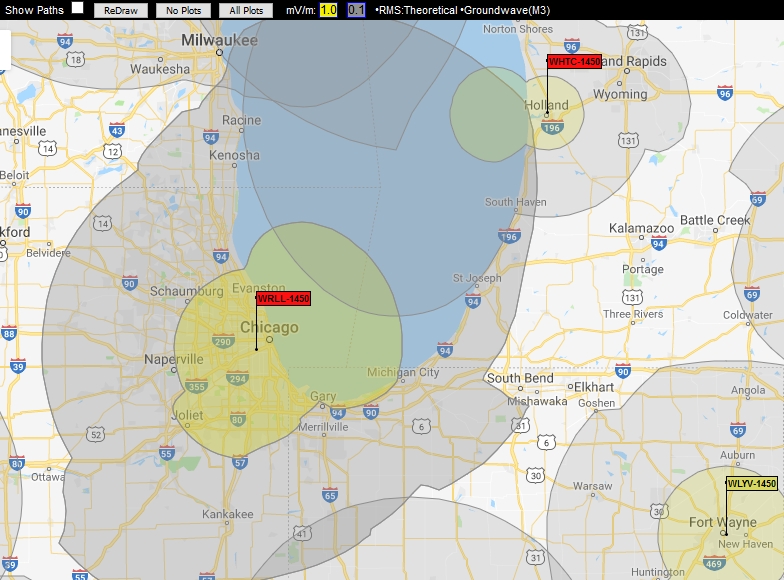
Below is a plot of the present-day, daytime1450 kHz fields in the Chicago region.

1450-Khz-Daytime-Sig-Chgo-area.jpg
 
Last edited:
Thanks, rfry. I have noticed those kind of intermodulation products around Detroit and Flint. The third order radiated intermod products are most noticeable in the expanded band. I have also heard sum products in the X-Band. Another thing I've noticed is 455 kHz (450 and 460) separated strong signals mixing and heard throughout the band. This would have been more of an issue during the Chess Brothers WVON 1450 days, when 1450 had fairly good ratings.

From looking at the Aeronautical Chart, it doesn't look like the FAA would approve a tower higher than the 499 foot center WMVP tower that close to ORD. And they would point to the KFI tower crash in any attempt at waiver or appeal.
 
Last edited:
Other r-f intermodulation products for the diplexed WSCR/WBBM site can be generated, within those transmitters. Two examples falling within the AM broadcast band are 560 kHz and 890 kHz (2F1 - F2).

However those signals are unlikely to pass through the diplexer and be radiated with enough power to cause significant issues in the Chicago market.
 
I had a cheap radio which would QRM itself when it was near a strong signal on 910.
The station would be mixed down to 455 which would double itself back to 910.
 
If you lived near a 910, the whistle is nothing new to you. In my area (WFDF 910), the competition never failed to mention it to potential advertisers, along with DA problem areas of other stations. It's less of a problem now due to PLL tuners.
 
BTW, many of the little "outbuildings" I thought I saw on the satellite photos are actually very large concrete guy anchors. There may also be a building or two for tractors to maintain the lawn. Funny thing, on the satellite photo, you can see the actual guy wires coming from the anchors, the shadows of all three towers, but only the red orange and white painted center tower. The other two towers cannot be seen. Probably an artifact of how the satellite photo data is stored.
 
WBBM has filed a license to cover application with FCC for the construction permit which will move their transmitter to the Bloomingdale, Illinois site. As part of the application WBBM also requests a program test authority. At the same time WSCR has filed an application for direct measurement

According to the application WBBM has to vacate their current Itasca site by August 2019, so they are asking FCC to expedite the process.

It looks like the WBBM move to Bloomingdale will be happening very soon.
 
This may not be the best place to ask, but… what exactly is direct measurement, and why does a station have to file an application to do it? I see that all the time in the FCC digests but have never really understood what it is, or what is for.
 
This may not be the best place to ask, but… what exactly is direct measurement, and why does a station have to file an application to do it? I see that all the time in the FCC digests but have never really understood what it is, or what is for.


From the FCC licensee checkbook:

DIRECT vs INDIRECT METHOD: The antenna input power of AM stations must be determined using the direct method. However, the indirect method may be used on a temporary basis when it is not possible or appropriate to use the direct method due to technical reasons. The direct method of power determination for an AM station uses either 1) a suitable instrument for determining the antenna's input power directly from the RF voltage, RF current, and phase; or 2) calculating the product of the licensed antenna or common point resistance at the operating frequency and the square of the indicated unmodulated antenna current at that frequency, as measured at the point where the resistance has been determined. The indirect method is determined by applying the appropriate factor to the input power to the last radio-frequency power amplifier stage of the transmitter, using the following formula: Transmitter output power = Ep x Ip x F Where: Ep= DC input voltage of final radio stage. Ip= Total DC input current of final radio stage. F = Efficiency factor of the transmitter. The value of the efficiency factor, F, is to be determined and a record of its value is to be maintained and available upon request.
 
In other words, the indirect method measures power at the transmitter times its efficiency whereas the direct method measures it at the base of the antenna.
I could be wrong, but I believe that the direct method can also measure power at the common point (input) of a phasor.
 
Quoting from the WBBM licence to cover application this is the reason for the direct measurement request by WSCR:

"The WBBM Transmitter site is that as currently licensed for Radio Station WSCR, 670 KHz. A type accepted transmitter, new matching, and filtering equipment have been installed. The existing main tower remains unchanged. The existing WSCR auxiliary tower is detuned for operation by WBBM on the main tower. The operating impedance has changed for the WSCR main antenna. Therefore, a 302AM application for direct measurement of power has been done for the existing WSCR main antenna as part of this license application. In addition, a new ground system has been installed at the site."
 
In other news.... WSCR is my main "go to" preset in the car. During the last 2-3 weeks I've noticed that the WSCR signal has been interrupted several times during mid-day hours. Usually only for a few seconds, but a couple of times for a minute or a minute or so. My takeaway is that the process has begun in earnest.
 
Apparently WBBM's license to cover was approved on the 10th. Someone about 50 miles away reported that the signal now seems a bit weaker than 670 and 720. I'm less than 20 miles from the new tower site and the only difference I notice is the HD is off. Anybody else notice a difference in the WBBM signal?
 
Not at my location, but I am just 5.26 miles away from the Bloomingdale transmitter. It's nice to have HD off though. I am able to actually hear WABC on 770.
 
I'm too close to notice any difference. (About 24 miles). RL now reflects the diplex, along with WBBM at 35kw day and 42kw night.
 
Status
This thread has been closed due to inactivity. You can create a new thread to discuss this topic.


Back
Top Bottom