• Get involved.
    We want your input!
    Apply for Membership and join the conversations about everything related to broadcasting.

    After we receive your registration, a moderator will review it. After your registration is approved, you will be permitted to post.
    If you use a disposable or false email address, your registration will be rejected.

    After your membership is approved, please take a minute to tell us a little bit about yourself.
    https://www.radiodiscussions.com/forums/introduce-yourself.1088/

    Thanks in advance and have fun!
    RadioDiscussions Administrators

FCC to consider ongoing operation of existing FM6/Franken FMs, Expanded FM Band and Elimination of Reserved Band Protection Requirements

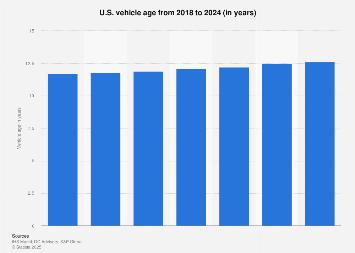
Actually the average age of cars on the road in the US is 17 years!!
Not true.


"Automobiles in the United States had an average age of 12.1 years in 2021. This figure represents a slight increase from 11.9 years in 2020."

I found about 100 sites that have similar data, but this was the one with the best attribution.
 
Some time back, I visited all the stores in town and not one of them could sell me a portable radio for the existing FM band. Lots of smart phone and smart speaker options though.

I had to go on eBay to find a new radio.
There was an "FM2' proposed in the 80s, somewhere in the 220 mHz spectrum. It would have displaced the 220mHz ham band, among others. It would have made sense then.
 
Some time back, I visited all the stores in town and not one of them could sell me a portable radio for the existing FM band. Lots of smart phone and smart speaker options though.

I had to go on eBay to find a new radio.
Nothing on radio is interesting enough to buy a new radio to hear it, especially if FM 82.1 also streams.
 
Good luck with that. Radio has enough struggles competing with streaming smartphones and the gold rush that is digital ads. Adding more channels for LPFM's to fail, or more esoteric formats that struggle, doesn't do anything for radio. Commercial or non-commercial.

Great, time to put your money where your values are. There are plenty of small market stations available at bargain prices without petitioning the Commission to expand the band. You should get out there and show all of us greedy bastards how it's done.
I saw these concepts actually implemented during my 5 year tour with Emmis in Buenos Aires, Argentina. That is a market about the size of New York City, but at the time there were over 200 FM stations and about 25 AMs.

There were community stations that covered neighborhoods. There were suburban stations that covered the equivalent areas of the counties in the New York metro. And there were lower power AMs from 1610 to 1700. Finally, there were about 12 really good AMs (50 to 100 kw) and about 18 full market FMs.

But the two Emmis stations, well researched and programmed, took over a third of the total audience. The next ten stations along with the Emmis ones represented over 95% of all listening. When you added in the various government stations (several FMs, all tango and all classical, and an several municipal or governmental FMs) you had about 97% of all listening.

The other 180 or so stations, run by unions, political groups, colleges and schools, cultural and art groups, alternate lifestyle groups and just people who wanted to play their own music libraries did not even register any audience. Many of them went through multiple operators in the years I was involved in the market, as in nearly every case the volunteers tapered off their hours and eventually left the operation and someone else with a magic formula came on to occupy a little slice of the dial.

Consolidation in the US took place because such a high percentage of stations were not able to make money to sustain their operation. The cause? Docket 80-90 that expanded dramatically the number of stations, particularly in smaller and medium markets. Nobody thought to consider that the available ad revenue or the potential non-profit donor base did not expand proportionally, so stations in general were worse off than before unless bunches were grouped together where new technology allowed vastly cheaper operation.

 
Starting with Docket 80-90 and to this day, we have speculators applying for radio stations both commercial and educational . In many cases they lied on their application when they said they had the funds to build and operate. Consequently applicants who would have provided a service were cheated out of a grant.

And then you had licensee's who tried to live like a KING on borrowed money. They went broke.
 
Last edited by a moderator:
Nothing on radio is interesting enough to buy a new radio to hear it, especially if FM 82.1 also streams.

How would anyone know if the radios they already have don't receive it. This was the reason it took so long for FM to gain acceptance. Most radio manufacturers didn't include FM in their portable radios until the Armstrong patent ran out in 1966. RCA was at war with the Armstrong family and refused to include FM in their radios.

Right now sales of free standing internet table radios are mostly non-existant. Smart speakers are popular, but they're not marketed as radios.
 
Consolidation in the US took place because such a high percentage of stations were not able to make money to sustain their operation. The cause? Docket 80-90 that expanded dramatically the number of stations, particularly in smaller and medium markets. Nobody thought to consider that the available ad revenue or the potential non-profit donor base did not expand proportionally, so stations in general were worse off than before unless bunches were grouped together where new technology allowed vastly cheaper operation.
Exactly. This whole line of: "Airwaves are a public resource" is; (to use my father's description) complete hogwash. Tell that to the PCS and Cell companies who purchased their frequencies from the government at auction. Tell that to the TV stations during the the government repack of the UHF TV band. Some public stations who were already in financial jeopardy didn't have enough funding to move channels and simply went dark.

We've been living with the ramifications of 80-90 for decades. Like you, I don't think a lot of stations would have survived without some form of consolidation. Since 2008 and then following with the pandemic, radio property values have tanked. There are many small and medium market stations who have filed for bankruptcy or are in receivership. If someone wanted to get into the radio biz at bargain basement prices, this would be the time to do it. I'm just feeling fortunate to have recently closed on selling my last remaining station before things got really tough.
 
As a reminder, there may be some US-Canada, US-Mexico Biliteral issues that will need to be resolved. Perhaps non-border areas would be the first to initiate any changes.
 
What's interesting to me is we have the FCC talking about expanding the FM band, making Franken FMs legal, and other ways of growing FM radio. Meanwhile at RadioInk, their big story is Fred Jacobs' survey about declining radio listenership. All the comments there are about how no one listen to FM because of the music and commercials.


If this is true, and listenership is declining, why in the world are we talking about expanding the FM band? Adding more stations isn't going to solve the problems of boring playlists and too many commercials. In fact, it's likely to make the situation worse.
Services like NPR and K-Love would benefit from having all their member stations moved to 82-88. Make it easy for the average listener to find them across the board and be ensured the best possible signals.

Their current dial positions would not be replaced, freeing up an FM dial clogged and compromised by the FCC’s failed “AM Revitalization” “plan”.
 
Services like NPR and K-Love would benefit from having all their member stations moved to 82-88. Make it easy for the average listener to find them across the board and be ensured the best possible signals.

The number of FM receivers that tune down to 82 MHz is zero. Other than via streaming, nobody could listen to these stations.

Maybe the tuner chips could be configured to tune down that far, but who would bother? Even if they were aware of the possibility of doing so (and only engineers familiar with the tuner chips' data sheets would be), you can file that under "Not happening."
 
The number of FM receivers that tune down to 82 MHz is zero. Other than via streaming, nobody could listen to these stations.

Maybe the tuner chips could be configured to tune down that far, but who would bother? Even if they were aware of the possibility of doing so (and only engineers familiar with the tuner chips' data sheets would be), you can file that under "Not happening."
There are many portable radios that go down to at least 76 mhz, as the Japanese FM band starts there. One of my radios that I use often is the HanRongDa shown in my profile picture, which tunes 64-108 mhz, so it also includes the OIRT FM band. Modern radios with DSP tuners could easily include any expansion to the band if manufacturers wanted to do it. Most cars could probably have their firmware updated to get the new band.

Even if only a few stations such as non-commercial and translators went to 82-88 mhz, it would reduce a lot of the overcrowding in the FM band, possibly allowing more stations to upgrade their signals. Almost all radios have 87.9 and 87.7, which are usually empty frequencies, so the FCC should at least expand to those 2 channels instead of wasting them because of the handful of Channel 6 stations.
 
How would anyone know if the radios they already have don't receive it. This was the reason it took so long for FM to gain acceptance. Most radio manufacturers didn't include FM in their portable radios until the Armstrong patent ran out in 1966.
That was part of it, but the real issue with FM in the later 40's and 50's was the lack of AFC, so you had to re-tune your radio with considerable frequency. The creation of automatic frequency control and the move to transistorized radios brought a slew of good, stable FM radios in the very early 60's.
RCA was at war with the Armstrong family and refused to include FM in their radios.
But by the 60's, RCA had moved on to focus on TV for the most part and did not care about a person who had died a decade before.
Right now sales of free standing internet table radios are mostly non-existant. Smart speakers are popular, but they're not marketed as radios.
You mean "AM and FM radios" and not "internet table radios", right?
 
Services like NPR and K-Love would benefit from having all their member stations moved to 82-88. Make it easy for the average listener to find them across the board and be ensured the best possible signals.
I am positive the K-love folks would object vigorously. They like being amid commercial stations, not isolated at the "left" side of the dial.
Their current dial positions would not be replaced, freeing up an FM dial clogged and compromised by the FCC’s failed “AM Revitalization” “plan”.
The use of translators by stations in small and medium markets has been enormously successful. Daytime AMs have benefited the most, followed by stations on the former Class IV local channels. And many highly directional stations got improved fulltime coverage. Of course, the main benefit is moving away from a band that nobody under 50 really wants to listen to.
 
Maybe the tuner chips could be configured to tune down that far, but who would bother? Even if they were aware of the possibility of doing so (and only engineers familiar with the tuner chips' data sheets would be), you can file that under "Not happening."
Even if the radios shipped to North America could tune to an expanded band, I doubt the radios themselves are programmable so vehicle owners would have to swap the radio module in their car... probably something costing in the $200 to $300 dollar range. Few would do that.
 
Any device called a radio isn't selling. AM, FM, XM, satellite, or internet.
I did not understand those to be "internet table radios".
Amazon was smart to not call their speaker a radio.
It's not a radio. It is a wireless Internet device that selects a fixed frequency within a home and is not, technically, tunable except to select which wifi signal your home is set up for.

An Amazon device is more like the wireless remote control on your TV set than like a radio.
 
LPFM is then replaced by K-Love translators in the commercial band . Thus, LPFM is ruined and the Low Power FM stations all go dark because no one can hear them anymore.
There would be major expenses and lots of red tape involved if all us LPFM and Non-Commercial stations were forced to relocate to this new expanded FM dial. In my case, that would more than likely cause me to go off the air for good. I'm better off staying where I am. It makes perfect sense for me and this broadcast.

Dan <><​
 
Even if the radios shipped to North America could tune to an expanded band, I doubt the radios themselves are programmable so vehicle owners would have to swap the radio module in their car... probably something costing in the $200 to $300 dollar range. Few would do that.
The chips can be programmable (I have read some of the datasheets), but who will bother? Nobody.
 
The chips can be programmable (I have read some of the datasheets), but who will bother? Nobody.
Are all the chips programmable in every make and model of car, or just some of them? The big question is whether doing that involves removing the radio module from the car, or whether it can be done by just plugging a device into the car's electronic system and sending an update.
 
There are many portable radios that go down to at least 76 mhz, as the Japanese FM band starts there. One of my radios that I use often is the HanRongDa shown in my profile picture, which tunes 64-108 mhz, so it also includes the OIRT FM band.
The Japanese FM band may start there, but name ONE radio sold in the US that tunes it.
Modern radios with DSP tuners could easily include any expansion to the band if manufacturers wanted to do it. Most cars could probably have their firmware updated to get the new band.
Again, name ONE manufacturer that will do this for the US market. One.
Even if only a few stations such as non-commercial and translators went to 82-88 mhz, it would reduce a lot of the overcrowding in the FM band, possibly allowing more stations to upgrade their signals. Almost all radios have 87.9 and 87.7, which are usually empty frequencies, so the FCC should at least expand to those 2 channels instead of wasting them because of the handful of Channel 6 stations.
No radio, no listening. No listening, stations shut down (see: Ancient Modulation).
 
Status
This thread has been closed due to inactivity. You can create a new thread to discuss this topic.


Back
Top Bottom