H
Harvey_Dogg
Guest
Like 33% modulation on an FM broadcast.That's because analog TV audio only uses 25 kHz deviation, compared to 75 kHz on FM broadcast. The lower deviation will make TV audio sound lower in volume.

Like 33% modulation on an FM broadcast.That's because analog TV audio only uses 25 kHz deviation, compared to 75 kHz on FM broadcast. The lower deviation will make TV audio sound lower in volume.
Uh....what?I predict that the FCC will not approve this as a result it will conjest more spectrum on the extended Frequency's on FM and we Might See FM channel repacks if this happens theres major media companies that will possibly see "FM repacks" And Channel 6 LPTV stations can get manidtory Decommissioned just like 2021. Thats Just my opinion and the FM band will possibly be in high risk on Interference

Please give itzygachabro a break. It's clear that English is not his primary language.Uh....what?

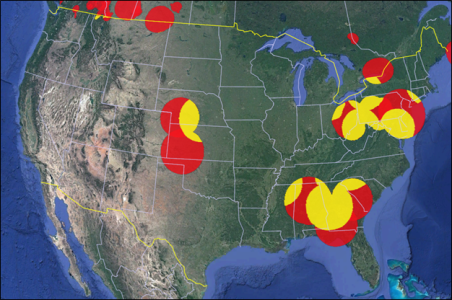
We will never see repacks in radio like we have in television. Television repacks are as a result of the need for the spectrum for non-broadcast purposes. Our plan will designate "exclusion zones" around each existing full service and Class A TV (primary) station on Channels 5 and 6. The exclusion zone is the area where both a full-service FM and a primary TV station cannot operate without one interfering with the other. If a location is outside of a Channel 6 exclusion zone, full-service FM will be available in the Channel 6 spectrum. If a location is inside of a Channel 6 exclusion zone but outside of a Channel 5 exclusion zone, then Channel 5 spectrum will be used for full-service FM. There will be parts of the country that are inside exclusion zones for both 5 and 6. Those areas will not have full service stations available. Secondary LPFM and translator stations will be able to receive interference from TV stations but not give it and will be available inside portions of the exclusion zones with restrictions. In the map below, within the United States, the areas in red are Channel 6 exclusion zones where Channel 5 would be used and the areas in yellow are double exclusion zones where full-service will not be available anywhere on 76-88. This means that in most of the country, Channel 5 LPTV stations will not be displaced (only those in and around the red areas where Channel 5 spectrum needs to be used for full-service FM stations):I predict that the FCC will not approve this as a result it will conjest more spectrum on the extended Frequency's on FM and we Might See FM channel repacks if this happens theres major media companies that will possibly see "FM repacks" And Channel 6 LPTV stations can get manidtory Decommissioned just like 2021. Thats Just my opinion and the FM band will possibly be in high risk on Interference
Their post didn't make any sense. "What?" is a simple means of asking them to clarify.Please give itzygachabro a break. It's clear that English is not his primary language.
I've used many FM tuners in my life, and never seen one that had such a switch. Note that it doesn't count as "user accessible" in my book if you have to take the cover off.Many FM receivers have the capability of covering 76-88 MHz using a user accessible switch.
Almost all higher end AM/FM/SW SWL receivers that I have seen have them. Manufacturers could ship the 76-88 MHz enabled receivers to the US and the rest of North America that they already send to other countries.I've used many FM tuners in my life, and never seen one that had such a switch. Note that it doesn't count as "user accessible" in my book if you have to take the cover off.
Again, who's going to buy these new radios when people aren't now?Almost all higher end AM/FM/SW SWL receivers that I have seen have them. Manufacturers could ship the 76-88 MHz enabled receivers to the US and the rest of North America that they already send to other countries.
I agree with your point about it not being universal, and having to take the back off not being user accessible. But almost any ham knew how to enable the "illegal" cellular frequencies. By the time they outlawed them, digital cellular technology had made it virtually impossible to listen in to any cellular conversations anyway. Spies and "diplomats" could get away with it anyway.
Protected contour at 63 dBu is going the wrong way... most of the rest of the world uses 54 dBu as the standard. We use 60 dBu.Many FM receivers have the capability of covering 76-88 MHz using a user accessible switch. I suspect that many others may have a less accessible feature which changes the lower range to 76 MHz for other countries. This would be similar to the days when UHF scanners had internal switches to turn on and off the cellular phone frequencies, depending on the laws in the country the scanner was being sent to.
I agree that it should go down to 76 MHz. However, it should also allow for moving commercial AM stations to FM STATIONS which cover the entire market, not the games that are being played with translators which interfere with nearby stations in nearby markets because the interference prediction model didn't contemplate those possibilities years ago.
I have come up with models using 2-4 MHz for 1 to 3 kW/100 meter facilities which COULD replace the service areas of virtually all the Class C and <= 1 kW Class B and D AM stations above 1000 kHz. The model also increased the protected contour to 63 dBu and various other exceptions for second and third adjacents used in other FM services, earlier FM rules, and rules in other countries.
This sounds very much like the LPFM allocation system from the 2000s. LPFM has been a failure almost everywhere. We should not allocate 12 more MHz of spectrum for such poor efforts at "localism"The consensus is that a forced migration should not be a part of the equation. Instead, a different approach to open spectrum for new NCE stations, requiring localism in the first window series and using an allotment system for the first window only to assure that channels are fairly distributed, without the 1st/2nd NCE priority nonsense which has shut out many local groups in the past 2 windows (since the first filing window series would be allotments, all applications would have the same community of license and fair distribution is satisfied through the allotments). After the first filing window series, this band will return to status quo in the legacy band.
The problem was that LPFM was too easy and the FCC refuses to add any complexity. For the so-called LPFM "failures", there are just as many if not more successful LPFM stations. The problem too is that the FCC rubber stamped too many bad applications. If applications go to a comparative hearing (which would happen if allotments are used for a filing window), then a closer look can be taken and we can have less issues. Also, additional service rules added in MB 19-3 will address some of the issues that happened in the last two filing windows.This sounds very much like the LPFM allocation system from the 2000s. LPFM has been a failure almost everywhere. We should not allocate 12 more MHz of spectrum for such poor efforts at "localism"
I volunteer at an LPFM, and I respectfully could not disagree more. I was able to do a show celebrating a local restaurant owner’s 81st birthday by playing 81 hits from 1965, the year she began working at the restaurant. Fifty-seven years at the same location is something to be honored. No other type of station could or would do this. Make fun of this if you wish, but we had fun, and made a beloved lady’s special day hopefully more so.This sounds very much like the LPFM allocation system from the 2000s. LPFM has been a failure almost everywhere. We should not allocate 12 more MHz of spectrum for such poor efforts at "localism"
I certainly wouldn't make fun of that! It sounds like you work with one of the handful of LPFMs that produce programming that is more than a music jukebox or a feed of a religious network.I volunteer at an LPFM, and I respectfully could not disagree more. I was able to do a show celebrating a local restaurant owner’s 81st birthday by playing 81 hits from 1965, the year she began working at the restaurant. Fifty-seven years at the same location is something to be honored. No other type of station could or would do this. Make fun of this if you wish, but we had fun, and made a beloved lady’s special day hopefully more so.
No problem! I understand your point, and respect it, but just wanted to add perspective.I certainly wouldn't make fun of that! It sounds like you work with one of the handful of LPFMs that produce programming that is more than a music jukebox or a feed of a religious network.
If half of LPFMs I've sampled were like yours, I wouldn't have made the comment I made above.
And why would they? AM is slowly being eliminated in some vehicles. With the exception of radio nerds and an occasional senior citizen, nobody actively purchases new radios.Almost all higher end AM/FM/SW SWL receivers that I have seen have them. Manufacturers could ship the 76-88 MHz enabled receivers to the US and the rest of North America that they already send to other countries.
What mom in her minivan, or millennial in his SUV, would actively seek out something that they don't even know exists? 99.98% of consumers don't think of those sorts of things.I agree with your point about it not being universal, and having to take the back off not being user accessible. But almost any ham knew how to enable the "illegal" cellular frequencies. By the time they outlawed them, digital cellular technology had made it virtually impossible to listen in to any cellular conversations anyway. Spies and "diplomats" could get away with it anyway.


