• Get involved.
    We want your input!
    Apply for Membership and join the conversations about everything related to broadcasting.

    After we receive your registration, a moderator will review it. After your registration is approved, you will be permitted to post.
    If you use a disposable or false email address, your registration will be rejected.

    After your membership is approved, please take a minute to tell us a little bit about yourself.
    https://www.radiodiscussions.com/forums/introduce-yourself.1088/

    Thanks in advance and have fun!
    RadioDiscussions Administrators

HD subchannels with high ratings

I disregard the analog rebroadcasts in a theoretical illustration, to point out that HD tuner penetration is sufficient to create a 3.8 share combined across all stations.

Wish you had made that clearer in the first place. My apologies.

(And I note that Huff apparently came to a similar misconception about your intent ... and he's a moderator!)
 
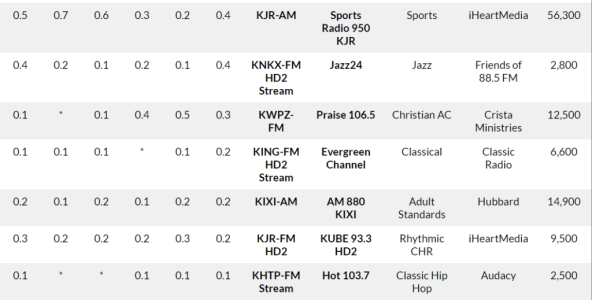
There are two examples of what we are talking about here re: penetration of HD2 channels (in the Seattle market in this case.)

KING-FM
Class C very longstanding station with a rich cleintele who definintely have HD in their Mercedes. Main station gets 3.0 to 4.0 in the 6+. HD2 gets a 0.2 Both are different flavors of classical music. Very stable numbers year around except around Dec when numbers shoot way up.

KNKX- FM
Class C very longstanding station with a rich cleintele who definintely have HD in their BMWs. Main station gets 2.5 to 3.0 in the 6+. HD2 gets a 0.4 HD1 is NPR news blocks and Jazz. HD2 is Jazz all the time.

Neither has translators, so these are naked HD numbers. There are people listening to HD2, certainly. Just not a ton.

They are by far the two highest rated HD2s in the market. Two others show up with participation ribbons (0.1, sometimes.) There are NO translators which add to the numbers in this market for ANY station, largely due to the topography of the place- 250 watts won't do much once you hit the first hill.
 
Having visited Seattle in the past, I can attest to the topography not being very conducive to using a translator to make an "analog station" out of a HD subchannel.

Having said that, I agree with your alluding to those two stations having a target audience which is much more likely to own HD-capable radios, and that can definitely have an impact on ratings if even a handful of those in the "rich clientele" carry PPMs.

It's obvious that there are exceptions for situations like these, but the fact remains that in the majority of markets where it is technically feasible, HD subchannels are used to feed translators, and the Nielsen policies do not allow us to come to any definitive conclusions as to what percentage of such stations' listening come from which transmitter (we have a similar such dilemma on translators combined with parent AM stations).

I think our best guesses are that in cases where all of the circumstances favor either AM with a translator or HD with an analog translator, most of the listening is to the translator. But what the percentages are in either scenario is anyone's guess.

 
Now I wonder how the OP thinks they could find the "analog rebroadcasts" to "disregard" them.
Mua? :)

It's obvious that there are exceptions for situations like these, but the fact remains that in the majority of markets where it is technically feasible, HD subchannels are used to feed translators, and the Nielsen policies do not allow us to come to any definitive conclusions as to what percentage of such stations' listening come from which transmitter (we have a similar such dilemma on translators combined with parent AM stations).
Any idea, then, why Nielsen has made it their policy -- per Huff's screen capture -- to not measure translators separately? Technically, because translators can be fed their audio through direct STLs (even though for FCC record-keeping purposes they must "come from" HD subchannels), it would be quite possible to encode different PPM watermarks into a station's HD2 audio and its corresponding analog translator's. So is Nielsen refusing to make room for this possibility for some internal reason that it won't budge from? Or is it that stations just haven't shown enough interest in having distinct numbers measured for Nielsen to alter its habit of not distinguishing among them?

We have had this same conversation more times than I can count, and the answers are always the same:
I sincerely had no idea. I'm sorry I brought up such a tired clunker.
 
Having visited Seattle in the past, I can attest to the topography not being very conducive to using a translator to make an "analog station" out of a HD subchannel.

Having said that, I agree with your alluding to those two stations having a target audience which is much more likely to own HD-capable radios, and that can definitely have an impact on ratings if even a handful of those in the "rich clientele" carry PPMs.

It's obvious that there are exceptions for situations like these, but the fact remains that in the majority of markets where it is technically feasible, HD subchannels are used to feed translators, and the Nielsen policies do not allow us to come to any definitive conclusions as to what percentage of such stations' listening come from which transmitter (we have a similar such dilemma on translators combined with parent AM stations).

I think our best guesses are that in cases where all of the circumstances favor either AM with a translator or HD with an analog translator, most of the listening is to the translator. But what the percentages are in either scenario is anyone's guess.
I was agreeing with your take. These examples pretty much show the maximum (in my view, anyway) of what one can expect from a standalone HD2 under ideal demographic circumstances. And that maximum is not much.
 
Any idea, then, why Nielsen has made it their policy -- per Huff's screen capture -- to not measure translators separately? Technically, because translators can be fed their audio through direct STLs (even though for FCC record-keeping purposes they must "come from" HD subchannels), it would be quite possible to encode different PPM watermarks into a station's HD2 audio and its corresponding analog translator's. So is Nielsen refusing to make room for this possibility for some internal reason that it won't budge from? Or is it that stations just haven't shown enough interest in having distinct numbers measured for Nielsen to alter its habit of not distinguishing among them?

As has been explained here and in other threads, translators are not considered to be separate stations. Even the FCC treats them as an extension of the originating station's signal (especially in the case of those which were specifically tied to the license for their parent AM). They are prohibited from originating programming on their own, with the exception of those whose parent is a daytimer ... and even then, they are considered to be a part of the parent.

Nielsen's policy follows all of that legality. A translator is always going to be part of single-line reporting because they are not stations on their own. As David E. has said, subscribing stations can see what part of the listening is on the primary signal -- be that AM, FM, or HD -- and what percentage is from the translator. For advertising sales purposes that has no measure of importance, either to the stations or the ad agencies. You're asking for something that no one wants.

You are correct that a lot of translators are not actually direct rebroadcasting their parent, and the FCC is fully aware of that, else translators for daytimer AMs would be unable to receive programming; they have taken a position of defining translators as simultaneously broadcasting the same programming as their parent as a practical matter. KRKE operates exactly that way in Albuqerque; K229CL is fed via STL from the studios to Sandia Crest and the AM 1100 transmitter actually receives 93.7 off-air for its programming, sunrise to sunset. Perfectly legal.
 
I was agreeing with your take. These examples pretty much show the maximum (in my view, anyway) of what one can expect from a standalone HD2 under ideal demographic circumstances. And that maximum is not much.

And I agree with your agreement. You gave two good examples. I am only adding that topography is not a universal factor in all markets, and that your examples are likely successful, as you said, because of their listener demographics.
 
KING-FM
Class C very longstanding station with a rich cleintele who definintely have HD in their Mercedes. Main station gets 3.0 to 4.0 in the 6+. HD2 gets a 0.2 Both are different flavors of classical music. Very stable numbers year around except around Dec when numbers shoot way up.

KNKX- FM
Class C very longstanding station with a rich cleintele who definintely have HD in their BMWs. Main station gets 2.5 to 3.0 in the 6+. HD2 gets a 0.4 HD1 is NPR news blocks and Jazz. HD2 is Jazz all the time.
And KING-HD2 has only shown up 3 times in the last year (each time with a 0.1) and KNKX-HD2 has only shown up once in the past year (a 0.1 in April), so it is negligible listening.
 
Mua? :)


Any idea, then, why Nielsen has made it their policy -- per Huff's screen capture -- to not measure translators separately?
Translators are totally subservient to either a licensed AM or FM or the HD channel of one. They are not stand-alone stations.

In any case, Nielsen does take "market needs" into account, and since nearly every other kind of simulcast opts to have all their signals combined, this is something the industry has no objection to. I can't think of an AM and FM full simulcast that does not opt for "single line reporting" as doing otherwise would hurt sales.
Technically, because translators can be fed their audio through direct STLs (even though for FCC record-keeping purposes they must "come from" HD subchannels), it would be quite possible to encode different PPM watermarks into a station's HD2 audio and its corresponding analog translator's. So is Nielsen refusing to make room for this possibility for some internal reason that it won't budge from? Or is it that stations just haven't shown enough interest in having distinct numbers measured for Nielsen to alter its habit of not distinguishing among them?
There is no interest at the station level. And Nielsen does not consider translators to be independent stations.
 
And KING-HD2 has only shown up 3 times in the last year (each time with a 0.1) and KNKX-HD2 has only shown up once in the past year (a 0.1 in April), so it is negligible listening.
Do you know if there was actual listening behind the 0.1 in each case, or was it the "if you are subscribed and get one detection you get a 0.1 door prize"?
 
In Houston, the Classical format on KUHF HD-2 regularly shows up with 6+ numbers in the low to mid-zeros.
"Low to mid-zeros". I love it!!!
 
So is Nielsen refusing to make room for this possibility for some internal reason that it won't budge from? Or is it that stations just haven't shown enough interest in having distinct numbers measured for Nielsen to alter its habit of not distinguishing among them?

It is somewhat offensive to insinuate that Nielsen won't "budge" from its policies. Ratings are their business, and they will always do their best to accommodate the stations and agencies that are their customers.

As David said (and actually, so did I, more bluntly): No one wants/needs/cares about the translators being listed separately. In fact, the idea is counterintuitive to the reasons why the ratings even exist.

With all due respect, @yeoldeschool, your line of reasoning almost reads like there is a presumption that the ratings are taken for the direct benefit of the listeners.
 
It is somewhat offensive to insinuate that Nielsen won't "budge" from its policies. Ratings are their business, and they will always do their best to accommodate the stations and agencies that are their customers.
And Nielsen is "audited" by the MRC and everything it does has to meet the standards of a committee / organization that dates back to the congressional ratings hearings over 60 years ago. The MRC is mostly focused on the needs and requirements of ad agencies and their clients, but has members who are part of the radio industry too.

Nielsen does not make or change policy without running it by the MRC.
As David said (and actually, so did I, more bluntly): No one wants/needs/cares about the translators being listed separately. In fact, the idea is counterintuitive to the reasons why the ratings even exist.
I should have illustrated this further. If there is an AM/FM combo like WINS in New York and the AM gets 35% of the listening and the FM gets 65%, the station could either show up as # 5 or #6 with combined "single line reporting" shares, or maybe 11th on the FM and 22nd on the AM if listed separately.

If an agency is buying "ten deep" in NYC, they would get no buys on separate listings.
With all due respect, @yeoldeschool, your line of reasoning almost reads like there is a presumption that the ratings are taken for the direct benefit of the listeners.
Americans love lists. Arbitron knew and Nielsen knows that publishing useless 6+ or 12+ shares is liked by the public. It also helps them with instant recognition when they try to recruit participants.

But ratings are paid for by radio and TV but are primarily used by ad agencies and their clients. Their purpose? To establish pricing for advertising.
 
Do you know if there was actual listening behind the 0.1 in each case, or was it the "if you are subscribed and get one detection you get a 0.1 door prize"?
Sea HD Ratings.JPG

Looks like slightly more than a door prize. Slightly.

KING runs the Classical "Greatest Hits" format on the main, and deeper cuts (as it were) on the 2. The 2 will also feature cuts from the Seattle Symphony and Opera, along with local choirs and string quartets. In December they open up HD3 for holiday stuff- Messiah, Nutcracker and whatnot. WIll be curious to see if any of these have any meaningful numbers. And by meaningful I am saying anything .2 and above.

The main KING is a relative ratings powerhouse, considering the format. Runs in the low 3s 6+ most of the year, low 4s during the holidays.
 
Last edited:
Status
This thread has been closed due to inactivity. You can create a new thread to discuss this topic.


Back
Top Bottom